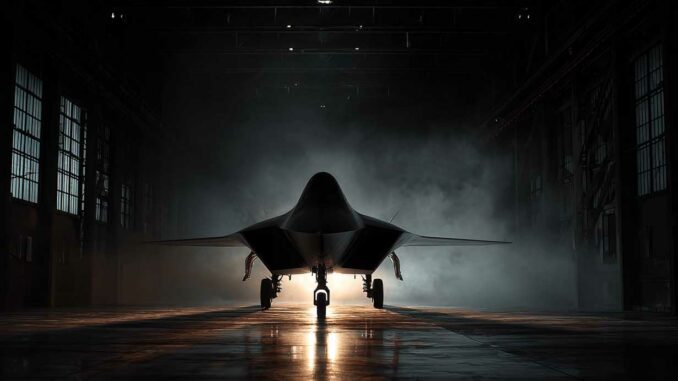
The F-47 is set to replace the F-22 in the face of China. Its range, drones, and budget reveal the new U.S. air strategy.
At a Glance
Boeing’s F-47 is set to become the centerpiece of the U.S. Next Generation Air Dominance system. Its mission goes beyond simply replacing the F-22 Raptor. It will need to penetrate Chinese defenses, operate far from U.S. bases, and coordinate semi-autonomous combat drones. The U.S. Air Force reports a combat range exceeding 1,000 nautical miles—or 1,852 kilometers—as well as a maximum speed exceeding Mach 2. However, it has never confirmed supercruise at Mach 2 without afterburner. The claim that a single F-47 would command 1,000 drones is also false. This number corresponds to an initial fleet target for the Collaborative Combat Aircraft. The cost reflects the scale of the project: more than $5 billion is requested for the F-47 in 2027, in addition to the engine, drones, and infrastructure. Washington is not choosing between piloted fighters and drones. It is funding both.
The F-47 Will Not Be a Simple Successor to the F-22
The F-47 is intended to replace the F-22 Raptor in the air superiority mission. This description is accurate, but incomplete.
The F-22 was designed during the Cold War. It was intended to detect and destroy Soviet fighters before being detected itself. Its stealth capabilities, maneuverability, and supercruise made it a formidable aircraft. However, it remains limited by its computer architecture, its range, and a fleet reduced to 187 production aircraft.
The F-47 addresses a different challenge. It must confront an adversary equipped with stealth fighters, multiband radars, satellites, long-range anti-aircraft missiles, and powerful electronic warfare capabilities. It will also have to operate in a vast area where available airfields are scarce and vulnerable.
The new aircraft will therefore be the centerpiece of a family of systems. This architecture includes the piloted fighter, Collaborative Combat Aircraft, satellites, surveillance aircraft, refueling aircraft, distributed sensors, and command networks.
The F-47 will not simply replace one aircraft with another. It must replace an entire approach to conducting air warfare.
In March 2025, Boeing was awarded the Engineering and Manufacturing Development contract. This phase is intended to finalize the design, integrate the equipment, and produce several test aircraft. The contract is valued at over $20 billion. Initial production options are planned, but the unit price of the aircraft remains classified.
The U.S. Air Force has indicated it intends to acquire at least 185 F-47s. This number corresponds almost exactly to the F-22 fleet. However, it remains a planning target and does not yet constitute a firm order for 185 aircraft.
The Indo-Pacific Theater Dictates the Specifications of the New Aircraft
The F-47 is not officially presented as an aircraft intended solely for use in the Pacific. It must be capable of operating in all theaters. Its design, however, very clearly addresses the constraints of a conflict with China.
Europe offers a dense network of bases, roads, airports, and logistics hubs. The Pacific involves much greater distances. U.S. forces rely on a limited number of bases located in Japan, South Korea, Guam, Alaska, Hawaii, and several island territories.
These facilities are well known. Their coordinates cannot be concealed. They would be exposed to Chinese ballistic and cruise missiles from the very first hours of a conflict.
The U.S. strategy of Agile Combat Employment therefore seeks to disperse aircraft among numerous airfields. Some would be small, sparsely equipped, and used for only a short period. This dispersion improves the force’s survivability but complicates maintenance, refueling, and ammunition storage.
A long-range aircraft can take off from farther away from the combat zone. It can change bases more easily. It is less dependent on a refueling aircraft stationed near the contested area.
Range Becomes a Condition for Survival
The U.S. Air Force attributes a combat radius of over 1,852 km to the F-47, or more than 1,000 nautical miles.
A combat radius is not the maximum distance traveled in a straight line. It corresponds to the distance the aircraft can travel to its mission area while retaining the fuel necessary to engage in combat and return to base.
This distinction is important. A combat radius of 1,852 kilometers theoretically allows for a mission covering more than 3,700 kilometers round-trip, before taking into account time spent in the area, flight profile, reserves, and maneuvers.
An infographic published by the U.S. Air Force assigns the F-22 a range of 590 nautical miles, or approximately 1,093 kilometers. The F-35’s range is listed as 670 nautical miles, or approximately 1,241 kilometers. The F-47 would therefore offer nearly 70% more range than the F-22.
This difference is not merely a matter of convenience. It determines the ability to operate when forward bases are damaged or when refueling aircraft must stay out of range of enemy missiles.
The Vulnerability of Refueling Aircraft Requires Greater Range
U.S. air power relies heavily on in-flight refueling. A high-performance fighter with a limited range must regularly meet up with a KC-135 or a KC-46A.
These aircraft carry large quantities of fuel. They are bulky, not very maneuverable, and significantly less stealthy than a fighter. Their loss would have a disproportionate impact on the air campaign.
China is developing long-range air-to-air missiles, surveillance aircraft, over-the-horizon radars, and systems capable of threatening support platforms. The objective would not necessarily be to destroy every U.S. fighter. It might be enough simply to drive away or neutralize the refueling aircraft.
The F-47 must therefore fly farther on its internal fuel. It must also have a more efficient engine and sufficient internal fuel capacity so as not to compromise its stealth capabilities with large external fuel tanks.
The announced performance figures remain more limited than the rumors
The program is largely classified. The images released by the U.S. Air Force are artist’s renderings. They do not reveal the aircraft’s final design.
Some general data has nevertheless been made public. The F-47 is expected to exceed Mach 2. It is expected to offer stealth capabilities superior to those of fifth-generation aircraft. It is expected to feature a modular architecture, advanced sensor fusion, and long-range strike capability.
These details do not allow for a precise assessment of its exact performance.
Maximum Speed Does Not Prove Mach 2 Supercruise
The U.S. Air Force has announced a maximum speed exceeding Mach 2. This means the aircraft must be capable of exceeding twice the speed of sound under certain conditions.
This value does not confirm Mach 2 supercruise.
Supercruise refers to the ability to maintain supersonic flight without using afterburner. Afterburner injects additional fuel into the exhaust stream. It significantly increases thrust, but also fuel consumption and the infrared signature.
The F-22 can maintain supersonic speed without afterburner. It stands to reason that the F-47 would retain or improve upon this capability. However, no official source confirms supersonic cruise at Mach 2 without afterburner.
Such performance would be extremely demanding. Drag increases sharply at supersonic speeds. Maintaining Mach 2 without afterburner would require an optimized airframe, high-performance air intakes, and engines capable of delivering exceptional dry thrust.
Maximum speed is crucial for intercepting a target or quickly exiting a danger zone. High-speed endurance is more important in the Pacific. An aircraft that reaches Mach 2 for a few minutes does not gain the same advantage as one capable of remaining in supersonic flight for an extended period without depleting its fuel.
The adaptive engine must balance power and fuel consumption
The Next Generation Adaptive Propulsion program is tasked with providing the F-47’s propulsion system. General Electric Aerospace and Pratt & Whitney are working on competing solutions.
A traditional engine is optimized around a trade-off. A low bypass ratio favors speed and military thrust. A higher bypass ratio improves fuel efficiency during cruise.
An adaptive engine modifies airflow depending on the flight phase. It can prioritize fuel economy during cruise, then prioritize thrust during acceleration or combat.
This technology is expected to increase the aircraft’s range. It must also provide more electricity and cooling.
These requirements are becoming critical. A sixth-generation fighter will carry powerful radars, infrared sensors, electronic warfare systems, and computers capable of processing large volumes of data. All of this electronics generates heat.
The future engine will therefore not only have to propel the aircraft; it will also have to support a flying power plant.
Stealth Capabilities Must Address Multiple Types of Detection
The F-47’s stealth capabilities will not be limited to a low radar signature when viewed head-on.
Modern systems combine multiple radar bands, infrared sensors, passive detection methods, and distributed sensor networks. A target can be detected by the heat from its engines, its electromagnetic emissions, or the interference it causes in a sensor network.
The F-47 will need to reduce its signature from multiple angles. Its weapons will be carried in internal bays. Its air intakes will need to conceal the reflective parts of the engines. Its radar and radio emissions will need to be controlled.
Stealth does not make an aircraft invisible. It reduces the distance at which it can be detected, identified, and engaged. This reduction gives it time to fire first or to avoid combat.
The 1,000 drones will not be controlled by a single pilot
The claim that a single F-47 would command a swarm of more than 1,000 drones confuses two distinct concepts.
The U.S. Air Force has used the number 1,000 as a planning factor for its entire future fleet of Collaborative Combat Aircraft. It has never announced that a single pilot would control 1,000 aircraft.
The forward-looking document Department of the Air Force in 2050 even specifies that the final number of CCAs and the ratio of piloted to unpiloted aircraft remain to be determined.
It is therefore important to note that 1,000 CCAs refer to a fleet, not a swarm under the direct command of a single F-47.
The initial objective was historically based on approximately 200 NGAD aircraft, each paired with two CCA, as well as 300 F-35s accompanied by two drones. This calculation resulted in a theoretical fleet of 1,000 aircraft. The final structure may still change.
The pilot will assign objectives rather than issue flight commands
A pilot will not be able to maneuver multiple drones using individual controls. The pilot’s workload would immediately become excessive.
The CCAs will have to manage their own navigation, formation, obstacle avoidance, and part of the sensor processing. The pilot will assign them a task, an area, or a priority.
An order might involve searching for a radar signal, jamming a frequency, monitoring a sector, or moving into a firing position. The onboard autonomy will then determine the flight path and intermediate actions.
The F-47 will thus serve as the mission commander. It will not become a remote-piloting cockpit.
The number of drones actually supervised by a crew will depend on their autonomy, the complexity of the mission, and the quality of communications. This could be two, four, or more. No definitive operational figures have been made public.
Drones Will Provide Sensors, Weapons, and Mass
CCAs will be able to perform multiple functions.
A drone positioned ahead of the F-47 can use its radar to detect a target without forcing the piloted aircraft to transmit. Another can jam enemy defenses. A third can carry additional air-to-air missiles.
Some can serve as decoys. They will force the enemy to activate its radars or expend costly missiles.
Others will act as communication relays between several groups of aircraft.
The reported combat radius for the first CCA models exceeds 700 nautical miles, or approximately 1,296 kilometers. They will therefore not necessarily have the same endurance as the F-47. The mission plan will need to take this difference into account.
Not all CCA’s will be expendable. A stealth drone equipped with radar, a jet engine, and missiles will remain a costly piece of equipment. The U.S. Air Force instead uses the term “attritable aircraft.” The aircraft must be affordable enough that its loss can be accepted during a decisive mission, without being considered disposable.
The budget reveals the scale of the U.S. gamble
The F-47’s budget cannot be reduced to the price of the aircraft alone.
For fiscal year 2026, approximately $3.45 billion was allocated to its development. The request for 2027 exceeds $5 billion for the F-47. The projection reaches approximately $5.25 billion in 2028, before an expected gradual decline in subsequent years.
The NGAP adaptive engine is the subject of a separate budget line item. Approximately $514 million is requested for 2027. The projection approaches $906 million in 2028.
The CCA program represents yet another budget line item. The U.S. Air Force is requesting approximately $2.37 billion for the CCAs in 2027. This amount includes nearly $1.37 billion for research and development, as well as approximately $996.5 million to begin production.
The total cost for the F-47, its propulsion system, and the CCA thus approaches $7.9 billion for 2027 alone. This calculation does not include all communication networks, missiles, satellites, refueling aircraft, and other components of the NGAD family.
The U.S. Air Force is also allocating approximately $730 million for F-47 hangars and test facilities at Nellis Air Force Base.
These figures explain why the program was temporarily suspended in 2024 to reevaluate its requirements. Washington needed to verify that an extremely high-performance aircraft would not divert too many resources away from drones, munitions, and the operational readiness of the current fleet.
The unit cost remains the big unknown
The U.S. Air Force claims that the F-47 will cost less than the F-22. This comparison should be treated with caution.
The price of the F-22 was significantly driven up by the halt in production after only 187 aircraft. Development costs were spread across a fleet that was far too small.
Saying that the F-47 will cost less does not, therefore, mean it will be affordable. Previous estimates for the NGAD program cited several hundred million dollars per aircraft. No contractual production price is currently public.
The acquisition cost will be only part of the problem. Maintenance of stealth coatings, engines, software, spare parts, and infrastructure will determine the actual cost over several decades.
The program promises simpler maintenance and higher availability than the F-22. This promise will have to be proven.
The F-35 has already shown that a modern architecture and high production volume do not automatically guarantee high operational availability.
Drones Do Not Make the F-47 Obsolete
The rise of drones raises a legitimate question. Why invest tens of billions in a piloted fighter when autonomous aircraft can take on greater risks?
The U.S. response is clear. Drones increase the total number of aircraft. They do not yet replace all the functions of a piloted fighter.
An F-47 will integrate sensors, computing power, communications, and decision-making capabilities that would be costly to replicate on each drone. It will be able to adjust the mission when information becomes contradictory or when communications with command are cut off.
Autonomy is advancing rapidly. However, it remains vulnerable to classification errors, electronic warfare, and situations that have not been properly anticipated.
The issue becomes more sensitive when a weapon must be deployed in an environment containing civilian aircraft, allied forces, or ambiguous targets. The United States does not appear ready to fully delegate these decisions to a machine.
The F-47 therefore represents human command of an autonomous system. The CCA pilots take the greatest risks. The pilot retains tactical responsibility.
This architecture remains relevant on one condition: drones must be genuinely available in large numbers. A very expensive F-47, accompanied by a few rare and fragile CCAs, would not deliver the promised scale.
Other Powers Are Following the Same Hybrid Approach
The United States is not the only country combining a piloted aircraft with drones.
The United Kingdom, Japan, and Italy are developing the Global Combat Air Program. The goal is to field a new piloted aircraft by around 2035, integrated with autonomous platforms, advanced weapons, and data networks.
The United Kingdom has announced more than 3 billion pounds in public investment for its Future Combat Air System. The British defense industry has committed more than 700 million pounds. Japan has allocated 160.2 billion yen for the development of a next-generation fighter in its 2026 budget, alongside studies on collaborative drones.
China is testing at least two large experimental aircraft that have been observed since December 2024. They are commonly referred to as the J-36 and J-50 by Western analysts. Their actual names, missions, and performance specifications have not been officially confirmed.
The larger of these aircraft appears to prioritize range, stealth, and a large internal volume. It could serve as a heavy fighter, a strike platform, or an airborne command center. China is also developing stealth drones and maintains several hundred former fighters converted into unmanned aircraft.
France is taking a more gradual approach with the Rafale F5 and a future combat drone. This approach allows the country to maintain a credible manned capability while developing collaborative combat.
However, it highlights the gap in budgetary scale. The amount requested by the United States for the F-47, its engine, and the CCA in a single year approaches $8 billion. An isolated European power would struggle to sustain a comparable effort over the long term while also funding its nuclear forces, navy, satellites, and ground-based equipment.
Above all, the American example shows that drones do not automatically reduce spending. They create a new layer of capabilities that must be funded in addition to manned aircraft.
The Industrial Challenge Goes Beyond the Race for Records
The F-47 will not be judged solely on its speed or stealth.
Its utility will depend on its ability to take off from dispersed bases, operate with few technicians, and remain connected in a jammed environment. It will also depend on the number of CCA available, missile stockpiles, and the survivability of refueling aircraft.
A combat radius exceeding 1,852 kilometers represents a significant advance. It does not eliminate the vast distances of the Pacific. A speed exceeding Mach 2 is impressive. It guarantees neither endurance nor availability. A fleet of 1,000 drones creates scale. It does not mean that a single pilot will be able to command an army of robots on their own.
The U.S. program is relevant because it treats the fighter, the engine, the drones, and the networks as a single system. It becomes problematic if the F-47 absorbs the funding needed for the other components of this system.
The real test, therefore, will not be the first flight. It will come when the U.S. Air Force must simultaneously produce manned aircraft, drones, engines, and weapons at a rate compatible with high-intensity warfare.
The Pacific will not reward the most spectacular aircraft. It will favor the force capable of remaining dispersed, connected, resupplied, and sufficiently numerous after the initial strikes.
Sources
United States Air Force, “Air Force Awards Contract for Next Generation Air Dominance Platform, F-47,” March 21, 2025.
United States Department of Defense, “Trump, Hegseth Announce Air Force’s Next Generation Fighter Platform,” March 21, 2025.
General David W. Allvin, official infographic comparing the F-47, U.S. fighters, and Collaborative Combat Aircraft, May 13, 2025.
Department of the Air Force, “The Department of the Air Force in 2050,” December 2024.
Pacific Air Forces, “PACAF Strategy 2030: Evolving Airpower.”
Department of the Air Force, “Fiscal Year 2027 Budget Estimates,” April 2026.
Department of the Air Force, R&D, T&E budget documents related to the F-47, the NGAP, and the Collaborative Combat Aircraft, April 2026.
Air & Space Forces Magazine, “What the F-47’s Projected Budget Suggests About Its Development,” May 4, 2026.
Defense News, “From Prototypes to Production: U.S. Air Force Seeks Nearly $1B for Initial CCA Procurement,” April 30, 2026.
Defense One, “F-47 Will Have 70% Better Combat Radius Than F-22, Air Force Says,” May 13, 2025.
Reuters, “Trump Picks Boeing Over Lockheed for Fighter Jet Contract,” March 21, 2025.
United Kingdom Ministry of Defence, “Strategic Defence Review 2025.”
United Kingdom Ministry of Defence, “Defence Industrial Strategy 2025.”
Japan Ministry of Defense, “Progress and Budget in Fundamental Reinforcement of Defense Capabilities, FY2026,” December 2025.
Reuters, “Images Show Novel Chinese Military Aircraft Designs,” December 27, 2024.
War Wings Daily is an independant magazine.