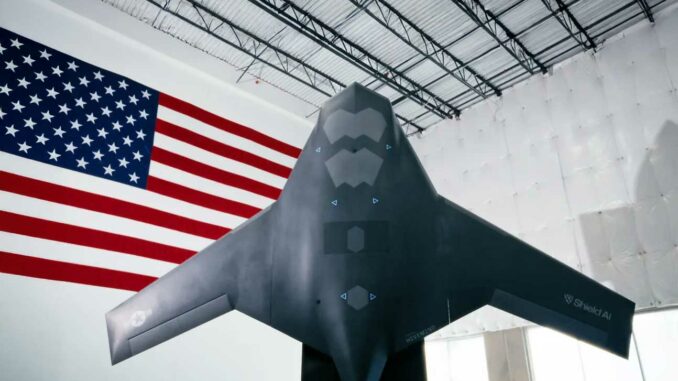
Warsaw is studying Shield AI’s X-BAT, an autonomous vertical takeoff and landing combat drone designed to support its F-35, F-16, and FA-50 aircraft.
Summary
Poland is evaluating a potential participation in Shield AI’s X-BAT program. The American company has proposed manufacturing a portion of this autonomous aircraft on Polish territory. However, the project represents neither a firm order nor an announced replacement for crewed fighter jets. The X-BAT remains in development, with its first vertical flight scheduled for 2026, operational capability not expected until 2028, and production slated for 2029. On paper, the aircraft boasts a range exceeding 3,700 km, vertical takeoff capability, F-16-class propulsion, and suitability for air-to-air, air-to-ground, or electronic warfare missions. Its actual performance has yet to be demonstrated. For Warsaw, the primary appeal lies in the dispersion of aerial assets and protection against a Russian strike targeting airbases. The American choice is also explained by Poland’s already deep integration into the F-16 and F-35 ecosystem.
The Alliance with Shield AI Remains an Industrial Proposal
While the announcement is politically significant, it must be described accurately. Poland has not decided to purchase the X-BAT, nor has it abandoned plans to order additional crewed fighter jets.
On June 16, 2026, Prime Minister Donald Tusk indicated that Shield AI wished to cooperate with the Polish defense industry and manufacture a portion of the X-BAT in Poland. The leader presented the project as an opportunity to gain access to advanced technology and strengthen national capabilities in autonomous systems.
At this stage, therefore, it remains an industrial project, not an order. No aircraft quantities, financial figures, or Poland-specific delivery timelines have been announced. The terms of technology transfer are unknown, and the share that could actually be manufactured in Poland remains to be defined.
Such caution is warranted. The X-BAT is not yet an operational aircraft. Shield AI unveiled its concept in October 2025. The initial vertical takeoff and landing tests are scheduled for 2026, with representative full-mission flights announced for 2028. Production is slated to begin in 2029 if development adheres to its schedule.
Warsaw is thus examining a promising but still immature platform. This distinction is vital: the communicated performance metrics originate primarily from the manufacturer and have not yet been validated through a complete flight test campaign.
Polish interest comes at a time when the government is considering the acquisition of 32 additional combat aircraft. Publicly discussed options include more F-35As, the Boeing F-15EX, and the Eurofighter Typhoon. The X-BAT does not fit directly into this competition; it could accompany these platforms rather than take their place.
The X-BAT Aims to Combine a Drone and a Fighter
Shield AI markets the X-BAT as the first artificial intelligence-piloted, vertical takeoff autonomous fighter aircraft. While this phrasing is commercially effective, it requires nuance from a military perspective.
The X-BAT belongs more to the category of collaborative combat aircraft than to that of conventional fighters. It is designed to fly alongside an F-35 or an F-16, penetrate defended airspace, carry sensors, launch weapons, or jam enemy radars. It could also execute certain missions independently.
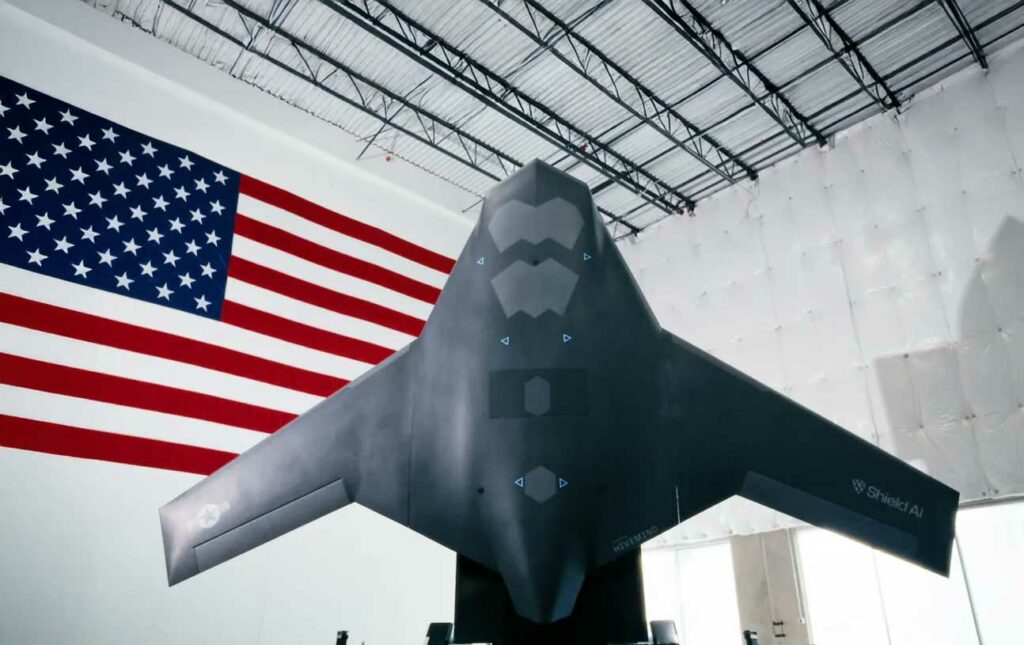
The aircraft measures approximately 7.9 meters (26 feet) in length, with a wingspan of 11.9 meters (39 feet). Its wings are foldable; in its storage configuration, it would occupy roughly 12.2 meters in length, 4.3 meters in width, and 1.8 meters in height.
Shield AI claims that three X-BATs could be stored in the space normally occupied by a single fighter jet or helicopter. This compactness would facilitate road transport, shipborne installation, and deployment to dispersed sites.
The manufacturer claims a maximum range exceeding 3,704 km (2,000 nautical miles) with a mission payload. The service ceiling is said to exceed 15,240 meters (50,000 feet), and the airframe is designed to withstand a load factor greater than 4 g.
These figures place the X-BAT in a very different category from small reconnaissance drones or loitering munitions. Its theoretical operating radius would allow it to operate at a theater-wide scale. However, maximum range must not be confused with combat radius; a portion of the fuel must be reserved for tactical maneuvers, loitering, diversions, and the return flight.
The maximum speed has not been precisely published. Shield AI mentions supersonic capability without announcing a Mach number or specifying flight conditions. This omission prevents any comprehensive comparison with an F-16, F-35, or Eurofighter Typhoon.
Vertical Takeoff Reshapes Operational Logic
The primary innovation of the X-BAT lies in its ability to operate without a runway. The aircraft is positioned vertically on a launch and recovery vehicle. It takes off in a nearly vertical attitude before transitioning to horizontal flight.
To execute this maneuver, Shield AI selected GE Aerospace’s F110-GE-129 turbofan engine. This powerplant notably equips certain versions of the F-16 and F-15, developing approximately 131 kilonewtons (29,500 pounds-force) of maximum thrust with afterburner.
The engine is to feature an AVEN thrust-vectoring nozzle, which directs the exhaust gas flow during vertical phases and enhances maneuverability in horizontal flight. GE Aerospace indicates that the F110 family has accumulated more than 11 million flight hours. Shield AI thus mitigates a portion of the technical risk by using a proven powerplant.
The X-BAT is expected to take off using afterburner, then return to land vertically without it. The maneuver remains complex: an aircraft resting on its tail must precisely control its pitch, descent rate, and position relative to the recovery vehicle.
Crosswinds, rain, icing, turbulence, and combat damage will complicate this phase. The engine’s hot exhaust will also impose safety distances. Furthermore, the operating site will still require fuel, material handling assets, munitions, technicians, and communication equipment.
The X-BAT eliminates the runway, but it does not eliminate logistics.
Comparison with a Fighter Jet Reveals Trade-offs
The X-BAT possesses several advantages over a crewed aircraft. It does not place a pilot at risk, and it eliminates the need for a cockpit, ejection seat, heads-up display, oxygen system, or flight controls tailored to a human crew.
The absence of a pilot also allows for extended mission durations, as fatigue, stress, and physiological limits no longer dictate flight length. The loss of an aircraft does not mean the death or capture of an aviator trained over several years.
Training a fighter pilot costs several million euros and requires aircraft, instructors, simulators, and flight hours. An autonomous system can, in theory, replicate already validated software across every new airframe.
The reality is less straightforward. The X-BAT does not yet possess the proven capabilities of a modern fighter jet. Its radar has not been identified, and the range of its sensors, its radar cross-section, its survivability against missiles, and its weapon accuracy remain unknown.
Shield AI announces internal bays for air-to-air and air-to-ground missiles, as well as external hardpoints for heavier weapons. However, no complete weapons suite has been certified; an image displaying a missile under a wing does not constitute operational integration.
The stated load factor provides another clue. The X-BAT does not exceed 4 g in its currently published characteristics. An F-16, F-35A, or Eurofighter can approach 9 g in certain configurations. The drone therefore does not appear designed to replicate the tight maneuvers of a crewed fighter.
This limitation is not necessarily a disqualifier. Modern air combat relies primarily on detection, electronic warfare, data sharing, and long-range missile launches. A drone does not need to win a dogfight if it spots the adversary and fires before being detected.
However, the term “fighter” can convey an exaggerated impression. The X-BAT resembles an autonomous carrier of sensors, jammers, and missiles more than a direct replacement for the F-35.
The Stated Cost Prevents the X-BAT from Being a Disposable Asset
The projected price is expected to hover around $27 million per aircraft (approximately €24 million depending on exchange rates). This figure remains provisional and does not rest on a finalized production contract.
At this price point, the X-BAT would cost significantly less than a modern fighter jet. However, it would not be expendable like a loitering munition worth a few tens of thousands of euros.
The F110 engine, sensors, communication suites, low-observable airframe, and electronic warfare equipment represent expensive components. Maintenance requirements could also closely mirror those of a complex military aircraft.
The term “attritable” implies that commanders can accept greater risks with the drone than with a crewed aircraft. It does not mean the platform can be sacrificed without economic consequences.
Furthermore, a comparison with the F-35 must factor in military value. The F-35 features proven data fusion, an AESA radar, electro-optical sensors, electronic warfare suites, and an international logistical network. The X-BAT has yet to prove it can deliver a portion of these capabilities at a lower cost.
Polish Geography Validates the Choice of Vertical Takeoff
Poland stands adjacent to Belarus, Ukraine, and the Russian enclave of Kaliningrad. Its primary airbases can be tracked by satellite and targeted by ballistic missiles, cruise missiles, or long-range drones.
In a major conflict, runways, fuel depots, hangars, and command centers would rank among the primary Russian targets. A runway cratered by strikes can temporarily ground aircraft that are otherwise entirely intact.
The X-BAT addresses this vulnerability directly. It could be dispersed along roads, within forested areas, on secondary military sites, or near industrial facilities, while its launch vehicles could change positions regularly.
Such an organization would complicate Russian planning. The adversary could no longer concentrate strikes on a few known airfields; it would have to search for numerous mobile sites, verify their activity, and expend more missiles.
Dispersion would create a distributed combat mass. Multiple X-BATs could monitor a sector, carry air-to-air missiles, jam enemy radars, or serve as communication relays. Their loss would be politically and humanly less severe than that of a crewed aircraft.
However, this advantage would only materialize if the detachments remained mobile. Vehicles stationary in one location would quickly become detectable, as transmissions, logistical movements, and radar emissions could betray their presence.
Survivability will therefore depend as much on operational discipline as on vertical takeoff capability.
The X-BAT’s Role Would Be to Expand the Fleet, Not Replace It
Poland has ordered 32 F-35As. The first aircraft arrived in the country in May 2026, with deliveries scheduled to continue through 2029. Warsaw also operates 48 F-16C/D Block 52+ fighters and has initiated their modernization for approximately $3.8 billion.
The fleet also includes 48 FA-50s ordered from Korea Aerospace Industries. The initial FA-50GFs were delivered rapidly to replace MiG-29s and Su-22s, while the future FA-50PLs are to feature equipment better tailored to Polish requirements.
The X-BAT could form a fourth layer. The F-35 would handle penetration, detection, and data fusion; the F-16 would provide a mature multirole capability and a broad selection of munitions; the FA-50 would fulfill training, light attack, and air policing missions; and the X-BAT would deliver mass, dispersion, and risk tolerance.
This organization relies on the principle of complementation, not replacement.
An F-35 could detect a threat without utilizing its own radar too conspicuously, transmitting the position to an X-BAT. The drone would advance, activate its sensors, or launch a missile. It could also serve as a decoy to force a Russian radar to activate.
Another mission would involve jamming surface-to-air defenses. The manufacturer claims the X-BAT’s engine will generate enough electricity to power high-output electronic warfare equipment. This capability would be valuable against S-300 and S-400 systems and the radars deployed around Kaliningrad.
Finally, the X-BAT could execute reconnaissance missions beyond the front line. While its loss would still be costly, it would not expose a crew.
Hivemind Autonomy Promises Resistance to Russian Jamming
The X-BAT is to be controlled by Hivemind, the autonomy software developed by Shield AI. The company claims this system can pursue a mission even when communications and satellite navigation are disrupted.
This functionality responds directly to conditions observed in Ukraine, where Russian jammers can sever data links, degrade GPS signals, and prevent operators from piloting drones remotely.
Hivemind goes beyond merely stabilizing the aircraft; the software must interpret sensor data, select a flight path, avoid threats, and coordinate multiple aircraft. A human commander could assign a mission to a group of X-BATs without piloting each platform.
This tactical autonomy reduces the need for permanent communications. It also limits the effectiveness of an adversary seeking to cut the drone off from its control station.
Nevertheless, the technology faces limits. Successes achieved with small drones or with the V-BAT do not automatically prove that software can manage supersonic air combat. The speeds, distances, and consequences of an error are entirely different.
Air target identification represents a particularly sensitive issue. An algorithm must distinguish a Russian aircraft from an allied, civilian, or neutral one, interpreting incomplete data in a jammed environment.
The decision to fire must remain bound by precise rules of engagement. Public documents do not yet reveal how far the X-BAT’s lethal autonomy will extend.
The American Choice Does Not Signify the Abandonment of European Fighters
The question of why Poland does not choose a European fighter jet rests on an incorrect premise. Warsaw has not ruled out the Eurofighter Typhoon, which remains among the solutions being examined for a potential order of 32 additional aircraft.
Furthermore, the X-BAT is not a direct competitor to the Typhoon. The Eurofighter is a twin-engine crewed fighter capable of air policing, high-altitude interception, dogfighting, and conventional strikes. Shield AI’s drone serves a different function.
Nevertheless, an American preference remains visible in Polish acquisitions. This is explained primarily by the American ecosystem already in place. Polish forces utilize the F-16, F-35, Patriot missiles, HIMARS rocket launchers, Abrams tanks, and AH-64E Apache helicopters.
This concentration facilitates data sharing, training, ammunition storage, and cooperation with US forces deployed in Europe. It also strengthens the political link with Washington, viewed by Warsaw as the primary military guarantee against Russia.
The United States has made up to $20 billion in military financing available to Poland, following the announcement of a new $4 billion package in June 2026. A European manufacturer cannot easily match this financial leverage.
Moreover, ordering more F-35s would avoid creating an entirely new training and maintenance pipeline. Purchasing Eurofighters would demand additional simulators, parts, engines, technicians, and munitions. While diversification reduces certain dependencies, it escalates costs.
However, the selection of the South Korean FA-50 demonstrates that Poland does not buy exclusively American. Warsaw primarily prioritizes rapidly available solutions accompanied by industrial cooperation and credible political backing.
European Delays Open a Window for the X-BAT
While Europe possesses advanced expertise in combat drones, it does not yet have a direct operational equivalent to the X-BAT.
The nEUROn program led by Dassault Aviation is a technology demonstrator. It validated stealth, autonomous flight, and weapon release from an internal bay, but it was never intended to enter operational service.
France plans a stealth combat drone to accompany the Rafale F5 starting in 2033, while Airbus envisions the first European Wingmen in the early 2030s. The comprehensive FCAS system remains projected for the 2040 horizon.
The X-BAT targets production as early as 2029. This timeline gives it a theoretical lead of several years. The critical word remains “theoretical”: a testing delay, a certification hurdle, or a propulsion issue could quickly erase this advantage.
Warsaw is also considering joining the Global Combat Air Programme led by the United Kingdom, Italy, and Japan. This participation would offer a stake in developing a next-generation aerial system. However, the future GCAP aircraft is not expected before the mid-2030s.
Poland must therefore manage two timelines: it must rapidly bolster its air power against Russia while building an industrial base capable of participating in future programs.
Integration Will Demand More Than a Data Link
Shield AI presents Hivemind as an open architecture designed to allow the X-BAT to communicate with different platforms and receive software developed by third-party companies.
Integration with Polish F-16s and F-35s will nonetheless prove challenging. The F-35’s most sensitive data cannot be freely shared with a third-party platform. The United States will need to authorize interfaces, certify communications, and verify the system’s cybersecurity.
The X-BAT must also connect to Polish command centers, airborne early warning aircraft, ground-based radars, and NATO networks. Data must flow without unnecessarily exposing the aircrafts’ positions.
Weapon integration will represent another phase. An AIM-120 AMRAAM missile cannot simply be placed in a bay and declared operational; vibrations, temperatures, weapon separation, electronic dialogue, and targeting data transmission must all be verified.
Every configuration must be tested, and every software update must be controlled. Authorities will also need to define accountability in the event of an error or a friendly-fire engagement.
The promise of software sovereignty therefore forms a central point in the negotiations. Shield AI proposes to help Poland create its own artificial intelligence pilots. Warsaw must ensure it can modify system behaviors without requesting the manufacturer’s authorization at every evolution of the threat.
An assembly plant is not enough to create strategic autonomy. Control over source codes, training data, sensors, and interfaces matters far more than manufacturing fuselage panels.
Program Risks Dictate a Phased Decision
The X-BAT addresses a genuine military need: airbases are vulnerable, pilots are scarce, modern fighters are expensive, and electronic warfare makes remotely piloted drones difficult to employ.
However, the program remains a technological gamble. The aircraft has yet to demonstrate its vertical takeoff, supersonic flight, combat autonomy, or missile launch capabilities.
Relying on the F110 engine reduces powerplant-related risk but increases fuel consumption and thermal signature. Vertical takeoffs demand a large volume of fuel, and the vectoring nozzle adds moving parts and maintenance constraints.
The claimed low-observable signature must also be confirmed. Intakes, nozzles, external hardpoints, and vertical phases can render the aircraft more visible. A stealth drone is not invisible; it can be detected by low-frequency radars, infrared sensors, or passive networks.
The optimal strategy for Warsaw would be to join the program progressively. An initial phase could focus on software development, testing, infrastructure, and subassembly production, with an operational order remaining contingent upon verifiable results.
Poland must avoid two errors: the first would be to reject the X-BAT simply because it is not a conventional fighter; the second would be to believe the announced performance figures before they are proven.
The true evaluation does not pit an American drone against a European aircraft. It consists of determining what combination of F-35s, additional fighters, and autonomous platforms can survive the initial hours of a conflict. In this equation, the X-BAT could become a force multiplier, but it will only achieve credibility when it leaves industrial presentations to face the realities of flight, jamming, and combat.
War Wings Daily is an independant magazine.