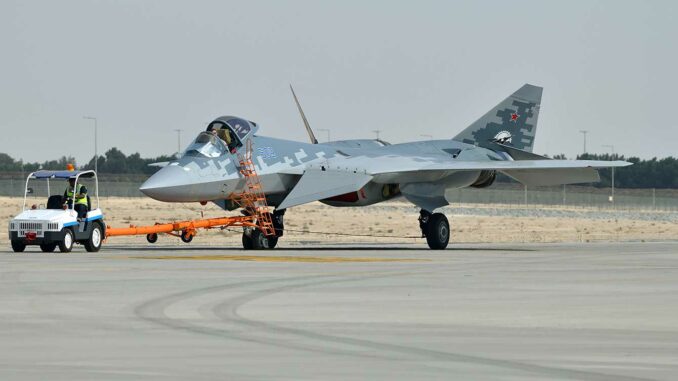
In Komsomolsk-na-Amure, Moscow is safeguarding production of the Su-57 and Su-35, which is now at risk from the expansion of Ukrainian air strikes.
In summary
Russia is stepping up protection of the Komsomolsk-na-Amure aerospace complex in its Far East. Satellite images released in July 2026 show a large hangar nearing completion and several reinforced shelters built near the factory and the Dzemgi airbase. The site is the only factory assembling both the Su-57 and the Su-35, the two most advanced fighter jets currently produced in Russia. Located more than 7,000 kilometres from Ukraine, it remains out of reach of a conventional attack launched directly from Ukrainian territory. However, the strike on the Omsk refinery, 2,700 kilometres away, and the covert ‘Spiderweb’ operation have demonstrated that geographical distance no longer guarantees security. A successful attack on Komsomolsk would result not so much in an immediate massive loss as in a long-term industrial paralysis. It would undermine military deliveries, export contracts and the Russian narrative of a power capable of protecting its territory.
The fortification of Komsomolsk reveals a long-overlooked vulnerability
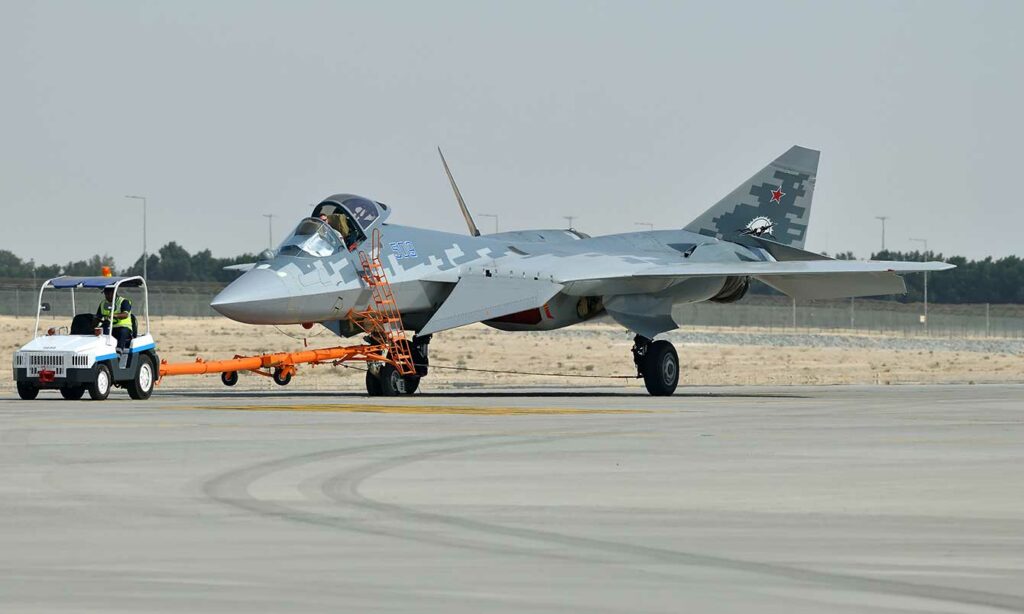
The Komsomolsk-on-Amur Aviation Plant named after Yuri Gagarin, commonly referred to by the acronym KnAAZ, occupies a unique position within the Russian military aviation industry. This factory does not simply manufacture aircraft airframes. It assembles, equips, tests and delivers the Su-35S as well as the production-run Su-57s.
It shares its aeronautical infrastructure with the Dzemgi airbase. This proximity allows aircraft rolling off the production line to undergo ground tests, their maiden flights and acceptance procedures without being transferred to another airfield. It also creates an irreplaceable industrial hub where assembly lines, test benches, specialist personnel and several completed or nearly completed aircraft are concentrated.
Satellite images published on 8 July 2026 show a large industrial hangar nearing completion. They also reveal several reinforced structures around the parking areas. Some hangars appear large enough to accommodate two, or even three, fighter aircraft.
The imagery alone does not allow us to determine the exact thickness of the walls, the type of concrete or the strength of the doors. Nor does it prove that the new hangar was built specifically in response to Ukrainian attacks. Its construction is part of an expansion programme that has been underway for several years to increase production of the Su-57.
The shelters, however, serve a different purpose. Their location near the aircraft and their rapid construction are consistent with the Russian programme to protect aircraft on the ground, which has been observed at several bases since 2024.
The new hangar boosts production rates whilst the shelters protect the aircraft
A production hangar is not necessarily a bunker. It can improve production rates, house new assembly stations or allow for the installation of additional machinery. It remains vulnerable to fire, a power cut or the collapse of part of its roof.
Reinforced shelters serve a more direct purpose: to improve the ground survivability of completed aircraft. A concrete wall and thick roofing can stop shrapnel, limit the effects of a nearby explosion and prevent a light drone from striking the fuselage directly.
They do not guarantee invulnerability. A penetrating munition, a large explosive charge or several successive strikes could neutralise them. A collective shelter even has an obvious flaw: when it contains several aircraft, a successful penetration could result in multiple simultaneous losses.
The construction of protective structures around aircraft that are already parked is, above all, a sign of urgency. Russia is no longer merely seeking to expand its production; it is attempting to protect a production capacity that has become a strategic target.
The risk of an attack remains low but is no longer purely theoretical
Komsomolsk-na-Amure is located in the Russian Far East, approximately 7,100 kilometres from Odesa and more than 8,000 kilometres from Kyiv as the crow flies. This distance remains well beyond the publicly demonstrated range of Ukrainian drones launched from Ukraine.
On 6 July 2026, however, Ukrainian drones struck the Omsk refinery, located some 2,700 kilometres from territory controlled by Kyiv – a distance of 1,700 miles. The operation confirmed a spectacular advance in Ukrainian long-range systems.
Komsomolsk remains nearly three times as far away. A direct attack would require a drone combining exceptional range, robust navigation, a low radar signature and a sufficient payload. Flying over thousands of kilometres of Russian territory would also greatly increase the risks of detection, failure and interception.
The most credible threat therefore does not necessarily come from a drone launched from Ukraine.
Operation Spiderweb on 1 June 2025 demonstrated another method. The Ukrainian services had concealed 117 drones within structures transported by lorry. The drones were then launched near Russian bases, notably in Siberia. This operation circumvented distance, border radars and a large part of the air defence system.
The lesson is stark. Ukrainian long-range strikes are no longer measured solely by a drone’s range. They may rely on infiltration, sabotage, clandestine preparation or launch from Russian territory.
Industrial concentration is the real weak point
KnAAZ does not produce every radar, engine, computer or piece of equipment for the Su-57 on its own. These components come from a network of companies spread across Russia. However, the factory carries out the final integration. It therefore represents a single point of failure.
A strike against a few parked aircraft would cause a visible but limited loss. An attack on tooling, test benches or technical networks would have a far more serious impact.
The manufacture of a modern fighter aircraft depends on precise jigs, lifting equipment, metrology devices and control equipment suited to each stage.
This equipment cannot be replaced like ordinary machine tools. Rebuilding it can take months. Recalibrating it then requires further validation.
Staff are another vulnerability. A qualified welder, an avionics technician or a composite materials specialist possesses experience gained over several years. The building can be rebuilt. An experienced team cannot be reassembled so quickly.
Finally, the Dzemgi runway represents a bottleneck. Without taxiing tests, acceptance flights and in-flight checks, the aircraft cannot be delivered, even if their assembly is complete.
The military impact would far exceed the number of aircraft destroyed
The Su-57 is still being produced in limited numbers. Public estimates put the fleet at around two dozen aircraft by the end of 2025, although the exact figures have not been disclosed. The Russian order is for 76 aircraft by 2028.
This timetable is already tight. The programme has experienced technical and manufacturing delays. The first production aircraft crashed in December 2019 before it was delivered. Production ramp-up has since progressed slowly.
The Su-35S has been in production for longer and in greater numbers. It plays a more direct operational role in the war against Ukraine. It carries out air superiority, escort and cover missions for attack aircraft. Its Irbis-E radar, long-range missiles and endurance make it a key component of Russia’s air power.
A shutdown of KnAAZ would therefore affect two distinct requirements. It would slow down the immediate modernisation of the air force with the Su-35S. At the same time, it would delay the strategic Su-57 programme.
The result would be a capability shock, even without the total destruction of the factory. A six-month shutdown would not merely cancel six months’ worth of deliveries. It would lead to a backlog of incomplete aircraft, disrupt suppliers and divert teams to repairs rather than production.
Russia could transfer certain tasks to other sites. However, it would not be able to quickly set up a second complete production line. Building redundant capacity would take several years and require considerable investment.
The economic cost would be measured first and foremost in terms of lost production
The financial value of the destroyed aircraft would be staggering. Yet this would represent only part of the loss.
The true indicator would be the cost of disruption. An aircraft manufacturing plant involves thousands of parts and hundreds of suppliers. When a final assembly line stops, components sometimes continue to arrive. They must be stored, inspected and protected. Some become unusable if the configuration is changed.
Subcontractors may be forced to slow down their own production. Advance payments made by the state remain tied up. Deliveries are delayed. Contractual penalties and the costs of resuming operations mount up.
United Aircraft Corporation recorded a turnover of 759 billion roubles in 2025. Its net profit amounted to just 9.5 billion roubles, representing a margin of around 1.25 per cent. Its reported debt stood at 405.3 billion roubles at the end of the financial year.
These figures show an improvement on the loss of 14.2 billion roubles recorded in 2024. They also reveal a financial structure that is vulnerable to delays and cost overruns. A company can report high turnover whilst having little margin to absorb a major industrial crisis.
The Russian state could, of course, finance the reconstruction. The military budget planned for 2026 is estimated by the Stockholm International Peace Research Institute at 14,900 billion roubles, or 6.3 per cent of gross domestic product. The issue is therefore not merely one of available funds.
The problem lies in the allocation of resources. Every billion spent on shelters, repairs or a new redundant production line is money that is lacking elsewhere. It does not fund missiles, drones or ground vehicles. Protecting Komsomolsk thus becomes a defensive expenditure imposed by Ukraine, several thousand kilometres from the front line.
US and European sanctions targeting KnAAZ also complicate the purchase of Western components, industrial software and machinery. Russia can substitute certain equipment or use intermediaries. In doing so, it pays more and accepts longer lead times.
The diplomatic risk would affect customers as much as allies
Russia does not present the Su-57 as merely a national programme. It seeks to make it an export product and a symbol of strategic cooperation.
United Aircraft Corporation announced in November 2025 the delivery of two Su-57Es to a foreign customer whose name has not been officially disclosed. Algeria is generally cited, but Moscow has not publicly confirmed the operator’s identity. Rosoboronexport has since stated that several customers have signed contracts for the aircraft.
Russia has also offered India local production of the Su-57, accompanied by technology transfer. This offer seeks to revive an industrial relationship weakened by Russian delays and New Delhi’s diversification of suppliers.
A successful attack on Komsomolsk would directly affect Russia’s export credibility. A customer does not simply buy an aircraft. They buy guaranteed deliveries, training, spare parts, engines and support for several decades.
If the main site appears vulnerable, doubts immediately arise regarding delivery schedules. They also concern Russia’s ability to simultaneously support its own forces and its foreign customers.
Moscow might choose to prioritise its own needs. It might also protect export contracts in order to preserve its diplomatic relations and revenue. In either case, striking a balance would prove politically costly.
A deep strike could ultimately exacerbate tensions between Russia and Ukraine’s Western supporters. The Kremlin would likely seek to portray the operation as the consequence of foreign assistance, even if the systems used were Ukrainian.
Such rhetoric would not automatically trigger a direct escalation with the North Atlantic Treaty Organisation. It could, however, narrow the diplomatic space, strengthen Russian demands for retaliation and complicate any future negotiations.
The psychological blow would target the Russian narrative of strategic depth
The defence of Komsomolsk has a psychological dimension. For several decades, the Russian Far East has enjoyed a sense of security linked to its remoteness.
Military installations located beyond the Urals appeared to be protected by geography.
This certainty has already been shaken. In June 2024, a Su-57 was damaged at the Akhtubinsk base, 589 kilometres from the front line – 366 miles. In June 2025, Spiderweb struck bombers in Siberia using drones smuggled into Russia. In July 2026, the attack on Omsk extended the demonstrated range to 2,700 kilometres.
A strike against KnAAZ would permanently destroy the notion of an internal sanctuary. Its psychological impact would outweigh the physical damage. It would demonstrate that Ukraine can strike not only forces engaged in combat, but also the source of their reinforcements.
For employees at the complex, the shelters may have a reassuring effect. They show that the danger is being taken seriously. They also serve as a reminder that their workplace has become a potential military target.
For the Russian population, the impact would depend on the Kremlin’s ability to control the information. A limited attack could be portrayed as a Ukrainian failure. Satellite images showing destroyed buildings or burning aircraft would be more difficult to dismiss.
The most profound effect would be felt if such attacks were repeated. An isolated strike might spark a surge of patriotism. A series of successful attacks on sites considered untouchable would fuel doubts about the authorities’ competence and the effectiveness of the air defence system.
For Ukraine, the morale boost would be immediate. Striking the Su-57 factory would send a powerful symbolic message. Kyiv would demonstrate that it can threaten one of the Kremlin’s technological showpieces without possessing a comparable strategic air force.
The aerospace stronghold buys time without guaranteeing security
Russia’s decision to reinforce Komsomolsk is a rational one. However, it comes after several years during which expensive aircraft remained parked in the open at Russian bases.
The shelters will reduce vulnerability to shrapnel and light drones. The new hangar could speed up production. These investments will not eliminate the reliance on a single site, the vulnerabilities of its suppliers, or the threat of a covert operation.
True industrial resilience would require more. Critical tooling would need to be duplicated, completed aircraft dispersed, close-in defence strengthened, power networks protected and off-site repair capabilities established. Above all, a second production line capable of rapidly resuming operations would be required.
Komsomolsk-na-Amure remains an extremely difficult target. A direct attack from Ukraine remains unlikely at present. But the course of the war demands a clear distinction between the improbable and the impossible.
Russia is now building defences more than 7,000 kilometres from the battlefield. This observation alone illustrates the strategic impact of the Ukrainian campaign. Kyiv does not need to destroy the factory immediately to impose a cost. The very fact of forcing Moscow to fortify it, to disperse its aircraft and to mobilise defensive resources already constitutes a military achievement.
Sources
United Aircraft Corporation, official presentation of the Su-57 and information on serial production at Komsomolsk-na-Amure.
United Aircraft Corporation, expansion of KnAAZ’s industrial capacity and construction of new production facilities, August 2024.
Military Watch Magazine, AviVector and UNITED24 Media, satellite imagery published in July 2026 showing the new hangar and reinforced shelters in Komsomolsk and Dzemgi.
Reuters, Ukrainian strike against the Omsk refinery, located approximately 2,700 kilometres from Ukrainian-controlled territory, July 2026.
Reuters, reconstruction of Operation Spiderweb and the use of 117 drones smuggled into Russia, June 2025.
Associated Press, first known strike against a Su-57 in Akhtubinsk and a Russian order for 76 aircraft to be delivered by 2028.
Interfax, United Aircraft Corporation’s 2025 financial results: turnover, profit, debt and short-term bonds.
Stockholm International Peace Research Institute, estimate of projected Russian military expenditure in 2026.
Reuters, Russian offer to manufacture the Su-57 in India and issues relating to Western sanctions.
United Aircraft Corporation and Rosoboronexport, first overseas deliveries of the Su-57E and the development of export contracts.
Office of Foreign Assets Control and the US State Department, sanctions targeting the Komsomolsk-on-Amur Aviation Plant.
War Wings Daily is an independant magazine.