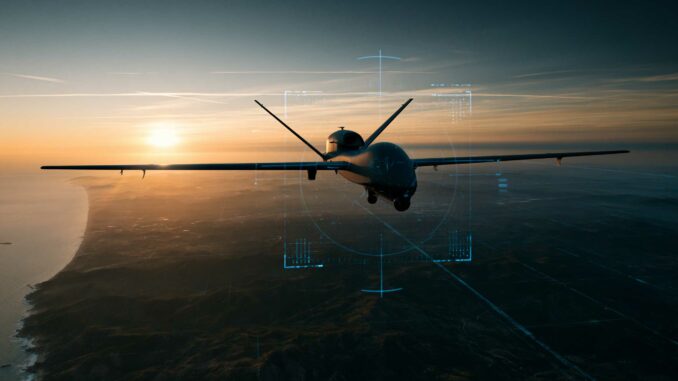
Range, stealth capabilities and sensors are driving up the cost of the USAF’s CCA drones, at the risk of undermining the promise of an affordable air force.
In summary
The US Air Force wants to deploy semi-autonomous combat drones alongside the F-35 and the future F-47. These Collaborative Combat Aircraft are designed to detect threats, jam enemy radars, carry missiles and penetrate heavily defended areas. However, the project is based on a contradiction. To survive in the Pacific, these aircraft must fly long distances, remain stealthy, communicate without being detected and operate despite jamming. Each of these requirements increases their weight and cost. The stated target is around 25 to 30 million dollars per aircraft, compared with 82.5 million for an F-35A at ex-factory cost. At this level, the CCA remains cheaper than a piloted fighter. However, it is no longer a drone that can truly be treated as expendable. The USAF will therefore have to maintain strict discipline: accepting limited performance, developing multiple specialised variants and preventing the CCA from becoming a new, sophisticated unmanned fighter.
The CCA must restore scale to an air force that has become too expensive
The Collaborative Combat Aircraft programme addresses a structural problem. American fighter aircraft are high-performing, but their cost limits the number of aircraft available. Their complexity also slows down production and makes maintenance more costly.
The US Air Force cannot deploy an F-35A or a future F-47 against every radar, every anti-aircraft battery and every enemy fighter. It is therefore seeking to supplement its fleet with less expensive unmanned aircraft. These could accompany manned aircraft, fly ahead of them or occupy multiple positions within the airspace.
The CCA is not a remote-controlled drone like an MQ-9 Reaper. It must be given general objectives, understand its environment, adjust its flight path and coordinate its actions with other platforms. The human pilot will retain authority over the use of force. However, they will not direct every movement using a control stick or a screen.
This organisation must produce an affordable combat force. An F-35 or an F-47 could be accompanied by several drones. Some would carry air-to-air missiles. Others would use passive sensors, jammers or decoys. The loss of a drone would still be serious, but it would not result in the death of a pilot or the loss of an aircraft worth tens or even hundreds of millions of dollars.
The USAF now plans to have more than 150 combat-capable UCAVs before the end of the decade. Its long-term target remains set at around 1,000 aircraft. In June 2026, it awarded industrial development and production contracts to General Atomics for the FQ-42 and to Anduril for the FQ-44. The prototypes were previously designated YFQ-42A and YFQ-44A. ([US Air Force][1])
The expendable drone was initially much simpler
The concept has its roots partly in the work carried out on the XQ-58A Valkyrie and the Low Cost Attritable Aircraft Technology programme.
The aim was to produce an aircraft capable of performing well enough to be reused, yet economical enough that its loss would remain acceptable.
In 2020, the USAF estimated the cost of ‘attritable’ drones to fall within a range of approximately 2 to 20 million dollars. This definition covered a wide variety of platforms. Some were intended to carry out repeated intelligence missions. Others were more akin to recoverable cruise missiles.
The term ‘attritable’ is often too readily translated as ‘expendable’. The distinction is important. An attritable aircraft is not intended to be destroyed on every mission. It is designed to be deployed in an environment where the command would be reluctant to risk a manned fighter.
The XQ-58A provided an opportunity to test this concept. Its relatively simple airframe, its ability to launch without a conventional runway, and its modular architecture reduced logistical requirements. However, a technology demonstrator does not necessarily possess the performance required of a combat system deployed in the Pacific.
The modern CCA must keep pace with fast fighters, operate over long distances, carry weapons, withstand jamming and communicate in a monitored environment. The transition from demonstrator to operational aircraft accounts for much of the rise in costs. ([Air Force Research Laboratory][2])
Combat radius triggers a costly physical spiral
The Pacific imposes considerable distances
Increment 1 of the programme is said to target a combat radius of at least 1,296 km (700 nautical miles). This distance does not simply correspond to maximum range. A combat radius must take into account the outbound journey, manoeuvres within the area of operations, any detours, the return journey and a safety margin.
This requirement is dictated by the geography of the Indo-Pacific. The available airfields are far apart. The bases closest to a conflict zone would be exposed to Chinese ballistic and cruise missiles. US aircraft will therefore often have to take off from dispersed or more distant facilities.
An escort drone with a short range would become dependent on refuelling aircraft. However, the KC-46A and KC-135 are priority targets. They generally have to remain at a distance from enemy fighters and missiles.
Increasing range requires more fuel. A greater volume of fuel requires a larger airframe. This airframe demands a reinforced structure, a more robust landing gear and, in some cases, a more powerful engine. The engine then consumes more fuel. This sequence creates a mass-cost spiral well known to aeronautical engineers.
Fuel competes with weapons
A drone cannot increase in size indefinitely. It must remain cheaper and easier to produce than a fighter aircraft. Every kilogramme of fuel also reduces the mass available for missiles, sensors or electronic warfare equipment.
The USAF must therefore choose between endurance, speed, payload and stealth. A CCA capable of flying very long distances with several internal missiles quickly approaches the size and complexity of a small fighter aircraft.
The cost of an engine illustrates this problem. A simple, mass-produced engine can significantly reduce the unit price. A more powerful, more reliable engine with a low infrared signature requires more durable materials, advanced control systems and more testing.
Stealth costs far more than just an angular shape
Stealth escort drones must avoid detection for long enough to complete their mission. This does not mean they are invisible. Their design aims to reduce the distance at which a radar or infrared sensor can detect and identify them.
Radar stealth begins with the geometry of the airframe. The edges of the wings, hatches and control surfaces must be oriented precisely. The air intake must conceal the metal parts of the engine. Antennas must be integrated into the fuselage. Weapons should ideally be carried in an internal weapons bay.
These solutions increase the number of manufacturing constraints. Surfaces must be assembled to tight tolerances. Seals, hatches and absorbent materials must retain their properties despite rain, heat, vibrations and maintenance operations.
An internal weapons bay is far more complex than a pylon mounted under a wing. It requires doors, ejection mechanisms, sensors and separation tests. It also occupies space that can no longer be used for fuel.
Reducing the infrared signature imposes further trade-offs. Hot exhaust gases from the engine must be masked or mixed with cooler air. These solutions can increase weight and reduce engine performance.
Finally, stealth adds to operating costs. A damaged coating must be inspected and repaired. Operations carried out from small, dispersed bases become more difficult when the aircraft requires air-conditioned workshops, specialised products or highly qualified technicians.
Sensors are rapidly transforming the drone into an unmanned fighter
Removing the cockpit, ejection seat and life-support systems results in cost savings. However, these components do not account for the bulk of the cost of a modern fighter aircraft. Sensors, software, the engine and weapons integration often cost more.
A CCA designed to detect enemy fighters on its own might require an active-scan radar. It would also need early-warning sensors, electro-optical systems, jamming-resistant navigation and a computer capable of fusing the information.
Communication poses a further challenge. The drone must exchange data with the F-35, the F-47, radar aircraft, satellites and other UCAVs. A constantly transmitting link could reveal its position. It is therefore necessary to use directional beams, discrete waveforms, robust encryption and procedures that allow the mission to continue when the network is down.
This mission autonomy requires significant computing power. The computers must process data in real time, without relying on a control centre located several thousand kilometres away. They generate heat, consume electricity and require software that is continuously tested.
The risk is clear. By adding sophisticated radar, a jammer, several missiles, a powerful engine and advanced stealth capabilities, the USAF could end up recreating a fully-fledged fighter aircraft. Only the pilot would be missing.
The public price tag is already setting the CCA apart from the ‘disposable’ drone
Former Secretary of the Air Force Frank Kendall had set a target of around 25 to 30 million dollars per Increment 1 CCA. This sum represented roughly a quarter or a third of the factory price of an F-35A.
The announced average cost for an F-35A from batches 15 to 17 was $82.5 million. However, this comparison must be treated with caution. The factory-gate price does not necessarily include the same components across different programmes. Spare parts, ground support equipment, software, engines, infrastructure and weapons may be accounted for separately. ([F-35 Lightning II][3])
The USAF states that the successful bids for Increment 1 meet, or even exceed, the target of one-third of the price of an F-35. However, the contract values and quantities ordered have not been made public. It would therefore be an exaggeration to claim that costs have already spiralled out of control. The main risk remains that of future scope creep. ([Air & Space Forces Magazine][4])
A $25 million aircraft is not a consumable munition. With two air-to-air missiles, mission equipment and a supply chain, the committed value can rise sharply. A commander will be willing to expose it to greater risk than an F-35, but will not sacrifice it for a secondary target.
This development changes the concept. The CCA is becoming a ‘no-human-risk’ aircraft rather than a genuinely low-cost one. The distinction is crucial.
The USAF budget reveals the shift towards mass production
The draft budget for the 2027 financial year requests $1.4 billion for the research, development, testing and evaluation of CCA. This budget line has increased by approximately $500 million compared with the 2026 financial year.
A second allocation of $1.1 billion is intended to launch production. The programme therefore represents approximately $2.5 billion over a single financial year, not including missiles, infrastructure and certain related activities.
The detailed budget document allocates $996.5 million for the production of the aircraft and $150.5 million for advance purchases for the following financial year. It does not publicly specify the number of drones involved. Simply dividing this figure by an estimated unit cost would be misleading, as this budget also funds the industrial ramp-up, tooling and initial support. ([Air Force][5])
At $25 million per airframe, a fleet of 1,000 aircraft would cost $25 billion. At $30 million, it would cost $30 billion. These figures remain well below the $82.5 billion required to purchase 1,000 F-35As at the announced average price for batches 15 to 17.
However, the CCA does not replace the F-35; it is an addition to it. Its cost must therefore be funded alongside that of the F-47, the B-21, the modernisation of the F-35, air-to-air refuelling aircraft, missiles and the renewal of the nuclear deterrent.
The 2027 financial year illustrates this competition. The USAF is requesting $5 billion for the development of the F-47, approximately $2.5 billion for the CCA (covering both development and production), and $7.4 billion to purchase 38 F-35s. An increase in the drone’s price will therefore result either in a reduction in quantities or in additional pressure on the other programmes.
Cost directly determines combat deployment
The value of the CCA lies in its ability to alter the balance of power. A drone can fly ahead of a formation, briefly activate a sensor, force an enemy radar to transmit, or draw a missile’s fire. It can also carry additional weapons and boost a fighter’s firepower.
This doctrine only works if there are sufficient numbers of aircraft and if their loss remains tolerable. At 5 or 10 million dollars, a drone can be sent on a high-risk mission. At 25 or 30 million, the decision becomes more cautious. At 40 million, it begins to be treated as a scarce asset.
The CCA could then lose its key advantage. Instead of overwhelming defences, it would be kept at a distance. Instead of taking the first hit, it would prioritise its own survivability. The USAF would have an excellent platform, but not the scale required.
Discussions regarding Increment 2 show that the debate remains unresolved. Frank Kendall had estimated that additional capability could justify a price increase of 20 to 30 per cent. Such a scenario would place certain versions at between approximately 30 and 39 million dollars. Other officials subsequently argued for a second generation that was simpler, more specialised and significantly less expensive. ([Air & Space Forces Magazine][6])
The open architecture must prevent a new industrial drift
The USAF is attempting to control costs by separating hardware from software. General Atomics and Anduril will produce the airframes. Mission autonomy is the subject of a separate competition involving six companies: Anduril, General Atomics, Lockheed Martin, Northrop Grumman, RTX Collins Aerospace and Shield AI.
All software must comply with the Autonomy Government Reference Architecture. This architecture is owned by the government. It is designed to enable the transfer of autonomy software from one aircraft to another without having to completely rebuild the system.
This approach limits dependence on a single supplier. It also allows for more frequent updates. The USAF will theoretically be able to replace a substandard algorithm without modifying the airframe or renegotiating the entire programme. ([Air Force][7])
The simultaneous selection of the FQ-42 and the FQ-44 also maintains industrial competition. This choice may appear more costly initially, as two production lines must be supported. However, it reduces the risk of a single manufacturer gradually imposing its prices and terms.
The best protection against cost inflation, however, remains stable requirements. No contractual framework can make an aircraft affordable if it is equipped with intercontinental range, extreme stealth, a powerful radar and a large weapons bay.
The future CCA must remain imperfect to remain useful
The USAF should not be seeking a drone capable of doing everything. It is in its best interests to create a family of specialised platforms. One model can carry missiles. Another can jam radars. A third can serve as a decoy or an advanced sensor.
This approach avoids having to install all the equipment on every airframe. It also allows the most expensive platforms to be reserved for missions that warrant it. The simpler versions can be produced in large numbers and deployed more widely.
The service life must also remain limited. An aircraft designed to fly for thirty years must have a durable airframe, significant fatigue margins and a heavy maintenance programme. A CCA intended for a ten-year service life can accept more aggressive compromises.
The central question is therefore not whether the drone can replicate all the performance capabilities of a fighter.
It is to determine the minimum capability required to change the nature of air combat.
Price dictates doctrine. As long as the CCA costs around a third of an F-35, the USAF can still purchase enough of them to increase its numbers and take on greater risks. If its requirements gradually bring it closer to a fully-fledged stealth fighter, the programme will lose its raison d’être.
The challenge facing the US is no longer merely technological. It lies in resisting the temptation to continually improve an aircraft that must, by definition, remain incomplete. An imperfect escort drone, produced in the hundreds and easily replaceable, can revolutionise air combat. An exceptional drone purchased in the tens will merely add another costly platform to a fleet that already has many.
Sources
United States Air Force, ‘Air Force Advances Future of Air Superiority with CCA Contracts’, 17 June 2026.
United States Air Force, ‘Fiscal Year 2027 President’s Budget Rollout Brief’, April 2026.
United States Air Force, ‘Fiscal Year 2027 Aircraft Procurement’, Air Force, Volume I, April 2026.
United States Air Force, ‘Air Force Validates Open Architecture, Expands Collaborative Combat Aircraft Ecosystem’, 12 February 2026.
Air Force Research Laboratory, XQ-58A Valkyrie, programme fact sheet.
Air & Space Forces Magazine, Kendall: CCA Increment 2 Shouldn’t Be “Exquisite”, 8 January 2025.
Air & Space Forces Magazine, Air Force Officials Say They’re Beating Cost Goal for CCA Drones, 25 March 2026.
Breaking Defense, Air Force Selects General Atomics and Anduril to Build First CCA Drones, 17 June 2026.
Aviation Week, USAF Defines Price Range for “Attritable” UAS, June 2020.
Lockheed Martin, F-35 Production Lots 15–17 Cost Data.