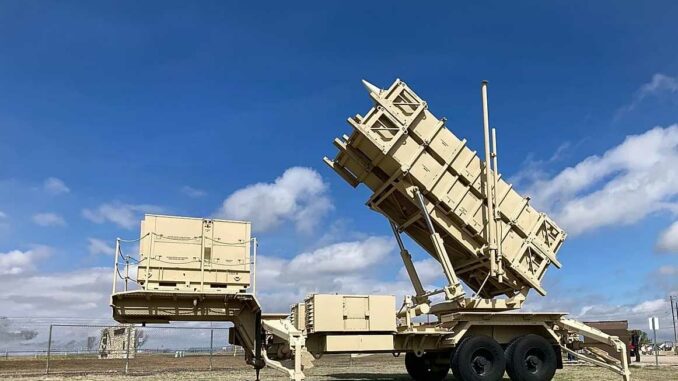
Washington has promised Kyiv a Patriot licence. This represents a major industrial breakthrough, but is not an immediate solution to the shortage of interceptors.
In summary
The US announcement of a possible licence to produce Patriot missiles for Ukraine marks a strategic shift. Until now, Kyiv has relied almost entirely on US and allied stocks to intercept Russian ballistic missiles. However, these stocks are low, expensive, slow to replenish and contested by other theatres of operation, from the Middle East to the Indo-Pacific. The licence will not change the course of the war in a matter of weeks. Producing a Patriot interceptor requires qualified production lines, sensitive components, testing, extreme industrial security and genuine agreement from US manufacturers. But the idea is powerful: it shifts military aid from a logic of donation to one of industrial sovereignty. For Ukraine, the stakes are clear. Without interceptors, the Patriots become under-utilised radars and launchers. With local or European production, Kyiv could close the gap left by Moscow in ballistic missile defence.
The industrial turning point behind the American promise
The announcement made by Donald Trump at the NATO summit in Ankara on 8 July 2026 is simple in its wording but complex in its implications: the United States would be prepared to grant Ukraine a production licence to manufacture Patriot interceptors. The message is political, but it strikes at the heart of Ukraine’s military problem. Kyiv does not merely lack air defence systems. Above all, Kyiv lacks the missiles to fire from these systems.
This distinction is crucial. A Patriot system is not a single piece of equipment. It is a complete architecture. It combines radar, a command post, generators, data links, launchers and interceptors. In Ukraine’s case, the launchers and radars are of strategic value, but they solve nothing if the available missiles are too few. This is precisely what Russia has been seeking to exploit for several months: forcing Ukraine to choose between defending Kyiv, protecting energy infrastructure, covering major industrial centres, or conserving missiles for an even more massive attack.
This announcement should therefore be seen as a change in approach. The United States is not merely promising a new tranche of deliveries. It is opening the door to licensed production – in other words, a controlled transfer of industrial know-how. This does not mean that all Patriot technology would be transferred to Kyiv. Rather, it means that certain stages of production, assembly, maintenance or component manufacturing could be entrusted to Ukraine, Europe or a hybrid industrial arrangement. Reuters has also reported that Washington is preparing a PAC-3 maintenance facility in Europe, with the possibility of future production outside the United States still under consideration.
The shortage of interceptors that leaves Kyiv vulnerable
The US decision comes against a backdrop of urgency.
According to the Ukrainian authorities, Russia launched nearly 500 drones and 77 missiles during the night of 1 to 2 July 2026, including 25 ballistic or hypersonic missiles. The Ukrainian Ministry of Defence subsequently asked nearly 40 partner countries to rapidly transfer Patriot missiles from their existing stocks, in exchange for future replacements already contracted for.
Recent figures highlight the severity of the problem. During an attack on Kyiv in early July, Ukraine intercepted 139 out of 169 drones, but none of the five ballistic missiles launched that night. Reuters also reported that, since the beginning of July, only four out of 54 ballistic missiles had been intercepted around Kyiv. This is not merely a statistical detail. It is an operational signal: Ukraine’s defences remain highly effective against some drones and cruise missiles, but they become vulnerable to ballistic missiles when Patriot interceptors are lacking.
This weakness gives Moscow a clear military option. Russia can combine cheap drones, cruise missiles, decoys and ballistic missiles to overwhelm the defences. Drones tie down defences, cruise missiles force air defence systems to engage, and then ballistic missiles strike with a speed and trajectory that are more difficult to counter. The shortage of interceptors is therefore not merely a logistical problem. It alters Russia’s targeting calculations.
The irreplaceable role of the Patriot against ballistic missiles
The Patriot is not the only air defence system used by Ukraine. Kyiv also deploys NASAMS, IRIS-T, SAMP/T, Gepard, modernised Soviet systems and electronic warfare capabilities. However, the Patriot remains one of the few systems capable of effectively countering tactical ballistic missiles, particularly during their terminal phase. It is this capability that makes it politically and militarily crucial.
The PAC-3 MSE, manufactured by Lockheed Martin, operates on a ‘hit-to-kill’ principle. It destroys the target through direct impact, using its kinetic energy, rather than relying solely on a fragmentation warhead. This approach is particularly well-suited to ballistic missiles, as it aims to neutralise a fast, compact object that is difficult to divert. Lockheed Martin describes the PAC-3 MSE as an interceptor designed to counter ballistic missiles, cruise missiles, airborne threats and certain hypersonic threats.
The GEM-T, manufactured by Raytheon, belongs to the modernised PAC-2 family. It complements the PAC-3. It can engage tactical ballistic missiles, cruise missiles and aircraft. Its operational role is not identical, but it remains a key component of the Patriot system. For Ukraine, the equation is therefore a pragmatic one: having a mix of PAC-3 MSE and GEM-T systems means avoiding the need to use the scarcest interceptors against all threats.
The technical challenge of licensed production
The promise of a licence should not be confused with a factory churning out missiles as early as this autumn. A Patriot interceptor is a highly precision-engineered product. It combines solid-propellant propulsion, guidance systems, ruggedised electronics, sensors, actuators, software, qualified materials, safety tests and certification procedures. The slightest manufacturing flaw can render the missile unusable or dangerous.
This is why production timelines are long, even when the budgets are in place.
The most sensitive issue is the scope of the licence. Washington may authorise full-scale production, but this is the most difficult scenario. It may also authorise partial production: final assembly, production of sub-assemblies, major maintenance, reconditioning, and the manufacture of canisters or non-critical components. This model would be more realistic in the short term. It would reduce repair times and free up US capacity, without exposing the entire technology.
There is also a geographical problem. Manufacturing in Ukraine under Russian missile fire is dangerous. A Patriot factory would immediately become a priority target. This necessitates either dispersed sites, underground facilities, or production in Europe with Ukrainian involvement. The most credible scenario is therefore not a single large factory in Kyiv or Dnipro. Rather, it is a fragmented production chain spanning the United States, Germany, Poland, the Netherlands, Sweden and Ukraine, with strict protection of industrial secrecy.
Budgets shifting their focus
The Patriot system is expensive because it combines a rare capability: intercepting fast-moving threats capable of destroying a power station, a military headquarters or an urban district. In September 2025, Lockheed Martin was awarded a $9.8 billion contract to produce 1,970 PAC-3 MSE interceptors and associated equipment, representing an average contractual cost of around $5 million per missile. This figure should not be interpreted as a universal list price, as it includes equipment and contractual terms, but it does give an indication of the budgetary scale.
The GEM-T contract for Ukraine is also massive. In April 2026, Raytheon announced a $3.7 billion contract to supply Patriot GEM-T interceptors to Kyiv. The company states that the Schrobenhausen site in Germany, operated by COMLOG – a joint venture between Raytheon and MBDA Deutschland – will play a key role in this ramp-up.
These figures are reshaping the political debate. Providing a few dozen interceptors is an emergency measure. Funding several hundred missiles is an industrial policy. Licensed production follows yet another logic: it requires funding machinery, training engineers, qualifying suppliers, securing sites, building up stocks of propellant and entering into multi-year commitments. NATO has, moreover, announced in Ankara more than $50 billion in new procurement and a commitment to expand the Alliance’s defence industrial capacity.
Deliveries to other allies will remain under strain
The Ukrainian licence will not immediately relieve the pressure on other customers. It could even, initially, create additional strain. The same critical components, the same specialists, the same test benches and the same supply chains will be in demand. Countries that are already Patriot customers, particularly in Europe, the Middle East and Asia, also want to replenish their stocks.
Lockheed Martin claims to have delivered 620 PAC-3 MSEs in 2025, following a rise of more than 60 per cent over two years, and is targeting around 2,000 missiles per year as part of a seven-year ramp-up agreement.
That is spectacular. But it also means that the full industrial impact will be felt over several years, not just a few months.
For the Europeans, the challenge is twofold. They must help Ukraine without depleting their own stockpiles. They must also ensure that every missile delivered today does not create an operational shortfall lasting until 2028 or 2030. This is why Kyiv is proposing an exchange mechanism: allies transfer missiles now, and are then reimbursed or restocked later through deliveries already ordered for Ukraine. It is a clever approach, but it requires strong political trust.
The military impact on the war against Russia
The main effect of licensed production would be to reduce the window of vulnerability that Russia is exploiting. If Kyiv can rely on a more regular supply of Patriot interceptors, Moscow will have to reassess its calculations. Ballistic missile attacks will remain dangerous, but they will be more costly in terms of missiles expended, planning and uncertain outcomes. A better-supplied Ukrainian defence also makes it more difficult to repeatedly destroy energy infrastructure before winter.
We must not overestimate the effect. Even with more Patriots, Ukraine will not be able to cover its entire territory. The country is vast. There are numerous targets. Patriot batteries are scarce. Russian ballistic missiles, such as the Iskander-M, can be fired rapidly and in salvos. Patriots protect priority areas, not the entire national airspace. The licence will therefore not grant Ukraine invulnerability. It will provide greater stockpile depth.
This point is crucial. In a protracted war, the question is not merely whether a system works. The question is how many times it can be deployed. A Patriot system without missiles is no longer a deterrent. A Patriot system with around a hundred missiles available transforms the defence of a capital city. A Patriot system with regular deliveries alters Russian strategic planning.
The political and industrial limitations of the pledge
Caution remains necessary. Several media outlets have noted that the US announcement has not yet been accompanied by a detailed production schedule, nor by a comprehensive public agreement with the companies concerned. The Guardian even described the pledge as vague, emphasising that key manufacturers had not necessarily been consulted prior to the political statement.
Air defence cannot be decreed by press release. It is built through contracts, production lines, qualified suppliers and testing. The industrial production rate will therefore be the true yardstick. If the licence is limited to a diplomatic gesture, it will have little impact on the war. If it becomes a concrete transatlantic programme, it could change the trajectory of Ukraine’s air defence within two to four years.
There is also a risk of technology transfer. The Patriot is one of the most sensitive systems in the Western arsenal. The United States will be reluctant to allow the widespread dissemination of its most critical components. Russia will seek to spy on, sabotage or strike any supply chain linked to these missiles. Ukrainian production must therefore be conceived as high-value military infrastructure, not merely as an ammunition factory.
The real test will be the production rate, not the announcement
The US pledge is significant because it acknowledges a reality that the West has underestimated for too long: Ukraine cannot defend its cities in the long term with residual stocks alone.
It needs an industrial base. It needs predictable production. It needs an air defence system that does not depend solely on Washington’s decisions during every crisis. This marks the gradual end of absolute dependence on the US.
But the Patriot licence will not be a miracle solution. It will not replace immediate transfers from allied stocks. It will not eliminate competition with US, Saudi, European or Asian requirements. It will not make the missiles cheap. It will not protect the whole of Ukrainian territory.
It may, however, have a major strategic effect: transforming aid to Ukraine into an acknowledged industrial war of attrition. When facing Russia, it is no longer just the quality of the systems that matters. It is the ability to produce them faster, to maintain them closer to the front line, to fund them over several years and to prevent Moscow from dictating the pace through saturation.
For Kyiv, the stakes are clear. Every available interceptor means a power station, a hospital, a bridge or a neighbourhood that can survive. For NATO, the stakes are broader. The Patriot licence will determine whether the Alliance is capable of shifting from a policy of support to one of wartime production. This is where the true significance of the US announcement will be decided.
Sources
Reuters — Trump says Ukraine to be allowed to make Patriot missile interceptors.
Associated Press — Trump says the US will grant Ukraine a licence to produce Patriot defence systems.
Reuters — Russia attacks Kyiv for the third time in a week, killing three.
NATO — The Ankara Summit Declaration.
Lockheed Martin — PAC-3 MSE production acceleration and 2025 delivery data.
Lockheed Martin — US Army awards $9.8 billion PAC-3 MSE contract.
RTX / Raytheon — $3.7 billion GEM-T contract for Ukraine.
Raytheon — Technical description of the Patriot Guidance Enhanced Missile.
Ukrainian Ministry of Defence, via European Pravda — appeal to nearly 40 partner countries for Patriot missiles.
CSIS — Last Rounds? Status of Key Munitions at the Iran War Ceasefire.
War Wings Daily is an independant magazine.