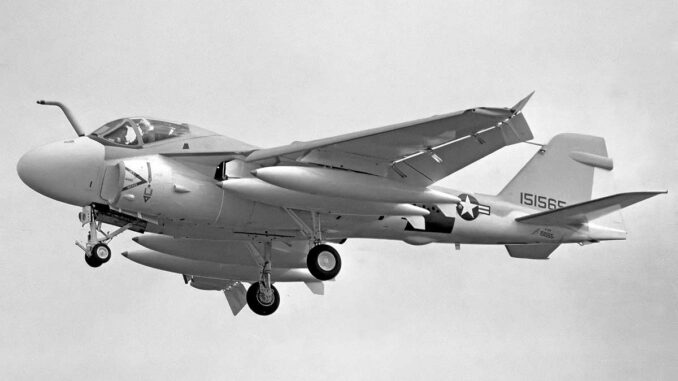
Before modern avionics, the A-6 Intruder relied on DIANE to fly low, strike at night, and bomb targets without visual contact.
Executive Summary
The Grumman A-6 Intruder was one of the strangest and most important attack aircraft of the Cold War. Slow, squat, and ungraceful, it had none of the traits of a spectacular fighter. Yet, it introduced a decisive concept to carrier-based aviation: trusting a machine to fuse navigation, radar, altitude, speed, and ballistic data to strike in the dark, under the rain, and without visual contact with the target. Its DIANE system—Digital Integrated Attack Navigation Equipment—combined radars, an inertial navigation system, an AN/ASQ-61 ballistic computer, and electronic displays. In the 1960s, this architecture was near an industrial miracle. It required analog-to-digital conversions, continuous calculations, and a permanent dialogue between the pilot and the bombardier-navigator. The A-6 was not just a carrier-borne bomber; it was a flying mainframe launched from an aircraft carrier.
The Ugly Bomber That Was Twenty Years Ahead of Its Time
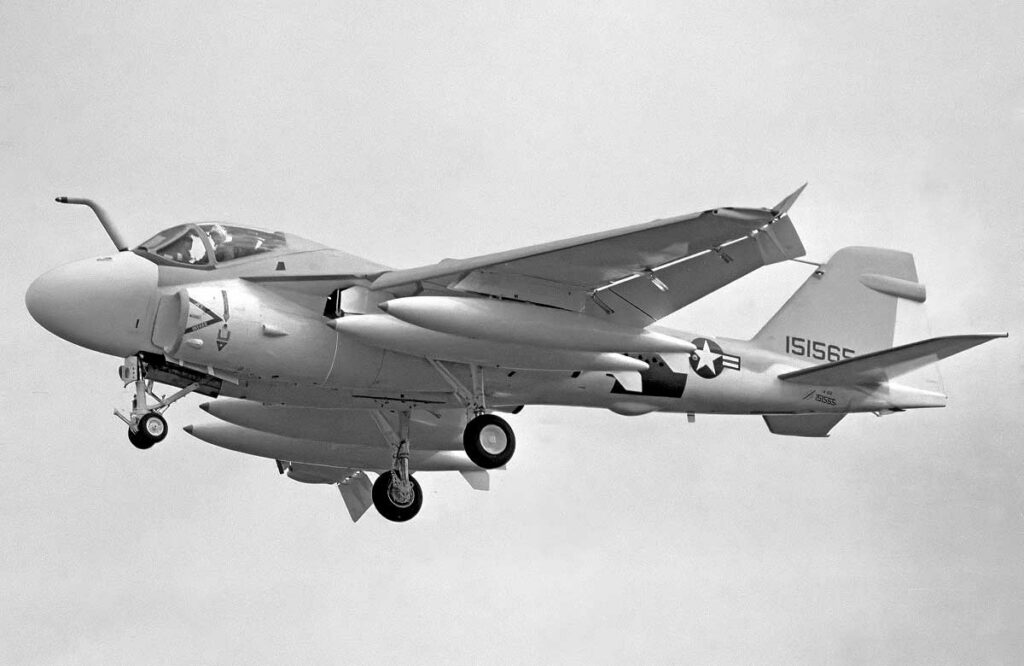
The Grumman A-6 Intruder did not look like a revolution. Its thick fuselage, blunt nose, massive air intakes, and side-by-side cockpit earned it unflattering nicknames. Crews called it the “Iron Tadpole,” “Double Ugly,” or the “Flying Drumstick.” But this shape was no accident. It stemmed from a brutal technical requirement: housing two crew members, two radars, computers, display screens, an inertial navigation platform, and heavy attack avionics inside an aircraft capable of operating from a carrier.
In the late 1950s, the U.S. Navy was seeking an aircraft capable of striking at night, in bad weather, at low altitude, and with a heavy payload. The piston-engined Douglas A-1 Skyraider remained useful, but it belonged to another era. The American Navy wanted a jet bomber capable of penetrating beneath enemy radar coverage and delivering bombs blindly. The first A2F-1, the future A-6A, flew on April 19, 1960. The aircraft entered service in 1963 and was deployed to Vietnam by 1965.
The technical specifications were impressive for a subsonic carrier-capable aircraft. The A-6E measured approximately 16.69 meters in length, with a wingspan of 16.15 meters. Its maximum weight approached 27.4 metric tons. It could carry up to 8,165 kilograms of ordnance (18,000 pounds) across five hardpoints. Its maximum speed was roughly 1,035 kilometers per hour at sea level, depending on the variant. But the true secret was not its speed. The true secret was DIANE.
The DIANE System Transformed the Aircraft into a Flying Computer
DIANE stands for Digital Integrated Attack Navigation Equipment. The name sounds almost ordinary today, but in the 1960s, it was audacious. Military avionics were still dominated by analog instruments, electromechanical computers, raw radar signals, and heavy human workloads. DIANE promised something else: the automatic integration of navigation and attack.
The system had to answer a simple and terrifying question: how do you strike a target the crew cannot see, at night, during monsoon season, at low altitude, from a fast-approaching aircraft, over rugged terrain, and under anti-aircraft threats? The answer required non-stop data fusion. The search radar had to map the terrain or identify a target area. The track radar had to lock onto or follow a more precise point. The inertial navigation system had to track the aircraft’s position. The Doppler radar corrected navigation drift. The radar altimeter measured the actual height above the ground. The air data computer provided speed, altitude, pressure, and flight parameters. The ballistic computer had to transform all of this into a firing solution.
At the heart of this logic was the AN/ASQ-61 computer, manufactured by Litton. It should not be envisioned as a modern computer. It was neither a compact digital chip nor a programmable processor in the contemporary sense. It was a massive, specialized, fragile system built with transitional technologies: discrete electronics, modules, a magnetic drum memory, converters, logic relays, and analog interfaces. For a carrier-based aircraft shaken by catapult launches, arrested landings, salt humidity, and vibrations, it was a major technical gamble.
The A-6 thus carried a miniaturized military mainframe scaled to an aircraft. It did not calculate everything, but it calculated what mattered: the route, height, release point, and corrections related to wind, speed, altitude, and munition type. It was not elegant; it was laborious. But it was pioneering.
The Dual AN/APQ-92 and AN/APQ-112 Radar Gave Eyes to DIANE
The power of DIANE came from its capacity to manage multiple sources. The AN/APQ-92 radar was used for search, mapping, and navigation. It allowed the bombardier-navigator to read the terrain through radar returns. In an era without GPS, moving digital maps, or modern data links, this radar image was already a primitive form of augmented reality.
The tracking radar, associated with the AN/APQ-112 families or earlier equipment like the AN/APG-46 depending on the version, had a more refined function. It helped track a specific point, area, target, or bombing reference. This distinction between search and track was vital. A wide radar beam sees more, but with less precision. A tracking radar sees less, but provides a more stable solution.
The difficulty lay in the nature of the signals. The radar produced analog information. The radar altimeter gave a continuous measurement. The inertial navigation system drifted slowly, and the Doppler corrected that drift. The computer had to convert, compare, filter, and process these real-time streams. Today, an onboard computer handles this type of data without apparent effort. In 1965, every conversion was an event. Every sensor had its own noise, delay, error, and drift.
The mission of the bombardier-navigator was therefore central. Sitting to the right of the pilot, he did not just look at a map; he operated the attack system. He interpreted the grainy radar returns, selected modes, corrected navigation, designated targets, monitored errors, and prepared the release sequence. The pilot, meanwhile, had to follow flight guidance commands, often with his head down, trusting the displays. The A-6 did not eliminate the human element; it transformed the crew into system operators.
Automated Ballistic Calculations Enabled Blind Bombing
Conventional bombing depended heavily on visibility, pilot experience, navigation accuracy, and wind estimation. The A-6 changed this dynamic. Its ballistic computer did not merely signal when to drop a bomb; it continuously solved a physics problem.
Once released, an unguided bomb does not fall vertically. It retains the horizontal speed of the aircraft while being subjected to gravity, drag, wind, air density, and variations linked to its shape. The release point therefore depends on speed, altitude, attitude, flight path, munition type, and target location. The calculation must be executed at the exact right moment. An error of a few seconds can shift the impact point by several hundred meters.
DIANE gathered the necessary parameters to generate a firing solution. The system could display the flight path for the pilot to follow and automatically trigger the bomb release at the calculated moment. This logic prefigured modern CCRP (Continuously Computed Release Point) modes, where the pilot designates a target, follows a flight director line, and lets the computer release the weapon at the optimal point.
The difference is that the A-6 achieved this with tools that look archaic by current standards. It had no GPS, no modern multi-function display, no fast processor, and no smooth digital map. It worked with radars, memory drums, gyroscopes, air data, and conversions. This is precisely what makes DIANE fascinating. It enforced a form of digital warfare before compact digital avionics became standard.
Automated Terrain-Following Was the Other Major Breakthrough
Terrain-following was the other revolutionary dimension. The A-6 had to penetrate at low altitudes to reduce detection time by adversary radars. But flying low at night or in bad weather is dangerous. A pilot can avoid a mountain he sees, but he cannot safely navigate invisible relief at high speeds for long without assistance.
The DIANE system and its associated radars gave the Intruder the ability to follow a low-altitude flight path calculated from detected terrain relief and flight parameters. The principle was to provide the pilot with climb or dive cues—or even feed the autopilot, depending on the mode—to maintain a safety margin above the ground. The system did not turn the A-6 into an autonomous drone, but it gave it a nighttime penetration capability that few carrier aircraft possessed.
This function was terrifying and demanding. At low altitude, there is no time to think. The radar must detect terrain early enough, the system must convert that information into a command, and the aircraft must react without excessive oscillation. The pilot had to completely trust the equipment. If the radar was jammed, if the inertial system drifted, or if the display was misread, the error became fatal.
This is where the word “analog” takes on its full meaning. The A-6 operated in a world of continuous signals, voltages, radar sweeps, and electromechanical data. DIANE had to transform this unstable world into executable decisions. The aircraft was an analog beast attempting to behave like a digital system.
The Side-by-Side Cockpit Created a True Combat Team
The side-by-side cabin layout was not a convenience; it was a necessity. The pilot and the bombardier-navigator had to work as two halves of a single system. In a tandem cockpit, communication would have been slower. In the A-6, both men shared the same environment, the same alarms, and the same tension.
The bombardier-navigator managed DIANE, the radars, and the attack sequence. The pilot managed the aircraft, the flight path, flight safety, and immediate survival. Yet the boundary was not rigid. On night missions over Vietnam, one could not succeed without the other. Trust was absolute. The pilot could find himself following guidance bars in the dark, without seeing the target, while the bombardier-navigator worked on a grainy radar screen.
This setup heralded a major evolution in military aviation. Modern air combat is no longer just a matter of piloting; it is a matter of managing sensors, data, and decisions. The A-6 understood this ahead of many others. It transformed the crew into a system team, rather than a simple pilot-observer duo.
This workload was heavy. DIANE was powerful, but it was also temperamental. The early years were marked by breakdowns, difficult adjustments, and reliability issues. Crews knew the system could be brilliant when it worked, but frustrating when it degraded. This ambiguity is part of the Intruder’s history. It was ahead of its time, and therefore imperfect.
Vietnam Validated the Concept Under the Worst Conditions
Vietnam was the brutal laboratory for the A-6. Southeast Asian weather, pitch-black nights, rugged terrain, anti-aircraft artillery, and surface-to-air missiles created the exact environment for which the Intruder had been designed. The first deployed squadrons quickly learned that the aircraft could achieve what other planes struggled to do: strike alone or in small groups, at night, in foul weather, without relying entirely on visibility.
The missions were highly dangerous. The A-6 flew low, often slowly compared to fighters, with a predictable flight path during certain attack phases. Its ability to bomb in the dark did not make it invulnerable. Anti-aircraft fire, SA-2 missiles, terrain collisions, and system failures remained constant threats.
Yet the operational impact was real. The Intruder could maintain pressure when other aircraft were grounded by weather. It could attack bridges, depots, convoys, power plants, and logistical positions under conditions where a visual strike would have been impossible or imprecise. The U.S. Navy used it throughout the war and kept it in service for decades afterward.
The paradox is stark: the A-6 was not fast, it was not stealthy, and it was not beautiful. But it was available for missions that many more elegant aircraft could not fly. Its strength came from its system, not its silhouette.
The Shift to the A-6E Confirmed the Victory of the Architecture
The A-6E introduced a profound modernization. The early DIANE systems on the A-6A had laid the groundwork, but their reliability and complexity remained problematic. The A-6E replaced several elements with more advanced avionics, notably the AN/APQ-148 multi-mode radar and more modern computers. Later, the TRAM (Target Recognition and Attack Multi-sensor) system added a turret under the nose combining a FLIR, laser rangefinding, and laser designation.
This evolution proved a fundamental point: the core concept of DIANE was correct, even if its initial execution was difficult. Integrated navigation-attack architecture became the global standard. Modern aircraft, from the F-15E to the Rafale, and from the F/A-18E/F to the F-35, all rely on sensor fusion, automated calculations, assisted weapon delivery modes, and synthetic displays. The A-6 lacked modern processing power, but it possessed the core intuition.
One must avoid a simplistic, nostalgic reading of history. The Intruder was not a magical aircraft. Its systems broke down, its subsonic performance limited certain missions, and its low-altitude flight profile exposed it to fire. Its retirement was logical as F/A-18s, cruise missiles, precision-guided weapons, and fully digital systems advanced.
However, its legacy is considerable. It showed that an attack aircraft could become a computing platform. It proved that precision did not come solely from the bomb, but from the quality of the sensor-computer-crew loop. It also demonstrated that a carrier-borne aircraft could execute a complex mission without ever seeing its target.
A Technical Lesson That Remains Modern
The history of the A-6 Intruder still speaks to modern militaries. Contemporary debates about digital warfare, artificial intelligence, sensor fusion, and collaborative drones did not appear out of nowhere. They extend an old question: how do you transform imperfect data into rapid military decisions?
DIANE answered with the tools of its era. The AN/APQ-92 and AN/APQ-112 radars provided the raw material. The inertial platform, Doppler, radar altimeter, and air data computer situated the aircraft. The AN/ASQ-61 computer transformed these inputs into navigation and a firing solution. The side-by-side cockpit converted the results into human action. This chain was slow, heavy, and fragile, but it was coherent.
This is why the A-6 deserves better than its image as a squat, old bomber. It was one of the first attack aircraft to make digital integration, in the operational sense of the term, the core of its military value. It heralded today’s world—one where an aircraft wins not just through speed, but through its capacity to understand the battlefield before the adversary does.
The Intruder was a transitional machine. It had the guts of the analog era and the ambition of the digital age. Amid the noise of radars, memory drums, and cathode-ray tubes, it opened a path that all combat aviation would follow: seeing without seeing, calculating under pressure, and striking without waiting for clear skies.
Sources
National Naval Aviation Museum, A-6E Intruder.
Naval History and Heritage Command, A-6E Intruder.
Smithsonian National Air and Space Museum, Grumman A-6E Intruder.
Designation-Systems.net, AN/ASQ Equipment Listing.
Naval Aviation News, Life of the Intruder, September-October 1997.
A-6 Intruder Association, A-6 History.
Osprey Combat Aircraft, A-6 Intruder Units of the Vietnam War.
Grumman A-6A, B, C, E and KA-6D Intruder Flight Manual, NAVAIR 01-85ADA-1, 1975 edition.
Flight Manual and technical references on DIANE, AN/ASQ-61, AN/APQ-92 and AN/APQ-112.
Pima Air & Space Museum, Grumman A-6E Intruder technical specifications.
War Wings Daily is an independant magazine.