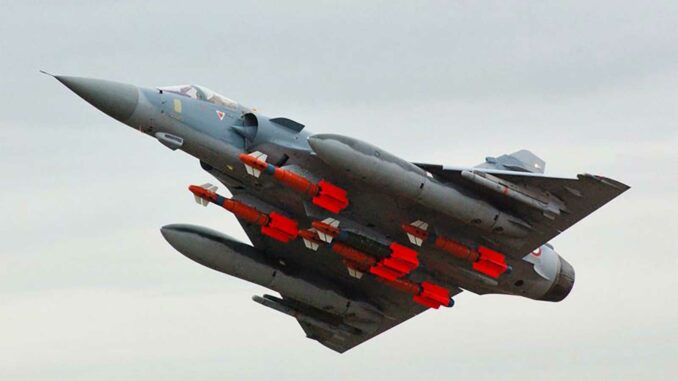
A video showing very low-altitude flight suggests air-to-ground strikes by Ukrainian Mirage 2000s. Tactical proof, a real shift, or a political signal?
Summary
A short video showing a Ukrainian Mirage 2000 flying at a very low altitude, then pulling up sharply, revives a sensitive question: are the French fighter jets delivered to Kyiv now being used for air-to-ground strike missions? The most reliable answer is nuanced. The observed flight profile matches a known pitch-up bombing technique, often used to launch AASM Hammer guided bombs without exposing the aircraft for too long to Russian air defenses. However, the footage does not show a release. It therefore does not formally prove a strike. Above all, it confirms that the Ukrainian Mirage 2000-5F is no longer just a symbol of air defense. Its role could expand. Nonetheless, manned aviation remains rare, costly, and vulnerable. Ukraine’s daily offensive power still relies primarily on Ukrainian drones, which are cheaper, more numerous, and easier to deploy.
The video reviving the debate on Ukrainian Mirage 2000s
The image is short, but it speaks volumes. A Ukrainian Mirage 2000-5F passes at a very low altitude, skimming a tree line, before pulling back sharply on the stick and climbing at a steep angle. The flight is fast, aggressive, and exposed. It looks less like a demonstration and more like a combat sortie.
It is this profile that fuels the hypothesis of an air-to-ground strike mission. In a war saturated with radars, surface-to-air missiles, jammers, and surveillance drones, a fighter jet almost never has the luxury of flying high and long near the front line. It must stay low, use the terrain for cover, reduce its radar signature, and then briefly pop out from its concealment to launch its weapons.
The critical detail is the pull-up. A sudden climb after very low flight can correspond to a toss bombing or loft bombing maneuver. The principle is simple. The aircraft approaches low to avoid detection. It pulls up, releases a guided munition on an upward trajectory, and then quickly exits. The bomb then continues its trajectory toward predefined coordinates. This delivery method allows for increased range without entering too deeply into the most dangerous zone.
But to be clear: the video does not show a bomb being released. It shows neither impact, nor explosion, nor identifiable weaponry under the wings. It is therefore insufficient to assert that this Mirage 2000 struck a Russian target. It makes the theory credible. It does not make it certain.
The Mirage 2000-5F was not originally a ground-attack aircraft
The Mirage 2000-5F delivered by France to Ukraine is primarily an air defense fighter. In the French Air and Space Force, this version was designed chiefly for interception. Its RDY radar, MICA missiles, and ability to climb rapidly to altitude make it an aircraft well-suited for hunting planes, cruise missiles, and certain drones.
Dassault Aviation states that the Mirage 2000 can reach Mach 2.2, fly up to approximately 18,300 meters, carry nine hardpoints, and accommodate two 30 mm cannons in its single-seat version. The Mirage 2000-5 has a maximum takeoff weight of 16.5 tons and an external payload capacity of 5.2 tons. These are not the figures of a modern fifth-generation aircraft. But they belong to an aircraft that remains capable, fast, robust, and well-known to the French armed forces.
The Ukrainian novelty lies in the adaptations. Prior to their transfer, the Mirage 2000-5Fs destined for Kyiv were modified to receive an air-to-ground capability and reinforced electronic warfare systems. This is a major evolution. The Mirage becomes more than just an interceptor. It can contribute to the offensive effort, notably with French munitions already in use by Ukraine.
This transformation is significant. It means that Paris did not just deliver an air-policing platform. France has delivered a more versatile combat tool, capable of defending Ukrainian airspace but also of striking ground targets if tactical conditions permit.
The most credible lead points to the AASM Hammer
If Ukrainian Mirage 2000s are indeed performing air-to-ground missions, the most likely weapon is the AASM Hammer. This French munition, produced by Safran Electronics & Defense, is a modular guided bomb. It can be equipped with various guidance kits: inertial and GPS, infrared, or semi-active laser. Its main advantage is its rear propulsion unit, which gives it a range superior to that of a simple glide bomb.
Safran gives a range exceeding 70 kilometers under favorable launch conditions. This distance depends heavily on altitude, aircraft speed, and the launch profile. From a very low altitude, the range is more limited. But the AASM retains an advantage: it can be launched without the pilot needing to fly directly over the target.
Ukraine is already familiar with this weapon. AASM-250s, the 250-kilogram versions, have been integrated onto Ukrainian MiG-29s and Su-25s. These Soviet aircraft had to be adapted to use Western armaments. The Mirage 2000, meanwhile, offers a more consistent French baseline for employing French munitions. This does not make integration automatic, but it reduces some of the complexity.
The profile observed in the video matches the employment of this type of munition well. A very low approach. A pull-up. A quick exit. This is a logical way to use the AASM in an environment where Russian S-300, S-400, Buk, Tor, and Pantsir systems make any high-altitude flight extremely risky near the front line.
The SCALP-EG remains another capability, but not the most likely here
The Mirage 2000 is also associated with the SCALP-EG, the French version of the British Storm Shadow. This air-to-ground cruise missile, developed by MBDA, weighs approximately 1,300 kilograms, measures 5.10 meters, and targets high-value fixed objectives: bunkers, command posts, military infrastructure, depots, or logistical hubs. It flies at a very low altitude after launch to reduce detection.
On paper, the interest for Ukraine is obvious. The SCALP-EG allows for precise, long-range strikes without exposing the launch platform to deep penetration. Ukraine already uses it from adapted Su-24s, with notable operational effects against deep Russian targets.
But the video in question does not resemble the most obvious profile for a SCALP launch. A cruise missile of this type is generally employed from a safer launch zone, with a mission planned well in advance. The very low flight profile followed by a pull-up is more compatible with a propelled guided bomb, like the AASM Hammer, than with a heavy cruise missile launch.
It would therefore be imprudent to associate this footage with the SCALP-EG. The hypothesis exists technically, but the explanation involving the AASM is more consistent with the imagery, tactics, and precedents observed on other Ukrainian aircraft.
Air-to-ground missions may be real, but likely limited
The central question is not just whether a Ukrainian Mirage 2000 has carried out a strike. The real question is whether this marks the beginning of a French aerial campaign in service of Ukraine. The answer is no, at least for now.
Ukrainian Mirage 2000s are few in number. The exact figures are not public for obvious security reasons. The first deliveries began in February 2025. A French parliamentary report mentioned six aircraft transferred in an initial phase. Ukraine expects more planes, but the fleet remains small. It cannot produce a daily volume of sorties comparable to that of an air force with dozens of modern aircraft, tankers, AWACS, a protected network of bases, and air superiority.
A lost Mirage would be a heavy loss. A pilot trained in France for several months cannot be replaced in a few weeks. A Mirage 2000-5F airframe, even an older one, remains a scarce resource. Every sortie must therefore be justified by a sufficiently important target.
This is why excessive interpretations should be avoided. If Ukrainian Mirage 2000s are now firing AASM Hammers, it would be a useful expansion of their role. It would not be a strategic shift. The aircraft would become an additional strike platform. It would not become the centerpiece of the Ukrainian offensive effort.
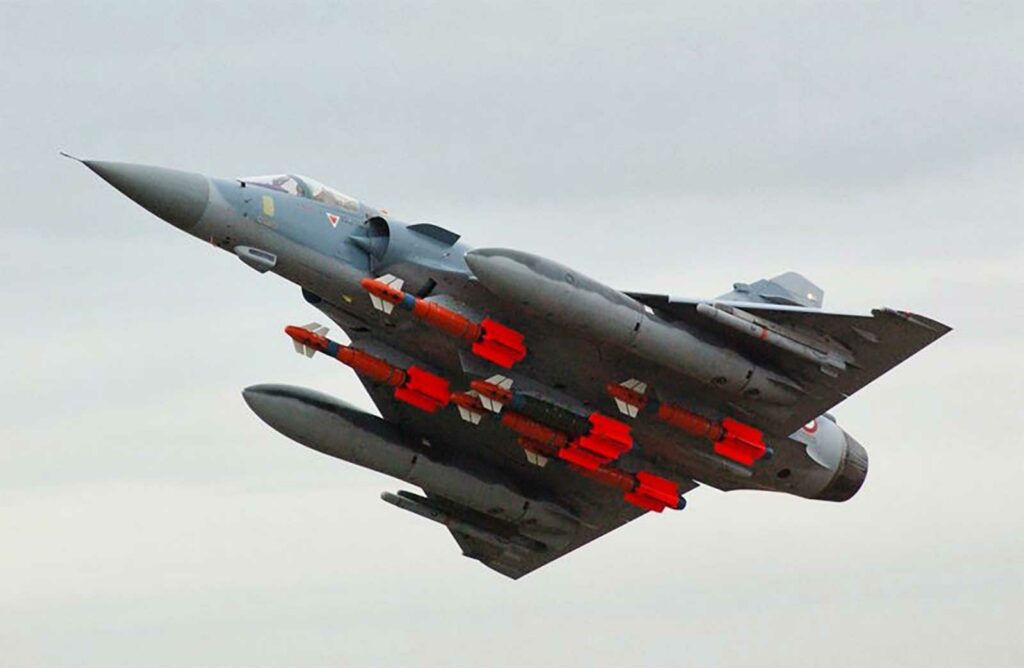
Air defense remains the most cost-effective role for the Mirage
Since their arrival, Ukrainian Mirage 2000s have mostly been presented as air defense assets. This is logical. Ukraine is subjected to massive attacks by cruise missiles, Shahed drones, Geran drones, decoys, and ballistic missiles. Defending Ukrainian skies consumes a considerable quantity of surface-to-air missiles. Yet these missiles are expensive and sometimes scarce.
A fighter jet can contribute to this defense by intercepting certain drones and cruise missiles. The Mirage 2000-5F, equipped with Magic 2 and MICA, can fulfill this role. According to MBDA, the MICA exists with either radar or infrared homing heads. It equips recent versions of the Mirage 2000-5 and the Rafale. This flexibility is useful when facing varied targets.
In this context, employing a Mirage to destroy a drone or a missile can be rational. But here again, everything depends on cost, missile availability, the distance to be covered, and the risk to the aircraft. The war in Ukraine is not a classic air war. It is a war of attrition, where every munition must be weighed against its actual effect.
The Mirage therefore likely possesses a dual value. It protects the skies when necessary. It can strike the ground when the target justifies it. But its employment must remain selective.
The Ukrainian war remains primarily a war of drones
The most important point lies here. Ukraine does not rely primarily on French fighter jets to strike Russia. It relies first and foremost on drones, locally produced missiles, loitering munitions, FPV drones, long-range drones, and autonomous systems.
This hierarchy is visible in the numbers. The National Security and Defense Council of Ukraine has indicated that FPV drones are responsible for 60% of the losses inflicted on the Russian army. It also claims that the Ukrainian industry could produce over 8 million FPV drones per year. A Ukrainian official even put forward a potential capacity of up to 20 million drones per year with sufficient partner funding.
These figures state something simple. A drone is expendable. A Mirage is not. A drone can be mass-produced. A Mirage requires years of design, maintenance, training, and logistics. A lost drone is a cost item. A lost aircraft is an operational crisis.
Ukraine has also used drones to strike refineries, fuel depots, pumping stations, and bases several hundred kilometers from the front line. Recent strikes targeted Saratov, about 700 kilometers from the front line, and the Kirov region, about 1,300 kilometers from Ukraine-held areas. No Mirage 2000 can offer this persistence, dispersion, and depth at this cost.
The political message matters as much as the military effect
It would be naive to dismiss the communication dimension. Showing a Ukrainian Mirage 2000 flying low near the front line sends several messages.
To Russia, it says that Ukraine continues to integrate Western platforms despite strikes against its bases. To France, it shows that the delivered equipment is not sitting in storage. It flies. It serves. It enters a combat chain. To other allies, it suggests that Kyiv can absorb complex systems and make them operational. To the Ukrainian public, it projects an image of modernization and resistance.
But a communication effect does not mean the event is fake. In modern warfare, the two dimensions overlap. A video can document a real capability while being published to produce a psychological effect. This is likely the case here.
Prudence therefore dictates a precise wording: it is credible that Ukrainian Mirage 2000s are beginning to be employed in air-to-ground missions, notably with the AASM Hammer. It has not yet been publicly demonstrated that the video in question shows an actual strike. The capability exists. The employment seems plausible. Complete proof is missing.
The real turning point would be regular use, not the first image
The first air-to-ground flight of a Ukrainian Mirage 2000 would not alter the course of the war on its own. What would matter is regularity. How many sorties? How many munitions fired? Which objectives? With what success rate? With what losses? With what level of coordination with reconnaissance drones, electronic warfare assets, and Western intelligence?
An isolated strike can have media value. A repeated campaign can have operational value. For now, public elements primarily allow us to speak of a likely expansion of the Mirage 2000’s repertoire. Not a transformation of Ukrainian aviation.
Ukraine needs all available means. Mirage 2000s bring speed, precision, an interception capability, and an additional Western air-to-ground option. However, they remain few in number. They operate under permanent threat. They depend on an exacting maintenance chain. And they do not erase the fact that the war has shifted toward less prestigious systems that are more decisive on a daily basis.
The symbol of the French Mirage is strong. The military effect is real if properly employed. But the Ukrainian center of gravity remains elsewhere: in the mass of drones, the precision of intelligence, electronic warfare, local production, and the capacity to strike Russian logistics far behind the front line. The Mirage 2000 can enhance this architecture. It does not replace it.
War Wings Daily is an independant magazine.