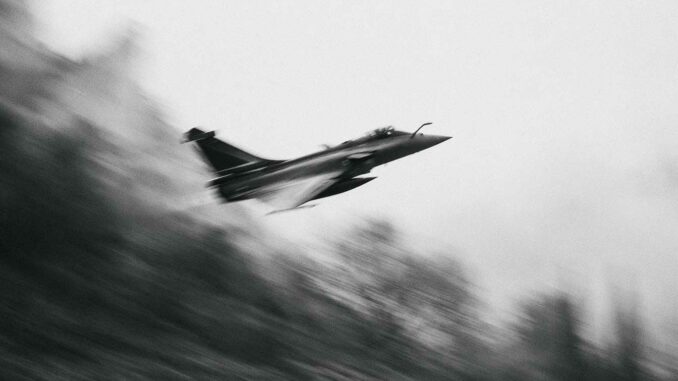
Paris is preparing 16 Rafale F4s for Kyiv starting in 2028. Cost, European loan, Dassault’s share, taxation, and actual profitability for France.
In Summary
France and Ukraine have agreed on a roadmap for an initial order of 16 Rafale F4s, part of Ukraine’s target of up to 100 aircraft. Training is set to begin in France as early as 2026. The first aircraft are expected to take to the skies over Ukraine in 2028 or 2029. The price has not been disclosed. However, based on comparable contracts, the Rafale package is estimated to be between 2.8 and 3.8 billion euros, including weapons, training, and initial support. Funding would be sought through the European Ukraine Support Loan mechanism. This mechanism totals 90 billion euros for 2026 and 2027, of which 60 billion is earmarked for defense. Dassault Aviation could record several billion euros in revenue, but a significant portion would be paid to Thales, Safran, and subcontractors. Its likely operating profit would be between 180 and 250 million euros. For the French government, the tax revenue will be significantly lower than the contract amount.
The agreement transforms a political promise into an arms program
The Franco-Ukrainian announcement on July 14, 2026, goes further than the declaration of intent signed in November 2025. Kyiv has announced an initial order for 16 Rafale jets, complete with their armaments. This tranche is part of a stated requirement that could reach 100 aircraft. The roadmap also includes four SAMP/T NG systems, radars, Aster 30 missiles, and the licensed production of French ammunition in Ukraine.
However, we must be precise with our wording. The political roadmap has been finalized. The full commercial contract has not been made public. No price, payment schedule, or detailed list of services has been released.
The official text states that funding “will be requested” under European loans to support Ukraine for 2026 and 2027. The financial framework is therefore in place. But each line item must still be approved, formalized in a contract, and included in European funding programs.
Training for pilots and mechanics is set to begin in France as early as 2026. It will build on the work already done regarding the Mirage 2000-5Fs transferred to Ukraine. The Mirage aircraft have established an initial foundation for training, maintenance, and the use of French weapon systems.
The Rafale, however, requires a significant increase in scale. Pilots must be trained, as well as specialists in engines, avionics, radar, electronic warfare, data links, mission planning, and weapons systems.
The target date of 2028 or 2029 seems consistent with this level of complexity. It also aligns with Dassault Aviation’s industrial constraints. At the end of 2025, the group had an order backlog of 46.6 billion euros, including 220 Rafales. The production line is already serving France, the United Arab Emirates, Indonesia, and several other customers. Ukraine is therefore not purchasing a product that is immediately available. It is joining a production line that is under significant strain.
The Rafale F4 offers capabilities that the Mirage cannot provide
The Rafale F4 is not a stealth aircraft. Nevertheless, when integrated into a cohesive system, it remains much more difficult to detect, jam, and engage than an older fighter.
Its active-scan radar, SPECTRA electronic warfare suite, sensors, and data links enable it to build and share a richer tactical picture. The F4 standard also improves secure communications, connectivity, and the integration of new weapons.
For Ukraine, the main benefit does not lie in maximum speed. It lies in the ability to detect threats earlier, engage targets at longer ranges, and improve survivability. The Rafale can also operate in conjunction with ground-based radars, air defense systems, surveillance aircraft, and allied intelligence assets.
The Meteor missile provides long-range combat capability. The MICA and the future MICA NG cover short- and medium-range engagements. The AASM enables precision strikes at ranges of several tens of kilometers. It can be equipped with various guidance systems and carry payloads ranging from 125 to 1,000 kilograms.
However, the Rafale will not eliminate Russian air defense. It will have to operate against long-range radars, fighters equipped with long-range missiles, and multi-layered surface-to-air systems.
Its survival will depend on the quality of electronic intelligence, mission data, dispersion tactics, and base protection. Shelters, secondary runways, spare parts stockpiles, and crews capable of quickly repairing damage will be required.
Sixteen aircraft constitute a squadron, not an air wing. Part of the fleet will be undergoing maintenance, in training, or on standby. The number actually available each day will therefore be less than 16. This initial batch can create a credible operational capability. It cannot, on its own, ensure air superiority over the whole of Ukraine.
The actual cost far exceeds that of the sixteen aircraft
No official figure has been announced. We must therefore start with comparable contracts and then account for their differences.
In January 2024, France ordered 42 Rafale jets for more than 5 billion euros. That already amounts to more than 119 million euros per aircraft. However, this amount does not represent a complete export package.
Greece committed 2.32 billion euros for 18 new and used Rafale aircraft, including approximately 400 million euros for weapons. The United Arab Emirates signed a deal worth 16 billion euros for 80 Rafale aircraft, including significant support and equipment.
India paid more per aircraft for 26 Rafale Marine aircraft. However, its contract includes navalized aircraft, missiles, infrastructure, simulators, and extensive support.
The Likely Cost of the Aircraft and Their Support
For 16 Rafale F4s, the airframes, engines, onboard equipment, ground support systems, and an initial stock of spare parts can be estimated at between 2.2 and 2.8 billion euros.
This range takes into account the technological level of the F4 standard, the Ukrainian modifications, and the small volume of the first batch. A small order generally costs more per aircraft than a batch of 60 or 80 aircraft.
Training, simulators, infrastructure, secure communications, and initial support must be added.
Above all, missiles and bombs must be included. A squadron delivered without sufficient combat stockpiles would be militarily vulnerable.
An additional budget of 600 million to 1 billion euros seems realistic. The total cost of the first Rafale batch would therefore be around 2.8 to 3.8 billion euros.
It could exceed 4 billion euros if the contract includes several years of support, major infrastructure, and a substantial stockpile of Meteor, MICA, SCALP, and AASM munitions.
The price could be lower if the first four aircraft were temporarily drawn from the French inventory. This solution would not make them free. If France withdraws aircraft from the Air and Space Force, it will have to replace them. The cost would then be shifted to the French military budget.
The official text refers to the transfer of the first four Rafales following personnel training. It does not specify whether these will be new aircraft, refurbished French aircraft, or a combination of the two.
The Cost of the Full Franco-Ukrainian Program
The Rafales are only part of the roadmap. The four SAMP/T NG systems, their missiles, the GM400, GF300, and Kronos radars, as well as the licensed production of the AASM and SCALP add up to several billion euros in potential costs.
A Danish contract for four SAMP/T NG systems, including missiles, training, and support, was recently valued at nearly 1.5 billion euros. Five GM400 radars could amount to approximately 140 million euros based on comparable European orders.
Including aircraft, ground-to-air defense systems, radars, and initial munitions, the initial phase of the program could reach between 4.5 and 6 billion euros.
This estimate remains conservative. The investments required for licensed production in Ukraine are unknown. The quantities of missiles have not been made public. Maintenance services and the duration of support may also significantly alter the final amount.
The European loan finances the purchase without writing off the debt
The European Ukraine Support Loan mechanism totals 90 billion euros for 2026 and 2027. It includes 30 billion euros in budgetary support and 60 billion euros earmarked for defense.
The European Commission must borrow the funds on the markets. This debt is guaranteed by the available margin in the European budget. Repayment of the principal must remain linked to reparations owed by Russia. Financing and management costs are borne at the European level.
This arrangement differs from a direct check from the French Treasury to Dassault Aviation. The European Union raises the funds. Ukraine receives a loan. Kyiv then orders equipment falling within the authorized categories.
Purchases must prioritize Ukrainian, European, and associated industries. The Rafale, MBDA missiles, Thales radars, and SAMP/T NG systems naturally fall within this framework.
This arrangement speeds up the order process despite Ukraine’s current financial constraints. It also directs a significant portion of spending toward European industry. Finally, it spreads the risk among the states participating in the financing.
It does not eliminate this risk. If Russia’s reparations are never paid, repayment will become a European political and budgetary issue. Interest will also have to be paid.
France contributes to the EU budget. It therefore indirectly bears a portion of the cost and risk. This French share is not isolated in a separate account dedicated to the Ukrainian Rafales. It cannot be accurately calculated without knowing the final guarantee formula, borrowing rates, the repayment schedule, and future repayments.
Presenting the contract as “paid for by one country” would be incorrect. The financing pools the burden; it does not eliminate it. Presenting the aircraft as a €3 billion gift from France would be just as inaccurate. France is a contributor to the mechanism, but it does not bear the cost alone.
Dassault’s share is reflected in revenue, not profit
Dassault Aviation explains that it recognizes Rafale export contracts in their entirety, including the shares of Thales and Safran. This rule is essential. It means that the revenue reported by Dassault may include equipment purchased from its partners before it is integrated into the aircraft.
Out of an aerospace segment valued at between 2.2 and 2.8 billion euros, Dassault could therefore recognize a share close to this amount, spread over several fiscal years.
This does not mean that this sum remains in its accounts. Safran supplies the M88 engines and various pieces of equipment. Thales supplies a major portion of the radars, avionics, communications, and electronic warfare systems. Approximately 400 companies are involved in the Rafale program.
Missiles may follow a different contractual structure. MBDA produces the Meteor, the MICA, and the SCALP, among others. Safran Electronics & Defense produces the AASM. These weapons can be sold separately or included in the main contract.
In 2025, Dassault Aviation reported 7.4 billion euros in revenue and 635 million euros in adjusted operating income. Its operating margin was close to 8.6%.
Applying this margin as a simple reference to an aerospace contract worth 2.2 to 2.8 billion euros yields a theoretical operating profit of 180 to 250 million euros for Dassault.
This estimate does not constitute an official contractual margin. The first units may require more engineering work. Support services may be more profitable. Conversely, delays, inflation, and ramp-up difficulties could reduce the profit.
Saying that “Dassault receives 3 billion euros” without further explanation would therefore be misleading. The company may report several billion in revenue. Its net economic gain is much lower.
French Taxes Recover Far Less Than the Contract Value
The first mistake is to apply a 20% VAT rate to the sale amount. Exports to countries outside the European Union are exempt. Therefore, there will be no French VAT on the Rafale jets delivered to Ukraine.
The second source of revenue is corporate income tax. The standard French rate is 25%. If Dassault generates between 180 and 250 million euros in operating profit on this portion of the deal, the corresponding theoretical tax would be in the range of 45 to 65 million euros.
The actual taxable income may differ. It depends on depreciation, financial expenses, tax credits, the allocation of costs, and the timing of profit recognition.
To this must be added the taxes paid by Safran, Thales, MBDA, and French suppliers. A reasonable estimate puts the direct corporate tax for the entire supply chain at 80 to 150 million euros over the duration of the first Rafale contract phase.
This figure is merely an order of magnitude. No government ministry publishes the profit margin realized by each company on this contract.
Social security contributions, payroll taxes, and employees’ income taxes will also generate revenue. But it would be misleading to count every euro as new revenue.
Dassault and its partners already have a large order backlog. Some of the employees would have worked on other programs. The true additional tax revenue therefore depends on the jobs created, the additional investments, and the value that would not have been generated without the Ukrainian order.
The French government may also receive royalties linked to historical public investments in the research and industrialization of the Rafale. The Court of Auditors has already described this mechanism. Its yield remains difficult to predict. Royalties associated with previous Rafale contracts have experienced delays in collection. No specific amount pertaining to Ukraine has been made public.
The realistic order of magnitude is therefore clear. The contract may represent approximately 3 billion euros in aerospace activity. Direct French tax revenues will likely be limited to a few hundred million euros at most. These revenues will be spread over several years.
They will not automatically cover France’s share of the European risk. Nor, however, do they constitute the program’s sole economic benefit.
Profitability exists, but it is not solely a budgetary matter
For Dassault Aviation, the contract is highly likely to be profitable. The Rafale is a mature program. The main development costs have been largely amortized. An additional order extends the production run, stabilizes the supply chain, and spreads fixed costs across more aircraft.
It also opens the door to future revenue from maintenance, modernization, training, and ammunition supply. A fleet of 16 aircraft could serve as the starting point for a much larger order.
For French industry, the impact is positive. The contract supports design offices, assembly plants, engine manufacturers, electronics firms, and missile manufacturers. It consolidates a level of sovereign expertise that is rare in Europe.
It also bolsters the Rafale’s credibility in a high-intensity warfare environment. This track record can aid future export campaigns, provided that operational performance is convincing.
For French public finances, the picture is more nuanced. The government does not receive 3 billion euros. It does not collect VAT. It recovers a fraction of the profits in the form of taxes, social security contributions, and fees.
At the same time, it contributes to the European budget. It may have to replace aircraft or missiles drawn from its stockpiles. It also bears part of the financing risk.
The macroeconomic outcome may remain favorable. A large portion of the value added is generated in France. Wages, investments, and industrial purchases stimulate the economy.
But this effect will be weaker if the order delays French deliveries, overwhelms suppliers, or forces the government to urgently finance new production capacity.
Licensed production in Ukraine creates another source of tension. It is strategically useful. It brings ammunition closer to the front lines and strengthens Ukraine’s autonomy. It also transfers part of the industrial value outside of France. The outcome will depend on the sharing of licenses, components, royalties, and intellectual property.
France’s benefit will depend on execution
The real test will not be the photo op at the summit. It will be the ability to deliver aircraft, pilots, mechanics, missiles, and mission data at the same pace.
A Rafale grounded due to a lack of parts yields neither military effect nor industrial return. An aircraft delivered without a sufficient stockpile of missiles becomes a costly showcase.
The sale is likely a good deal for Dassault Aviation and its supply chain. It could be beneficial for France from an industrial and strategic standpoint. It is not a miraculous tax maneuver.
The European loan transforms a Ukrainian budgetary constraint into a European industrial order. However, it shifts part of the risk to the common budget.
The final assessment will depend on four questions. Will the 16 aircraft actually arrive in 2028 or 2029? Will missile stockpiles be sufficient? Will France be able to meet its own needs without further delays? Will the European Union ever recover the principal of the loan from Russia?
The contract is profitable from an industrial standpoint. It may become profitable from a strategic standpoint. Its budgetary return for France will remain more limited and uncertain. It is precisely this distinction that the public debate must keep in mind.
War Wings Daily is an independant magazine.