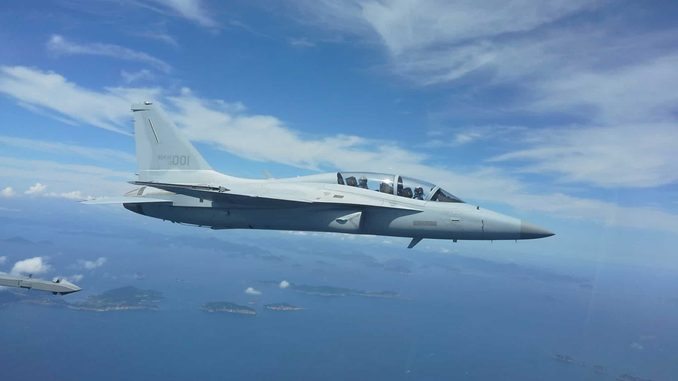
Malaysia takes delivery of its first South Korean FA-50Ms. Performance, AESA radar, armament, and delivery schedule for the 18 ordered fighters.
Summary
The Royal Malaysian Air Force (RMAF) has received its first KAI FA-50M Fighting Eagle light combat aircraft, marking an important milestone in the modernization of its military aviation. The first aircraft, registered M58-01, landed on October 30, 2026, at Labuan Air Base following a flight from South Korea. Delayed by a technical issue, the second aircraft joined it before both arrived in Kuantan on November 1. Malaysia ordered 18 FA-50M Block 20 fighter jets for $920 million, with deliveries phased through March 2028. Equipped with a PhantomStrike AESA radar, an in-flight refueling system, and modernized avionics, these fighters are set to replace the aging BAE Hawks. They will also provide advanced pilot training and complement the F/A-18D Hornet and Su-30MKM in air combat missions.
Malaysia welcomes its first FA-50Ms after a three-year wait
On October 30, 2026, the first FA-50M Fighting Eagle intended for the Royal Malaysian Air Force landed at Labuan Air Base, off the coast of Borneo. Aircraft M58-01 had departed the Korea Aerospace Industries (KAI) facilities in Sacheon, South Korea, before reaching Malaysia via Jeju and the Philippines.
Its arrival featured a symbolic escort comprising BAe Hawks, Boeing F/A-18D Hornets, and Sukhoi Su-30MKMs. This formation brought together the three types of combat aircraft that the FA-50M is designated to replace or complement.
Malaysian Defence Minister Mohamed Khaled Nordin attended the ceremony. A second aircraft, M58-02, was initially scheduled to arrive simultaneously. However, a technical anomaly detected during ferry flight delayed its departure from the Philippines.
The issue was resolved quickly. On November 1, both FA-50Ms reached Kuantan, their primary home base, after departing Labuan at 1:45 PM. They landed at 3:38 PM local time.
Final aircraft acceptance remains subject to testing
This arrival does not mean the aircraft are immediately available for military operations. The RMAF must still conduct final acceptance tests to verify technical and contractual compliance.
An official handover ceremony was initially announced for mid-November. However, the latest information released by the Malaysian Air Force puts final acceptance of the two aircraft toward the end of November 2026.
The $920 million contract modernizes Malaysian aviation
The order dates back to February 2023, with an official contract signing held in May during the LIMA exhibition in Langkawi.
The contract covers 18 FA-50M Block 20 aircraft, valued at an announced $920 million—approximately 1.2 trillion South Korean won at the time of signing. Malaysian authorities cite an investment close to 4 billion ringgit.
This amount represents a contractual average of approximately $51 million per aircraft. However, it should not be confused with the unit price of the airframe alone. The program also includes training and support services.
Deliveries are now scheduled according to a progressive timeline:
- Six aircraft expected by April 2027.
- The remaining twelve delivered in stages until March 2028.
- A fleet primarily operated by No. 15 Squadron in Kuantan, with planned deployments to Labuan.
The acquisition fits into the Capability Development Plan 2055 (CAP55), designed to restructure Malaysian air capabilities over several decades.
The FA-50M combines fighter performance with trainer versatility
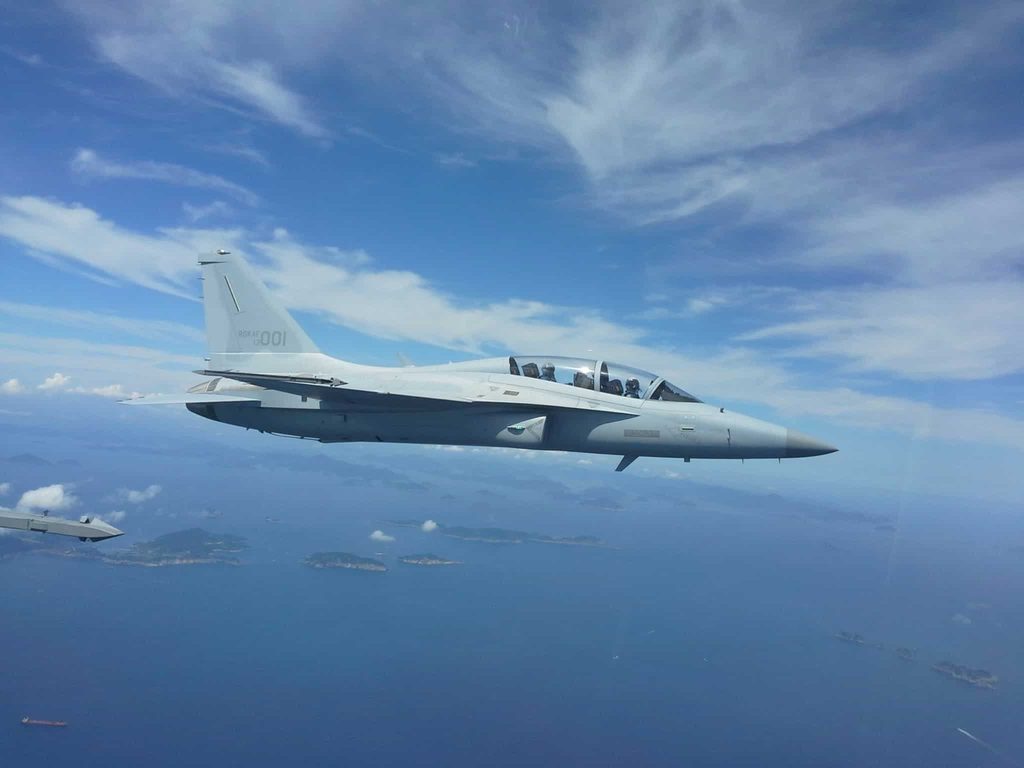
Developed from the T-50 Golden Eagle, the FA-50 Fighting Eagle is a supersonic two-seat single-engine aircraft designed for advanced training and combat missions.
It measures 13.13 meters in length (43.1 ft), has a wingspan of 9.44 meters (31 ft), and features a maximum takeoff weight of approximately 12,215 kg (26,929 lb).
Its propulsion relies on a General Electric F404-GE-102, license-assembled in South Korea by Hanwha Aerospace. This afterburning turbofan engine produces approximately 78.7 kN of thrust (17,700 lbf).
The aircraft reaches Mach 1.5 and has an announced operational ceiling of 13,716 meters (45,000 ft). Its fly-by-wire controls, digital cockpit, and HOTAS controls replicate several features of modern fighters.
The FA-50M also benefits from probe-and-drogue in-flight refueling capability. This evolution allows extended missions, which are particularly important for a nation whose territories are separated by the South China Sea.
The PhantomStrike radar enhances detection capabilities
One of the main innovations of the Malaysian configuration lies in the integration of RTX Raytheon’s PhantomStrike AESA radar.
Unlike traditional mechanically scanned radars, an AESA radar uses multiple electronic modules to direct its beam without physically moving its antenna.
The PhantomStrike notably leverages gallium nitride (GaN) components, a technology allowing efficient management of electrical and thermal power. Its air-cooled architecture eliminates certain liquid cooling equipment.
RTX quotes a weight under 68 kg (150 lb). The radar can provide air-to-air surveillance, ground target detection, and simultaneous tracking of multiple targets.
These capabilities enhance the pilot’s tactical awareness. However, they do not guarantee, on their own, the capability to engage enemy aircraft at long range.
Armament enables air defense and precision strike missions
The FA-50 features seven hardpoints and an internal 20 mm cannon.
The FA-50 family can integrate AIM-9 Sidewinder air-to-air missiles, AGM-65 Maverick air-to-ground missiles, and 227 kg (500 lb) guided bombs, notably the GBU-12 Paveway II and GBU-38 JDAM.
The Sniper Advanced Targeting Pod allows target identification and tracking via its electro-optical and infrared sensors. It also contributes to the laser designation required for certain guided munitions.
The Malaysian configuration specifies these advanced capabilities, but not all weapons compatible with the platform are necessarily purchased, integrated, or qualified by the RMAF.
The question of beyond-visual-range combat remains particularly significant. During the Singapore Airshow 2026, KAI proposed integrating this capability on a potential second batch of aircraft. Operational integration of AIM-120 AMRAAM missiles is not confirmed on the initial Malaysian FA-50Ms.
The Hawk retirement redistributes combat missions
The FA-50Ms are set to progressively replace the RMAF’s BAE Hawk 108 and 208 aircraft, whose retirement is scheduled for 2028.
The Hawk performed two essential missions: training future fighter pilots and light attack operations. Replacing it with a supersonic aircraft featuring more recent avionics represents a major transition.
However, the FA-50M will replace neither the F/A-18D Hornet nor the Sukhoi Su-30MKM. These heavier aircraft retain their advantages regarding payload, range, and complex missions.
The new South Korean aircraft is intended instead to take charge of missions suited to a light fighter: operational training, interception, air patrol, and tactical support.
This distribution allows reserving the most powerful aircraft for operations requiring their specific capabilities.
Crew training drives capability growth
The establishment of No. 15 Squadron began prior to the aircraft’s arrival. As of October 30, 2026, 127 of the 209 planned positions were filled.
An initial group of 57 personnel, including six pilots, six engineering officers, and 45 technicians, completed training in South Korea. The six pilots completed their flight syllabus on October 21.
The RMAF will now need to build its domestic maintenance, training, and operational readiness capabilities. A flight simulator developed with Malaysian industrial participation is also part of this effort.
The program could be extended through a second order of 18 aircraft. The fleet would then reach 36 light fighters, in line with the original ambitions of CAP55.
However, this additional acquisition is not contracted. Mohamed Khaled Nordin clarified that the decision would depend on the operational evaluation of the first batch and could involve another model.
The real issue will be operational availability in 2028
The arrival of the first FA-50Ms marks concrete progress for Malaysian military modernization. It also confirms KAI’s progression in the international light combat aircraft market.
A key question remains: will the RMAF have a sufficient number of aircraft, qualified pilots, and experienced technicians when its last Hawks leave service?
Meeting the industrial schedule will not be enough. The success of the program will be measured by the number of aircraft genuinely available to fly, train, and fight. It is on this terrain that the FA-50M must deliver on its promises.