Ethiopia acquires 12 Russian Su-35 fighters and four S-400 batteries. Performance, regional military balance, and strategic stakes for Moscow.
Summary
Ethiopia officially announced on October 28, 2026, the acquisition of 12 Russian Sukhoi Su-35 fighter jets, of which the first two aircraft were presented to Prime Minister Abiy Ahmed at Zhukovsky Airport near Moscow. This delivery comes a year ahead of the originally scheduled timeline. Addis Ababa is also set to receive four S-400 anti-aircraft missile batteries. These acquisitions constitute a major modernization of Ethiopian aviation, which has hitherto been primarily equipped with Su-27s and Su-30s. They come amid high tensions with Eritrea and a resurgence of fighting in Tigray. For Russia, the contract represents a commercial and diplomatic opportunity in an African market where its influence remains significant. It also allows Moscow to demonstrate that it retains aeronautical export capabilities despite Western sanctions and the considerable needs of its own military aviation engaged in Ukraine.
Russia delivers its first Su-35s to Ethiopia at the Russia-Africa summit
On October 28, 2026, Ethiopian Prime Minister Abiy Ahmed announced the acquisition of 12 Sukhoi Su-35 combat aircraft, accompanied by an order for four S-400 air defense batteries.
The announcement was made during the third Russia-Africa summit, held in Moscow on October 28 and 29.
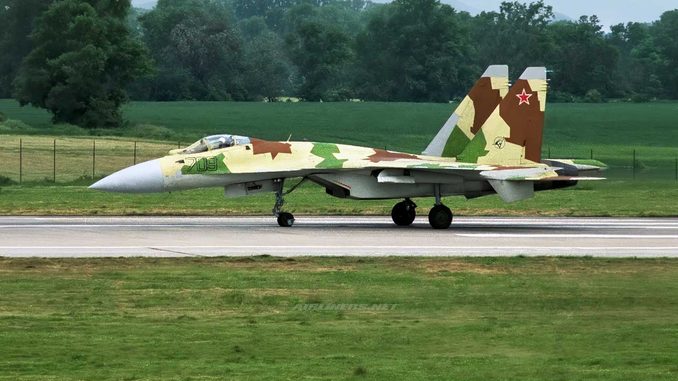
Two aircraft bearing registrations 2551 and 2552 were presented in Ethiopian colors at Zhukovsky Airport, near the Russian capital.
State exporter Rosoboronexport confirmed to Reuters the delivery of an initial batch of two fighters.
This distinction is important. Although Abiy Ahmed mentioned receiving the first twelve aircraft, only two planes have been publicly identified. Their physical transfer to an Ethiopian base was not yet confirmed as of November 1.
The delivery schedule for the remaining ten aircraft, the contract value, and its financing terms have not been communicated.
The Prime Minister thanked Vladimir Putin for accelerating deliveries by about a year.
Ethiopia thus becomes the first country in sub-Saharan Africa to officially acquire the Su-35, following previous Russian exports to China and Algeria.
The Su-35 represents a major technological advance for Ethiopian aviation
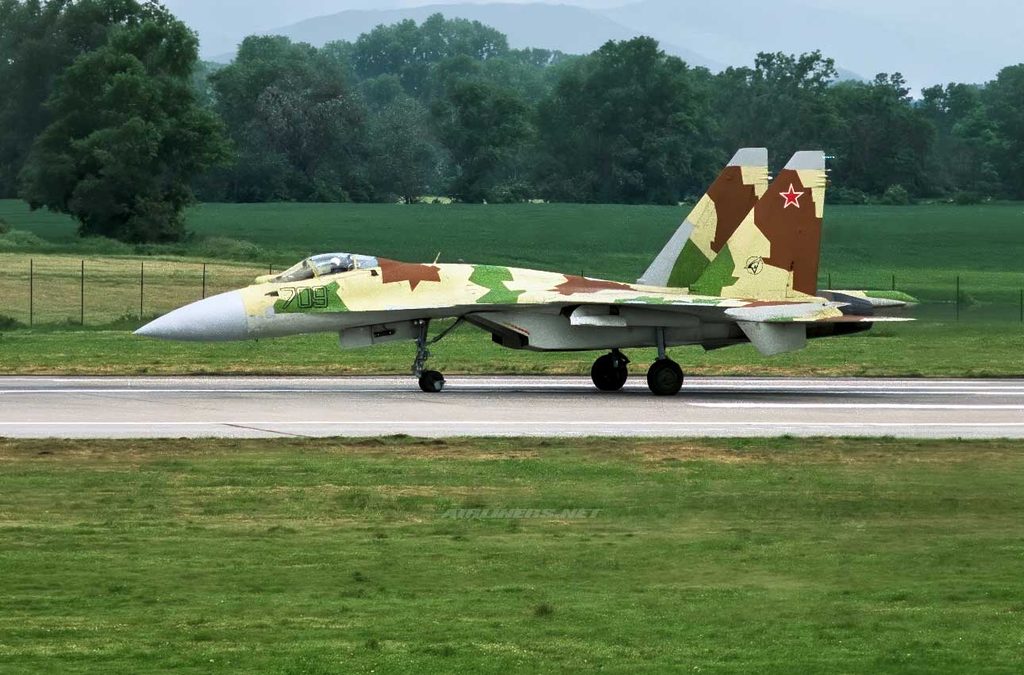
Developed by Sukhoi, the Su-35 is a Generation 4++ multirole fighter derived from the Su-27 Flanker-C.
The aircraft measures 21.9 meters in length (71.9 ft) and has a wingspan of 14.7 meters (48.2 ft).
Its maximum takeoff weight reaches 34,500 kg (76,059 lb).
It features two Saturn AL-41F1S turbofans, also designated 117S, each developing approximately 142 kN of thrust with afterburner (31,900 lbf).
Its thrust-vectoring nozzles allow it to modify the direction of thrust to improve maneuverability, particularly at low speed and high angle of attack.
The Su-35 can reach Mach 2.25 at high altitude and has an operational ceiling of 18,000 meters (59,055 ft).
Its announced ferry range reaches 3,600 km (2,237 mi) at cruising altitude without refueling. This distance does not correspond to its combat radius, which is necessarily smaller.
The Irbis-E radar enables long-range engagements
One of the Su-35’s primary capabilities relies on its N035 Irbis-E passive electronically scanned array (PESA) radar.
Unlike an AESA radar, it uses a primary emission source and electronically steers the beam via its antenna.
United Aircraft Corporation announces a maximum detection range of 350 km (217 mi), as well as the simultaneous tracking of 30 aerial targets and the engagement of eight of them.
These performances correspond to favorable conditions. The actual distance depends on the size, radar cross-section, altitude, and electronic environment of the target.
The Su-35 also features an infrared search and track system, usable without radar emission.
Armament enables air-to-air and air-to-ground missions
The aircraft features 12 hardpoints capable of carrying up to 8,000 kg of armament (17,637 lb).
It can use various families of air-to-air missiles, notably the R-73 and R-77, as well as Kh-29 and Kh-31 air-to-ground missiles and guided bombs.
Its internal 30 mm GSh-30-1 cannon completes this armament.
However, the exact configuration of the Ethiopian aircraft, notably the delivered missiles and electronic warfare equipment, has not been made public.
The new fleet reinforces Ethiopian air superiority
The Ethiopian Air Force has extensive experience with Soviet-designed fighters.
It notably operates Sukhoi Su-27 Flanker aircraft acquired starting in the late 1990s.
In January 2024, Addis Ababa also presented two Sukhoi Su-30 Flanker-Cs, sourced from airframes originally manufactured for India and subsequently refurbished.
Public inventories of this fleet remain uncertain, but several estimates point to around a dozen Su-27s still available.
The Su-35 significantly improves detection, long-range combat, and precision strike capabilities.
The familiarity of technicians and pilots with the Flanker family could facilitate the transition, without eliminating the need for specific training.
Confrontation with Eritrea increases the importance of these acquisitions
The regional context is particularly tense.
On October 9, 2026, Ethiopia accused Eritrea of having crossed into its territory. Asmara rejected these accusations and denounced Ethiopian ambitions for access to the Red Sea.
The two countries severed diplomatic relations at the beginning of October.
The Su-35 would offer Addis Ababa a significant technological advantage over the Eritrean Air Force, which consists primarily of older aircraft, notably MiG-29s.
The range of its sensors and its payload capacity would also reinforce its ability to protect strategic infrastructure and air bases.
However, the acquisition does not give Ethiopia superiority over all regional powers.
Egypt, with which divergences persist regarding the Grand Ethiopian Renaissance Dam, possesses a much larger air force, equipped notably with F-16s and Rafales.
The four S-400 batteries could transform the country’s air defense
The other component of the contract concerns four S-400 Triumf batteries, Russia’s long-range anti-aircraft system.
The S-400 combines detection radars, fire control systems, command centers, and mobile launchers.
Depending on the missiles used, it can engage aerial targets at varying distances. The 48N6 missile notably has an announced range reaching up to 250 km (155 mi). Newer versions offer superior performance.
However, the effectiveness of the system depends on target altitude, terrain, jamming, and the quality of the radar network.
The combination of the Su-35 and S-400 would make it possible to develop an integrated air defense system, combining fighter interceptions and ground-based engagements.
It would complement the Pantsir-S1 systems already present in the Ethiopian arsenal.
No official delivery date for the four batteries has been announced.
Russia consolidates its military influence in the Horn of Africa
For Moscow, this contract goes beyond the sale of twelve aircraft.
It allows Rosoboronexport to strengthen its presence on the African market and maintain a strategic relationship with Addis Ababa.
According to the Stockholm International Peace Research Institute (SIPRI), Russian exports of major arms decreased by 64% between the 2016–2020 and 2021–2025 periods.
Russia’s share of the global market dropped from 21% to 6.8%.
This contraction stems notably from the war in Ukraine, economic sanctions, and international competition.
The Ethiopian order allows Moscow to demonstrate that it remains capable of supplying complex military systems for export.
It also creates a lasting industrial relationship.
A Su-35 requires engines, spare parts, software, armaments, and specialized maintenance for several decades.
Russia could therefore benefit from additional revenues related to technical support and aircraft modernization.
However, the contract price remains unknown. It would be impossible to seriously calculate its economic benefit without knowing financial conditions and service details.
Sanctions and Russian military needs could complicate deliveries
The war in Ukraine mobilizes a significant share of Russian aeronautical production.
The Su-35 is notably assembled at the Komsomolsk-on-Amur plant, which must simultaneously meet domestic and foreign orders.
Western sanctions complicate access to certain electronic components, manufacturing equipment, and financial channels.
They do not make exports impossible, but can extend lead times and increase costs.
Ethiopia will also need to train its crews, build up parts inventories, and develop infrastructure capable of maintaining this new generation of aircraft.
The acquisition of S-400s adds another layer of complexity: the need for compatible radars, reserve missiles, and specialized crews.
Furthermore, transactions with the Russian defense industry can expose buyers to the risk of US sanctions, depending on the companies involved and contractual terms.
The Su-35 gives Ethiopia a new instrument of deterrence
The delivery of the first Su-35s constitutes an important step forward for Addis Ababa.
In the long run, a fleet of twelve modern aircraft could alter the balance of power in the air against certain neighbors and strengthen Ethiopia’s ability to defend its territory.
However, twelve aircraft do not mean twelve fighters available simultaneously. Inspections, maintenance, training, and operational reserves will necessarily reduce this number.
Nor can the Su-35s resolve the land conflicts weakening the country, particularly in Tigray and Amhara.
For Moscow, the agreement represents a commercial and diplomatic success, but also a long-term industrial commitment.
Russia will need to demonstrate that it can deliver the remaining ten aircraft, provide the S-400 systems, and guarantee their maintenance despite the constraints of its wartime economy.
The true measure of this acquisition will be the operational availability of the Ethiopian fleet in the coming years.
It is this, rather than the presentation of two fighters in Moscow, that will determine whether this purchase durably transforms Ethiopia’s air power.