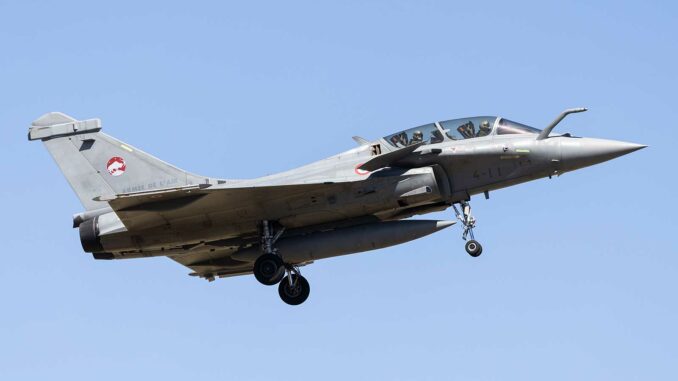
With 220 Rafale aircraft on its order book, Dassault is ramping up production. We break down exports, the F4.1 standard, and the impact on the French military.
In summary
Production of the Rafale is entering a new phase of acceleration. Dassault Aviation must now fulfill an order book of 220 aircraft, the vast majority of which are destined for export. This momentum is driven by several major contracts signed in recent years, notably with the United Arab Emirates, Indonesia, Serbia, and Egypt. The year 2026 marks a turning point with the first deliveries to Indonesia and the ramp-up of the Rafale F4.1 standard, designed for collaborative combat.
This ramp-up, however, raises a strategic question: how can exports be reconciled with the needs of the Air and Space Force? France has already had to sell used Rafales to Greece and Croatia, which has temporarily reduced its operational fleet.
The situation illustrates a classic paradox of the defense industry: commercial success strengthens the industrial base but can create tensions regarding national availability. The challenge for Paris is now clear: to produce faster without weakening its own military posture.
The Record Order Book That Is Changing the Scale of Production
Dassault Aviation currently has an order book of 220 Rafale aircraft, of which approximately 175 are for export and 45 for France.
This level is historic for the Rafale program. It confirms its transformation from a national program into an international commercial success.
Annual production has gradually increased. Dassault delivered 26 Rafales in 2025 compared to 21 in 2024. The industrial goal is now to move toward a production rate of nearly three aircraft per month, with a gradual increase in the coming years.
This ramp-up involves the entire industrial supply chain.
The Rafale involves approximately 500 companies, including Safran for the M88 engines, Thales for the electronics, and MBDA for the weapons.
The Structuring Effect of Exports
Export orders now account for the bulk of the industrial workload.
Without them, the production line would have slowed down after the initial French orders were completed.
Exports enable:
- the maintenance of industrial expertise
- the reduction of unit costs
- the financing of technological advancements
- the support of France’s strategic autonomy
The Rafale thus follows the classic logic of modern defense programs: exports become essential to economic balance.
Major customers and order volumes
The Rafale’s success is based on several major contracts signed since 2015.
The major contract with the United Arab Emirates
The largest contract remains the one signed with the United Arab Emirates for 80 Rafale F4 aircraft, valued at an estimated 14 billion euros.
This is the largest export contract in the history of the Rafale.
This contract includes:
- the aircraft
- the weapons
- training
- logistical support
This type of comprehensive contract explains the high costs.
The Indonesian program is gradually ramping up
Indonesia has ordered 42 Rafale aircraft, for an estimated amount of between $8 billion and $11 billion depending on the scope of the contract.
Deliveries began in early 2026 with an initial batch of three aircraft.
Each aircraft is estimated to cost around $115 million based on available data.
This contract aims to replace a mixed fleet consisting of F-16s and Sukhois.
It illustrates Indonesia’s strategy of diversifying its suppliers.
Other key contracts
Several other countries have contributed to the current order book:
Egypt: 54 Rafales ordered
Qatar: 36 Rafales
Greece: 24 Rafales
Croatia: 12 Rafales
Serbia: 12 Rafales
These contracts demonstrate strong momentum in Europe and the Middle East.
They also reflect a geopolitical shift: several countries wish to reduce their dependence on Russian equipment.
Industrial Expansion at Dassault
To meet demand, Dassault must transform its industrial organization.
Production does not depend solely on final assembly in Mérignac. It depends primarily on supplier capacity.
Supply chain difficulties since the health crisis have slowed down certain aerospace production lines.
Dassault is therefore working on several fronts:
- securing suppliers
- increasing production rates
- industrial digitalization
- investments in production capacity
The goal is clear: to avoid bottlenecks.
Expanding Industrial Capabilities
Investments have been made to increase production capacity.
The manufacturing of certain structures is gradually being internationalized, particularly in India for certain fuselage parts.
This strategy aims to secure production in the long term.
It also reflects the transformation of the Rafale into a global program.
The strategic role of the Rafale F4.1 standard
The Rafale F4.1 standard represents a major evolution.
It introduces collaborative combat capabilities.
The principle is simple: connecting aircraft to each other and to other systems.
This evolution includes:
- improved data links
- advanced sensor fusion
- connectivity with drones
- predictive maintenance
Collaborative combat as the new standard
The Rafale F4.1 is designed to operate in a network-centric environment.
This means the aircraft becomes a node in a global system.
Information can be shared between:
- Rafale
- AWACS
- satellites
- drones
- command centers
This evolution brings the Rafale closer to sixth-generation combat doctrines.
The Impact on Export Competitiveness
These technological advancements enhance the Rafale’s appeal.
Customers are no longer looking for just an aircraft.
They are looking for a complete combat system.
The F4.1 meets this demand.
It allows the Rafale to remain competitive against the F-35 in certain markets, particularly those that prioritize technological sovereignty.
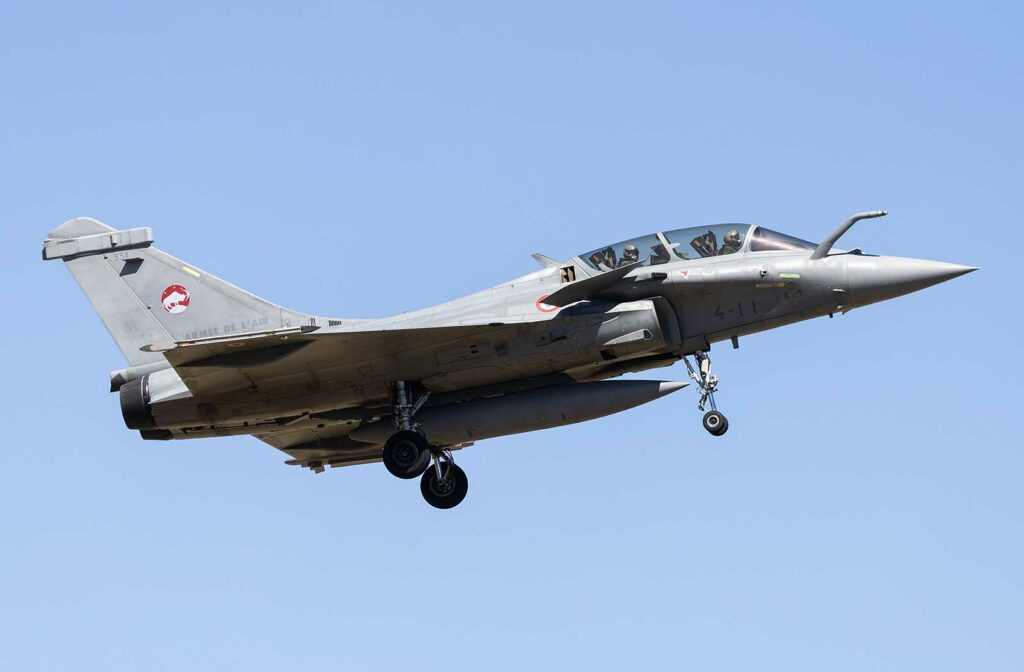
The impact on the French Air Force’s availability
Export success has a direct effect on the French fleet.
France has already transferred used Rafales to Greece and Croatia.
These transfers have temporarily reduced the available fleet.
Today, France operates approximately 165 Rafales, divided between the Air Force and the Navy.
The long-term goal is to reach approximately 225 operational aircraft.
Temporary strain on capabilities
Used sales have created a temporary shortfall.
To address this, France has placed new orders.
This reflects a strategic trade-off:
Accepting a temporary decline to support exports and strengthen the industry.
This logic is based on a conviction: a strong industry guarantees long-term strategic autonomy.
The balance between exports and sovereignty
The central issue remains balance.
Exporting too much can weaken national forces in the short term.
Exporting too little weakens the industrial base.
France is therefore seeking a dynamic balance.
This model is based on:
- regular domestic orders
- long-term planning
- close coordination between the government and industry
The Rafale’s Overall Strategic Impact
The Rafale’s success goes beyond the purely industrial dimension.
It strengthens France’s strategic influence.
Each Rafale contract creates a lasting military relationship:
pilot training
maintenance
joint exercises
interoperability
This creates partnerships spanning several decades.
Industrial Diplomacy
The Rafale is also a diplomatic tool.
Each sale strengthens political and military ties.
This gives France leverage.
This phenomenon is comparable to that of the American F-35.
A Confirmation of the French Model
The Rafale’s success confirms the viability of an independent model.
France remains one of the few countries capable of designing a complete fighter aircraft.
This success validates the investments made since the 1980s.
It also shows that a well-modernized multi-role aircraft can remain competitive against newer programs.
Production Under Pressure but a Consolidated Program
The Rafale is entering a decisive phase.
Demand is strong. Industrial capacity must keep pace.
The question is no longer whether the Rafale sells.
The question is now whether production can keep up with demand.
The success of this ramp-up will determine France’s industrial credibility for future programs, notably the F5 standard and associated technologies.
The real challenge goes beyond mere production.
It concerns France’s ability to remain a comprehensive aerospace power amid intense industrial competition.
Current trends show that the Rafale is no longer just an aircraft.
It has become a pillar of French industrial and military strategy.
Sources
Dassault Aviation – 2025 annual results and order backlog
Reuters – 2026 Rafale deliveries to Indonesia
Air Force Technology – Rafale production
Aerospace Global News – Rafale backlog
Jane’s Defence Weekly – Rafale export market
Ministry of the Armed Forces – Rafale production schedule for France
IISS Military Balance 2025
War Wings Daily is an independant magazine.