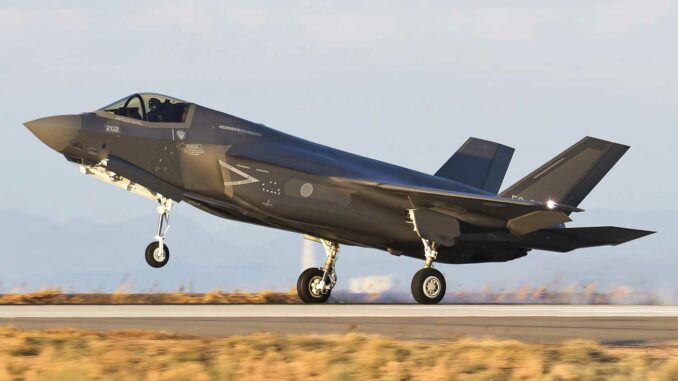
The deployment of F-22 Raptors and F-35 Lightning IIs to the Middle East reflects rising tensions and highlights their key role in modern air superiority.
In summary
The deployment of 11 F-22 Raptors to the Israeli base at Ovda, accompanied by approximately 30 F-35 Lightning IIs stationed in the region, constitutes a clear military signal from the United States amid tensions with Iran. This forward air presence serves several objectives. It establishes immediate air superiority, strengthens strategic deterrence, and prepares for potential operations against air defense systems or military infrastructure.
The F-22 is a fighter designed to dominate the airspace. The F-35 is a multi-role aircraft intended to penetrate defenses and strike strategic targets. Together, they form a complementary system. The former secures the skies. The latter carries out offensive missions.
This deployment also illustrates the evolution of modern air doctrines. Fifth-generation aircraft are no longer just fighters. They are becoming flying command platforms capable of coordinating the entire aerial battlefield.
The U.S. deployment as a regional strategic signal
The arrival of 11 F-22 Raptors at Ovda Air Base, located in the Negev Desert, is a rare event. This is the first time U.S. fighter jets have been stationed in Israel for a potentially operational role.
This base offers several operational advantages:
- more than 100 hardened aircraft shelters
- significant logistical infrastructure
- location approximately 60 km from the Gulf of Aqaba
- direct access to regional areas of operations
The objective is clear: to reduce response times in the event of a crisis. An aircraft based closer to the theater of operations can intervene within a matter of minutes rather than hours.
This positioning also helps avoid certain diplomatic constraints. Several Gulf states have refused to allow the use of their airspace for offensive operations against Iran.
Deploying fighters in Israel therefore offers a simpler logistical solution.
This deployment is part of a broader military buildup:
- U.S. carrier strike groups in the region
- deployed refueling aircraft
- additional fighters in Europe
- increased ISR (Intelligence, Surveillance, and Reconnaissance) capabilities
This approach aligns with a classic U.S. doctrine: demonstrate strength to avoid having to use it.
The visible presence of fifth-generation aircraft constitutes a direct military deterrent.
The Role of the F-22 Raptor in Air Superiority
The F-22 Raptor remains today the most advanced air superiority fighter in operational service.
Its main characteristics:
- maximum speed: Mach 2.25 (approximately 2,410 km/h)
- supercruise: approximately Mach 1.8 without afterburner
- service ceiling: 20,000 meters
- range: approximately 850 km on combat missions
- extremely low radar signature
Its primary mission is simple: to destroy enemy aircraft before they pose a threat.
The F-22 possesses several major technical advantages:
Advanced radar stealth
Its design significantly reduces its radar signature. Its radar cross-section is estimated to be that of a metal marble.
This allows it to approach an adversary without being detected.
Sensor fusion
The cockpit displays a synthetic view of the battlefield. The pilot does not receive raw data. Instead, they receive a consolidated tactical image.
This reduces cognitive load.
Networked warfare
The F-22 also acts as a flying sensor. It detects threats and transmits information to other aircraft.
It becomes a force multiplier.
The Theater Opening Mission
In a modern air campaign, the F-22 is the first to engage. Its mission:
- destroy enemy fighters
- neutralize radars
- disrupt air defenses
This then allows attack aircraft to engage with less risk.
This is exactly the role it could play in a scenario involving Iran.
The role of the F-35 Lightning II in multi-role operations
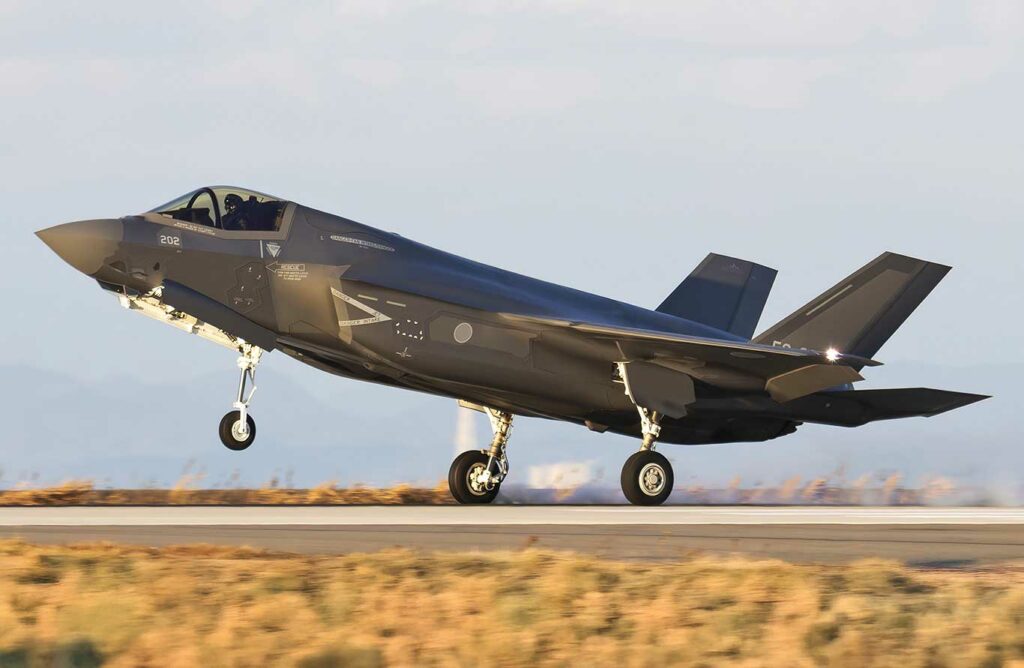
The F-35 Lightning II has a different philosophy. It is not a pure fighter. It is a multi-role aircraft designed for versatility.
Its specifications:
- maximum speed: Mach 1.6
- combat range: approximately 1,100 km
- payload capacity: 8,100 kg
- advanced electro-optical sensors
- AN/APG-81 AESA radar
The F-35 can perform several missions:
- precision strikes
- air defense suppression
- reconnaissance
- electronic warfare
- tactical command
Its true advantage lies elsewhere.
The F-35 is an airborne information hub.
The cockpit as a command center
The pilot views data from:
- radar
- infrared sensors
- satellites
- other aircraft
- drones
The aircraft fuses this data.
The pilot gains an immediate understanding of the situation.
The role of combat coordinator
The F-35 can guide:
- missiles fired by other aircraft
- combat drones
- coordinated strikes
It becomes a conductor.
Actual operational capabilities
Israeli F-35s have already been used in several operations:
- strikes in Syria
- missions against targets in Yemen
- operations against Iran
- long-range aerial interception
In March 2026, an Israeli F-35 reportedly achieved the first confirmed air-to-air kill for this model against an Iranian aircraft.
This demonstrates that the aircraft is no longer just a technological program. It is now a mature operational tool.
The tactical complementarity between the F-22 and the F-35
The key point of this deployment is not the presence of a single type of aircraft.
It is their combination.
The F-22 and the F-35 do not perform the same functions. They are designed to operate together.
In summary:
F-22:
- air superiority
- neutralization of enemy fighters
- securing airspace
F-35:
- precision strikes
- intelligence
- coordination
This combination corresponds to a doctrine known as collaborative air combat.
In a typical scenario:
Initial phase:
The F-22s enter first. They neutralize aerial threats.
Next phase:
The F-35s enter the area. They strike the targets.
Advanced phase:
The F-35s coordinate subsequent operations.
This approach reduces losses.
It also maximizes the effectiveness of strikes.
The Operational Approach to Iranian Defenses
Iran possesses a complex air defense system:
- Russian S-300 systems
- Domestic Bavar-373 systems
- long-range radars
- surface-to-air missiles
Facing these systems, the use of conventional aircraft would be risky.
Stealth aircraft are a game-changer.
Their reduced radar signature allows for:
- stealthy penetration
- surprise strikes
- targeted destruction
F-22s could neutralize Iranian interceptors.
The F-35s could then destroy:
- command centers
- radars
- missile sites
- military infrastructure
This approach aligns with a classic U.S. doctrine: Suppression of Enemy Air Defenses.
The Political Dimension of the Deployment
This military move should not be analyzed solely from a technical perspective.
It has a strong political dimension.
It sends three messages.
A message to Iran
The United States is demonstrating its rapid deployment capability.
It is showing that it can concentrate advanced assets within a few days.
A message to allies
Regional partners see that Washington remains committed.
This reinforces U.S. credibility.
A message to strategic adversaries
Russia and China are observing these deployments.
They are analyzing:
- deployment timelines
- coordination
- doctrines
Every actual deployment becomes an operational laboratory.
The Evolving Role of Fifth-Generation Fighters
The F-22 and F-35 illustrate a profound evolution.
Fighters are no longer just combat machines.
They are becoming:
- intelligence platforms
- command centers
- communication relays
- electronic warfare tools
Speed is no longer the primary value.
It is information.
An aircraft capable of seeing before others wins the battle.
Future doctrines are based on:
- platform interconnectivity
- real-time data sharing
- drone-aircraft coordination
The F-35s are at the heart of this evolution.
The Limits of This Type of Deployment
These aircraft also have limitations.
Operating costs are high:
- F-22: approximately $70,000 per flight hour
- F-35: approximately $33,000 per hour
Their maintenance is extensive.
Their availability depends on significant logistics.
These aircraft require:
- specialized technical teams
- secure infrastructure
- sensitive supply chains
This explains why these deployments remain rare.
They are reserved for major strategic situations.
Medium-term military implications
This deployment shows a clear trend.
Future conflicts will rely on:
- information superiority
- multi-domain coordination
- rapid strike
Stealth fighters will remain essential.
But their role is evolving.
They are becoming the brains of aerial combat.
Their presence in the Middle East also demonstrates one thing.
The United States wants to maintain its technological edge.
And it wants to demonstrate it.
A Presence That Redefines Regional Balances
The simultaneous deployment of F-22s and F-35s shifts the regional military balance without a single shot being fired.
This is the modern logic of air power.
Strike capability matters. But the ability to be ready matters more.
The presence of these aircraft means that a military option exists. Even if it is not used.
This is the principle of modern deterrence.
In this context, these aircraft are not merely weapons.
They are political instruments.
And their deployment underscores a constant reality of military strategy:
Technology changes.
But the logic remains the same.
Demonstrating strength to avoid having to use it.
War Wings Daily is an independant magazine.