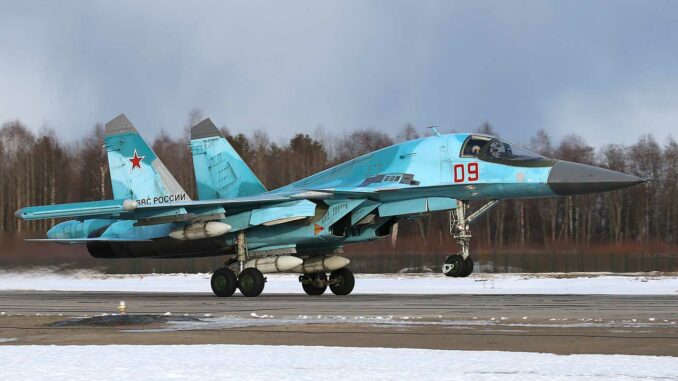
An armored cockpit, access via the nose gear, unusual comfort, and massive range: ten surprising facts to help you understand the Sukhoi Su-34 beyond the cliché of a “flying tank.”
In summary
The Sukhoi Su-34 is a fighter jet like no other. Seen from a distance, it resembles a beefed-up version of the Su-27. Up close, it almost seems like an anomaly in the world of modern fighters. Its side-by-side cockpit, its armored titanium capsule, its access via a hatch under the nose, its unusual interior space, and its survivability philosophy make it a unique aircraft, designed less for pure aerodynamic elegance than for endurance, ruggedness, and real warfare. Some stories about it are accurate. Others have been exaggerated over time, particularly regarding the rear-facing radar or onboard comfort. That is precisely what makes the aircraft interesting: it blends very practical, almost rustic solutions with ambitious design choices for a tactical bomber. Behind its nickname, the flying tank, the Su-34 above all embodies a Russian concept of air strikes: go far, strike hard, survive for a long time, and spare the crew, who are called upon to spend hours in an armored airframe.
The cockpit that breaks with the conventions of modern fighters
The first oddity of the Su-34 is immediately apparent: its two crew members sit side by side rather than in tandem. In the world of fighter-bombers, this choice is rare. It aligns more with the logic of tactical bombers than with that of fighters designed for air superiority. Sukhoi chose this configuration to facilitate visual coordination, reduce instrument redundancy, and improve crew collaboration during complex navigation and bombing missions. This is not an ergonomic whim. It is a mission-driven decision. The Su-34 is designed for long-range strikes, sometimes at low altitude, involving a great deal of information to process. In this context, two men sitting side by side can work more naturally than two men stacked one on top of the other.
This configuration also explains its distinctive silhouette. The nose was widened, reshaped, and lengthened to accommodate this larger cockpit. The Su-34 is therefore not simply a reinforced two-seat Su-27. Its forward fuselage is profoundly different. This additional volume also contributes to one of its other unusual features: it offers a significantly more livable interior space than that of most fighter aircraft. This point has fueled many stories, sometimes a bit romanticized, but the gist is true: the Su-34 was designed so that its crew isn’t simply strapped into a cramped cockpit for two hours, but can endure very long missions with a minimum of mobility.
The bottom entry that gives the Su-34 the look of a bomber
The second striking detail is how one enters the aircraft. On a Su-34, you don’t climb up a side ladder next to the cockpit. Pilots board through a hatch located behind the nose gear, using a built-in ladder. The canopy is not the main access point. Once again, this choice reinforces the aircraft’s uniqueness. It better protects the integrity of the armored cockpit and aligns with a cockpit designed as a capsule. This solution is uncommon on an aircraft of this category. It contributes to the image of an aircraft that, in spirit, is closer to an armored combat post than to a conventional fighter.
This access method is not only unusual; it also makes practical sense. In a massive aircraft, sometimes operating from rudimentary bases or in harsh weather conditions, having a self-contained access path integrated into the airframe offers clear advantages. It avoids the need to rely on external equipment. The Su-34 was never intended to be a showpiece at an airshow. It was designed to withstand high-intensity warfare, with all that this implies in terms of rugged simplicity.
The titanium capsule that justifies the nickname “flying tank”
The heart of the Su-34 legend is its armor. And on this point, the legend is firmly grounded in reality. The forward cockpit forms a titanium-armored capsule approximately 17 millimeters thick, with an armor mass of about 1,480 kilograms. That’s enormous for a fighter jet. This protection is designed to improve the crew’s survivability against small-arms fire and certain shrapnel, particularly during low-altitude penetrations or attacks in heavily defended environments. It’s not invulnerable armor, of course. But it’s an unusual level of protection for a supersonic tactical aircraft.
It is precisely this armor that has earned it the nickname flying tank. The term is apt, but it can also be misleading. The Su-34 is not a Russian A-10. It is not a close-air-support aircraft designed to circle slowly over the battlefield. It is a fast tactical bomber, capable of carrying up to 12,000 kilograms of ordnance on 12 hardpoints, with a maximum speed of around 1,900 kilometers per hour. Its armor should therefore be understood as an added measure of survivability in a rapid-strike platform, not as an invitation to take every hit.
Onboard Comfort That Fuels Legends
The Su-34 is also famous for its comfort features. This is where we need to be precise, as many articles have exaggerated the story. Yes, the aircraft has a rudimentary sanitation system and a basic system for heating food.
No, these are not actual toilets or a kitchen in the conventional sense. The most reliable sources describe instead a very basic system, suited for long missions, as well as a heating unit for rations or canned food. The general idea is true: the Su-34 treats its crews a little better than average. But the “flying mini-apartment” version is an exaggeration.
This relative comfort is consistent with the mission profile. The Su-34 can exceed a 4,000-kilometer range without refueling, and much further with in-flight refueling. For extended missions, keeping the crew functional is not a luxury. It is an operational requirement. Some accounts even mention the possibility for a pilot to stand up, stretch, or even lie down in the aisle between the seats. Here again, the gist seems accurate: the space behind and between the seats is indeed more spacious than in an ordinary fighter, even if the most dramatic descriptions should be taken with a grain of salt.
Seats and endurance reflecting an obsession with long missions
The two crew members sit in NPP Zvezda K-36DM ejection seats, a renowned standard in Russian military aviation. Some sources indicate that these seats incorporate a rudimentary massage or stimulation system designed to reduce fatigue during long missions. Caution is warranted here: this information has long circulated in secondary sources, but it is less solidly documented than the rest of the Su-34’s specifications. What can be stated with certainty is that every aspect of the cockpit’s design is geared toward endurance: spaciousness, protection, minimal comfort, unconventional access, and an overall philosophy of extended missions.
This focus on endurance is reinforced by in-flight refueling and a very large internal fuel capacity. The Su-34 was designed to gradually replace the Su-24, but with a longer range, greater payload, and a higher level of survivability for the crew. It is no coincidence that its development took so long. The first prototype flew on April 13, 1990, and it did not enter service until 2014. In between, the collapse of the USSR, budget cuts, and industrial delays stretched the program out over more than two decades. The fact that this first flight took place on a Friday the 13th adds an unusual touch, but the real story is less about superstition and more about politics and finances.
The landing gear that reveals an obsession with ruggedness
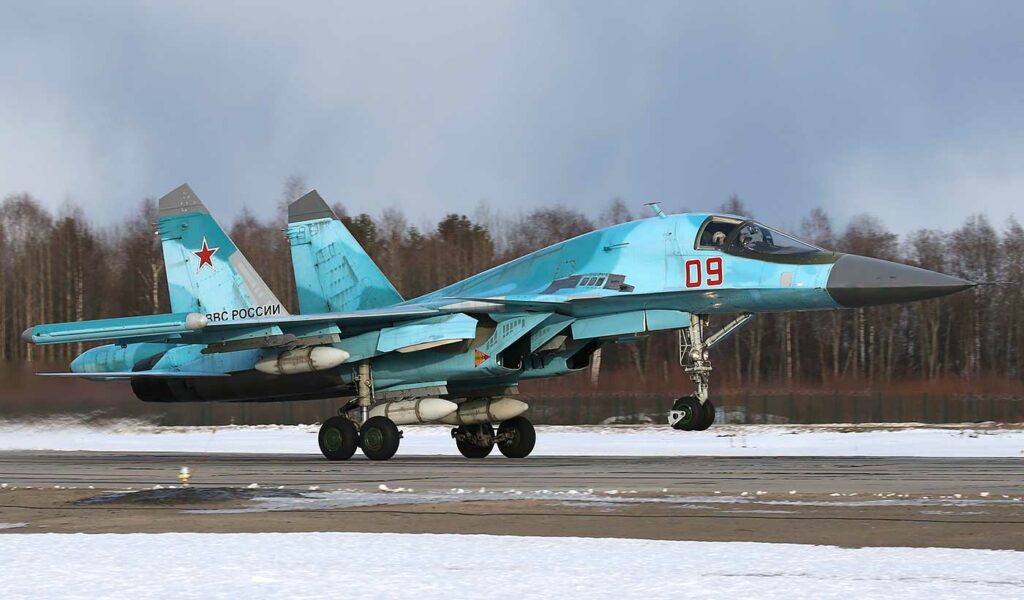
Another highly visible feature: the Su-34’s main landing gear uses tandem twin wheels. This design allows for better distribution of ground load and facilitates operation from less prepared or poor-quality runways. For a frontline bomber, this capability has real military value. An aircraft incapable of operating anywhere other than from pristine bases loses flexibility. The Su-34, however, was designed to maintain a certain ruggedness despite its significant weight. This solution isn’t glamorous. It’s pragmatic.
This same logic partly explains its massive appearance. With its armored cockpit, reinforced airframe, abundant internal fuel, and sturdy landing gear, the Su-34 pays a price in terms of elegance and weight. But this compromise makes sense for an aircraft intended to penetrate, strike, and return with a good range. Sukhoi’s engineers prioritized function over sleek lines. This is likely what makes the aircraft so recognizable.
The rear-facing radar: as much a part of the program as it is a myth
One of the most frequently cited points regarding the Su-34 is the existence of a rear-facing radar in the tail cone. Here, we must be clear: this subject is more ambiguous than many texts suggest. Early sources and descriptions of prototypes do indeed mention a rearward-facing early warning or defense radar in the “stinger.” Other sources indicate that the elongated cone primarily houses an APU—that is, an auxiliary power unit—and that the planned rearward-facing radar was not implemented across the entire production fleet, or evolved according to standards. The most accurate statement is therefore as follows: the Su-34 was associated with a rear detection concept, but presenting this radar as a simple, systematic, and fully confirmed feature across the entire fleet would be an overstatement.
This point is useful because it shows how aviation legends are born. A prototype detail, a subsystem design, or a planned capability sometimes ends up becoming, in general-interest articles, a truth set in stone. The Su-34 lends itself particularly well to this phenomenon because its airframe is already out of the ordinary. It attracts astonishing stories. Some are well-founded. Others call for a bit more restraint.
The Fuel Tanks and Range That Give the Fullback Its True Depth
Finally, the Su-34 impresses with its range. Available sources attribute a range of approximately 4,000 kilometers to it without refueling in certain transport configurations, and even more with in-flight refueling. This performance is based on an airframe optimized for internal fuel capacity, far superior to that of the early Flankers. Some descriptions even mention the integration of fuel tanks into the vertical stabilizers. This detail is often repeated, but it is less clearly documented in the most reliable open-source materials than the overall range itself. It is therefore more prudent to retain the general idea: the Su-34 was designed to maximize its internal range without systematically relying on external fuel tanks. It is this philosophy, rather than the exact details of each internal volume, that explains its operational depth.
Ultimately, the Sukhoi Su-34 is not just unusual because it has a hatch under the nose, an armored cockpit, or unusual comfort. It is unusual because it reveals a different way of designing a strike aircraft. Where many modern fighter-bombers remain compromises between speed, sensors, and versatility, the Su-34 embraces a heavier, more protective, and more rugged philosophy.
It does not seek to be the stealthiest, the most elegant, or the most conceptually pure. It seeks to last a long time, carry heavy loads, protect its crew, and survive in thankless missions. It is this honesty of design that makes it so unique. And it is also what explains why, more than thirty years after its first flight, it continues to fascinate as much as it divides opinion.
War Wings Daily is an independant magazine.