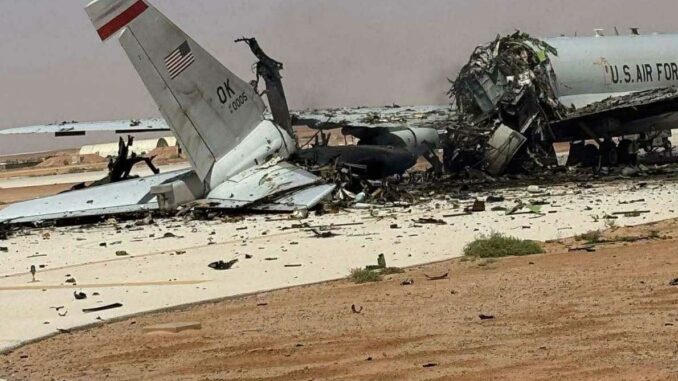
A U.S. E-3 AWACS is reported to have been destroyed following an Iranian strike in Saudi Arabia. If the footage is confirmed, the military implications go far beyond the loss of a single aircraft.
In Summary
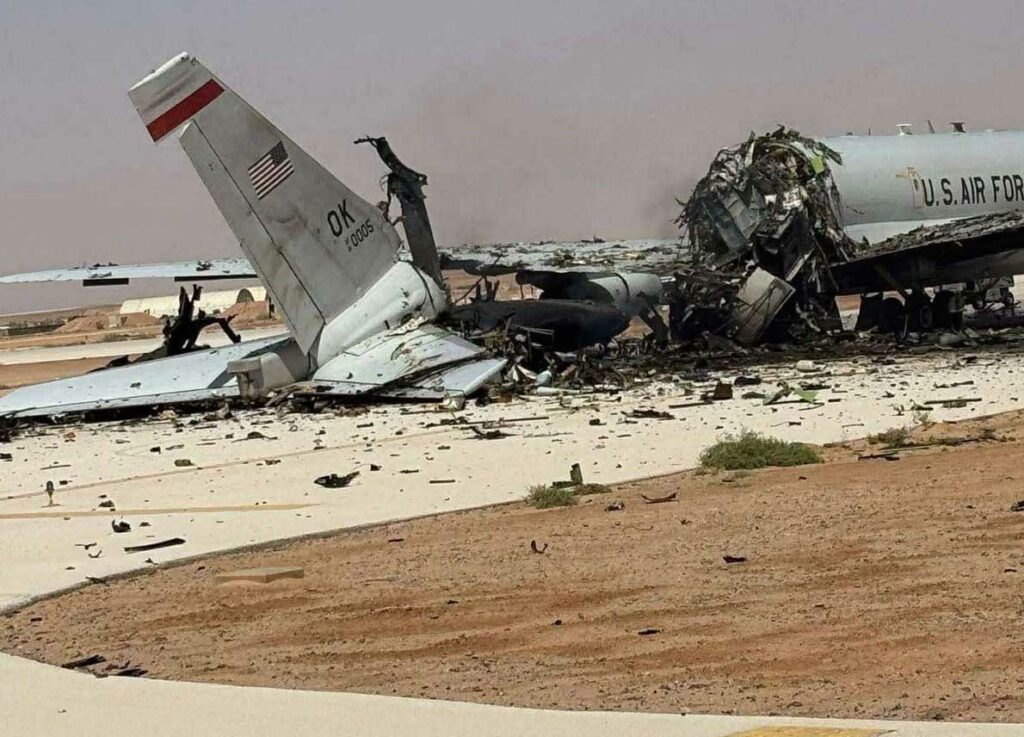
The established facts are already serious. On March 27, 2026, an Iranian missile and drone strike against Prince Sultan Air Base in Saudi Arabia injured at least 10 to 12 U.S. service members, including two seriously, and damaged several U.S. aircraft, notably refueling planes. This has been confirmed by Reuters and the Associated Press. What remains less clear, but increasingly plausible, concerns a U.S. E-3G Sentry AWACS. Images posted online and analyzed by several specialized media outlets appear to show an aircraft so heavily damaged that it may be beyond repair, or even virtually destroyed. U.S. authorities have not publicly confirmed the total destruction of the aircraft. But if this loss is confirmed, its impact will extend far beyond the symbolic. The AWACS is one of the few aircraft capable of providing a real-time picture of the sky, coordinating fighter jets, issuing missile alerts, and managing air combat. Losing one, when the U.S. fleet has only about 16 left, would be a tactical, operational, and industrial blow.
The strike that is confirmed and the destruction that is not yet fully confirmed
First, we must distinguish between what is confirmed and what is not yet fully confirmed. The Iranian strike against Prince Sultan Air Base is established. Reuters reported that 12 U.S. soldiers were wounded, including two seriously. The Associated Press, for its part, reported that at least 10 military personnel were hit and that several U.S. aircraft, notably refueling planes, were damaged. The central fact is therefore clear: Iran succeeded in striking a key base used by U.S. forces in Saudi Arabia, despite the robustness of the regional air and missile defense system.
The most sensitive issue concerns the E-3G Sentry. U.S. authorities have not released an official report detailing the loss of an AWACS. However, Air and Space Forces Magazine claims that an E-3 was damaged during the attack and that an image examined by the editorial staff shows damage so extensive that the aircraft appears likely to be totally destroyed. The Aviationist goes further and estimates, based on images circulating online, that an E-3G identified as 81-0005 is “basically destroyed.” This has not been officially confirmed. But it is enough to treat the hypothesis as credible, rather than as a mere viral rumor.
This distinction is essential. To write that the E-3 has been “destroyed” as a definitive fact would be jumping the gun based on the publicly available evidence. To write that an E-3 has been hit, heavily damaged, and possibly lost based on the images and specialized sources is, at this point, more rigorous. In a conflict where satellite imagery, social media, and partial leaks often precede official statements, caution is not a stance. It is an obligation.
The aircraft that is far more than just a giant flying radar
To understand the implications, we must recall what an E-3 AWACS is. The U.S. Air Force describes it as a platform for surveillance, detection, target tracking, and battle management. In short, the aircraft does more than just see far. It coordinates air operations. It provides a real-time picture of the battlefield to the air operations center, identifies friendly, neutral, and hostile activities, and helps direct fighters, tankers, and other air assets.
Technically, the E-3 is a modified Boeing 707, topped by a radome 9.1 meters in diameter and 1.8 meters thick, positioned 3.33 meters above the fuselage. Its radar can monitor targets up to over 375.5 kilometers away. The Air Force also notes that the IFF system and radar are designed to look downward and track low-flying targets, where ground clutter often interferes with other sensors. The aircraft can operate for about 8 hours without refueling, longer with in-flight refueling, and features an onboard rest area. So it’s not just a sensor. It’s an airborne command post.
This is precisely why its potential loss is so significant. A downed tanker is serious. But there are more alternatives to compensate for a tanker than for an AWACS. The E-3 sees the battle as a whole. As Air and Space Forces Magazine summarized, citing former pilot Mark Gunzinger and other experts, the AWACS acts as the conductor of the air battle. Without it, the fighters remain armed and capable, but they lose some of their shared situational awareness and coordination.
The aging fleet that turns every loss into a strategic problem
The situation is exacerbated by the state of the fleet. The U.S. Air Force now has only about 16 E-3s. Air and Space Forces Magazine notes that the fleet has dwindled to this level following several retirements and that, in fiscal year 2024, its availability rate was approximately 56 percent. In other words, even before the Iranian strike, only a portion of these aircraft were capable of flying and carrying out their missions at any given time.
The problem is therefore not merely quantitative. It is also qualitative. The War Zone noted as recently as February that the U.S. Air Force had deployed six of its 16 E-3s to Europe and the Middle East at the start of the crisis with Iran, highlighting both their importance and the extreme strain on an aging fleet. A single aircraft lost or grounded for an extended period can create a disproportionate gap in the system, especially if several other aircraft are undergoing heavy maintenance or are technically limited.
This is also what makes the Iranian attack smarter than it appears. Taking out an AWACS on the ground is not just about destroying a rare aircraft.
It degrades the adversary’s air command capability at a time when the adversary relies precisely on its advanced sensors to track missiles, drones, fighters, and interception corridors. Hitting an E-3 on the tarmac costs the attacker far less than attempting to shoot it down in flight. And the military impact can be significant.
Prince Sultan Air Base Appears Less Fortified Than Reported
The other major consequence concerns the vulnerability of the base itself. Prince Sultan Air Base is not a secondary facility. Reuters describes it as a key site for U.S. forces in Saudi Arabia, operating in coordination with the kingdom, particularly for air defense capabilities and support for U.S. air operations. Reuters had already shown in late February, through analysis of satellite imagery, a significant buildup at the base, with notably 13 KC-135s and 6 E-3 Sentry aircraft visible on site at one point.
This concentration of extremely valuable assets already raised a simple question: was the base sufficiently protected against a saturation strike combining missiles and drones? The March 27 attack provides at least a partial answer. Even if all the details are not public, Iran has clearly managed to get enough weapons through to injure personnel and hit several major aircraft. This implies either saturation, a local flaw in the detection-interception chain, or a combination of both. In any case, the message is bad news for U.S. and Saudi planners.
This vulnerability is not an isolated incident. The War Zone had already noted in early March that Iran appeared to be deliberately targeting radars and critical air defense nodes in the region. The attack on refueling aircraft and possibly an AWACS fits this pattern. The objective is not merely to kill or destroy. It is to reduce the U.S. ability to see, sustain operations, and project its airpower with fluidity.
Operational consequences that will extend far beyond the shocking image
If the E-3 is indeed lost, the first consequence will be a decrease in coverage. Air and Space Forces Magazine cites experts who estimate that there will be “coverage gaps.” This term is accurate. Fewer available AWACS means less continuous coverage over the area, less redundancy in the event of a failure, and greater fatigue for the remaining crews. In a war of missiles and drones, this matters enormously, because the value of an AWACS lies not only in its radar range. It also lies in its continuous presence and the quality of the shared imagery it provides to other platforms.
The second consequence affects offensive operations. An AWACS is not only useful for defending a base. It is also used to organize raids, deconflict air corridors, distribute tactical information to fighters, and optimize the use of tankers. If the same attack damaged an E-3 and several KC-135s, then it struck two of the logistical and informational pillars of U.S. air power in a single blow. This is no small matter. A stealth fighter or a bomber remains formidable. But without seamless refueling and a stable overview, the overall effectiveness of the system declines.
The third consequence is industrial and budgetary. The Wall Street Journal reports that the closest replacement, the E-7 Wedgetail, would cost over $700 million per aircraft.
Even without taking this figure as a definitive accounting truth for each aircraft, the order of magnitude already says it all: losing an E-3 today is not the same as losing an old 707 at the end of its service life. It is losing a rare capability, one that is expensive to replace and impossible to quickly regenerate.
The Wedgetail Debate Resurfaces with a Vengeance
This attack also reignites a debate the Pentagon has been dragging out for months: should we significantly accelerate the replacement of the E-3 with the E-7 Wedgetail, or continue to rely more heavily on distributed, space-based, and multi-platform architectures? Air and Space Forces Magazine notes that Pentagon leaders have expressed skepticism about acquiring the E-7, sometimes preferring to emphasize other battle management solutions. But an attack like the one on Prince Sultan highlights an embarrassing truth: distributed systems are promising, but manned AWACS remains a central component of actual air warfare.
The paradox is stark. The E-3 is old, costly to maintain, and technologically outdated in some respects. Yet it remains so indispensable that its potential loss immediately becomes a strategic issue. This is the very definition of a critical capability in transition: too old to be comfortable, too useful to disappear quickly, too rare to be lost without pain.
What emerges from this incident is therefore very clear. Even if Washington has not yet officially confirmed the total destruction of an E-3G Sentry, the mere fact that a U.S. AWACS could have been struck so heavily at a major Saudi base is already a severe warning. It says something about Iran, which seeks to attack the most valuable nodes of the enemy’s air power. It also says something about the United States, which remains formidable but is showing, in this war, very concrete points of vulnerability. And finally, it says something broader about modern conflicts: today, partially blinding an adversary can be almost as effective as destroying its fighter jets.
War Wings Daily is an independant magazine.