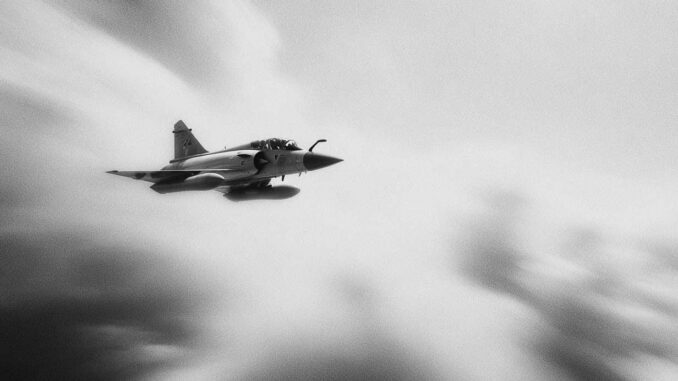
In Ukraine, the Mirage 2000-5s supplied by France are now engaged against Russian missiles and drones, supported by MICA and AASM Hammer missiles.
In summary
The Mirage 2000-5s delivered to Ukraine are no longer a political symbol. They have become a very real tool of war. By late March 2026, several indicators point in the same direction: Ukrainian authorities are now presenting these aircraft as direct reinforcements for the destruction of Russian cruise missiles and drones, while initial operational feedback confirms their active use in air defense and, now, in ground strikes with the AASM Hammer. The key point is this: the Mirage 2000-5 does not replace the F-16; it fills a need that Kyiv could not meet quickly enough with its aging MiG-29s, Su-27s, and Su-24s alone. France has delivered a proven fighter, modernized for high-intensity theater operations, capable of intercepting fast, low-flying threats and then switching to precision strikes. For Ukraine, it is a transitional capability. For Dassault, it is also a stark demonstration of the longevity of an airframe designed at the end of the Cold War.
The Mirage 2000-5 as a response to a very concrete emergency
The debate over Western aircraft in Ukraine has long been dominated by the F-16. This makes sense. The aircraft is more widespread, better documented, and easier to integrate into a broader NATO framework. But this perspective has obscured a simple fact: Ukraine did not just need a versatile Western fighter. It needed, quickly, an aircraft capable of carrying out very specific missions in a sky saturated with threats.
This is where the Mirage 2000-5 found its place. As early as March 2026, the Ukrainian Ministry of Defense explained that these aircraft directly bolstered the country’s ability to destroy cruise missiles and attack drones. This is no minor matter. Since 2024, Russian aerial warfare has relied largely on massive raids combining Shahed drones, decoys, cruise missiles, and sometimes ballistic missiles. On March 24, 2026, Ukraine even announced that it had faced 999 drones in a single day, in what it described as the largest air attack by volume since the start of the war.
In this context, any aircraft capable of handling part of the threat without consuming the scarcest resources becomes invaluable. An aircraft that can intercept a slow or low-flying target, patrol, redeploy quickly, and then strike the ground with guided munitions is not a luxury. It is an efficiency multiplier.
The Mirage 2000-5 as a cruise missile hunter
The most interesting point is that Ukraine no longer presents the Mirage as a mere prestige platform. It describes it as a tool for hunting cruise missiles. This approach has a clear operational basis.
The Mirage 2000-5 is a modernized interceptor. Its RDY radar, its avionics architecture—more recent than that of Ukraine’s Soviet-era MiG-29s—its data link, and its integration of French air-to-air missiles give it real effectiveness against difficult but non-supersonic, maneuvering targets, such as cruise missiles and certain attack drones.
The Ukrainian Ministry of Defense has also emphasized its ability to engage hard-to-detect targets, including Shahed, Geran, and Gerbera drones. This point matters more than it seems. Intercepting a bomber or a fighter is not the same mission as intercepting a small, low-flying, sometimes slow-moving aircraft, often mixed in with saturation fire. It requires reliable radar, effective information fusion, a manageable workload for the pilot, and missiles suited for rapid firing within a dense alert chain.
Feedback from Ukraine supports this. In November 2025, a Mirage pilot interviewed by the Ukrainian Air Force stated that the aircraft’s effectiveness against drones and missiles reached 98% in his operational experience. This figure should obviously be treated with caution. It is field feedback, not a consolidated independent statistic. But it provides a useful indication: for Ukrainian crews, the Mirage is perceived as a high-performing aircraft in this role.
The MICA and Magic 2 missiles as a useful interceptor pair
One reason for this effectiveness lies in its armament. Ukrainian Mirage 2000-5s have been spotted carrying MICA missiles, and Ukrainian authorities also mention the use of the Magic 2. Here again, we must be precise.
The MICA is a modern air-to-air missile designed for engagements beyond visual range or at short range, depending on the version and tactical situation. It was not designed solely to engage fighter jets. Its value also lies in its flexibility for use against more stealthy targets, including cruise missiles and drones. This is what gives the Mirage a very useful intermediate capability: it does not replace a strategic surface-to-air system, but it adds a mobile layer of defense.
The older Magic 2 also remains useful in the Ukrainian context. Available accounts show that it is valued for close-range engagements, particularly against targets with exploitable thermal signatures. It’s less glamorous than grand speeches about air superiority, but it’s exactly what Ukraine needs in the face of numerous, repetitive, and sometimes relatively inexpensive threats from the Russian side.
Let’s be frank: deploying fighter jets against drones isn’t always economically rational. But when a drone or missile targets a power plant, a city, or critical infrastructure, the equation changes. What matters is no longer just the cost of the shot. It’s the ability to prevent the impact.
The AASM Hammer: A Second Life for the Mirage in Ukraine
The other major development is the use of the Mirage 2000-5 in ground strikes. Footage released in late February 2026 showed a Ukrainian Mirage dropping AASM Hammer missiles on Russian positions. This is a significant shift.
Originally, the French Mirage 2000-5F was primarily designed for air-to-air missions. For Ukraine, the aircraft have been adapted to expand their capabilities. This is what now allows them to carry the AASM Hammer, and according to several corroborating reports, to also use SCALP missiles. In 2025, France allocated an additional €195 million to the production of munitions for Kyiv, including AASMs for the Mirage aircraft already delivered.
The value of the AASM Hammer is clear. It is a modular precision munition, announced by Safran with a range that can exceed 70 kilometers under certain flight profiles. Above all, it offers Ukraine a means to strike from a relatively safe distance, using a munition that carries less political and industrial weight than a strategic cruise missile. For a Mirage, this changes everything. The aircraft is no longer used solely to defend the rear. It can also strike tactical targets, logistics hubs, artillery positions, or infrastructure near the front lines.
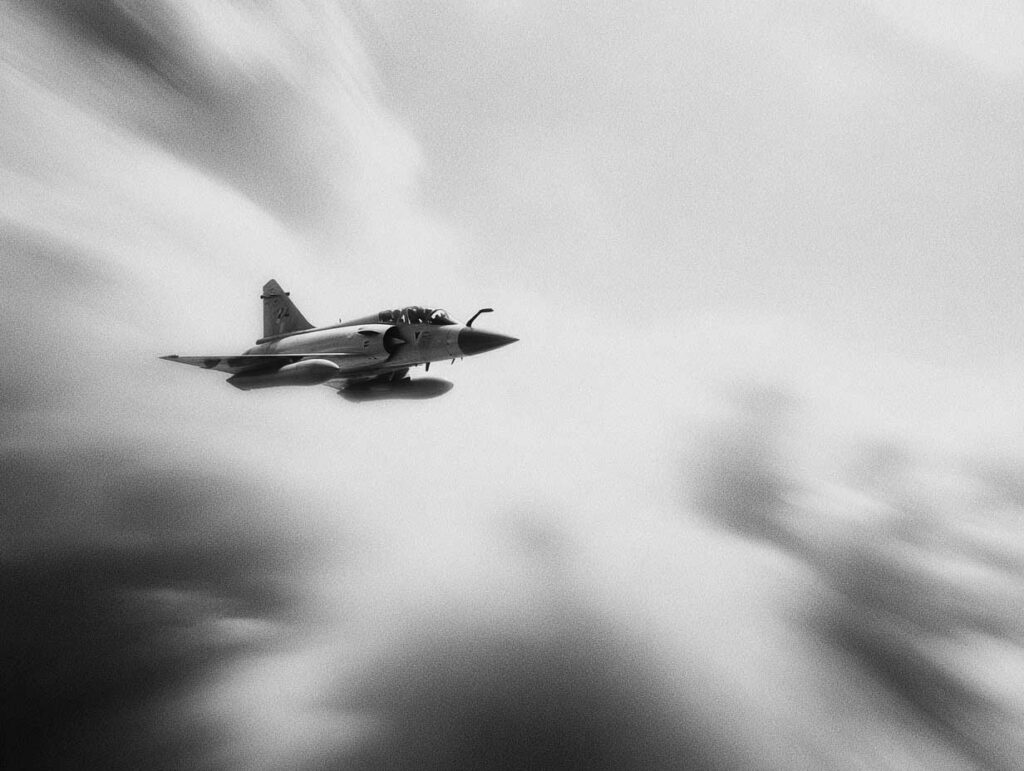
In other words, the Ukrainian Mirage 2000-5 is no longer limited to an air defense role. It becomes a dual-role aircraft, capable of switching from an air defense mission to a precision strike mission. This is exactly the kind of flexibility a country engaged in a war of attrition seeks.
The F-16 as the long-term goal, the Mirage as the immediate solution
However, it would be incorrect to present the Mirage 2000-5 as a complete alternative to the F-16. The two aircraft do not fit the same timeline or meet exactly the same needs.
The F-16 remains a more attractive option for Ukraine in the long term due to the volume available, Western logistical support, the variety of its weaponry, and the possibility of building a more homogeneous fleet with multiple supplier countries. The Mirage, on the other hand, is available in smaller numbers. It depends on a more limited ecosystem. Its global fleet is smaller. Industrial regeneration is impossible since the production chain no longer exists.
But this observation does not diminish its usefulness. It explains it. The Mirage 2000-5 fills a capability gap. It provides Ukraine with an immediate response in two critical areas: the interception of cruise missiles and drones, and the use of French precision munitions. It is a complementary aircraft, not a mass-produced one. In a war where urgency weighs as heavily as doctrine, this is sufficient to fully justify its deployment.
Dassault’s design as proof of operational robustness
The Ukrainian case also says something broader about Dassault’s design philosophy. The Mirage 2000-5 is not a new aircraft. Its airframe dates back to a different strategic era. Yet it remains operational in a high-intensity conflict against an adversary equipped with air defenses, fighter jets, electronic warfare, and long-range strike capabilities.
This does not mean it is invulnerable. It means that a well-designed, well-modernized, and well-armed aircraft can retain very real military value decades after entering service. This is an important lesson at a time when Europe is talking a lot about sixth-generation aircraft, combat clouds, and artificial intelligence. The war in Ukraine brings home a harsher truth: a useful aircraft is first and foremost one that takes off, survives, intercepts, and strikes.
The Mirage 2000-5 is currently ticking those boxes in Ukraine. In small numbers, certainly. With obvious limitations, yes. But with a far more tangible impact than many could have imagined just a year ago.
Perhaps the most striking aspect, at its core, lies elsewhere. In Ukraine, the Mirage 2000-5 is not winning the war in the skies on its own. It demonstrates something else: in a war of attrition, an older but well-adapted fighter can still become a decisive niche asset. And in this war, effective niche assets often end up mattering just as much as large, ideal fleets.
War Wings Daily is an independant magazine.