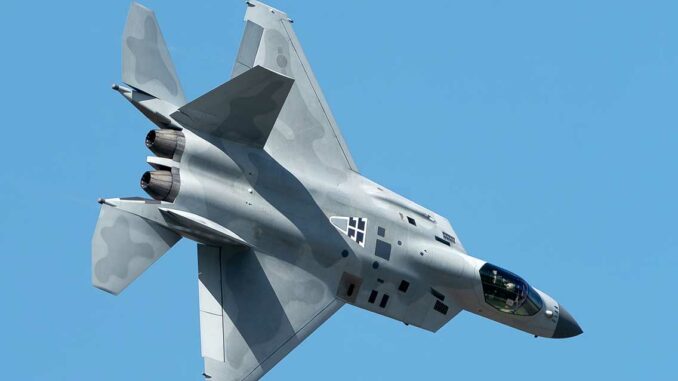
Seoul and Jakarta have moved the KF-21 project forward with the transfer of a prototype, data, and technology. This is a key agreement for the future export of the South Korean fighter jet.
In summary
The KF-21 Boramae project has just reached a decisive milestone. South Korea and Indonesia have reached an agreement to transfer a single-seat prototype from the program to Jakarta, along with a package that includes development data and technology transfer provisions. The total value of the deal is approximately 600 billion won, or around $400 million. This compromise serves to resolve years of tension over the financing of the joint program. Above all, it revives a prospect far more significant than the prototype itself: the potential purchase of 16 production KF-21s by Indonesia. For Seoul, the stakes go far beyond a simple contractual dispute. The goal is to secure the first export of its indigenous fighter and to prove that a 4.5-generation aircraft can hold its own among modernized F-16s, Rafales, Gripens, and heavier, more expensive aircraft.
The compromise that saves a partnership that had become a burden
The crux of the story can be summed up in one sentence: Seoul and Jakarta have decided to transform a financial conflict into an industrial arrangement. The agreement involves the transfer to Indonesia of a prototype of the KF-21 Boramae, specifically a single-seat test aircraft, along with development data and a package of technology transfers. The estimated value is around 600 billion won, or approximately $398 million to $406 million depending on conversion rates and publications.
This agreement did not come out of nowhere. For years, Indonesia had been dragging its feet on payments for the KF-21 program, formerly known as KF-X on the Korean side and IF-X on the Indonesian side. Initially, Jakarta was supposed to finance approximately 20% of a program estimated at 8.1 trillion won, or nearly 1.6 trillion won. This initial ambition eventually ran up against Indonesia’s budgetary and political realities. Seoul therefore agreed to reduce Jakarta’s contribution to 600 billion won.
Let’s be clear: Indonesia did not honor its initial commitment. But South Korea also had no interest in pushing its partner out the door. A complete breakup would have sent a very bad signal to all future export customers of the KF-21 Boramae. A fighter program isn’t sold solely on performance. It’s also sold on an image of contractual stability, political continuity, and industrial credibility.
The prototype worth far more than just a test aircraft
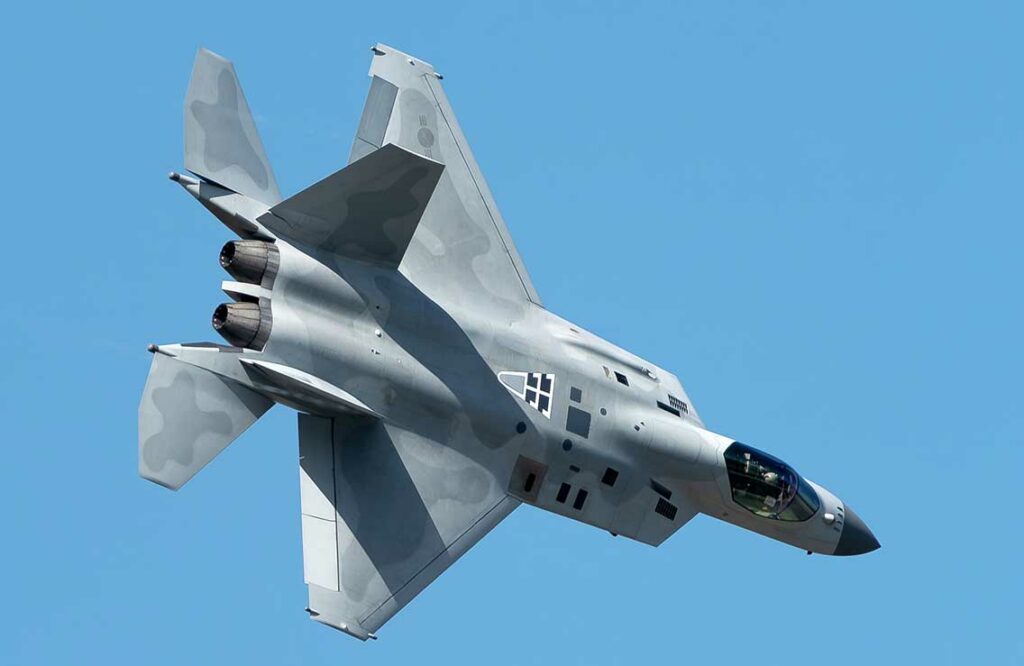
The prototype in question is not an empty symbol. Information published in Korea indicates that it is the fifth prototype of the KF-21, a single-seat aircraft already used for key tests, notably on avionics and in-flight refueling.
Its intrinsic value is estimated at approximately 350 billion won. The remainder of the package is divided among technology transfer, costs related to local research, and the provision of development data.
This point is essential. Jakarta is not merely receiving a flying airframe. It is acquiring a package of technical value. Test data, development insights, industrial interfaces, and building blocks of know-how sometimes count for more than the aircraft itself. In a modern fighter program, the accumulated knowledge on certification, sensors, weapons integration, and mission software holds considerable strategic value.
The choice of a single-seat verification prototype is significant as well. It is not a theoretical aircraft intended for a static display. It is an aircraft that has been used to verify concrete functions of the program. For Indonesia, this provides a useful foundation for building capabilities. For South Korea, it allows the country to fulfill the political promise of an industrial return, but without giving up a production aircraft intended first and foremost to supply the Republic of Korea Air Force.
The fighter South Korea wants to bring into the big leagues
The KAI KF-21 Boramae is presented as a 4.5-generation multirole fighter. This description is not just a marketing slogan. It says something specific about the program’s positioning. The KF-21 does not claim to be a pure fifth-generation stealth aircraft on par with an F-35 in every respect. Instead, it seeks to offer a balance between performance, survivability, modern sensors, controlled costs, and industrial sovereignty.
The program is being developed by Korea Aerospace Industries with support from the South Korean defense procurement agency DAPA. The prototype’s maiden flight took place in July 2022. Production has already begun, and the first deliveries to the South Korean Air Force are scheduled to start in September 2026, according to the most recent announcements.
Technically, the KF-21 is similar in size to modern medium-sized supersonic fighters. Recent specialized publications attribute a maximum speed of approximately Mach 1.8 and a payload capacity of up to 7.7 tons to the aircraft. The program has also emphasized domestically produced equipment in South Korea, including an AESA radar, an IRST, an electro-optical pod, and electronic warfare capabilities. This domestic production of technology is crucial. It reduces dependence and increases flexibility for export configurations.
One point that is often misunderstood must be clarified: the KF-21 is not being marketed as a cheaper F-35. It is being marketed as an advanced multirole aircraft offering a modern architecture, significant room for future upgrades, and credible weapons integration—without incurring the costs and political constraints of a fifth-generation American stealth aircraft.
The technology that makes the KF-21 credible in a saturated market
The real issue is not just the aircraft. It is what Seoul has managed to build around it. The KF-21 features a locally developed AESA radar, which represents a major breakthrough for the Korean industry.
This type of radar improves detection, simultaneous tracking of multiple targets, resistance to jamming, and the ability to handle complex scenarios.
The fighter must also integrate state-of-the-art air-to-air weapons. Tests have demonstrated progress in integrating the Meteor, a European long-range missile, as well as other Western and domestic weapons. This changes the perception of the program. A fighter jet is not defined solely by its airframe. It is defined by the integrated system comprising its sensors, computers, data links, and munitions.
Positioning it as a 4.5-generation fighter also has commercial merit. It reassures certain customers who want a leap in capability without entering the heavy, politically sensitive, and extremely costly maintenance world of a fifth-generation stealth fighter. The KF-21 is targeting this niche: more modern than a conventional F-16, less politically constrained than an American program, and potentially more affordable than a Rafale or a Eurofighter in certain regions.
This does not mean the path is clear. The market is already crowded. Indonesia, for example, has not put all its eggs in one basket. It has ordered 42 Rafales from France and continues to diversify its options. The KF-21 is therefore not entering an empty landscape. It must prove that it deserves a place in a fleet already undergoing restructuring.
The Indonesian deal becomes a full-scale test for exports
Indonesia’s interest in 16 production KF-21s would mark South Korea’s first export of its indigenous fighter. This is a historic milestone. KAI has already exported training and light combat aircraft such as the FA-50. But exporting a fighter in this category is a completely different matter from selling an armed trainer or a light fighter.
A first export contract always plays a disproportionately large role. It doesn’t just generate revenue. It validates the product. It reassures financiers, insurers, suppliers, and prospective customers. It also helps establish a long-term ecosystem of logistical support, spare parts, training, and industrialization.
This is precisely why settling the dispute with Jakarta matters so much. South Korea does not simply want to recover the missing funds. It wants to transform a defaulting partner into a launch customer for exports. That is far more useful. The prototype, the data, and the technology transfer therefore constitute less of a concession and more of a political and commercial investment.
Discussions remain open, however. Korean authorities have indicated that the exact timeline for the transfer of the prototype and data will be finalized after the remaining balance is fully settled, expected by June 2026. Until the money is paid in full, nothing is completely set in stone. Here again, we must remain realistic: the project is moving forward, but it is not yet guaranteed.
The market that could open up to a new Asian approach
The implications for the market could be significant. If the KF-21 Boramae secures its first export contract in Indonesia, South Korea will cross a strategic threshold.
It will transition from being a leading manufacturer in the training and light combat aircraft segment to becoming an exporter of top-tier multi-role fighters.
This would reinforce a trend already visible in the Korean defense industry: a rapid move upmarket, supported by an aggressive government apparatus, a coherent industrial base, and a structured export policy. The successes of the FA-50, armored vehicles, artillery, and ground systems have already demonstrated that Seoul knows how to meet international demand for effective equipment that can be delivered quickly and is politically more flexible than certain Western equivalents.
The KF-21 could capitalize on this reputation. Its selling point is not one of radical innovation. Its selling point is the balance between modernity, technological autonomy, and acceptable political cost. It is an offer that can appeal to countries in Southeast Asia, the Middle East, or Eastern Europe that want to strengthen their combat aviation without relying on a single supplier.
There is also another market effect. If Indonesia confirms a purchase of 16 aircraft, this will elevate the KF-21 into the category of truly exportable platforms, with a foreign user and an international support network. From that point on, the sales pitch changes. We are no longer selling a promising national program. We are selling an aircraft already adopted by another state.
The balance of power that must not be caricatured
It would, however, be an exaggeration to present this case as a triumph without any gray areas. Seoul had to massively reduce the Indonesian bill. This means that South Korea accepted a less favorable solution than the initial contract. It did so because it wanted to save what mattered most: the program’s continuity, the bilateral relationship, and the export opportunity.
For its part, Jakarta has achieved a significant outcome. Indonesia retains a place in the program at a much lower cost than originally planned. It secures a prototype, data, a share of technology transfer, and retains the option to order production aircraft. On paper, it’s a good deal for Indonesia.
But this good deal also has its limits. By accepting a revised contribution, South Korea has automatically reduced the level of technology transfer originally promised. Indonesia will therefore not receive exactly what it had hoped for when the partnership began. The balance of power has shifted in Seoul’s favor regarding actual control of the program, even if Jakarta saves face politically.
The real takeaway from this episode is this: both parties have abandoned their initial positions to avoid a failure that would be too costly. It is less elegant than a smooth partnership. It is much more realistic.
The window of opportunity opening for KAI, with much still to prove
The KF-21 Boramae is entering a phase where communication alone will no longer suffice. Starting in 2026, the program will be judged on very concrete criteria: production rate, cost control, availability, sensor quality, weapons integration, logistical support, and the ability to secure actual contracts.
The agreement with Indonesia clearly improves its prospects. It resolves an issue that had been plaguing the program and paves a possible path toward a first export sale. Politically and industrially, this is a major step forward.
But the fighter jet market is brutal. Customers want credible aircraft, on-time deliveries, transparent financing, and long-term operational flexibility.
The KF-21 now ticks more boxes than it did two years ago. It has not yet definitively earned its place.
The most interesting point may lie elsewhere. South Korea is showing that it no longer wants to be merely a secondary supplier in the global aerospace ecosystem. It wants to become a central player, capable of designing, producing, and exporting a national multirole fighter. If Indonesia signs for 16 aircraft, it won’t just be another contract. It will be proof that a new Asian entrant can now establish a lasting presence in a market once thought to be locked down.
War Wings Daily is an independant magazine.