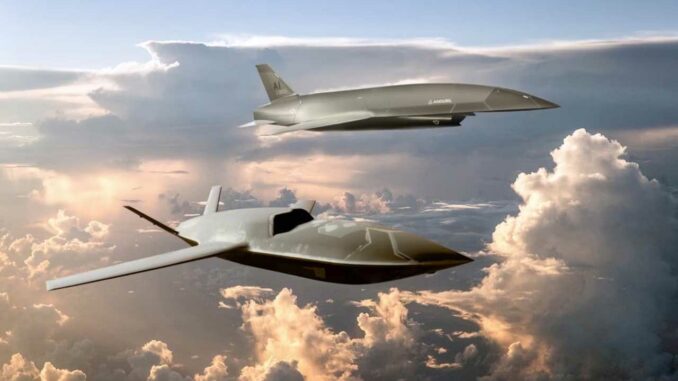
The U.S. Air Force plans to fund its first CCAs as early as 2027. Behind this $1 billion investment lies a major shift in doctrine centered on the F-35 and the future F-47.
In summary
The US Air Force is requesting nearly $1 billion in the FY2027 budget to launch the acquisition of the first Collaborative Combat Aircraft, or CCA, its future collaborative combat drones often described as “loyal wingmen.” The exact amount listed in the budget documents is $996.5 million. This is not a mere accounting detail. It marks the transition from an experimental program to a procurement strategy. The objective is clear: to create an affordable fleet capable of supporting the F-35 and, later, the F-47 of the NGAD program. Behind this approach, the USAF is attempting to solve an equation that has become central: how to maintain air power in an environment saturated with missiles, drones, electronic warfare, and attrition, without skyrocketing costs? This choice confirms a doctrinal shift. The piloted aircraft is not disappearing. But it is no longer alone at the center of the combat system.
The budget request marking a true shift in phase
The key figure is now public. In its FY2027 budget request, the U.S. Air Force has allocated $996.528 million for the first purchases of Collaborative Combat Aircraft under the Air Force’s procurement line. This is significant. Until now, the program has primarily focused on research, development, testing, and industrial maturation. With this budget line, the USAF is signaling its intention to shift toward actual acquisition. It is no longer just a technological promise. It is the beginning of a fleet-based approach.
The budget document also includes an advance procurement line of $150.5 million for the CCAs, confirming that the USAF is already preparing for subsequent purchases. The signal to industry is therefore twofold: initial purchase of a first batch, followed by preparation for subsequent batches. In U.S. budget parlance, this means that the supply chain, subcontractors, mission software, sensors, and support components are beginning to be considered at the production scale.
Let’s be blunt: if Congress approves this funding, CCAs will no longer be viewed as a marginal experiment. They will become a core component of U.S. tactical planning. That is the full political significance of this billion dollars.
The concept aimed at creating an affordable fleet
The term Collaborative Combat Aircraft refers to semi-autonomous combat drones designed to fly alongside piloted aircraft. The concept is neither that of a simple surveillance drone nor that of a disposable missile. The CCA is designed as a reusable, connected, armable aircraft capable of cooperating with a human crew on a tactical mission.
The USAF refers to combat effective mass at an affordable cost, in other words, a credible combat mass at a controlled cost.
Why is this approach necessary now? Because air warfare becomes too expensive as soon as every operation relies on a high-end piloted aircraft. An F-35A has a flyaway cost of around $82.5 million according to the most commonly cited figures. In contrast, the USAF wants UCAVs costing about one-third the price of an F-35, with a historical target of around $25 to $30 million per unit. And according to program officials, the USAF even believes it is currently beating that target. That is precisely the point: creating tactical volume without increasing the cost of manned platforms.
The “affordable mass” formula is therefore far from abstract. It addresses a very real impasse. Facing China, or in any high-intensity war, the USAF cannot rely solely on a few exquisite, very expensive, and very rare aircraft. It needs quantity, redundancy, and platforms that can be more easily sacrificed. That is what the CCA is for: absorbing some of the danger in place of piloted fighters.
The operation that redefines the pilot’s role
A loyal wingman is not a traditional wingman. It is a collaborative system. In practice, a piloted fighter like the F-35 or the future F-47 could control, guide, or supervise multiple drones depending on the mission. These drones could carry sensors, jammers, missiles, communication relays, or even serve as advanced scouts in a defended area. The idea is not to turn the pilot into a remote operator responsible for controlling every movement at all times. The idea is to allow the pilot to assign intentions, tasks, and priorities, while the autonomous system handles part of the execution.
This is the technological core of the program. A useful CCA must combine several layers: flight autonomy, data fusion, collaborative behavior, risk management, communications security, and the ability to remain effective in a jammed environment. Technically, this goes far beyond the airframe itself. The real challenge lies in the software. Many manufacturers know how to build a drone. Far fewer know how to build a combat drone capable of acting coherently alongside a fighter jet in a contested environment.
The USAF is specifically addressing this aspect through its Experimental Operations Unit at Nellis and the structuring of activities at Creech. Published environmental documents show that the service is preparing for real-world deployment through training, testing, and ramp-up. Once again, this is no longer just a trade show concept. The USAF is already preparing the “reps and sets,” that is, the operational rehearsals that transform an idea into a workable tactic.
The first phase within the NGAD family
The CCA Increment 1 program is part of the NGAD family, Next Generation Air Dominance.
It is important to understand this point. NGAD is not just the future manned fighter now designated F-47. It is a system of systems. The F-47 is its most visible tip, but the CCAs are the other pillar of the concept. Without them, NGAD would be much more vulnerable economically and tactically.
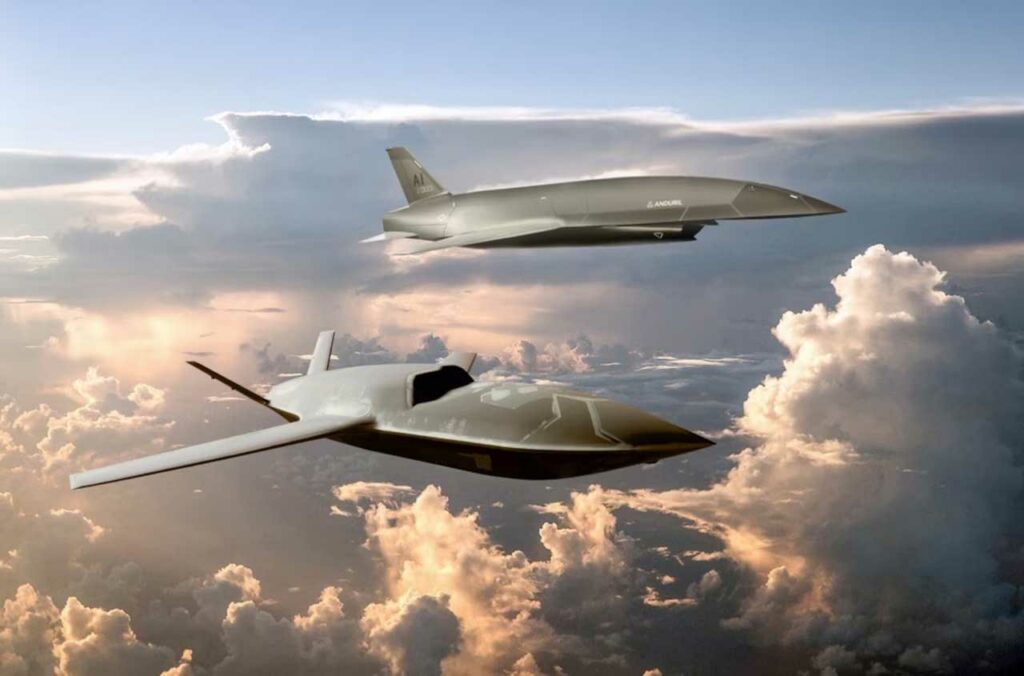
The USAF has already given concrete form to this first phase with two main contenders: the YFQ-42A from General Atomics and the YFQ-44A from Anduril. The former made its first test flight in August 2025. The second flew in October 2025. Both aircraft have thus already moved beyond the conceptual stage. They exist, they fly, and they serve as the basis for the expected production decision.
The fact that the USAF has classified them as YFQ is itself revealing. The “Y” denotes a prototype, the “F” a fighter role, and the “Q” an unmanned aircraft. This choice of designation is not merely cosmetic. It shows that the USAF intends to treat the CCA not as a supplementary drone, but as a future integral component of offensive air combat.
The target volume that reveals the project’s true ambition
The USAF’s ambition regarding UCAVs is far from modest. As early as 2023, Frank Kendall mentioned a nominal target of approximately 1,000 aircraft, based on a simple logic: roughly two CCA for each NGAD and two CCA for part of the F-35 fleet. This figure is not a firm contract, but it gives an idea of the scale. The USAF is not looking for a gimmick. It is looking for a new class of aircraft.
This scale changes everything for the market. At $25 to $30 million each, a fleet of 1,000 CCA represents theoretically $25 to $30 billion for the aircraft alone, not even counting weapons, sensors, software integration, support, and upgrades. It is a colossal market. That is also why the USAF is moving very quickly. Whoever wins the first batch does not just win an initial order. They win a position in a segment that could become as defining as that of light fighters was several decades ago.
However, caution is warranted. The FY2027 budget does not specify how many aircraft will actually be ordered in this first batch. With $996.5 million, the volume will depend on the final price, the exact contents of the package, the associated equipment, and the selected level of maturity. As a rough estimate, if we apply the historical ceiling of $25 to $30 million per aircraft, we arrive at a theoretical range of 33 to 40 drones. But this calculation remains indicative, as the budget may include much more than just the unit price of the airframes.
The operational logic behind the F-35 and the future F-47
The F-35 and the F-47 will not have exactly the same relationship with UAVs. The F-35 is already here. It is produced in large numbers, widely deployed, and features a sensor and data fusion architecture particularly useful for playing the role of tactical quarterback. An F-35 escorted by several UAVs could send less expensive effectors forward to probe an air defense system, jam communications, pin down a threat, or launch missiles from a distance. This would help preserve the piloted aircraft while increasing the effective range of its combat system.
The F-47, on the other hand, was designed from the outset with the NGAD concept in mind. The USAF has already indicated it aims for more than 185 aircraft. This future fighter must offer greater range, greater stealth, greater availability, and better sustainability than the F-22. But its true value could be amplified by UCAVs. In an Indo-Pacific theater, where distances are immense and threats are numerous, a lone piloted fighter does not serve the same purpose as a piloted fighter at the center of a small group of collaborative drones.
Let’s be frank: the USAF implicitly admits that the model of “a single, very expensive piloted aircraft is sufficient on its own” is no longer tenable. Future air combat will be distributed, networked, and more expendable. The CCA is not an add-on. It becomes a multiplier of survivability and effectiveness.
A market that could be disrupted far beyond the United States
The industrial implications extend far beyond the U.S. budget alone. If CCA becomes an operational reality rather than a perpetual prototype, the entire global combat aviation market will be affected.
First, traditional aircraft manufacturers will have to adapt their offerings. A fighter jet will no longer sell solely on its speed, radar, or stealth capabilities. It will also sell on its ability to pilot a drone ecosystem. Next, missile manufacturers, electronics firms, and military software developers will compete for a new layer of value: onboard autonomy, human-machine interfaces, mission systems, combat cloud, secure links, and distributed effects.
Finally, the very structure of fleets could change. If a country can purchase fewer high-end piloted aircraft but surround them with several less expensive collaborative drones, the budget calculation shifts. This does not mean that piloted fighters will become secondary. It means that their numbers, their roles, and their relative value will be reassessed in light of this new architecture.
This is the crux of the matter: the USAF is attempting to make air power sustainable when its own costs threatened to strangle it. It is a bold gamble. It is also a form of admission. High-tech air combat is no longer viable on a large scale if it relies solely on platforms costing $80 million, $100 million, or $300 million.
The fragility that continues to plague the program
It would be naive, however, to portray the program as a smooth, triumphant march.
UAVs remain a complex project. One of General Atomics’ prototypes recently crashed in California, leading to a temporary halt in test flights. This type of incident is not unusual during a rapid development phase, but it serves as a reminder that the path to robust capability remains fraught with technical risks.
There is also the doctrinal question. How much autonomy will the Pentagon actually accept for combat missions? What degree of reliance on the network will be tolerable in a jammed environment? How much trust will a pilot place in two, three, or four unmanned crew members during high-intensity combat? These are far more challenging questions than the airframe design alone.
The other risk is budgetary. The Pentagon has very ambitious plans, ranging from the F-47, CCA, hypersonic weapons, nuclear modernization, tankers, missile defense, and a push into high-end space capabilities. Even in the United States, trade-offs eventually have to be made. The billion requested for 2027 signals a priority. It does not guarantee that the pace will remain unchanged throughout the decade.
What is at stake here goes beyond the purchase of a new drone. The US Air Force is attempting to redesign its approach to air warfare before its adversaries force it to do so at a much higher cost. If Congress goes along with it, the first Increment 1 CCA’s will mark the concrete beginning of a more distributed, denser, and more replaceable combat aviation force. If this gamble fails, the USAF will be brought back to a brutal reality: in a long war, even the world’s best fighters aren’t enough when they’re too few, too expensive, and too isolated.
War Wings Daily is an independant magazine.