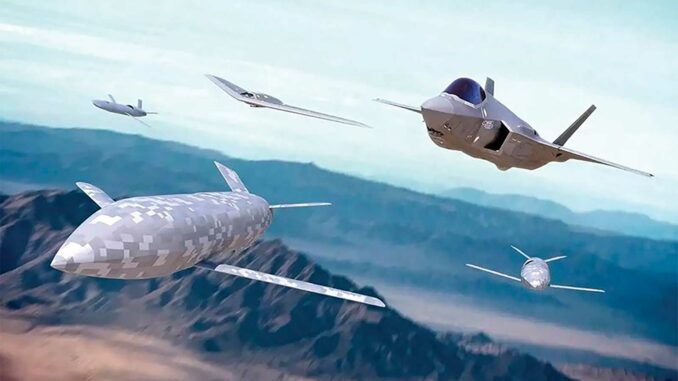
The U.S. Air Force is launching a key phase to arm its CCA drones. Behind the announcement lies a central challenge: demonstrating integration, software openness, and industrial speed.
In Summary
The U.S. Air Force has just reached a significant milestone in its Collaborative Combat Aircraft (CCA) program. The announcement does not yet mean that these autonomous drones are already firing missiles in operation. It does, however, confirm that the program is entering a phase where armament is no longer theoretical. The tests focus on the integration of external payloads, safety, compatibility with mission systems, and the safe separation of munitions. This is a necessary step before any live-fire testing. At the same time, the Air Force is validating its open architecture approach through the Autonomy Government Reference Architecture (A-GRA). The goal is clear: to decouple the drone, the autonomy software, and the onboard sensors or effectors, in order to prevent a single manufacturer from locking down the entire ecosystem. For industry players, the stakes are immense. The winners will not only be aircraft manufacturers, but also suppliers of software, integration services, sensors, data links, and compatible weaponry.
The true meaning of this new test phase
First, we must put the announcement into proper perspective. According to the official U.S. statement, the phase underway focuses on weapons integration testing, involving weapon carriage tests and safety validation using inert munitions. This changes a great deal. We are moving beyond conceptual discussions. We are entering the physical verification of what a CCA can carry, support, and, in the future, drop or fire without compromising its airframe, its aerodynamic behavior, or flight safety.
In concrete terms, the U.S. Air Force explains that this phase has three objectives. The first is airworthiness. A collaborative combat drone must demonstrate that it can carry external loads without degrading its flight envelope to the point of becoming unstable or dangerous. The second is system compatibility. It’s not enough to simply attach a missile under a wing. It must be proven that the mechanical, electrical, and software interfaces function correctly with the aircraft and its mission system. The third is safe separation, meaning the safe separation of the munition after release or upon leaving the rail.
This clarification is important, as many comments jump to conclusions too quickly. No, the Air Force has not publicly announced that its CCAs are already firing missiles in full tactical cooperation with an F-35 or a future F-47 in an operational environment. Yes, it has crossed a critical threshold: the point where the weapon becomes a tested, measured, and qualified subsystem, rather than just a marketing promise.
The Logic Behind Test Phases Before a Live Fire
In an air combat program, weapon integration follows a very rigorous sequence. The CCA is no exception to this rule. In fact, they follow it in a very traditional manner, a fact the Air Force openly acknowledges.
The ground testing phase
Before flight, everything begins on the ground. Engineers verify mechanical interfaces, electrical compatibility, data flows between the vehicle, the mission computer, and the warhead, as well as the responses of the control systems.
In the CCA program, this phase began in 2025 with the first two demonstrators, the YFQ-42A from General Atomics and the YFQ-44A from Anduril. The tests focused on propulsion, avionics, autonomy integration, and ground control interfaces.
The Initial Flight Phase
Once the initial risks have been mitigated, the aircraft move on to flight without active weaponry. The goal is to assess the platform’s behavior, the reliability of the controls, the performance of the autonomy algorithms, and the quality of mission integration. The YFQ-42A flew for the first time in 2025, less than two years after the program’s launch, which is extremely fast for a combat system of this class.
The captive carry phase
This is the central phase today. The drone flies with an inert munition or dummy payload on board. We then observe vibrations, drag, structural stresses, effects on stability, and the impact on performance. It is a grueling but essential step. An aircraft may fly perfectly well without a payload but become much less stable as soon as payloads are added.
The safe separation phase
After the captive flight, it must be verified that the munition leaves the aircraft without striking the airframe or passing through an unstable aerodynamic flow. This is where modeling, instrumentation, and dedicated test runs come into play. For a CCA, this step is even more critical, as the aircraft must simultaneously manage mission endurance, communication with the manned control system, and the final human decision regarding weapon deployment.
The firing phase or advanced simulated engagement
Only after these validations can a program move on to live-fire tests or more advanced tactical scenarios. To date, the U.S. Air Force explicitly states that a human retains authority over the firing decision. The CCA is therefore not presented as an autonomous machine authorized to open fire on its own. It is a supervised armed system, integrated into a traditional chain of command.
Open architecture at the heart of the program
This point may seem technical, but it is likely the most important aspect of the project. The Air Force doesn’t just want to buy a drone. It wants to build an open government architecture that allows it to quickly change software, a sensor, a payload, or a supplier without rebuilding the entire system.
The name of this central building block is Autonomy Government Reference Architecture, or A-GRA. The idea is simple on paper and has far-reaching industrial implications: the U.S. government owns the architectural reference that serves as a common language between platforms and autonomy software. This allows hardware to be decoupled from software.
To put it more bluntly, the Air Force wants to break the old habit of a single prime contractor locking down the platform, code, interfaces, and maintenance.
With A-GRA, it seeks to prevent an aircraft manufacturer from saying: my drone only works with my autonomy system, my interfaces, my integrators, and my upgrades. It is a deliberate strategy against vendor lock-in.
In practice, the Air Force has already demonstrated this approach with several industry partnerships. RTX Collins has integrated its Sidekick Collaborative Mission Autonomy solution with General Atomics on the YFQ-42A. Shield AI, for its part, is working with Anduril on the YFQ-44A. The message sent to the market is clear: autonomy is not meant to remain confined to the airframe manufacturer’s exclusive ecosystem.
What This Open Architecture Really Is
An open architecture does not mean that everything is interchangeable without cost or limit. The term is sometimes misused. In the CCA context, it should be understood as a modular structure with standardized interfaces, governed by the government, to facilitate the addition or replacement of components.
This involves at least five layers.
The vehicle layer
This includes the airframe, propulsion, control surfaces, onboard power, the flight computer, and physical interfaces.
The autonomy layer
This is the software brain responsible for navigation, avoidance, formation flying, task execution, and semi-autonomous behavior.
The mission layer
It aggregates sensors, effect management, tactical priorities, data fusion, and cooperation with the manned aircraft.
The communication layer
It includes data links, jamming resilience, cybersecurity, and the transmission of orders or constraints.
The Effect Layer
This encompasses everything that produces a military effect: missiles, jamming, decoys, ISR sensors, communication relays, and even electronic warfare payloads.
The major advantage is the speed of integration. The Air Force can theoretically introduce a new asset more quickly using a single building block without having to launch an entirely new program. The major challenge, however, is mastering the integration process. The more modular the system is, the more robust governance, rigorous standards, and intensive testing are required to avoid incompatibilities.
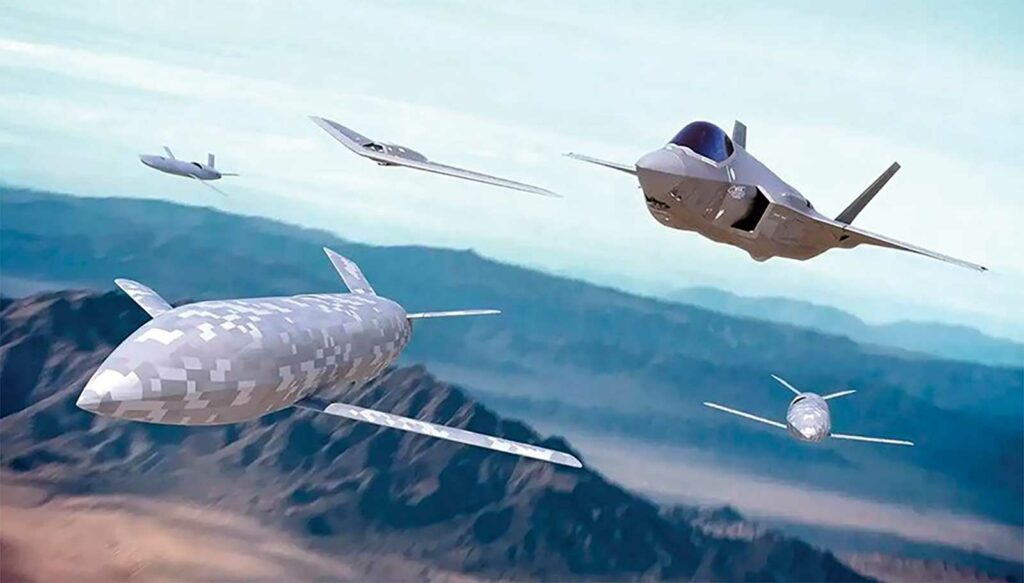
The connection to the F-35 and the future NGAD
The role of the CCA is not to replace an F-35 or the future F-47 from the NGAD program. Its role is to increase the payload, range, and survivability of the overall system. The Air Force refers to a system of systems. The concept is clear: a manned aircraft retains decision-making, coordination, and overall tactical awareness, while multiple drones handle advanced sensor, escort, decoy, jamming, or strike functions.
This is where armament changes the nature of the program. An unarmed CCA can already serve as a sensor or decoy. An armed CCA becomes a firepower multiplier. It allows missiles to be deployed closer to the threat without immediately exposing the pilot of the manned fighter. It also allows for saturating enemy defenses, distributing the load, and complicating the enemy’s tactical assessment.
The Air Force is still aiming for a fleet of at least 1,000 UCAVs. That is a significant number. The rationale is not only technological; it is also economic.
Public estimates suggest unit costs significantly lower than those of a modern manned fighter, with ranges cited from approximately $5 million to $30 million depending on versions and assumptions, while some officials have indicated that the price target remains under control. It is this promise of mass affordability that makes the concept credible on a large scale.
The Industrial Impact on Suppliers
The most profound effect of the CCA program may not be tactical. It is industrial.
In a closed model, the prime contractor captures most of the value. In an open model, the supply chain fragments. This opens doors for smaller, more specialized, and faster suppliers. One player can focus on autonomy, another on a data link, another on an electronic warfare module, and another on a specific payload.
For large conglomerates, the risk is clear: losing some of their historical control over the entire architecture. For mid-sized companies and firms with roots in software or AI, the opportunity is immense. The Pentagon is sending them a rare message: you can enter through a single component, without necessarily producing the entire aircraft.
But this openness comes with a steep price. Suppliers will have to prove they can integrate quickly, adhere to common standards, deliver robust code, maintain cybersecurity, and accept constant competition. Open architecture expands the market, but it makes selection more rigorous. It rewards speed of execution more than established market position.
What comes next will determine if the U.S. gamble pays off
The CCA program is beginning to move beyond the realm of mockups and slogans. Weapons integration tests show that the Air Force is now working on the most sensitive part: transforming a collaborative drone into a credible force multiplier, without losing control over security, rules of engagement, and tactical integration.
The real test, from now on, will not simply be to fly these aircraft or attach inert munitions to them. It will be to demonstrate three things simultaneously: safe separation, robust coordination with the piloted fighter, and an architecture open enough to foster competition without compromising operational coherence. This is where the difference will lie between an impressive innovation on PowerPoint and a military capability that truly shifts the balance of power.
Sources
U.S. Air Force, “Collaborative Combat Aircraft program progresses through deliberate weapons integration testing,” February 23, 2026.
U.S. Air Force, “Air Force validates open architecture, expands Collaborative Combat Aircraft ecosystem,” February 12, 2026.
US Air Force, “Experimental Operations Unit accelerates Collaborative Combat Aircraft program,” April 16, 2026.
US Air Force, “DAF begins ground testing for Collaborative Combat Aircraft, selects Beale AFB as the preferred location for aircraft readiness unit,” May 1, 2025.
Defense News, “US Air Force’s CCA program advances with auto-flying software integration,” February 12, 2026.
Defense News, “First flight tests begin for Air Force’s drone wingmen,” August 28, 2025.
Air & Space Forces Magazine, “Air Force wants nearly $1 billion to start buying CCAs in 2027,”April 6, 2026.
Air & Space Forces Magazine, “Air Force revisiting production goals for CCA with eye on Increment 2”, March 17, 2026.
US Air Force, “Air Force Awards Contract for Next Generation Air Dominance Platform, F-47”, March 21, 2025.
War Wings Daily is an independant magazine.