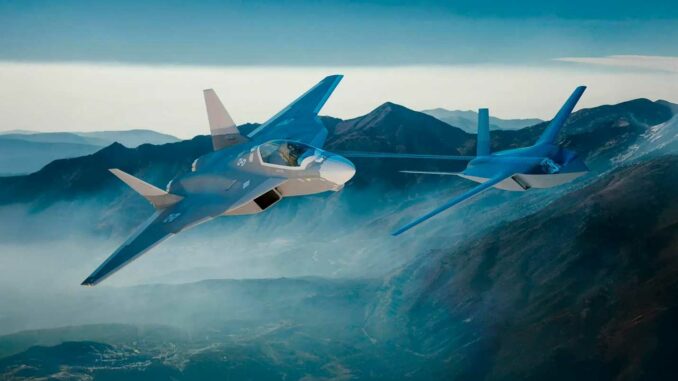
France is accelerating development of its stealth escort drone for the Rafale F5. Budget, contractors, timeline, objectives: this program is already reshaping Europe’s defense landscape.
In summary
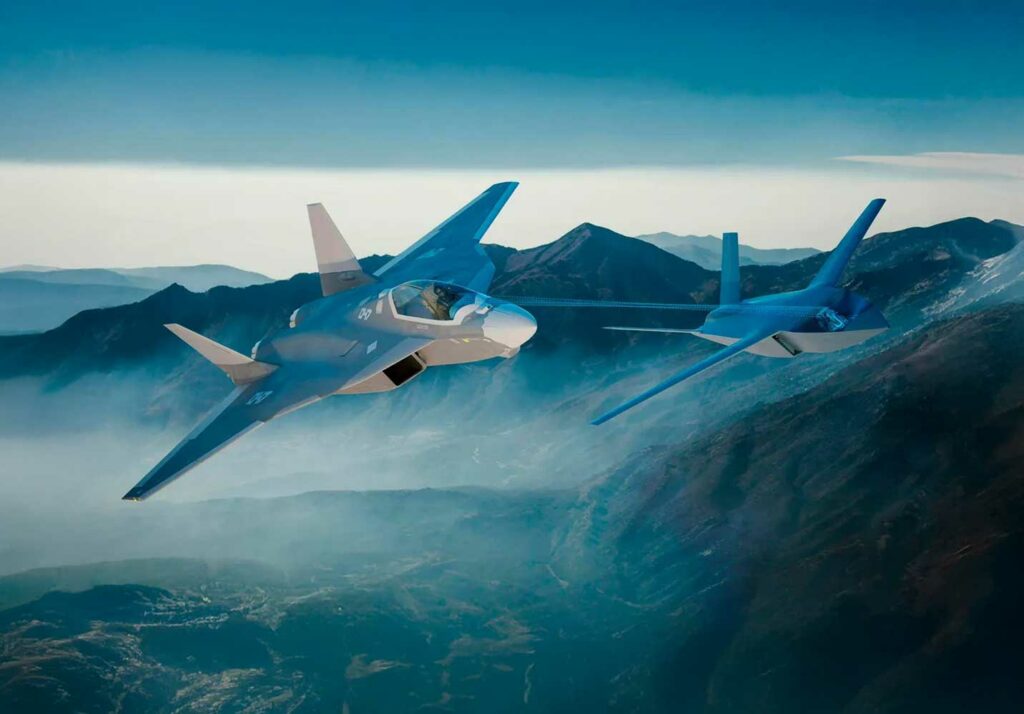
France has officially launched the development of a stealth escort drone designed to operate with the Rafale F5. The objective is far from symbolic. This drone is intended to help the French Air Force penetrate better-defended airspace, saturate enemy surface-to-air defenses, extend the range of collaborative combat, and bridge the gap until the eventual arrival of the SCAF. The program was announced in October 2024 by Dassault Aviation following notification of a contract by the Ministry of the Armed Forces. French budget documents subsequently confirmed an escalation of funding, with €704 million in commitment authorizations planned for 2025 to launch its development. The realistic timeline targets an entry into service around 2033, consistent with the Rafale’s F5 standard. This choice extends beyond France alone. It marks a strategic European shift: before the grand combat system of the future, a credible, sovereign, and more rapidly available capability is needed.
The Real Purpose of the French Program
France is not developing this drone to follow a trend from the United States. It is doing so because the operational challenge is now clear. A piloted fighter, even a highly capable one, is finding it increasingly difficult to penetrate an airspace saturated with radars, long-range surface-to-air missiles, passive sensors, jamming, and multi-layered defenses. The Ministry of the Armed Forces has, in fact, put it in black and white: the Rafale F5 will have to conduct more complex air operations in increasingly well-defended theaters. The combat drone is therefore not an accessory. It is becoming a direct response to the intensifying threat.
The most important point is this: this future drone is not designed to replace the Rafale. It is intended to complement it. Dassault describes it as a system complementary to the Rafale, suited for collaborative combat, featuring stealth capabilities, autonomous control under human supervision, and internal payload capacity. This last detail matters. A stealth drone that carries its payloads internally better preserves its radar stealth than an aircraft laden with external payloads. This aligns perfectly with the logic of penetration and opening a corridor in a contested environment.
Let’s be frank: France is seeking here to rebuild a capability it has allowed to erode. A parliamentary report notes that since 1999, the Air and Space Force has no longer had a true dedicated capability for destroying enemy surface-to-air defenses, as existed with the AS-37 Martel anti-radar missile. The accompanying stealth drone therefore also serves to fill a long-standing capability gap.
The tactical role of the stealth drone in defense saturation
The term “saturation” is often misunderstood. It is not merely a matter of sending a large number of objects toward a target. It is about overwhelming the enemy’s decision-making chain. A modern surface-to-air defense system must detect, classify, identify, prioritize, and then engage. The more varied, stealthy, coordinated threats it faces—coming from different directions—the greater its cognitive and technical load becomes.
In this scenario, the French stealth drone can fulfill several functions. First, it can serve as an advanced scout by penetrating deeper into the enemy’s defensive bubble than a piloted fighter. It can then force the enemy to activate its radars and thus reveal its position. It can also carry offensive or jamming payloads, or even act as a high-level decoy. The logic is not necessarily for it to fire the first missile on every mission. Rather, it is to disrupt the enemy’s system to allow the rest of the force—manned or unmanned—to strike under more favorable conditions.
This is precisely where French collaborative combat comes into play. The Rafale F5 will not be a simple modernized aircraft. According to the Ministry and Dassault, it will incorporate new sensors, a new radar, a new electronic warfare system, enhanced integration capabilities in flight and on the ground, as well as improved interaction with a combat drone. The piloted aircraft will retain the role of conductor. The drone will move closer to the danger. This is a more realistic division of labor than the fantasy of a fully independent drone.
The manufacturers involved and what each brings to the table
The program is primarily led by Dassault Aviation. This comes as no surprise. Dassault is the prime contractor for the Rafale and was previously the architect of the nEUROn demonstrator, which forms the technological foundation of the future drone. The company emphasizes this point: the new aircraft will directly benefit from the achievements of the nEUROn program. This is not just a PR detail. It is a shortcut in terms of time and risk. The nEUROn has accumulated more than 170 test flights, giving France a rare foundation in Europe regarding stealth, system integration, test operations, and the use of a UCAV.
Around Dassault, several key components are already visible, even if the full detailed industrial breakdown of the new drone is not public. Thales is naturally at the heart of the equation for sensors, avionics, connectivity, and work on sovereign artificial intelligence for air combat. Reuters reported in January 2026 that Dassault had formed a strategic partnership with Thales on AI for air combat. Harmattan AI is also gaining momentum in software components related to the control of unmanned systems.
Safran is another key player, not only for the Rafale F5’s propulsion systems but also because the evolution of the Rafale’s engine partly determines the entire combat system.
The Senate notes that Safran is proposing an incremental upgrade to the M88 engine, known as T-REX, to increase thrust from approximately 7.5 tons to 9 tons. This increase is significant. It impacts payload capacity, intercept capability, survivability, and compatibility with new weapons such as the ASN4G.
MBDA is also a logical participant, even though the specifics of the payloads to be integrated with the drone have not been made public. French industrial coherence points toward a partnership with Dassault for the platform, Thales for part of the electronics and AI components, Safran for propulsion systems, and MBDA for the munitions. It is also this architecture that makes the project a tool for sovereignty.
There is also a more subtle but real European dimension: the nEUROn legacy is already multinational. Under French project management, this demonstrator brought together Italy, Sweden, Spain, Greece, and Switzerland around Dassault. Approximately 50 percent of the project’s value was awarded to European partners, including Leonardo, Saab, Airbus Defence & Space Spain, HAI, and RUAG. The future French drone will not be a European program in the political sense of the SCAF, but it is built on a technological foundation that was indeed developed through cooperation.
Budgets Already Committed and Those Still to Be Secured
The most reliable public estimate is the one included in French budget documents. The parliamentary report on the 2025 budget mentions €704 million in commitment authorizations to finance the upcoming launch of the UCAV combat drone that will accompany the Rafale F5. The same document mentions €195 million in payment appropriations for work on the F5 standard, notably for the RBE2 XG radar.
However, one must avoid an overly simplistic interpretation. These amounts do not represent the total cost of the drone, nor even that of the entire Rafale F5 plus UCAV combination. They mark the start of industrial and programmatic development. The full cost will be spread over several fiscal years, with decisions still pending regarding the engine, sensors, electronic warfare, payloads, and overall integration. Reuters also noted in April 2026 that France intended to add 36 billion euros to its military budget through 2030, as part of a broader rearmament effort. This creates a more favorable budgetary environment, but not an unlimited one.
The weak point is clear: France wants to move faster, but every acceleration comes at a cost. The Senate also points out that funding for the T-REX engine has not yet been fully secured, even though this engine is a key factor in the credibility of the Rafale F5. This is one of the most useful insights from the report: the stealth escort drone is not an isolated project; it depends on an entire ecosystem.
Realistic Objectives and Timelines
The industry communication mentions a contribution to French technological and operational superiority starting in 2033. This milestone is consistent with Senate documents, which cite 2033 as the projected delivery date for the first Rafale to the F5 standard. In other words, France is aiming for a coordinated entry into service of the manned aircraft-combat drone pair in the first half of the 2030s.
Here, too, we must be realistic. A realistic timeline is not an optimistic one. Between the political announcement in October 2024, the ramp-up of funding in 2025, the industrial launch in 2026, and operational readiness around 2033, we are already talking about a tight cycle for a stealthy, autonomous, weaponizable system integrated into collaborative combat. It is ambitious, but not absurd, precisely because France is not starting from scratch thanks to nEUROn and the Rafale ecosystem.
The real risk factor is not the prototype. It is integration. The drone, the Rafale F5, connectivity, electronic warfare, data fusion, human-in-the-loop rules, weaponry, and support must all work together. This is where programs fall behind. France therefore has an initial technological advantage, but not an industrial free pass.
The implications for European defense
The first consequence is political. This program sends a clear message: before the SCAF, France wants a solution that is available. This does not mean that Paris is officially scrapping the SCAF. It means that France cannot put its air force modernization on hold because of a European program that has become uncertain. Reuters has shown just how strong the tensions surrounding the FCAS SCAF between Dassault and Airbus remain. In this context, the choice of the Rafale F5 accompanied by a stealth drone becomes a strategic safeguard.
The second consequence is industrial. European defense is already fragmenting along several paths: the American F-35, the British, Italian, and Japanese GCAP, and the continental SCAF FCAS. The French stealth drone adds another layer, but it also adds concrete capability. Yet in the current context, operational credibility often carries more weight than pure doctrinal consistency.
The third consequence is related to capability. If France does indeed deploy a stealth escort drone around 2033, it will become one of the very few European countries to possess a credible national system for high-level collaborative combat. This could create a ripple effect. European partners may be tempted to cooperate on payloads, sensors, links, or even the export of part of the ecosystem. But this could also intensify rivalries with other next-generation programs.
The fundamental issue is therefore simple: France is not merely seeking to improve the Rafale. It is seeking to gain strategic time. As long as the SCAF remains distant, contentious, and politically uncertain, the real risk would be having nothing in between. The stealth escort drone serves precisely to avoid this capability gap. And if it delivers on its promises, it could end up having a greater impact on the future of European combat aviation than much of the talk about cooperation.
Sources
Ministry of the Armed Forces, Rafale Standard F5: At the Cutting Edge of Technology, June 17, 2025.
Dassault Aviation, Launch of a Combat Drone Program as Part of the Rafale Standard F5, October 8, 2024.
Dassault Aviation, Evolving and Innovating, Rafale page.
National Assembly, report for opinion on the 2025 Finance Bill, program 146, sections on the UCAV drone accompanying the Rafale F5 and on 2025 appropriations.
Senate, 2025 Finance Bill: Defense, Force Equipment, launch of the Rafale F5 standard accompanied by its combat drone.
Senate, 2026 Finance Bill: Defense, Force Equipment, Rafale F5 objectives, 2033 timeline, and T-REX engine topic.
Dassault Aviation, nEUROn, program organization and European industrial distribution.
Reuters, France plans 36 billion euro boost to rearmament, nuclear deterrent expansion, April 8, 2026.
Reuters, Dassault Aviation invests in French defense AI unicorn Harmattan, January 12, 2026.
Reuters, statements by Éric Trappier on the FCAS SCAF crisis, April 1, 2026.
War Wings Daily is an independant magazine.