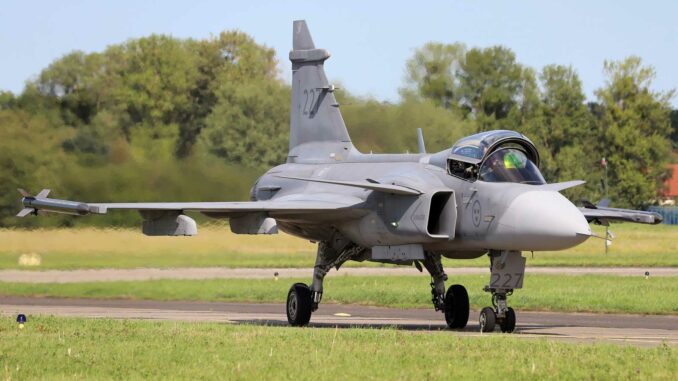
In Lviv, Zelenskyy and the King of Sweden are reviving the issue of the Gripen. Aid, budgets, training, funding, and the fighter’s role: what’s really changing.
In summary
King Carl XVI Gustaf’s visit to Lviv on April 17, 2026, has brought renewed attention to an issue many thought had been shelved: the potential reinforcement of the Ukrainian combat fleet with Swedish Gripen fighters. Volodymyr Zelensky stated that Sweden had approved €4 billion in support for 2026 and expressed hope that training for Ukrainian pilots on Swedish aircraft would begin this year. But we must be precise. At this stage, no transfer of Gripen aircraft to Ukraine has been officially announced. What does exist, however, is an escalation in the level of cooperation: massive military support, a Swedish budgetary framework of 80 billion kronor for 2026–2027, a letter of intent regarding advanced air capabilities, and discussions on the financing terms of a potential contract. Kiev is interested in the Gripen for one simple reason: it is a fighter designed for dispersed deployment, quick to redeploy, credible in air defense, and easier to maintain than other aircraft in a country under attack.
The Political Significance of the Lviv Visit
The scene in Lviv is not symbolic merely because a European leader visited Ukraine. It is symbolic because it combines three messages into a single trip: military support, civilian aid, and a signal regarding future air capabilities. The Ukrainian presidency stated that the meeting focused on strengthening the Ukrainian military, defense cooperation, humanitarian aid, and energy resilience. Zelensky also said he wished to discuss with the King of Sweden the launch, as early as this year, of training for Ukrainian pilots on Swedish aircraft. This point is central. It shows that Kyiv is no longer speaking only of abstract support, but of a complete chain ranging from political cooperation to crew training.
We must nevertheless remain rigorous. The visit to Lviv does not amount to an announcement of a delivery. Sweden has not issued a decision stating: we are now transferring Gripen aircraft to Ukraine. What is emerging, rather, is a gradual shift from the possible to the plausible. As early as January 2026, the Swedish Prime Minister had explained that Sweden was ready, “under the right conditions,” to provide Gripen aircraft for aerial surveillance missions. In October 2025, Stockholm and Kyiv signed a letter of intent on cooperation in the field of advanced air capabilities, explicitly mentioning the Saab JAS 39 Gripen as a potential area of cooperation. The events in Lviv are therefore part of a political and industrial continuum, not a sudden break.
The true nature of the announced “4 billion”
The figure of 4 billion spread very quickly, sometimes in a vague manner. It needs to be set straight. In his speech in Lviv, Zelensky said that Sweden had approved 4 billion euros in support for 2026. But official Swedish documents reveal a broader budgetary framework: Stockholm has established a budget of 80 billion Swedish kronor for military support to Ukraine over the period 2026–2027, or 40 billion kronor per year. The Swedish government also notes that, since February 2022, the total value of Swedish military aid has reached approximately 103 billion kronor, for total support to Ukraine of approximately 128 billion kronor.
In other words, the 4 billion euros mentioned by Zelenskyy correspond to a political order of magnitude for the year 2026, not necessarily to a Gripen package that has already been earmarked. Three levels must be distinguished. First, the Swedish national budget framework, which funds aid to Ukraine. Second, the specific military packages, such as the one from February 2026, worth nearly 12.9 billion kronor, devoted largely to air defense systems, long-range weapons, and ammunition. Finally, a potential specific Gripen arrangement, which would follow a different timeline and involve separate decision-making. This is where many narratives jump to conclusions too quickly. They give the impression that the 4 billion is already paying for the aircraft. That is not what the available public information indicates.
The potential financing of a Gripen deal
The real question isn’t just: Does Sweden want to help Ukraine? It’s already providing massive assistance. The real question is: Who will pay for the Gripens if the deal moves to the contractual stage? On this point, the most precise information emerged in the fall of 2025. Reuters reported at the time that Sweden was exploring the possibility of helping to finance a potential Ukrainian contract for up to 150 Gripen Es, which would have represented the largest fighter jet order in Swedish history. Defense Minister Pål Jonson mentioned several options: Swedish military aid, Ukraine’s post-war budget, export credits, and the potential use of frozen Russian assets.
Here, too, we must be frank. This scenario involving 100 to 150 Gripen E aircraft is not part of a short-term program intended to quickly fill a capability gap in 2026. It is a longer-term vision, almost a blueprint for a future fleet.
Yet Ukraine, today, first and foremost needs aircraft available quickly, training, ammunition, parts, maintenance teams, and a coherent doctrine of use. That is why the role of Swedish financing could take several forms. Stockholm can directly finance part of a deal. It can also provide training, equipment, technical support, spare parts, or even shoulder part of the risk through export agencies. And, politically, Sweden is also pushing at the European level for a more ambitious use of frozen Russian assets to bolster Ukraine’s war effort.
The Gripen’s Role in the Current War
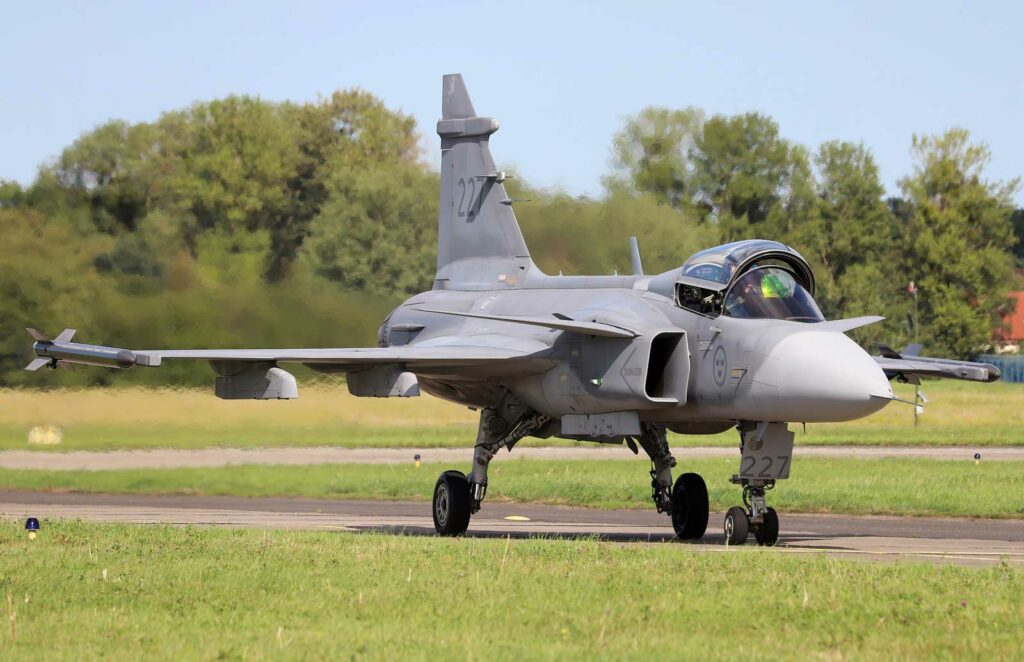
If the Gripen is back in the debate, it is not because it is more modern in every respect than the F-16. That is not the point. The point is that it meets certain constraints that are very specific to Ukraine. The JAS 39 Gripen was designed to operate in a dispersed Nordic environment, with operations from rudimentary bases, rapid redeployment, and relatively light logistics. For a country whose bases are targeted by airstrikes, this philosophy makes sense. The Gripen is also recognized for its performance in air defense, its ease of use in compact national formations, and its ability to operate in an architecture where dispersion and survivability matter as much as pure sophistication.
The Swedish fighter has a particularly logical role in four missions. First, air policing and interception. Second, defense against cruise missiles and aerial threats in a saturation scenario. Third, escort and protection of critical infrastructure or tactical air corridors. Finally, in the longer term, a more flexible strike capability should Ukraine obtain the necessary munitions and authorizations. However, the Gripen should not be turned into a miracle solution. No aircraft, whatever it may be, can replace either a multi-layered air defense system or a robust maintenance industry. The Gripen would be one more tool, potentially very useful, but not a shortcut to air superiority.
The Swedish rationale behind this opening
Sweden is not acting solely out of moral solidarity. It is also acting out of strategic calculation. The Swedish government makes it clear that support for Ukraine is a central element of Swedish security and defense. Since joining NATO, Stockholm has been thinking even more openly in terms of stability on the northern flank and European security. Helping Ukraine hold its ground militarily amounts, from the Swedish perspective, to containing the Russian threat away from the Baltic. That is the underlying logic.
There is also an industrial dimension. The Gripen regained export momentum in 2025–2026, with new contracts and a confident political communication strategy. The Swedish Minister of Defense even explained, in January 2026, that Sweden would likely soon be in a position to sell Gripen aircraft to Ukraine. This is no small matter. It means that Stockholm no longer views the aircraft solely as a national capability, but also as an instrument of strategic influence. Assisting Ukraine with the Gripen strengthens Kyiv, but it also establishes the Swedish fighter as a credible European solution in a market dominated by American aircraft.
The main obstacle: political and operational timing
The main obstacle is not merely technical. It is political and timing-related. In 2024, Stockholm ruled out an immediate shipment of Gripens, explaining that Ukraine’s priority should remain the integration of the F-16 and that Sweden preferred to contribute in other ways, notably with ASC 890 air patrol aircraft. This caution was not unreasonable. Opening too many aircraft programs in parallel can complicate training, maintenance, the parts supply chain, and infrastructure. Ukraine cannot integrate everything at once without spreading itself too thin.
This reasoning remains valid in 2026, even if the debate has evolved. Moving forward with the Gripen requires several conditions. Trained pilots are needed. Technicians and mechanics are needed. Ground support capabilities are needed. Compatible ammunition is needed. And, above all, a Swedish political decision is needed on the exact format: loan, donation, financed sale, partial support, or a hybrid scheme. Until these points are finalized, it would be misleading to speak of the transfer as a done deal. What the Lviv visit changes is that the issue is no longer relegated to a distant possibility. It is entering a phase where human and doctrinal preparation can begin even before the exact number of aircraft is known.
The budgetary role of humanitarian and energy aid
The Gripen issue must not overshadow the rest of the visit. Zelensky and the Swedish delegation also discussed humanitarian aid and energy resilience. This point matters more than it seems. A combat aviation force does not operate in a vacuum. It depends on an electrical grid, logistics networks, repairable infrastructure, medical capabilities, transportation, and a functioning state. In December 2025, Sweden granted 2 billion kronor in additional budgetary support to Ukraine via the European Union’s Ukraine Facility. This type of funding does not directly pay for an aircraft, but it helps maintain the Ukrainian state’s capacity to absorb the rest of the military aid.
This is where a purely military perspective falls short. The Gripens would only make sense within a broader framework: energy, reconstruction, command, air defense, European support, and sustainable financing. Sweden seems to have understood this. Its approach is not that of a mere potential aircraft seller. It is that of a partner who integrates military, humanitarian, and domestic resilience efforts.
What the Lviv sequence really says
The meeting in Lviv does not mean that Ukraine will receive a full squadron of Gripens tomorrow. It says something else, something more interesting. It shows that Stockholm and Kyiv are laying the political, human, and financial groundwork for a Gripen option that has become a serious possibility. Perhaps the most important thing, for now, is not the aircraft itself. It is the shift from speculative debate to a mindset of preparation: potential training starting as early as 2026, an expanded financial framework, a letter of intent regarding air capabilities, and a clearer Swedish openness than there was a year ago.
The real test will come soon. Either Sweden agrees to provide more substantial air support, and the Gripen will become a major European political marker. Or it remains at the stage of preparatory cooperation, and the aircraft will remain a diplomatic lever rather than an immediate tool of war. In either case, one thing is already clear: for Kyiv, the Gripen is no longer a distant dream. It is becoming a credible component of the discussion on post-F-16 emergency combat aviation, and perhaps one of the few European projects capable of linking military support, industrial sovereignty, and long-term war architecture.
War Wings Daily is an independant magazine.