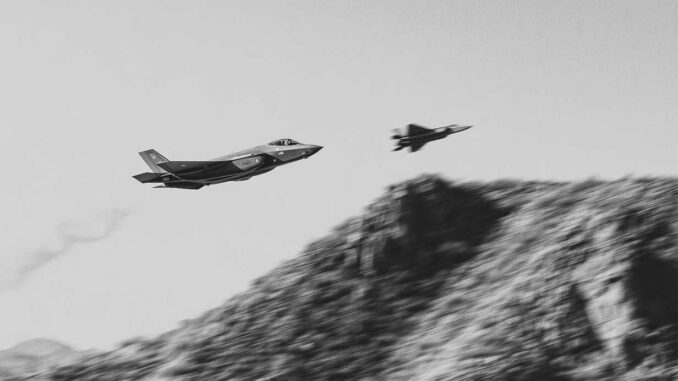
A technical look at whether the F-22 can defeat the F-35 in a dogfight, and why BVR combat, stealth and sensor fusion change the answer.
In Summary
In a classic close-range dogfight, the F-22 Raptor would almost certainly have the advantage over the F-35 Lightning II. It was built as an air-dominance fighter. It has two engines, thrust-vectoring nozzles, high thrust-to-weight performance, supercruise, strong energy retention and a weapons layout designed for air combat. The F-35 is not weak, but it was designed as a stealth multirole aircraft, not as a pure close-combat machine. Its real strength is elsewhere: sensor fusion, stealth, data sharing, electronic awareness and BVR combat. In a realistic modern engagement, the question is therefore misleading. The F-22 is the better dogfighter. The F-35 may be the better information node. Together, they are more dangerous than either aircraft alone. The F-22 hunts and controls the air. The F-35 detects, classifies, shares and attacks across a wider mission set.
The simple answer hides the real problem
Can an F-22 defeat an F-35 in a dogfight? Yes, in the narrow meaning of the word “dogfight”.
If the fight starts within visual range, with both aircraft aware of each other, with similar fuel states, similar weapon loads and no outside support, the F-22 has the better hand. It was designed for that world. It can point its nose aggressively. It can preserve energy better in vertical manoeuvres. It can accelerate harder. It can use thrust vectoring to sustain controllability at high angles of attack.
But that answer is also too simple. Modern air combat is not a boxing match. It is a system fight. The aircraft that wins is often the one that detects first, classifies first, shares first and fires first. In that environment, the F-35 is not a lesser F-22. It is a different kind of weapon.
The better question is this: what kind of fight are we talking about?
If the fight is a close-range turning contest, the F-22 is the favourite. If the fight begins beyond visual range, the result is less clean. The F-22 remains faster, stealthier in the air-superiority role and more kinematically powerful. The F-35 brings a newer sensor architecture, stronger data fusion and a cockpit designed around information management. That changes the tactical geometry.
The F-22 was built to dominate the air
The F-22 was conceived as an air-dominance fighter. That matters. Aircraft design is a set of compromises, and the Raptor’s compromises were made in favour of killing enemy fighters.
The aircraft uses two Pratt & Whitney F119-PW-100 turbofan engines. Each is in the 15,875-kilogram thrust class (35,000 pounds). The F-22 has a maximum takeoff weight of about 38,000 kilograms (83,500 pounds), carries about 8,200 kilograms of internal fuel (18,000 pounds), and can fly at Mach 2 class speeds with supercruise capability. Its ceiling is above 15,000 metres (50,000 feet).
That performance is not just brochure material. Speed and altitude matter in air combat because missiles inherit energy from the launching aircraft. A missile fired from a fast, high aircraft has a better starting condition than one fired from a slower, lower aircraft. This is why the F-22’s supercruise is so important. It can travel above Mach 1.5 without afterburner, which saves fuel while giving weapons more launch energy.
The F-22 also carries its air-to-air weapons internally. A standard air-to-air loadout includes six AIM-120 radar-guided missiles and two AIM-9 infrared missiles, plus a 20 mm M61A2 cannon with 480 rounds. Internal carriage preserves stealth and avoids the drag penalties of external pylons.
In close combat, the Raptor’s decisive feature is not just speed. It is the mix of high thrust, flight-control laws, large control surfaces and two-dimensional thrust-vectoring nozzles. These nozzles deflect engine thrust to help pitch the aircraft. That gives the pilot more authority when the wing is already working hard. It does not make physics disappear. It does, however, give the F-22 unusual nose-pointing power and post-stall handling options.
This is exactly the kind of advantage that matters in a visual fight.
The F-35 was built for a wider war
The F-35A is a different aircraft. It is a single-engine stealth multirole fighter. It was designed to replace several aircraft types, including the F-16 and A-10 in the U.S. Air Force. That alone explains much of the difference.
The F-35A has one Pratt & Whitney F135-PW-100 engine producing about 19,500 kilograms of thrust (43,000 pounds). It has a maximum takeoff weight in the 31,750-kilogram class (70,000 pounds), internal fuel of about 8,390 kilograms (18,498 pounds), a top speed of Mach 1.6 and a ceiling above 15,000 metres (50,000 feet). It is also rated as a 9g aircraft.
Those figures are respectable. The F-35 is not a clumsy bomber pretending to be a fighter. It can manoeuvre, fight and survive. But its main edge is not raw kinetic performance. Its edge is information.
The F-35’s sensor package includes the AN/APG-81 AESA radar, the Electro-Optical Targeting System and the Distributed Aperture System. These systems feed data into a fused tactical picture. The pilot is not expected to manually stitch together radar returns, infrared tracks, electronic emissions and off-board data in the old way. The aircraft does much of that work.
That is the heart of F-35 sensor fusion. It reduces pilot workload. It improves situational awareness. It allows the F-35 to act as a stealthy collector, shooter and data distributor. Lockheed Martin and the U.S. Air Force describe the aircraft as a force multiplier because it can share information with other aircraft, ships, ground units and command networks.
This is why judging the F-35 only by dogfight performance misses the point. The F-35 was not bought primarily to win airshow-style turning contests. It was bought to enter defended airspace, find targets, survive, strike and connect the force.
The dogfight favours the Raptor
A close-range F-22 vs F-35 engagement would expose the core aerodynamic gap between the aircraft.
The F-22 has more installed thrust overall, better acceleration, better supersonic persistence and thrust vectoring. It was shaped around air superiority. Its wing, control surfaces and propulsion system give it stronger energy manoeuvrability. In plain English, it can spend speed, altitude and angle more aggressively and recover better.
The F-35 can pull 9g and can fly at high angles of attack. It also has modern short-range missile options and a helmet-mounted display. Those are serious tools. In a within-visual-range fight, a pilot does not always need to point the aircraft perfectly at the opponent if a high off-boresight missile can be cued by the helmet.
But the aircraft still has to survive long enough to shoot. It must manage energy. It must avoid becoming slow and predictable. Against an F-22, that is a hard problem.
A Raptor pilot would likely try to exploit vertical manoeuvres, rapid nose pointing and energy control. The F-35 pilot would try to deny a sustained turning fight, use sensors and helmet cueing, and force a missile shot before the F-22’s energy advantage becomes decisive.
The blunt assessment is this: if both aircraft merge and remain in a traditional manoeuvring fight, the F-35 is in trouble. It can fight. It is not helpless. But the F-22 is the aircraft purpose-built for that exact scenario.
The BVR fight is less obvious than the dogfight
Beyond visual range combat changes the discussion.
The F-22 still brings major advantages. It is stealthy, fast and capable of launching missiles from high-energy conditions. Its supercruise gives it the ability to shape the fight before the merge. It can close, fire and reposition with more freedom than most fighters.
The F-35’s argument is different. It may not outrun or outclimb the F-22, but it can build a very rich tactical picture. Its Beyond Visual Range strength comes from detection, classification, sensor fusion, electronic support and data sharing. In a many-versus-many engagement, that can matter as much as speed.
No public source can honestly give a clean answer about which aircraft detects the other first. Radar cross-section, radar modes, electronic-warfare performance, datalink behaviour and missile employment envelopes are deeply classified. Any confident claim about exact detection ranges should be treated with suspicion.
What can be said is more limited, but more useful. The F-22 has the stronger air-superiority kinematic package. The F-35 has the stronger open-ended information architecture. In BVR combat, the F-35 could complicate the F-22’s problem if it receives off-board data, operates passively, uses electronic sensors well or works inside a networked force.
In a sterile one-on-one BVR duel, the F-22 remains extremely dangerous. In a real campaign, the F-35’s ability to feed and receive information may become the more valuable asset.
The two aircraft were designed to complement each other
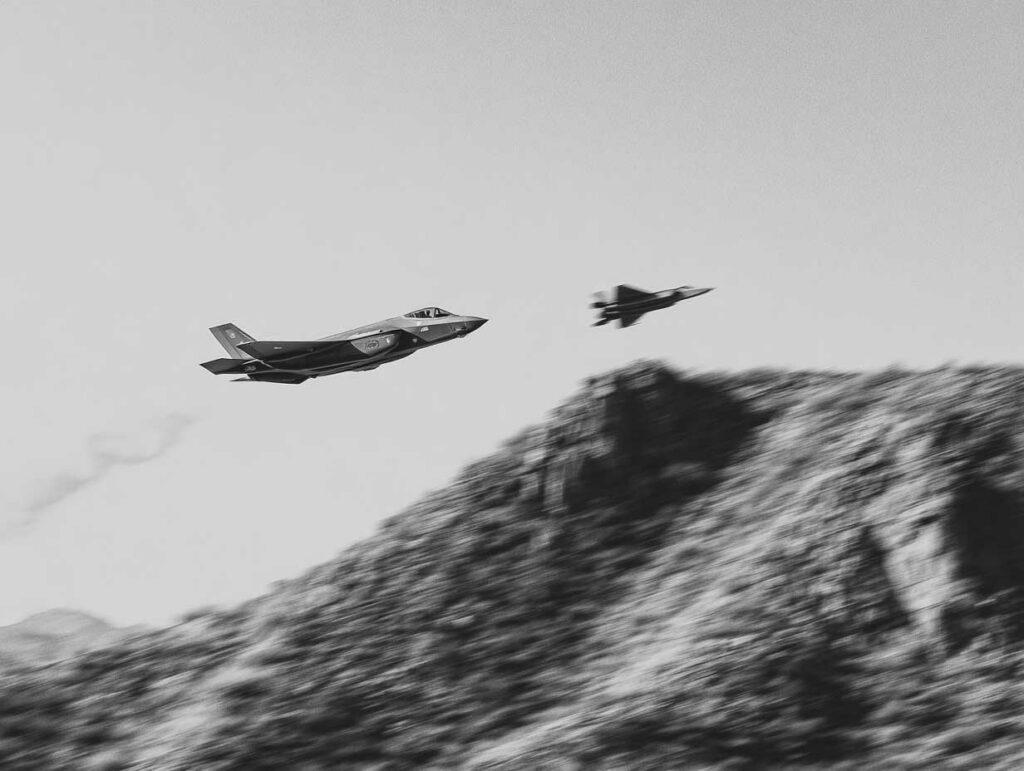
The F-22 and F-35 should not be seen only as rivals. They are better understood as complementary aircraft.
The F-22 clears the air. It was built to defeat enemy fighters and protect the force. It can escort, sweep, intercept and impose air dominance. It is the cleaner air-to-air machine.
The F-35 penetrates, senses, strikes and networks. It can attack ground targets, suppress air defences, identify emitters, share targeting data and support coalition operations. It is also widely exported, while the F-22 was never exported and exists only in small numbers.
That difference in fleet scale matters. The U.S. Air Force lists a total F-22 inventory of 183 aircraft. The F-35 program, by contrast, is a vast multinational fleet. Lockheed Martin said in early 2026 that the F-35 fleet had passed one million flight hours, and the broader program involves thousands of planned aircraft across the United States and partner nations.
In war, availability and networking matter. A small fleet of elite fighters cannot be everywhere. A larger fleet of stealth multirole aircraft can create a wider operational effect.
The strongest pairing is therefore not F-22 versus F-35. It is F-22 plus F-35. The F-35 can act as a forward sensor and data node. The F-22 can use its speed and weapons to exploit that picture. The Raptor gives the package air-combat authority. The Lightning II gives it information depth.
The F-35’s limits are real, but often misunderstood
The F-35 has often been criticised as a poor dogfighter. Some criticism came from early test reporting, especially the 2015 debate around F-35A basic fighter manoeuvres against an F-16. That episode still appears in almost every internet argument about the jet.
The problem is that the lesson was both real and overused.
Yes, early F-35 manoeuvring tests raised concerns about energy manoeuvrability and nose authority in certain conditions. Yes, those concerns matter when discussing close combat. But those tests involved a developmental aircraft, specific control-law maturity and a limited test objective. They did not prove that every operational F-35 is helpless in air combat.
The more serious point is structural. The F-35 will never become an F-22. It has one engine, different shaping priorities, different mission equipment, different thermal and payload constraints, and no thrust vectoring. Software and tactics can improve how it fights. They cannot turn it into a pure air-dominance fighter.
Recent modernization also shows the burden of the F-35’s ambition. The U.S. Government Accountability Office reported in 2025 that Block 4 modernization had suffered cost growth and schedule delays, with a reduced package now expected no earlier than 2031 for some capabilities. That matters because the F-35’s value depends heavily on continuous software, sensor, electronic-warfare and weapons upgrades.
The F-35 is a powerful combat system. It is also a demanding one.
The final verdict depends on the battlefield
The honest verdict is not flattering to internet simplicity.
In a dogfight, the F-22 should defeat the F-35 most of the time. It has the better aerodynamic and propulsion package for close-range air combat. Its thrust vectoring, supercruise, acceleration and air-dominance design give it a clear advantage once the aircraft merge.
In BVR combat, the picture is more complex. The F-22 still has superior speed and energy. The F-35 brings a more modern sensor-fusion philosophy and stronger networking logic. The result would depend on rules of engagement, pilot skill, starting geometry, fuel state, weapons load, emissions discipline, outside sensors and electronic warfare.
In a real war, neither aircraft should be used like a gladiator. The F-22 should not waste its strengths in avoidable turning fights. The F-35 should not be forced to fight as a lightweight air-superiority jet. Each aircraft has a job.
The Raptor is the sharper knife in the phone booth. The Lightning II is the aircraft that may know where the phone booth is before anyone else gets there.
That is the real answer. The F-22 is the better dogfighter. The F-35 is the broader combat system. The most dangerous force is not one defeating the other. It is both aircraft fighting together.
War Wings Daily is an independant magazine.