
In Dallas, Lockheed Martin and the Department of Defense aim to accelerate the development of precision munitions. The real challenge is industrial, not just military.
In summary
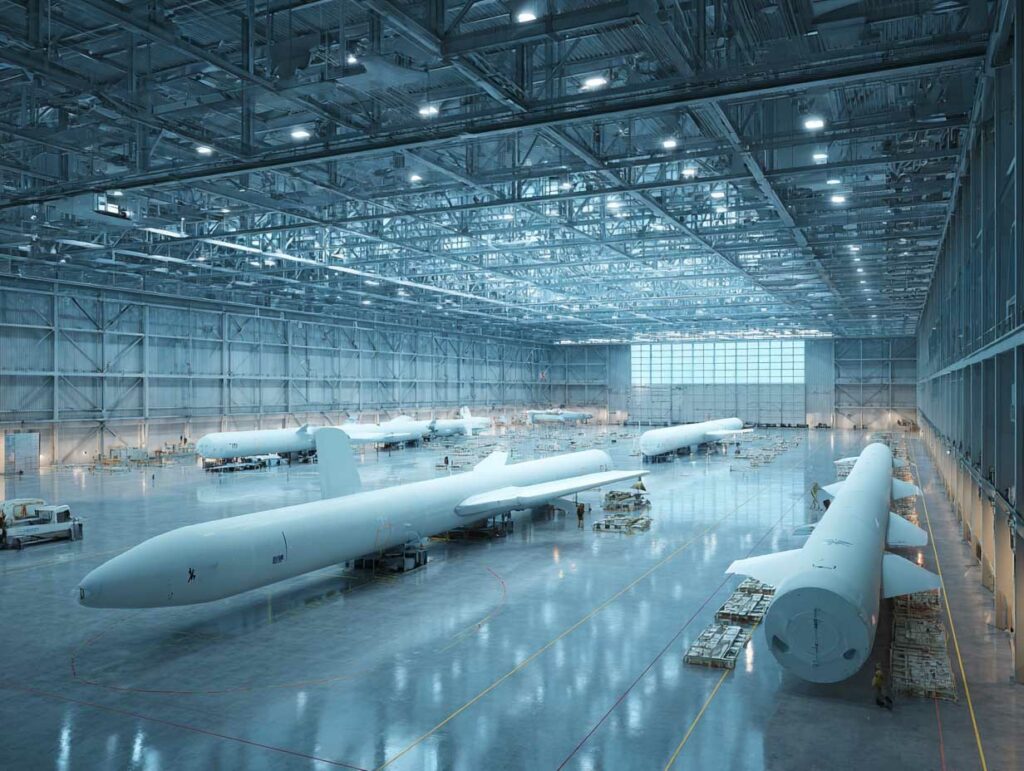
Lockheed Martin and the U.S. Department of Defense brought together more than 150 suppliers in Dallas to launch a series of conferences dedicated to accelerating precision munitions. The goal is clear: to produce missiles faster than the United States and its allies are now consuming them at a rapid pace. The programs involved include the PAC-3 MSE, the THAAD, and the Precision Strike Missile. Lockheed Martin plans to invest between $8 billion and $9 billion by 2030, with more than 20 new or modernized manufacturing sites across the United States. This strategy responds to a harsh reality: the wars in Ukraine and the Middle East, along with the rivalry with China, have shown that technological superiority is no longer enough if stockpiles run low. The issue is therefore not just about missile performance. It is about America’s ability to return to a mindset of stockpiling.
The Dallas Signal Reveals U.S. Industrial Concern
The meeting held in Dallas is not merely a gathering of suppliers. It is a political and industrial signal. More than 150 Lockheed Martin suppliers met with Department of Defense officials to discuss a topic that has become a priority: delivering munitions “at speed and scale,” that is, quickly and in large volumes. The inaugural event, dubbed the Munitions Acceleration Supplier Conference, was held in Grand Prairie, Texas, at the heart of an ecosystem already central to the U.S. missile industry.
The message is clear. The United States no longer wants merely to possess the best precision munitions. It wants to be able to produce them in sufficient quantities to sustain a protracted war, a major regional crisis, or multiple theaters of operation simultaneously.
This marks a cultural shift. For three decades, Washington has often viewed warfare through the lens of precision, air superiority, targeted strikes, and relatively short campaigns. This vision remains relevant, but it is incomplete. Recent conflicts have underscored an age-old truth: even a highly advanced military can be compromised if its stockpiles of missiles, interceptors, and critical components run too low.
Lockheed Martin and the DoW therefore aim to strengthen the ties between the prime contractor, suppliers, subcontractors, procurement authorities, and military customers. The conference is set to continue monthly, alternating between in-person and virtual formats. This detail matters. It shows that the goal is not merely a publicity stunt, but a consistent pace of industrial coordination.
The missiles in question are at the heart of modern warfare
The programs mentioned are not secondary. They address three major needs: air defense, missile defense, and precision ground strikes.
The PAC-3 MSE is one of the most in-demand interceptors today. It is part of the Patriot system and is used to intercept tactical ballistic missiles, cruise missiles, and aircraft. Its operational value has been reinforced by the war in Ukraine and by increased demand from European and Asian allies.
Lockheed Martin has announced a very ambitious goal: to increase annual production capacity from approximately 600 missiles to approximately 2,000 units over seven years. In 2025, the company delivered 620 PAC-3 MSEs, more than 20% more than the previous year.
The THAAD addresses another threat. This system is designed to intercept ballistic missiles at high altitude, during the terminal phase of their trajectory. Its importance is growing with the proliferation of ballistic missiles in Asia and the Middle East. Lockheed Martin and the Department of Defense (DoD) have announced plans to quadruple the production capacity of THAAD interceptors, from a level of approximately 96 per year to nearly 400 units annually.
The Precision Strike Missile, or PrSM, illustrates the third requirement: striking far, fast, and with precision. This ground-to-ground missile is intended to gradually replace the ATACMS. It can be fired from HIMARS and M270 launchers. Lockheed Martin specifies a range of 60 to over 499 kilometers. Most importantly, two PrSMs can be placed in a single pod, compared to a single ATACMS. For the same logistical volume, firepower therefore increases significantly.
These three programs encapsulate the new U.S. challenge: intercept more, strike farther, and sustain operations longer.
The Logic of Stockpiles Is Changing After Ukraine and the Middle East
The war in Ukraine has been a wake-up call. It has shown that precision munitions are not merely rare weapons used in limited campaigns. They can become strategic consumables. Patriot missiles, guided rockets, anti-tank missiles, artillery shells, and drones are being used at rates that are straining Western arsenals.
The Middle East has added a second layer of pressure. Drone, cruise missile, and ballistic missile attacks against Israel, U.S. bases, or commercial shipping have confirmed the importance of interceptors. Air defense is expensive. It depletes resources quickly. It requires deep stockpiles.
This is the heart of the problem. A precision-guided missile is not just a technological product. It is an industrial commitment. If it takes several years to replace just a few weeks’ worth of consumption, deterrence becomes fragile.
Washington wants to avoid this situation in the Indo-Pacific. In a scenario involving China, the distances would be immense. U.S. bases would be exposed. Supply ships and depots would be vulnerable. Allies would request deliveries. Stocks of long-range, air defense, and interceptor missiles would be depleted very quickly. The Pentagon cannot afford to discover, in the midst of a crisis, that its supply chains are not keeping up.
The Dallas conference must therefore be viewed as an exercise in preparation for a protracted war.
Missile production depends on thousands of invisible details
The general public sees the finished missile. The industry sees a supply chain. This chain is long, fragile, and sometimes surprisingly specialized.
A precision-guided missile contains rocket engines, propellants, ruggedized electronics, actuators, computers, sensors, navigation systems, communication links, warheads, composite materials, machined parts, wiring, and pyrotechnic components. The slightest bottleneck can halt the entire production line.
This is why Lockheed Martin is talking about developing alternative sources for critical parts. A single factory, a single supplier, or a single production line can become a vulnerability. If a component is available only from a highly specialized supplier, the final production rate of the missile depends on that supplier.
The problem isn’t just technical. It’s human. We need to recruit, train, and retain welders, technicians, engineers, quality control specialists, machine operators, materials specialists, and testing teams. A missile production line can’t be scaled up like a software line. It requires machinery, certifications, audits, security clearances, strict procedures, and time.
Lockheed Martin says it plans to invest between $8 and $9 billion by 2030 to increase munitions production, modernize or build more than 20 facilities, and strengthen the supply chain. That is a considerable sum. But it reflects the scale of the problem.
The acquisition strategy aims to break free from bureaucratic red tape
The DoD is framing this acceleration within an Acquisition Transformation Strategy. The term is bureaucratic, but the idea is simple: to reduce the slowness of the U.S. acquisition system.
Major U.S. defense programs are often highly effective but slow. They involve multiple phases, reviews, solicitations, negotiations, and budget approvals. This model can produce complex platforms. It is less suitable when a military needs to rapidly increase stockpiles of already proven weapons.
The new approach relies on framework agreements, multi-year contracts, and greater visibility for the industry. A manufacturer is reluctant to invest in a factory, machinery, or hiring if orders remain uncertain from one year to the next. To produce more, predictability is needed.
This is particularly true for missiles. Suppliers must purchase equipment, secure raw materials, validate processes, and hire staff. If Congress does not confirm funding, these investments become risky. Multi-year contracts therefore help reduce some of the uncertainty.
This approach is rational. But it also carries a risk: locking in industrial choices for too long, while threats evolve rapidly. Producing more existing missiles is necessary. But we must not freeze the arsenal in yesterday’s technologies.
The benefits are real for the United States and its allies
The first benefit is obvious: deeper stockpiles. An army with more interceptors and precision-guided missiles can sustain a campaign for longer. It can also transfer weapons to its allies without immediately weakening its own readiness.
The second benefit is the credibility of deterrence. An adversary does not look only at a missile’s technical specifications. It looks at the ability to produce many of them. If China, Russia, or Iran believe the United States can quickly replenish its stockpiles, the strategic calculus changes.
The third advantage concerns allies. Customers of the Patriot, THAAD, HIMARS, or PrSM are awaiting deliveries. Several European, Asian, and Middle Eastern countries want to strengthen their missile defense. Without increased production, delivery times lengthen, prices rise, and political priorities become explosive.
The fourth advantage is industrial. Investment in factories, suppliers, and secondary sources can strengthen the U.S. industrial base. This creates skilled jobs. It reduces certain dependencies. It also improves resilience in the event of a crisis.
The fifth advantage is military. Higher production rates allow for better absorption of the actual demand in modern conflicts. Air defense, in particular, is no longer a luxury. It is becoming a condition for the survival of bases, ports, ground forces, and critical infrastructure.
The limitations are financial, industrial, and political
Scaling up production is not free. Precision-guided missiles are expensive. The PAC-3 MSE, THAAD, and PrSM are not simple munitions. Even though exact unit costs vary depending on contracts, batches, exports, and logistical support, these are systems costing several million dollars each for the most advanced interceptors.
The budgetary issue therefore becomes central. Producing more is necessary, but budgets are not infinite. Every billion spent on missiles is a billion not spent elsewhere: maintenance, ships, aircraft, cyber defense, drones, military housing, training, or spare parts stockpiles.
There is also a risk of dependence on major prime contractors. Lockheed Martin is indispensable for these programs. But an overly concentrated industrial base can create situations of asymmetric power vis-à-vis the government. The Pentagon is pushing manufacturers to produce faster, but it remains dependent on their actual ability to deliver.
Labor is another constraint. The United States wants to revitalize its arsenal, but it must do so in an economy where skilled industrial workers are in high demand. Building a factory is easier than immediately finding the teams capable of running it at the required quality level.
Finally, there is a strategic limit. Producing more precision-guided missiles is not enough if the adversary imposes an economic war of attrition. If a drone costing a few tens of thousands of dollars forces the use of an interceptor costing several million, the equation remains unfavorable. The United States will therefore have to combine high-end missiles, lasers, electronic warfare, cannons, interceptor drones, and less expensive systems.
International comparison reveals a race for mass production
The United States is not alone in recognizing this problem. Russia has adapted its war economy to produce more missiles, Shahed-derived drones, glide bombs, and artillery munitions. Its method is less sophisticated, but it aims for the same goal: sustaining the effort over the long term.
China is watching closely. It has a deep industrial base, massive electronics production, and a growing arsenal of ballistic missiles, cruise missiles, and anti-access systems. In the Indo-Pacific, Beijing can rely on geographical proximity. Washington, on the other hand, must project its power over thousands of kilometers. This asymmetry heightens the urgency for the U.S.
Europe is in a more uncomfortable position. The war in Ukraine has exposed the weakness of stockpiles and the slowness of certain supply chains. Europeans are reinvesting, but industrial fragmentation, national procedures, and scattered volumes are slowing the effort. Europe understands the problem but still struggles to address it on the necessary scale.
Israel represents another model. Its industry has extensive experience with interceptors, guided munitions, and anti-missile systems. But even Israel depends on U.S. support to replenish certain stockpiles during prolonged crises. This shows that even a highly advanced military power cannot neglect industrial depth.
The current race is therefore not just a race for the best missiles. It is a race for the ability to produce complex munitions at high rates.
The real issue goes beyond Lockheed Martin
The Dallas conference is important, but it doesn’t solve everything. It shows that the Pentagon and Lockheed Martin have identified the right problem: production capacity has become a military capability in its own right. In a long war, the factory matters almost as much as the launcher.
But the effort will have to be judged by results, not press releases. The real questions are simple. Will the announced production rates be met? Will suppliers keep up? Will costs remain under control? Will Congress provide sufficient funding? Will allies receive their systems without depleting U.S. stockpiles? Will the new factories produce quickly enough to make a difference before the next crisis?
The answer will determine part of U.S. military credibility. The United States retains a major technological lead. But modern warfare imposes a harsh lesson: exceptional ammunition, available in too small a quantity, becomes a luxury. High-performance ammunition, produced at an industrial rate, becomes a strategic instrument.
Dallas thus marks less the launch of a conference than the return of an old American idea: the arsenal wins long wars. This time, the arsenal no longer produces only tanks, trucks, and shells. It must produce interceptors, tactical missiles, sensors, computers, and rocket engines. Precision remains essential. Mass once again becomes decisive.
War Wings Daily is an independant magazine.