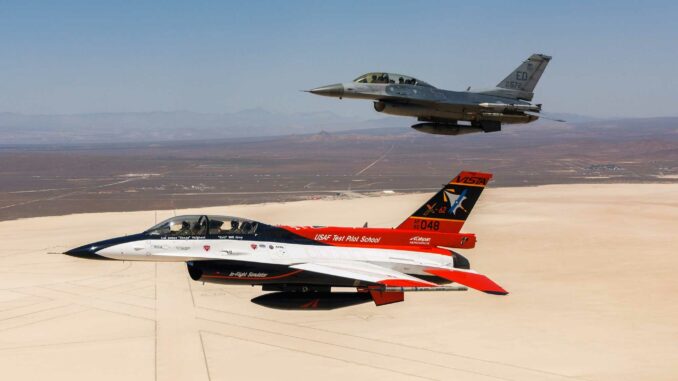
On August 4, 2026, Skunk Works revealed that the X-62A VISTA executed 27 autonomous interceptions driven by AI using the infrared Legion Pod. A technological breakthrough in real-world combat.
In summary
On August 4, 2026, Lockheed Martin Skunk Works and the US Air Force Test Pilot School made public the results of two test programs conducted in April 2026 at Edwards Air Force Base (California): HAVE HEAT and HAVE HOLIDAYS. Over the course of eight sorties, the X-62A VISTA—a modified F-16D used as an aerial testbed—executed 27 autonomous interceptions piloted entirely by artificial intelligence, without human intervention on the controls. The AI agent processed raw data in real time from the Legion Pod, a passive infrared search and track (IRST) sensor. The intercepted aircraft was an actual T-38 Talon, piloted by a human crew. These were not simulations, nor injected synthetic data: the system operated in a real flight environment, ingesting classified infrared streams to independently decide on the flight path to adopt. Complete integration of the AI agent into the avionics architecture was achieved in three months, thanks to the internal pipeline dubbed “Supermassive.”
The X-62A VISTA: A unique flying laboratory
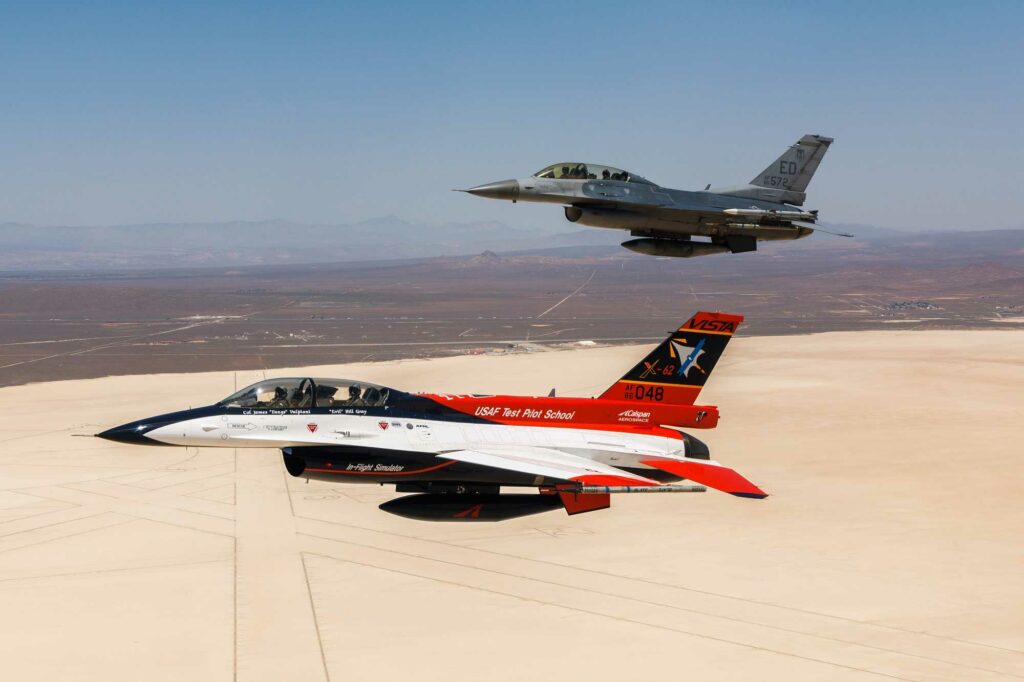
The X-62A VISTA—for Variable In-flight Simulation Test Aircraft—is not a standard fighter. It is a deeply reconfigured NF-16D assigned to the US Air Force Test Pilot School (TPS) at Edwards Air Force Base. Its key distinction is its ability to mimic the handling qualities of almost any aircraft in flight, making it the ideal testbed for evaluating autonomy software without risking a production aircraft.
Since 2023, the VISTA has been at the center of the VISTA-SABRE program, which had already yielded a historic milestone: an AI agent flew the F-16 in simulated air combat against a human pilot during tests in September 2023. However, those early campaigns used targeting data artificially injected into the system. The breakthrough of April 2026 is radically different: this time, the AI agent acted based on a real operational sensor on board, fed by the thermal signatures of an actual target aircraft in real flight.
The Legion Pod and IRST: Seeing without emitting
The Legion Pod is a sensor developed by Lockheed Martin around the IRST21 infrared receiver—the same unit carried by the US Navy’s F/A-18E/F Super Hornets. Its function is fundamentally passive: it detects targets through their infrared radiation—heat generated by engines, aerodynamics, and friction—without emitting a single electromagnetic signal.
It is this absence of emissions that represents the core strategic value of the system. A conventional radar sends out a wave and listens for its echo. In doing so, it reveals the transmitter’s position. An IRST system simply listens. It is invisible to adversary radar warning receivers, immune to electronic jamming, and capable of detecting stealth targets whose radar cross-section is virtually zero—yet whose thermal signature remains physically unavoidable. The Chinese J-20, the Russian Su-57, or an enemy F-35: all emit heat, regardless of their radar stealth.
The Legion Pod’s range exceeds 50 kilometers in the target’s rear hemisphere, where engine exhaust gases are directly exposed to the sensor. The architecture also enables multi-platform passive triangulation: two aircraft equipped with Legion Pods can determine the three-dimensional position of a target without using radar by combining their measurement angles via a dedicated datalink—a capability tested as early as 2022 on F-15s and F-16s at Eglin Air Force Base.
How the 27 interceptions unfolded
The eight test sorties took place throughout April 2026 as part of the HAVE HEAT program operated by the TPS research division. The target aircraft was a T-38 Talon, a real twin-engine jet trainer piloted by a human crew. The X-62A VISTA took off equipped with the Legion Pod. Upon infrared acquisition of the T-38, raw IRST data was transmitted in real time to the onboard AI agent, which extracted the target’s angular position, estimated range, and velocity vector.
Relying exclusively on sensory information—with zero radar assistance, no preloaded synthetic data, and no intervention from the human pilot on board—the AI agent calculated the optimal interception geometry and flew the X-62A into the corresponding tactical position. An aerial interception consists of placing the attacking aircraft within a spatial zone from which a weapon can be effectively employed. The AI agent repeated this complete sequence 27 times against moving targets under unscripted flight conditions.
Ron Fehlen, vice president and general manager of Lockheed Martin Skunk Works, stated on August 4: “Our autonomous agents consumed classified infrared streams and executed critical maneuvers in real time.” He described the result as an operational demonstration of AI’s ability to close the sensor-to-shooter loop aboard a combat aircraft.
The parallel HAVE HOLIDAYS program and open architecture
Concurrently with HAVE HEAT, the HAVE HOLIDAYS program tested a series of complementary capabilities using the same platform. These trials focused on the modular integration of a third-party autonomous agent—not developed by Lockheed Martin—into the X-62A’s Enterprise Open Mission System (Enterprise OMS) architecture. This open architecture is designed to accommodate software from different vendors without requiring a complete avionics overhaul.
HAVE HOLIDAYS also evaluated a suite of enhanced safety rules that prevent autonomous vehicles from breaching operational boundaries set by human operators—what engineers refer to as “operational guardrails.” It also included integration tests for specialized chips designed for advanced sensor data processing. These two programs were executed in parallel and under deliberate coordination as part of the Mission Systems Upgrade (MSU), a strategic investment by the Test Resource Management Center aimed at expanding the X-62A’s autonomy test capabilities in more complex scenarios.
“Supermassive”: The method compressing development timelines
What is as striking as the results themselves is the speed at which they were achieved. Lockheed Martin completed the full integration of the AI agent into the X-62A—from design to ground validation—in just three months. For a defense program of this complexity, that timeframe is unusually brief.
The key is Skunk Works’ internal pipeline named “Supermassive.” It is an AI agent development pipeline that compresses the entire cycle—from initial agent concept to simulation training, hardware-in-the-loop software testing, and flight deployment—into a schedule of months rather than years. This accelerated development capability is a strategic result in its own right: it means new autonomous behaviors can be developed, tested, and potentially fielded at a pace incompatible with traditional acquisition cycles.
How these tests reshape air combat doctrine
The significance of these 27 interceptions extends far beyond the lab. They represent the first real-world flight validation of an AI system closing the end-to-end sensor-to-decision-to-action loop on a fighter jet without synthetic data inputs. This is precisely the expected use case for future Collaborative Combat Aircraft (CCA)—the autonomous drone wingmen intended to accompany the F-35 or the future F-47—for which the US Air Force awarded initial production contracts to Anduril and General Atomics on June 17, 2026.
A CCA in high-intensity combat will not receive clean targeting data from a crewed platform: it must sense its environment, localize threats, and decide on its maneuvers autonomously within an electromagnetic spectrum potentially saturated by adversary jamming. That is exactly the scenario HAVE HEAT simulates with the passive Legion Pod: an agent that sees without emitting, decides without guidance, and maneuvers without a pilot.
What these 27 interceptions prove is that the loop works. Not in a cleanroom. Not with synthetic data. In the real sky, against a real jet, with an operational sensor. The question is no longer whether AI can fly a fighter. The question now is how quickly this capability will migrate from Edwards Air Force Base to an operational wing.
War Wings Daily is an independant magazine.