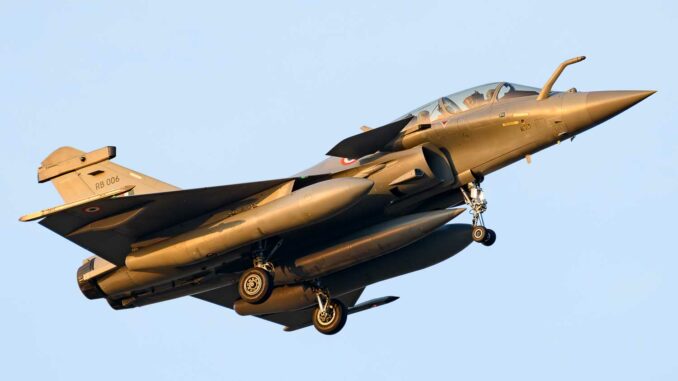
Paris proposes 114 Rafales to India, including 94 produced locally, featuring industrial transfers, maintenance, and increasing integration of Indian technology.
In summary
In early August 2026, France submitted its detailed technical and commercial proposal to India for the acquisition of 114 Rafale jets intended for the Indian Air Force. The framework currently reported provides for 20 aircraft delivered directly from France to meet urgent operational requirements, followed by 94 fighters manufactured in India. Estimated at approximately 3.25 trillion rupees, the program would far exceed a simple aircraft purchase. Dassault Aviation is set to oversee local industrialization, while Safran, Thales, and MBDA will progressively transfer to India a portion of the production, maintenance, and support for engines, electronic equipment, and weaponry. Tata Advanced Systems is already manufacturing future Rafale fuselage sections in Hyderabad. Safran is likewise preparing for local maintenance of the M88 engine. India’s objective is clear: quickly procure additional fighters while leveraging the order as a catalyst to upgrade the capabilities of its domestic aerospace industry.
The French proposal covers 114 Rafales and genuine Indian production
The process has just crossed a decisive threshold.
In early August, France transmitted its technical and commercial response to the Letter of Request sent by India in the spring of 2026. This procedure places both nations in the phase preceding final negotiations over pricing, industrial transfers, equipment specifications, and delivery schedules.
The project involves 114 additional Rafale combat aircraft for the Indian Air Force.
According to the scheme outlined by recent Indian sources, 20 aircraft would be produced in France and delivered in a “fly-away” configuration. The remaining 94 fighters would be built in India.
This split addresses two distinct challenges.
First, New Delhi needs aircraft quickly. The Indian Air Force must offset the progressive retirement of several older MiG generations while bridging delays encountered by certain domestic programs. An initial batch of French deliveries would allow India to boost its force strength without waiting for a new domestic manufacturing footprint to be established.
However, India now refuses to let an order of this magnitude be reduced to importing fully built fighters.
Consequently, the subsequent 94 aircraft are intended to establish a genuine Rafale industrial capability in India, progressively encompassing airframe manufacturing, final assembly, sub-assemblies, maintenance, and long-term support.
The cited value reaches approximately 3.25 trillion rupees. At this scale, the contract would represent one of the largest fighter procurement programs ever undertaken by India.
The Rafale already possesses an industrial and operational base in India
France is not starting from scratch.
The Indian Air Force already operates 36 Rafale aircraft ordered in 2016, which equip two squadrons based at Ambala and Hasimara.
In April 2025, India also ordered 26 Rafale Marine aircraft for the Indian Navy, comprising 22 single-seaters and four twin-seaters. That contract includes weaponry, simulators, training, support, and provisions allowing for the integration of indigenous Indian systems.
With this new order, India would eventually boast 176 ordered Rafales, including 150 for the air force and 26 for the navy.
This critical mass completely alters the economic equation.
Building a complex industrial infrastructure for a few dozen aircraft is cost-prohibitive. With nearly a hundred fighters to be produced locally—supplemented by several decades of maintenance—indigenization becomes far more rational.
Above all, the Indian government can amortize investments across a large fleet and apply the acquired technologies to other domestic aerospace programs.
Dassault Aviation will remain the architect of the industrial system
Dassault Aviation will remain the lead integrator for the Rafale.
This role extends far beyond assembling aircraft parts.
Dassault is responsible for the overall architecture, aerodynamics, systems integration, flight controls, mission software, and seamless interoperability among equipment supplied by Safran, Thales, MBDA, and industrial partners.
Producing a Rafale in India therefore requires replicating a portion of this complex industrial network.
That shift is already underway.
In June 2025, Dassault Aviation and Tata Advanced Systems Limited signed four production transfer agreements. Tata is constructing a facility in Hyderabad capable of manufacturing key sections of the Rafale fuselage.
Specifically, it is tasked with producing the lateral bodies of the rear section, the complete rear fuselage, the central fuselage, and the forward section.
This is not a symbolic operation.
These structural components represent a major portion of the airframe.
The first components are scheduled to leave the plant during fiscal year 2028. The site is designed to reach an output of two complete fuselages per month.
Crucially, these fuselages are not reserved exclusively for Indian aircraft. Dassault specifies that they will also feed into the global Rafale supply chain.
India is thus progressively embedding itself into the aircraft’s international supply chain.
Tata emerges as a central player, but not the sole Indian industrial partner
Tata Advanced Systems currently stands out as the most clearly identified Indian industrial partner.
However, it would be premature to assume that Tata will automatically handle the final assembly of all 94 locally built aircraft.
The precise division of labor for the future contract has not yet been made public.
Dassault already maintains another significant industrial presence in India through Dassault Reliance Aerospace Limited in Nagpur. Dassault now holds a 51% controlling stake in this entity, which has been steadily building expertise in Falcon business jet airframes.
Furthermore, Dassault’s wider Indian ecosystem comprises over 30 companies.
Groups such as Larsen & Toubro are cited among the firms likely to benefit from the program. Indian sources estimate that subcontracts placed with domestic industry could reach approximately 1.6 trillion rupees.
This figure illustrates the true dimension of the “Make in India” initiative targeted by New Delhi.
It is not merely a matter of establishing an assembly line where Indian workers assemble French kits. The goal is to drive value-added manufacturing deeper into the national supply chain over time.
Safran builds the M88 engine ecosystem in India
The second major pillar is Safran.
The Rafale is powered by two Safran M88 engines—afterburning turbofans in the 75 kN thrust class.
A complete transfer of the M88’s core design technology has not been announced.
However, engine support capabilities are already being localized.
Safran is constructing the first offshore M88 Maintenance, Repair, and Overhaul (MRO) center in Hyderabad.
The announced investment exceeds 40 million euros. The facility will cover roughly 5,000 square meters, employ up to 150 people, and be capable of servicing over 600 engine modules annually.
This capability is strategically vital.
With a potential fleet of 150 Air Force and 26 Navy Rafales, India would have hundreds of M88 engines requiring maintenance over several decades. The ability to disassemble, inspect, repair, and return a major portion of these engines to service without shipping them back to France reduces downtime and operational dependency.
The benefit is therefore not merely industrial—it is directly operational.
Thales progressively localizes the Rafale’s eyes and ears
Thales represents another massive portion of the Rafale’s technological value.
The group supplies key systems, including the RBE2 AESA radar, components of the SPECTRA electronic warfare suite, optronics, communications, navigation, identification, and a significant portion of the cockpit avionics.
Thales historically estimated its systems at roughly one-quarter of the aircraft’s total value.
India already possesses industrial experience in this domain.
Bharat Electronics Limited (BEL) has produced thousands of transmit/receive modules for the RBE2 AESA radar. That cooperation is now expanding to include microwave components for the SPECTRA electronic warfare system.
Thales is also collaborating with SFO Technologies on complex wiring assemblies for the RBE2 radar produced in India.
An important distinction must be made here.
Manufacturing specific electronic modules does not mean India receives the entirety of the radar or SPECTRA core technology. However, it enables domestic industry to master demanding manufacturing and testing processes for radio frequencies, AESA radars, and electronic warfare—skills that can subsequently be applied to indigenous defense programs.
MBDA brings missile maintenance closer to Indian soil
MBDA supplies a critical portion of the air-to-air and air-to-surface weapons utilized by Indian Rafales.
The current fleet employs weapons such as MICA and Meteor air-to-air missiles, as well as the SCALP cruise missile.
Industrial cooperation in this domain is taking another step forward.
In May 2026, MBDA signed an agreement with the Indian Air Force to establish a local facility for heavy maintenance and mid-life refurbishment of MICA missiles.
The Indian Air Force will operate the facility itself.
MBDA is tasked with providing industrial equipment, tooling, necessary technical data, training, and ongoing support.
This model is notable because it goes beyond basic squadron-level maintenance. It equips India with a national support capability for a complex, high-end munition.
Furthermore, MBDA maintains a long-standing partnership with Bharat Dynamics Limited. Tens of thousands of missiles leveraging MBDA technologies have been produced in India over past decades.
The localization potential for Rafale armament is therefore not starting from scratch in 2026.
Safran and BEL set to produce HAMMER in India
Cooperation is likewise expanding into air-to-ground ordnance.
Safran Electronics & Defense and Bharat Electronics Limited have established a partnership to locally produce the HAMMER (Highly Agile Modular Munition Extended Range), the export designation for the French Highly Agile Modular Munition.
This system transforms standard bombs into precision-guided munitions via a modular kit combining navigation, terminal guidance variants, and propulsion.
The arrangement is particularly strategic for New Delhi.
A fleet of 176 Rafales could consume vast quantities of precision munitions in a high-intensity conflict. The ability to locally manufacture and support key weapons becomes nearly as vital as producing the aircraft itself.
After all, a fleet possesses no true operational autonomy if it remains entirely reliant on foreign supply lines to replenish its ammunition stockpiles.
India seeks to integrate its own missiles onto the Rafale
This represents one of the most strategically sensitive points in the negotiations.
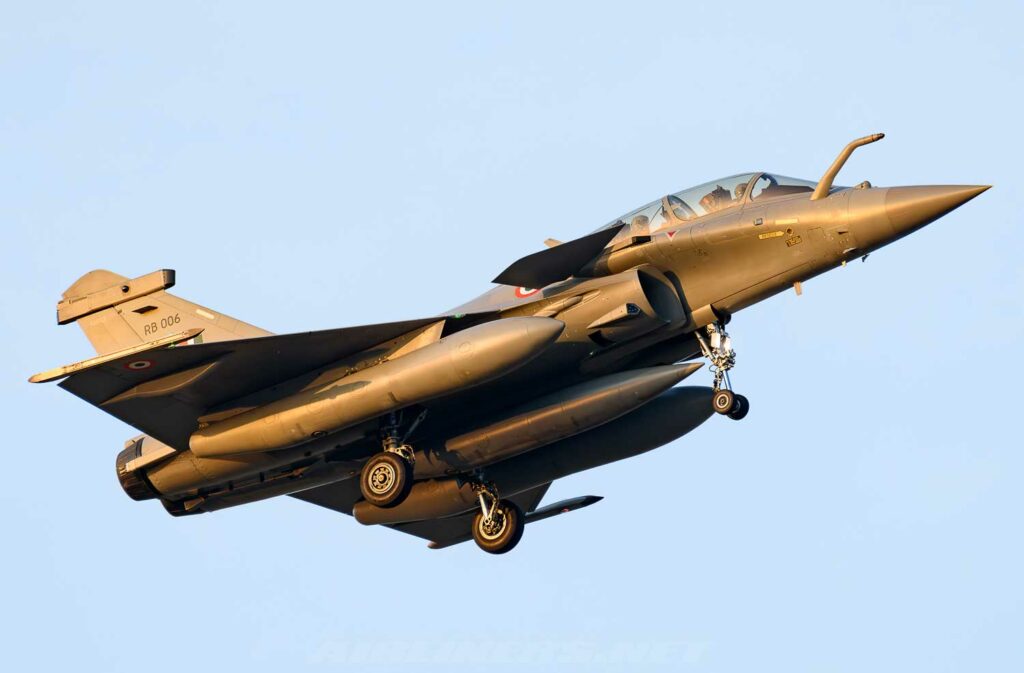
India wants the ability to integrate more of its indigenous weapons onto the Rafale, notably various iterations of the Astra air-to-air missile.
Physically mounting a missile under a wing is the simplest part of the process.
The mission computer must be enabled to recognize the weapon, exchange data with it, integrate its firing envelopes, ensure electrical and digital interfacing, verify aerodynamic behavior, and execute a complete flight-test and qualification campaign.
The contract for the 26 Rafale Marine fighters already contains technology transfer provisions designed to facilitate the integration of Indian weaponry.
The prospective 114-aircraft deal could push these boundaries further.
Yet a line must be drawn: technology transfer does not equate to a full transfer of intellectual property.
No official public sources indicate that Dassault, Thales, or Safran will hand over the full source codes for the Rafale’s mission computers, RBE2 radar, SPECTRA suite, or M88 engine.
The real challenge will be determining which interfaces and technical data will be accessible to Indian industry, enabling it to integrate indigenous systems without requiring French intervention for every software update or modification.
Indian content is expected to move beyond basic structural components
New Delhi has been pursuing a local content level approaching 50%—or even higher once production reaches maturity.
This percentage, however, must be evaluated with nuance.
A combat aircraft cannot be simplified into 50% French parts and 50% Indian parts.
The core technological value resides in the engines, radars, sensors, software, electronic warfare systems, weapons, and underlying intellectual property.
A locally manufactured wing may represent a large portion of the aircraft’s physical mass, but a far smaller fraction of its technological value.
The true value of the program lies in the cumulative effect of multiple transfers: fuselages with Tata, electronics with BEL and SFO Technologies, engines with Safran, missiles with MBDA, HAMMER munitions with Safran and BEL, alongside final assembly and MRO.
This accumulation is what transforms localized manufacturing into a genuine technological level-up.
The strategic yield for India extends far beyond 114 aircraft
In the short term, the Indian Air Force secures its immediate operational priority: acquiring more available aircraft relatively quickly while expanding a homogeneous fleet built around a proven platform it already knows well.
This simplifies pilot training, basing infrastructure, ordnance logistics, simulator usage, spare parts stockpiles, and overall maintenance.
In the longer term, the strategic stakes are even more significant.
India is simultaneously developing the Tejas Mk2 and the AMCA stealth fighter. The expertise gained in manufacturing complex airframes, jet engines, AESA radars, electronic warfare, systems integration, and weapons certification can directly nourish these indigenous programs.
Yet one should avoid overly optimistic conclusions.
Assembling the Rafale will not automatically grant India the capacity to design a Rafale.
Designing a modern fighter relies on decades of accumulated knowledge across aerodynamics, flight control laws, data fusion, electronic warfare, advanced propulsion, and software architecture.
India’s ultimate industrial success will not be measured by the number of bolts tightened in Hyderabad. It will be measured by the number of core technologies its engineers can subsequently master, modify, and deploy independently without external assistance.
France turns a Rafale sale into a long-term industrial partnership
For Paris and Dassault Aviation, agreeing to such extensive localized production carries an inherent trade-off.
A portion of the industrial value that would otherwise have been generated in France will be transferred to Indian facilities.
However, the alternative was risking the loss of a 114-aircraft market—and, more importantly, forfeiting an exceptional strategic foothold with one of the 21st century’s primary military powers.
Dassault is pursuing a strategy designed to mitigate this risk: select Indian plants will not work solely for the domestic market. Tata-built fuselages are slated to feed into the global Rafale supply chain.
France is not merely cloning its Mérignac assembly line. It is progressively building an integrated Franco-Indian defense supply chain.
For New Delhi, the benefits are reciprocal. Buying French provides rapid access to top-tier military capabilities while negotiating greater industrial sovereignty.
The final contract, however, remains to be negotiated. Pricing, delivery timelines, intellectual property rights, actual local content figures, integration liabilities, and the precise division of labor among industrial partners will dictate its long-term value.
These 114 Rafales represent less the end of a procurement process than the start of a full-scale industrial test. If India succeeds in converting this order into reusable competencies for the Tejas, the AMCA, its radar development, and future weaponry, the strategic benefits will far outstrip the aircraft themselves. Otherwise, it will have built Rafales on its own soil, while remaining dependent on France for the core technologies that give the fighter its military power.
War Wings Daily is an independant magazine.