Following the alert surrounding Zelensky’s flight, a comparison of the protections on American, Russian, French, and Chinese presidential aircraft.
In Summary
The incursion of a Russian drone into Moldovan airspace on September 8, 2026, delayed Volodymyr Zelensky’s departure for Oslo and reignited a rarely discussed question: how is a president’s plane actually protected? The statement claiming that the Ukrainian aircraft was “nearly hit” has not been precisely established. However, the incident reveals a new threat. Anti-missile systems designed against MANPADS do not necessarily neutralize an autonomous drone. The United States possesses the most comprehensive and best-documented airborne presidential architecture, centered around the VC-25A Air Force One. Russia utilizes its Il-96-300PU as a flying command post, though its defenses remain largely secret. France protects its presidential A330 with a DIRCM laser system. China remains the most opaque. In all cases, a head of state’s primary defense remains airspace control, long before any equipment installed on the aircraft comes into play.
The Zelensky Incident Highlights the Limits of Onboard Protection
The event that occurred in Moldova must be described with precision. On September 8, Moldovan authorities temporarily closed their airspace following the intrusion of Russian drones. Volodymyr Zelensky’s departure from Chișinău to Oslo was delayed as a result.
Norwegian Prime Minister Jonas Gahr Støre subsequently claimed that the Ukrainian president’s aircraft was “almost hit.” However, neither the distance between the drone and the presidential Airbus A319CJ nor any potential collision trajectory has been publicly established. A Geran-type platform ultimately crashed approximately 160 km from the airport.
Above all, there is no public evidence indicating that Zelensky was personally targeted.
The incident is nonetheless revealing. A drone is not an anti-aircraft missile. A laser protection system designed to jam the infrared homing head of a missile cannot single-handedly stop a drone flying on a pre-programmed route.
This is why presidential protection does not begin inside the aircraft.
The Primary Protection Is Controlled Airspace
An aircraft carrying a head of state benefits from multiple layers of security. Intelligence services first evaluate potential threats. Airports and parking areas are secured. Flight plans are subject to special precautions. Air traffic can be restricted, and military assets may be placed on alert.
Fighter aircraft can also intervene when the threat level warrants it. During the Moldovan incident, Spanish F/A-18s tracked the drone when it entered Romanian airspace. Kyiv had also offered the deployment of a F-16 Fighting Falcon.
This is a critical point. Onboard countermeasures constitute the last line of defense, not the first.
A properly protected presidential aircraft should normally never be intentionally placed within the engagement envelope of a modern surface-to-air system.
The United States Possesses the Most Comprehensive Protection
The American model remains the benchmark.
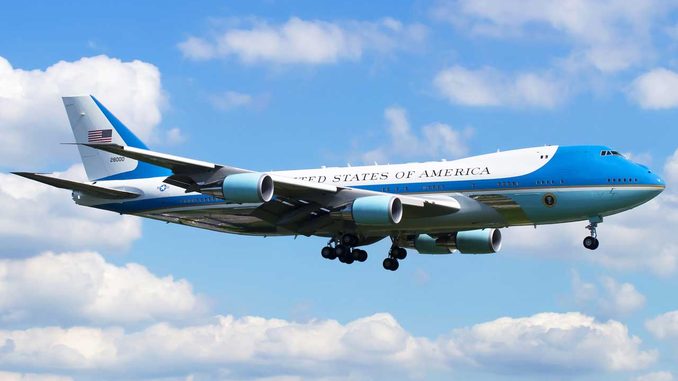
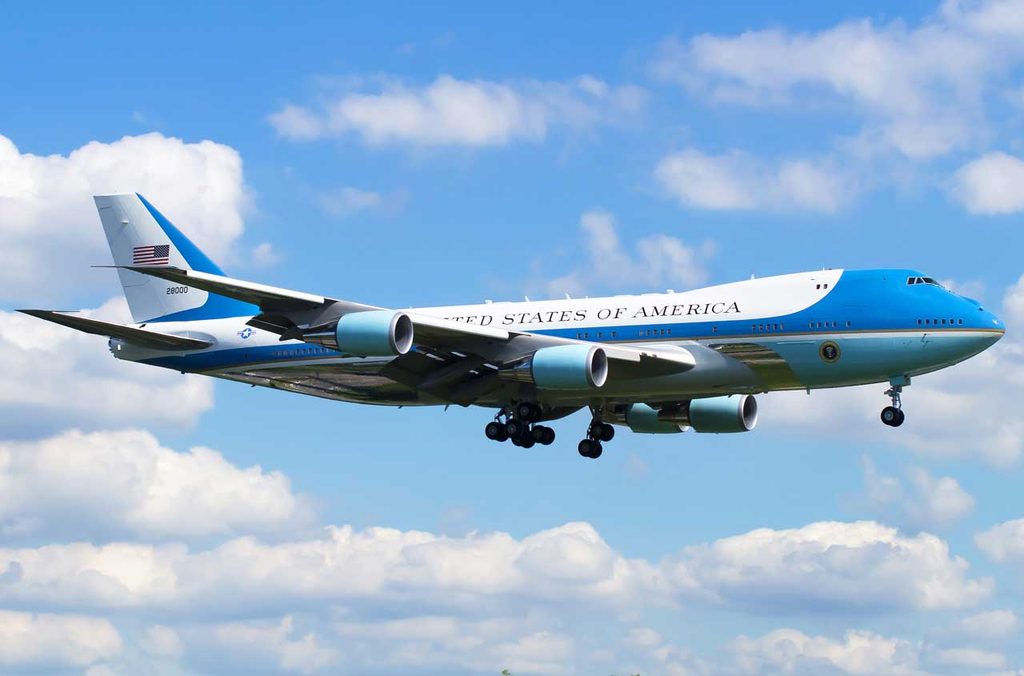
The United States operates two heavily modified Boeing 747-200Bs, designated VC-25A. The call sign Air Force One officially applies only to the US Air Force aircraft in which the president is currently traveling.
The Boeing VC-25 Air Force One is as much a transport vector as it is a command center.
The US Air Force confirms global secure communications, aerial refueling capability, specialized electronic systems, and a self-protection suite. The precise characteristics of this defensive suite are classified.
Equipment capable of detecting an infrared threat and subsequently disrupting missile guidance has long been publicly documented. Electronic countermeasures complement this protection. However, their architecture, performance metrics, and operational limits remain secret.
The most vital element lies elsewhere: Air Force One enables the president to continue governing while airborne. Strategic and military communications thus constitute an institutional protection as much as a physical one.
An event during the summer of 2026 underscored this reality. Facing a credible Iranian threat against Donald Trump in Ankara, US agencies discreetly arranged his transfer to another aircraft. No anti-missile system is considered infallible when it is possible to avoid the threat altogether.
Russia Protects a True Airborne Command Post
Vladimir Putin primarily uses the Il-96-300PU, a heavily modified variant of the Ilyushin Il-96.
The letters PU stand for Punkt Upravleniya, or “command post.” The aircraft features protected military and governmental communications gear, allowing the Russian president to maintain command capabilities during flight.
Western publications also attribute electronic warfare suites, decoys, and missile protection systems to the presidential Il-96s. However, unlike France, which disclosed the type of DIRCM installed on its A330, Moscow publishes virtually no verifiable information regarding this defensive suite.
Caution is therefore required regarding claims about Russian “anti-missile lasers.”
External protection, by contrast, is visible. During Putin’s travel to Syria in 2017, Russian Su-30SM fighters escorted his aircraft in the vicinity of Khmeimim Air Base.
Strategically, Russia likely belongs to the top tier alongside the United States. However, a precise technical comparison is impossible based on open-source data.
France Relies on a Laser System Against Infrared Missiles
The French presidential Airbus A330-200, designated COTAM Unité when the president is aboard, follows a different philosophy.
Since 2016, the aircraft has been equipped with the C-MUSIC DIRCM system developed by Elbit Systems.
DIRCM stands for Directed Infrared Counter Measures. A missile warning system detects the launch and approach of an infrared-guided missile. An electro-optical turret then directs a laser beam onto the projectile’s seeker. The objective is not to destroy the missile, but to blind its sensor so that it loses target lock.
C-MUSIC was specifically engineered to protect large aircraft against MANPADS, portable surface-to-air missiles that pose an extreme hazard during takeoff and landing phases.
The underlying principle is comparable to self-protection suites fitted on military transport aircraft.
However, this technology has a fundamental limitation: it acts on a missile’s infrared guidance system. It is not a laser cannon capable of destroying any airborne object.
The French approach thus complements the defense provided by air forces. Dassault Rafale fighters can conduct air security missions when circumstances demand it.
China Intentionally Maintains Opacity
Xi Jinping primarily uses Boeing 747-8 aircraft bearing Air China livery, including aircraft tail number B-2479, which was still being utilized for presidential missions in 2026.
China long favored temporarily converted civil airliners subjected to stringent inspections prior to official travel. The 747-8s currently used by the presidency represent an evolution toward far more specialized platforms.
Conversely, no Chinese anti-missile suite is publicly documented with a level of precision comparable to the French C-MUSIC or the information available regarding Air Force One.
This by no means implies that such systems do not exist.
China possesses advanced capabilities in electronic warfare, missile warning, and military aircraft protection. It would be surprising if a strategic transport carrying Xi Jinping were treated as a standard airliner. However, asserting this logical assumption as a technical certainty would be speculative.
China is therefore less “poorly protected” than it is poorly understood.
Drones Create a Threat That DIRCM Cannot Resolve
The Moldovan incident highlights an emerging problem.
Conventional protection systems for large aircraft are primarily designed to counter two weapon categories: infrared-guided missiles and radar-guided threats. The former can be disrupted by DIRCM or flares. The latter require radar warning receivers, jamming, and other electronic countermeasures.
A Shahed- or Geran-type drone operates differently. It can follow a trajectory using a combination of inertial and satellite navigation without relying on the target’s infrared signature.
A DIRCM laser is therefore insufficient.
The risk shifts to a direct collision, a proximity detonation, or a drone deliberately steered into the aircraft. The response must consequently occur further upstream: radar tracking, ground-based air defenses, tailored jamming, or interception by another aircraft.
Paradoxically, this evolution restores immense importance to territorial defense systems. A presidential aircraft costing several hundred million dollars can remain vulnerable to an infinitely less expensive threat if that threat penetrates all outer layers of protection.
Attacks on Presidents in Flight Remain Rare but Catastrophic
History shows that direct attacks against aircraft carrying heads of state are rare.
The most prominent case occurred on April 6, 1994, in Rwanda. The Dassault Falcon 50 carrying Rwandan President Juvénal Habyarimana and Burundian President Cyprien Ntaryamira was shot down on final approach to Kigali by surface-to-air missiles. All twelve people on board perished. The attack served as the immediate trigger for the genocide against the Tutsi.
Other cases remain shrouded in uncertainty.
In 1988, the C-130 carrying Pakistani President Muhammad Zia-ul-Haq crashed with thirty people aboard. The Pakistani investigation concluded that foul play or sabotage was likely, without identifying a culprit or definitive mechanism.
Two years prior, Mozambican President Samora Machel died in the crash of a Tu-134 near the South African border. The South African inquiry attributed the crash to pilot error, while Soviet experts cited a false navigation signal. The Truth and Reconciliation Commission was unable to produce conclusive evidence of an attack.
Conversely, the 2010 Smolensk crash, which killed Polish President Lech Kaczyński and 95 others, remains a key example of what should not be confused with an attack: aviation safety investigations concluded it was a CFIT accident.
The Best Aircraft Remains the One the Enemy Cannot Approach
Based solely on public information, Air Force One possesses the most comprehensive and demonstrably proven protection. It integrates self-protection suites, strategic communications, endurance, aerial refueling capability, and a dedicated military organization.
The Russian Il-96-300PU appears to belong to the same category of strategic command posts, but its precise level of protection remains too classified to allow for a conclusive comparison.
The French A330 features exceptional protection against infrared missiles via C-MUSIC, though it does not publicly carry the same mandate as an autonomous strategic command center like the VC-25A.
China cannot be properly categorized: its setup is simply under-documented. Describing it as the least protected would be misleading.
Above all, the Zelensky alert serves as a reminder of a core truth. Onboard lasers, jammers, and decoys can be multiplied indefinitely. Yet if a threat gets close enough to engage, the overall security apparatus has already partially failed.
The true “presidential shield” is not a piece of hardware. It is a continuous chain extending from intelligence to airspace control, interception, and finally onboard countermeasures. The aircraft itself is merely the final layer.
War Wings Daily is an independant magazine.