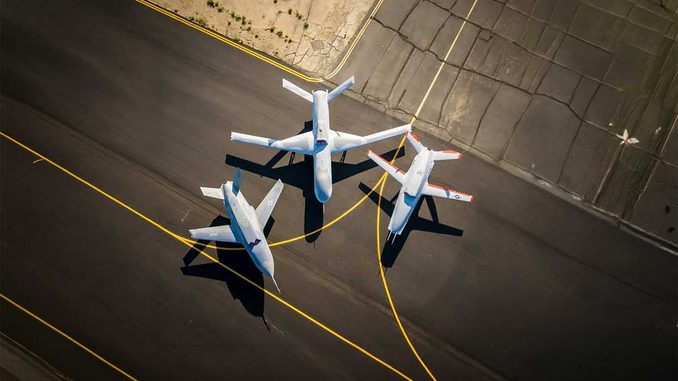
Facing China, the US Air Force is accelerating its Loyal Wingman drones. CCA budgets, NGAD risks, unit costs, and winning companies.
In Summary
Facing the rise of Chinese air power, the US Air Force wants to deploy around 1,000 semi-autonomous combat drones, the Collaborative Combat Aircraft (CCA), or Loyal Wingman. After an initial program allocation of $5.8 billion over 2024–2028, it is requesting around $2.52 billion for 2027, including procurement and advance procurement. The industrial target is now under $20 million per airframe, but no full-fleet cost has been published.
The parallel with NGAD is revealing. The projected price for its manned fighter, now designated the Boeing F-47, prompted a pause in 2024. However, an estimate deemed excessive should not be confused with a proven contractual cost overrun.
General Atomics and Anduril have secured the first drone orders. Shield AI and RTX remain well positioned in the software competition, while Boeing dominates manned fighter programs. The challenge will be funding mass production without sacrificing operational requirements.
The Loyal Wingman Turns Air Superiority into a Quantity Problem
Facing China, the US Air Force aims to complement its manned fighters with semi-autonomous combat drones, the Collaborative Combat Aircraft (CCA), often called Loyal Wingman. Their role is to extend sensor and missile reach, complicate adversary interceptions, and expose fewer pilots to air defenses.
These aircraft are not simple reconnaissance drones. They must follow a mission plan, maneuver with fighters, and execute tasks under human control. The concept relies on an equation: aircraft capable enough to impact a battle, yet affordable enough to be fielded in large numbers and, if necessary, lost in combat.
Initial Budgets Have Scaled Up
In 2023, the US Air Force projected $5.8 billion for CCAs between 2024 and 2028, with an ambition of around 1,000 aircraft. This figure represented a program trajectory, not the purchase of one thousand fully equipped drones.
Funding has since been separated from NGAD to make expenditures clearer. According to the Congressional Research Service, CCA research and development funding reached $711.7 million for fiscal year 2025. A budget act passed in 2025 subsequently provided an additional $678 million tied to resources available in 2026.
For 2027, the request reaches $1.374 billion in development, plus $996.5 million in procurement and $150.5 million in advance procurement for subsequent manufacturing: approximately $2.52 billion in total. These sums are requested, not all definitively voted into law.
Unit Price Represents the Real Red Line
The initial target hovered around $25 to $30 million per drone, roughly one-third the price of an F-35 Lightning II. In September 2026, the Air Force indicated it was now targeting under $20 million per airframe for the early models. It stated that both manufacturers were meeting its cost criteria, without publishing their detailed contract prices.
At $20 million per unit, one thousand drones would represent $20 billion in acquisition. This theoretical calculation excludes missiles, ground stations, software, maintenance, and attrition replacement. The gap between a flyaway price and the full cost of a military capability will be decisive.
NGAD Illustrates the Danger of an Overly Expensive Fighter
NGAD, whose manned fighter is now the Boeing F-47, was paused for review in 2024. Former Secretary of the Air Force Frank Kendall feared an aircraft reaching $300 million apiece, roughly three times the price of an F-35. This figure was a design estimate, not a definitively established contractual overrun.
Relaunched in March 2025, the program awarded Boeing an initial contract estimated at $20 billion. Development spending for the F-47, intended to succeed the F-22 Raptor, reaches $3.45 billion for 2026, with $5.04 billion requested for 2027. Projected funding peaks at $5.25 billion in 2028, excluding certain separate propulsion expenditures.
The US Air Force must therefore concurrently fund a sixth-generation fighter, CCAs, weapons, and infrastructure. Cost growth on the F-47 could reduce the number of drones purchased, even without overruns specific to the CCA itself.
Contracts Reveal Two Industrial Winners
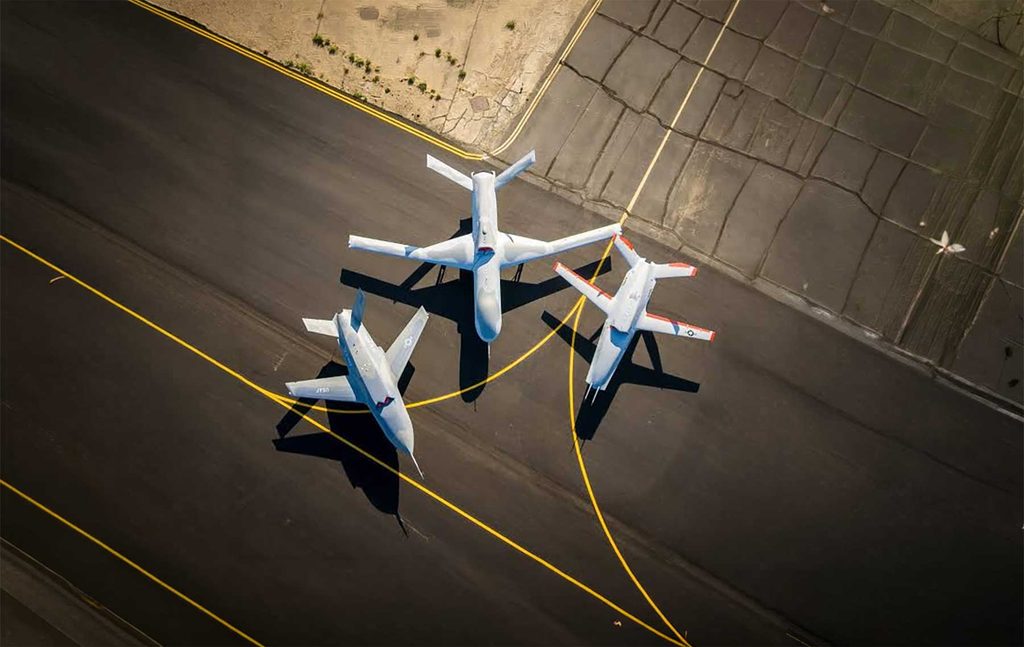
In June 2026, the Air Force selected General Atomics and Anduril to produce the first CCA tranches. The former’s FQ-42A Vengeance and the latter’s FQ-44A Fury are set to form an initial fleet of over 150 aircraft before 2030. Both companies hold contracts; neither the split in quantities nor the awarded amounts have been made public.
General Atomics leverages its military drone experience, claiming a capacity of six FQ-42A aircraft per month, or 72 per year. Anduril relies on its new Arsenal-1 facility in Ohio, targeting 150 FQ-44A aircraft per year. These represent industrial capabilities or goals, not completed deliveries.
Anduril demonstrated a live AIM-120 missile launch from its aircraft in July. General Atomics overcame a test interruption caused by a prototype accident in April. Both drones joined an operational flight test unit at Creech in September.
Software Redistributes Program Value
The Air Force is purchasing airframes and mission autonomy separately to prevent any single contractor from locking in updates. Six companies are qualified: Anduril, General Atomics, Lockheed Martin, Northrop Grumman, RTX Collins Aerospace, and Shield AI.
Anduril, Shield AI, and Collins Aerospace secured the initial software development options. Their respective systems—Lattice, Hivemind, and Sidekick—are competing for the primary selection expected in summer 2027. Future revenue will depend notably on licensing and operational performance, rather than aircraft sales alone.
Boeing is the other major beneficiary of this modernization: following the F-47, it won the US Navy’s F/A-XX development contract in September 2026, valued at $20 billion. This double victory strengthens its defense business, but also concentrates industrial capacity and recruitment risks.
China Dictates a Pace That US Funding Must Match
According to Royal United Services Institute estimates, China possessed 320 to 350 J-20 fighters at the end of 2025 and reached a production rate close to 120 aircraft per year. These figures, concerning one of China’s primary fighter jets, remain open-source estimates. They explain why Washington is seeking mass rather than an exclusively high-cost fleet.
The Air Force now projects 500 CCAs by 2032, followed by a fleet of roughly 1,000. However, the 2027 federal budget had not been passed by October 2026. The temporary continuation of prior funding levels prevents initiating new series production as planned. Defense companies can advance using their own funds, but they cannot self-finance a national fleet indefinitely.
The Real Test Will Be Squadron-Level Costs
A Loyal Wingman must function despite jamming, intermittent communications, and artificial intelligence limitations. Adding sensors, fuel, stealth features, or processing power quickly pushes up its price. The “attritable” drone then becomes too expensive to lose.
The success of the CCA will not be measured by the number of prototypes or signed contracts. It will require proving that a combined squadron of manned fighters and drones delivers greater military effect at a lower cost of ownership and reduced risk to human life. It is on this outcome, rather than unit purchase price alone, that Washington can truly respond to China’s growing power.
Sources
- US Air Force, “Air Force Advances Future of Air Superiority with CCA Contracts”, June 17, 2026.
- US Air Force, “SecAF Announces Names of New Collaborative Combat Aircraft”, September 14, 2026.
- Congressional Research Service, “U.S. Air Force Collaborative Combat Aircraft (CCA)”, report IF12740, November 28, 2025.
- Department of the Air Force, “FY 2027 President’s Budget”, official budget documents, April 2026.
- Air & Space Forces Magazine, “Competition Defines New Collaborative Combat Aircraft Program Now, But Not Forever”, September 18, 2023.
- Air & Space Forces Magazine, “What the F-47’s Projected Budget Suggests About Its Development”, May 4, 2026.
- Defense News, “Boeing Wins Contract for NGAD Fighter Jet, Dubbed F-47”, March 21, 2025.
- Defense News, “US Air Force Awards First CCA Production Contracts to General Atomics, Anduril”, June 18, 2026.
- National Defense, “Air Force Sets Up Continuous CCA Software Contest as Aircraft Production Begins”, September 2, 2026.
- Air & Space Forces Magazine, “CCA Builders Start Revving Production Rates, as They Await 2027 Funding”, September 23, 2026.
- Air & Space Forces Magazine, “Air Force, Industry Fear Continuing Resolution Could Hinder CCA Production”, September 28, 2026.
- Reuters, “Boeing Wins US Navy’s Next-Generation Fighter Contract, Pentagon Says”, September 29, 2026.
- Royal United Services Institute, Justin Bronk, “The Evolution of Russian and Chinese Air Power Threats”, January 8, 2026.