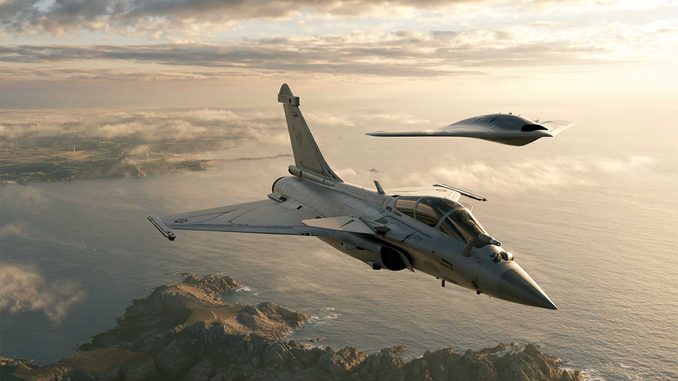
With HypAIRion, France is preparing collaborative combat between Rafales and drones. Tests in 2028, sovereign AI, technologies, and human control.
In Summary
Launched in July 2026, HypAIRion is designed to prepare cooperation between French piloted fighters and combat drones. The French Air and Space Force, the Direction générale de l’armement (DGA), and the Ministerial Agency for Defense Artificial Intelligence (AMIAD) want to rapidly test decision-support software, resilient communications, and open computing architectures.
Two Mirage 2000s are serving as flying laboratories at Mont-de-Marsan. A first test combining a fighter and a drone is announced for 2028. Meanwhile, the Rafale F5 and its future stealth drone are expected starting in 2033.
Dassault Aviation has already tested two AI algorithms on the Rafale, including one with Thales/cortAIx. But mission autonomy does not mean firing autonomy: the military wants to keep tactical judgment and engagement decisions in the hands of the crew. This requirement complicates design as much as it structures French sovereignty.
The HypAIRion Program Accelerates Trials Without Waiting for the Rafale F5
France wants to prevent a combat drone from remaining a trade-show concept until the next decade. Launched in July 2026 and publicly presented on October 1, HypAIRion brings together collaborative combat experimentation for the Air and Space Force, the DGA, and AMIAD.
The schedule is concrete. At Mont-de-Marsan, two Mirage 2000s are receiving additional onboard computers to test artificial intelligence functions as early as late 2026. A flight combining a piloted aircraft and a collaborative drone is planned for 2028.
This demonstrator should not be confused with the future serial drone. The 2028 aircraft could be a temporary platform. HypAIRion is primarily an experimentation framework, not an operational fleet order.
Collaborative Combat Transforms the Pilot into a Conductor
The principle consists of having a fighter work with one or more drones tasked with complementary missions. These drones can perform reconnaissance over an area, detect radar emissions, decoy air defenses, or carry sensors and weaponry.
The advantage is twofold: offloading risk to an unmanned platform and multiplying available assets without purchasing as many piloted fighters. A Rafale can maintain a less exposed position while a drone observes further ahead.
An onboard tactical AI can analyze data, propose a route, and distribute tasks. It must not turn the cockpit into a permanent remote-piloting station. At high speed, facing multiple threats, the pilot has neither the time nor the attention to maneuver each drone like a radio-controlled aircraft.
Sovereign Software Must Reduce Cognitive Load
AMIAD is developing the building blocks related to mission autonomy and command and control, while the DGA supervises integration and testing. Dassault Aviation remains the aeronautical system architect.
On September 22, 2026, Dassault announced that it had flown two sovereign AI algorithms on the Rafale. The first comes from its own teams, the second from a collaboration with Thales’ cortAIx artificial intelligence hub. Their precise function has not been made public: these tests prove in-flight integration, not the autonomous conduct of a combat mission.
A more identifiable application will arrive with Thales’ TALIOS pod: functions announced for 2027 are designed to detect and categorize ground objects to present potential targets to the pilot.
Data Quality Conditions Algorithm Reliability
An algorithm trained on perfect images can make mistakes with jammed sensors, adverse weather, or decoys. Errors must be tested, uncertainty measured, and suggestions prevented from presenting themselves as certainties.
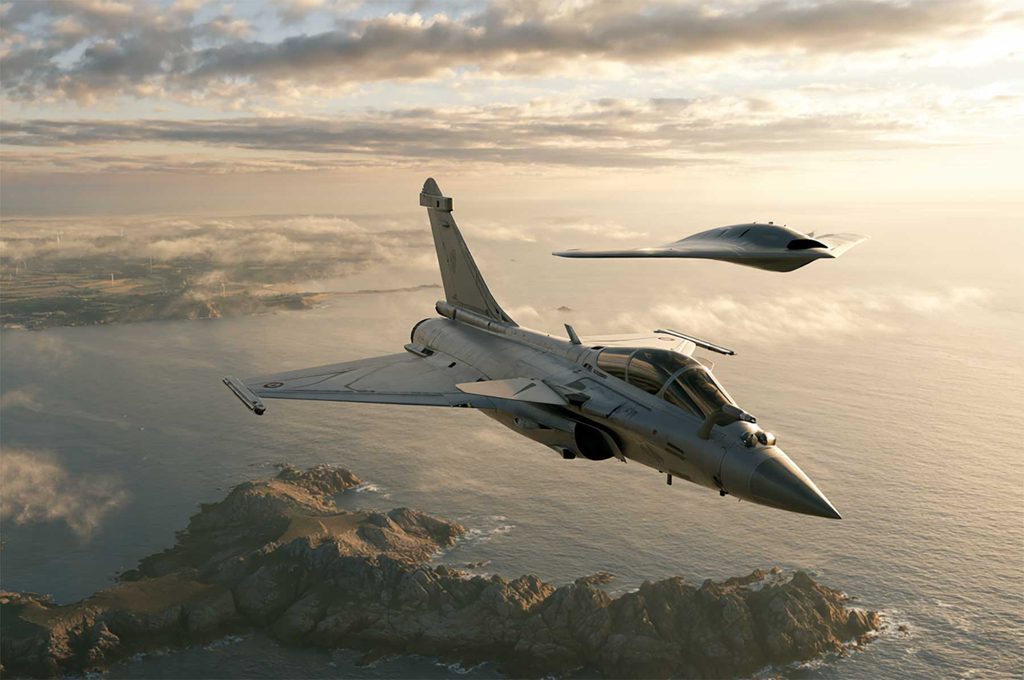
The Rafale F5 Must Provide Necessary Computing Power and Links
Scheduled for 2033, the Dassault Rafale F5 will go beyond a simple software update. In September 2026, the DGA announced work entrusted to Dassault, Thales, MBDA, and Safran.
Thales is developing the RBE2-XG radar, whose computers are intended to facilitate the use of AI, and the IVDL data link. This high-throughput link must allow aircraft to exchange data despite jamming, while reducing the risk of their emissions being detected.
The SPECTRA self-protection suite is set to evolve into a fully digital electronic warfare core. However, drone operation must still be ensured when transmissions are cut off: local navigation, pre-established instructions, and safe fallback procedures.
The other transformation concerns open software architecture. Forces want to be able to integrate or replace an AI function without rebuilding the entire mission system or compromising flight controls.
Dassault’s Stealth Drone Constitutes a Distinct Program
Announced in October 2024, the future combat drone associated with the F5 is designed to leverage experience from the nEUROn. This European demonstrator, industrially led by Dassault, flew for the first time in December 2012 and already totaled more than 170 test flights according to the DGA in 2024.
The new aircraft is intended notably for penetrating adversary defenses, reconnaissance, and radar suppression. Manufacturers anticipate stealth features, internal bays, and in-flight refueling.
Its price, mass, and the number of units planned have not been published. It would therefore be premature to present HypAIRion as the completed development of the future French wingman drone.
Human Control Will Remain a Technical and Military Constraint
The announced doctrine maintains the pilot’s assessment of the tactical situation and the decision to employ weapons. AI can recommend an action or execute authorized maneuvers; it must not select a target on its own and then decide to strike it.
This requires separating critical flight safety functions from AI applications, maintaining decision traceability, and planning what the drone does when the connection is severed.
The stake is as much industrial as it is legal. Owning the code, data, and interfaces allows the State to fix a model or integrate a new supplier without relying on locked software.
HypAIRion’s Success Will Be Judged on Its Ability to Equip Squadrons
The United States is already experimenting with collaborative drones alongside its fighter jets. France is following a more gradual path, with a testing schedule before any broad adoption.
No overall budget specific to HypAIRion has been made public. Its success will therefore depend less on a spectacular announcement in 2028 than on measurable results: algorithm reliability, jamming resistance, pilot workload, and integration cost.
An aircraft capable of commanding a drone during a prepared flight does not yet constitute a combat-ready squadron. The breakthrough will come when crews can rapidly modify their tactics without losing control of their assets or waiting years for a new software release.
Sources
- Ministry of the Armed Forces, “HypAIRion: AI at the service of French air combat”, October 1, 2026.
- Defense News, Rudy Ruitenberg, “French Air Force Plans Loyal Wingman Flight in 2028 in Sovereign AI Push”, October 2, 2026.
- Dassault Aviation, “New Artificial Intelligence Flies Aboard Dassault Aviation’s Rafale”, press release, September 22, 2026.
- Reuters, “Dassault Aviation Tests AI Algorithms on Rafale Fighter Jet”, September 22, 2026.
- Direction générale de l’armement, “DGA orders preliminary work ahead of the upcoming launch for realization of the F5 standard of the Rafale”, September 10, 2026.
- Dassault Aviation, “Launch of a combat drone program as part of the Rafale F5 standard”, October 8, 2024.
- Direction générale de l’armement, “Rafale standard F5: initial orders notified to industry”, October 14, 2024.
- Sentry Média, Audrey Rodrigues, “HypAIRion: The Air and Space Force prepares tomorrow’s combat aviation”, October 2026.
- Raids Aviation Magazine, Pascal Podlaziewiez, “HypAIRion”, October 12, 2026.
- Senate, Committee on Foreign Affairs, Defense and Armed Forces, report of hearings for the week of May 4, 2026.