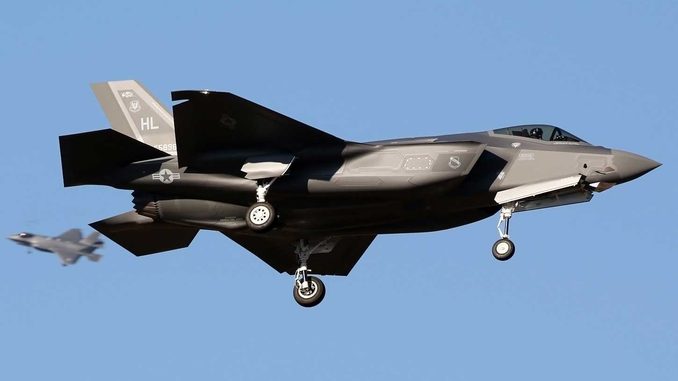
In response to the rise of Chinese J-20s, the US Air Force targets 1,509 fighters by 2035. Budgets, manufacturers, and limits of a decisive goal for the Pacific.
Executive Summary
On October 16, 2026, the US Air Force presented a new assessment of its needs to the US Congress: 1,509 fighter jets by 2035 to maintain its operational capabilities against China. This structure corresponds to a moderate level of military risk. A less risky posture would require 1,723 aircraft.
The project relies primarily on Lockheed Martin’s F-35A, and Boeing’s F-15EX and future F-47. However, the orders planned for 2027 remain insufficient to ensure the desired fleet renewal.
Chinese pressure is increasing rapidly. According to the Royal United Services Institute, Beijing is now producing around 120 J-20 stealth fighters per year.
The United States must therefore accelerate production, modernize infrastructure, develop combat drones, and improve aircraft availability. What is at stake goes beyond the number of fighters: it concerns the American capacity to sustain a prolonged air war in the Pacific.
The Pentagon Revises Its Requirements Upward for 2035
On October 16, 2026, the US Air Force submitted its new Long-Term USAF Fighter Force Structure report to Congress. Presented to the press four days later by Lieutenant General David Tabor, it sets a target of 1,509 fighters assigned to combat forces in 2035, compared to 1,288 planned for fiscal year 2027.
This figure corresponds to an operational posture presenting a moderate risk. To achieve a low risk level, the Air Force now estimates it needs 1,723 aircraft, up from 1,558 in its 2025 assessment.
The distinction is important. The figure adopted does not represent the number of aircraft simultaneously available for combat. The Combat-Coded Total Aircraft Inventory also includes replacement aircraft and reserves intended to compensate for losses.
The envisioned composition for 2035 is distributed as follows:
- 40% F-35A, or approximately 603 aircraft.
- 20% F-22 and F-47, or approximately 302 aircraft.
- 20% F-15E and F-15EX, or approximately 302 aircraft.
- 20% F-16, or approximately 302 aircraft.
This distribution reflects a strategy combining stealth fighters, multirole aircraft, and platforms capable of carrying heavy ordnance.
Fleet Modernization Relies on Three Industrial Programs
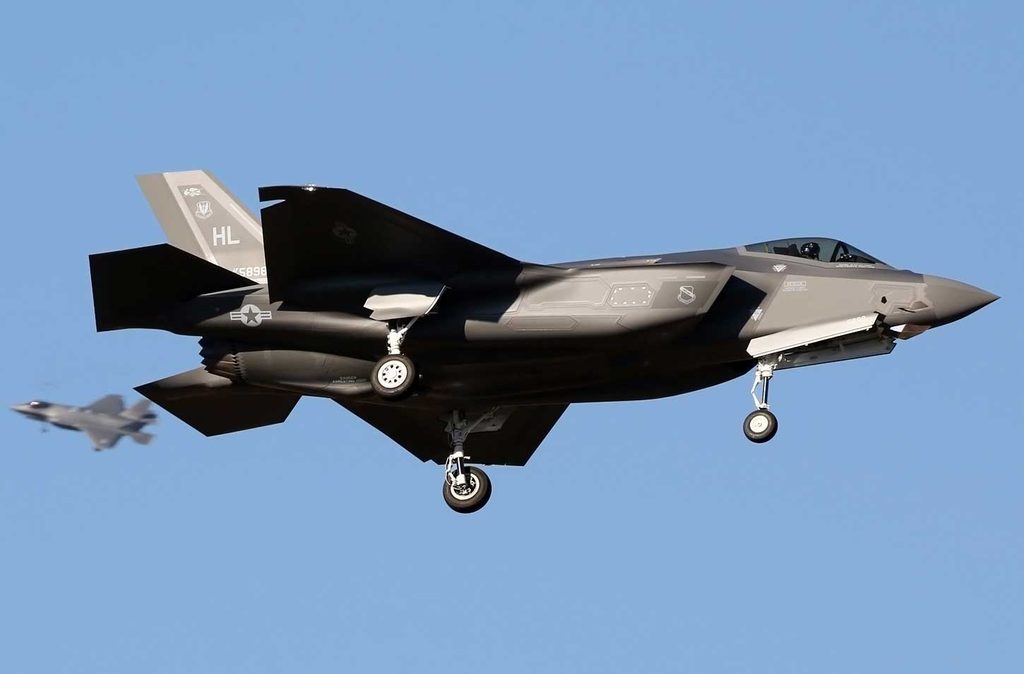
Lockheed Martin occupies a central position with the F-35 Lightning II. Its stealth, AESA radar, and data fusion make it possible to detect, identify, and share threat information in heavily defended environments.
The Block 4 modernization is intended to enhance its electronic capabilities and armament, but it has accumulated delays.
Boeing supplies the F-15EX Eagle II, intended notably to replace aging F-15s. Non-stealthy, this aircraft boasts a high payload capacity. It can perform air defense missions and launch long-range missiles, complementing stealth fighters.
The third program is the sixth-generation F-47, awarded to Boeing in March 2025. Designed to replace the F-22, it is expected to offer increased range, improved stealth, and coordination with autonomous drones.
Its maiden flight is expected in 2028. The USAF is considering at least 185 units, with no operational delivery schedule sufficiently established to guarantee this goal by 2035.
GE Aerospace and Pratt & Whitney are working in parallel on adaptive propulsion technologies under the NGAP program.
American Budgets Do Not Yet Guarantee Deliveries
The 2027 draft budget provides for significant investments in combat aircraft:
- $7.4 billion for 38 F-35s.
- $3 billion for 24 F-15EXs.
- $5.04 billion for F-47 research and development.
- Approximately $1.1 billion for the acquisition of Collaborative Combat Aircraft (CCA).
Depending on the program, these budget allocations include expenses other than the purchase price of the aircraft alone.
The USAF thus foresees 62 new fighters in 2027, whereas for several years it has considered a rate of around 72 annual acquisitions necessary to renew its fleet.
Another difficulty: funding for 14 of the 38 F-35s depends on an additional $2.34 billion allocation subject to a separate budget procedure. Its adoption remains uncertain.
The multi-year contracts under consideration for the F-35 and F-15EX could secure industrial investments. However, they require a lasting financial commitment from Congress.
China Accelerates Production of Modern Fighters
The expansion of Chinese aviation largely explains this reassessment.
According to a study published in January 2026 by the Royal United Services Institute, China had around 300 Chengdu J-20s in service in mid-2025, compared to only about fifty in 2020.
The production rate for the J-20A and J-20S variants reportedly reached 120 aircraft per year by late 2025. If this momentum continues, RUSI envisions around 1,000 J-20s in service by 2030. This is a projection, not a confirmed inventory.
China is also developing its J-16s, of which approximately 450 units had been delivered by late 2025. The stealth fighter J-35 is gradually entering production, while the J-36 and J-XDS/J-50 demonstrators bear witness to work on an additional generation of combat aircraft.
Beijing is also making progress in PL-15 and PL-17 air-to-air missiles, AESA radars, and KJ-500 airborne early warning aircraft.
This shift is altering the balance of power around Taiwan. China benefits from bases close to the theater of operations, while the Americans must project their forces over several thousand kilometers.
Industrial and Operational Difficulties Threaten Goals
The American objective remains technically achievable, but its realization by 2035 remains uncertain.
The main problem does not solely concern manufacturing plants. The 2026 report indicates a fighter availability rate of only 53.9%, compared to an operational benchmark of 70%.
The average age of the aircraft exceeds 31 years. F-16s, F-15Es, and A-10s require more frequent maintenance operations, while spare parts stocks and maintenance capacity remain constrained.
Production delays for the F-15EX and modernization difficulties for the F-35 further complicate the timeline. The Congressional Budget Office actually anticipated a contraction of the fighter fleet through 2030 before its recovery.
At the same time, Washington is betting on CCA drones. General Atomics is developing the FQ-42A Vengeance, while Anduril is producing the FQ-44A Fury. The USAF aims to have at least 500 CCAs by 2032.
These semi-autonomous aircraft will be able to accompany crewed fighters, conduct reconnaissance, jamming, or strike missions, and multiply the number of engaged platforms. However, they do not yet constitute a direct replacement for crewed aircraft in the calculation of the 1,509 fighters.
American Superiority Will Depend Mostly on Its Capacity to Fight in the Pacific
Reaching 1,509 aircraft will not be enough to guarantee American air superiority.
The priority is to have aircraft capable of operating over long distances, with sufficient fuel, missiles, and logistical support. KC-46A tankers, surveillance systems, and secure communications are becoming as important as the fighters themselves.
US bases in Guam and Japan must also withstand potential Chinese strikes. This requires hardened shelters, missile defense systems, rapidly repairable runways, and ammunition stockpiles distributed across multiple installations.
The Agile Combat Employment doctrine addresses this necessity by dispersing units across various airfields to reduce their vulnerability.
Finally, the USAF must be able to count on Japan, Australia, and its other regional partners to support its operations.
The timeline now constitutes the main American weakness. China is already manufacturing modern fighters at a high rate, while Washington must simultaneously fund the F-47, increase F-35 deliveries, renew its F-15s, and develop its drones.
The American advantage will depend less on the inventory announced for 2035 than on the number of aircraft actually available, armed, and ready to fight from the opening hours of a conflict.