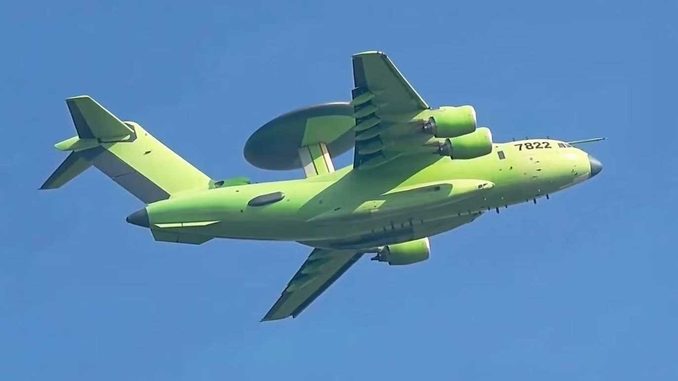
China is developing the KJ-3000, an airborne early warning and control aircraft capable of coordinating its long-range air forces. A new threat to the United States in the Pacific.
Executive Summary
China is accelerating the development of the KJ-3000, its new airborne early warning and command aircraft. Satellite images taken on October 5, 2026, show four units at the Xi’an-Yanliang industrial site, suggesting a possible start of production. However, their operational commissioning has not been confirmed.
Developed from the Y-20B transport aircraft, the KJ-3000 is designed to combine active electronically scanned array radars, digital data processing, and long-distance communications.
Its objective goes beyond aerial surveillance. Beijing seeks to integrate fighter jets, missiles, ships, ground radars, and satellites into a distributed targeting network, or kill-web.
This architecture could enable the identification and engagement of very distant targets, particularly American refueling aircraft and command platforms. Nevertheless, its actual effectiveness will depend on the quality of the transmitted data, resistance to jamming, and China’s ability to coordinate dispersed forces.
China May Have Started KJ-3000 Production
The latest satellite images provided by Vantor show four KJ-3000 aircraft at the Xi’an-Yanliang aviation complex in Shaanxi province. Three are located near the Xi’an Aircraft Company facilities and the fourth at the China Flight Test Establishment site.
According to J. Michael Dahm, a specialist at the Mitchell Institute for Aerospace Studies, this concentration could indicate a transition to serial production.
Andreas Rupprecht, a specialist in Chinese military aviation, remains more cautious. The four aircraft could also correspond to prototypes already identified, momentarily gathered at the same site.
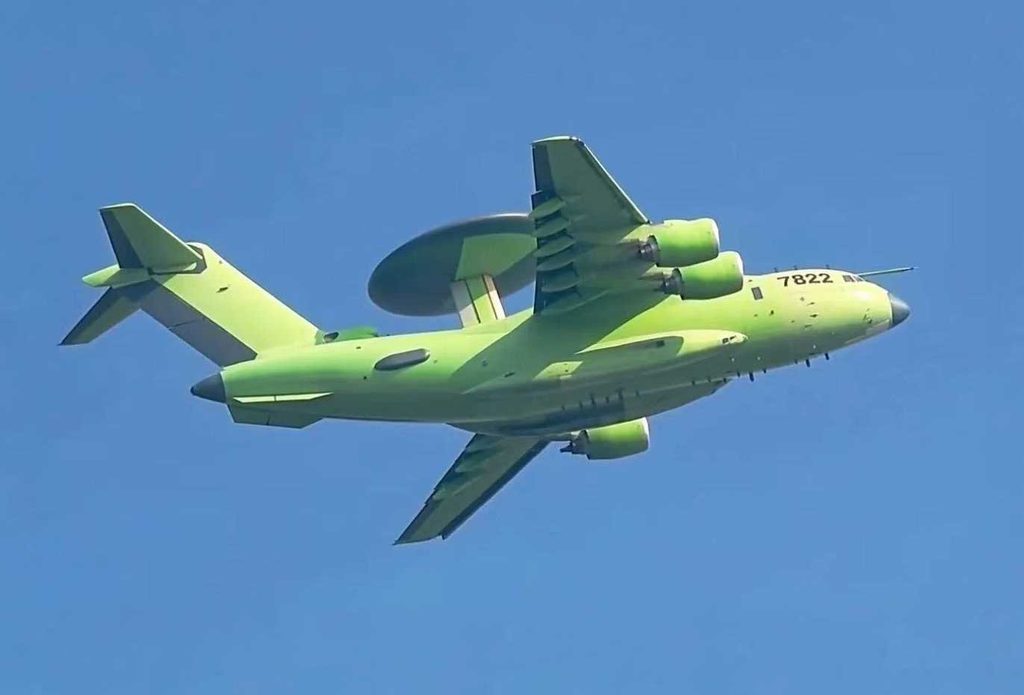
The program was first observed in flight on December 27, 2024. A prototype bearing the number 7821 appeared in photographs released in May 2025.
No public evidence yet confirms the operational deployment of the KJ-3000. However, the transition to initial production seems possible.
The stakes are high for the People’s Liberation Army Air Force (PLAAF). It seeks to replace its four KJ-2000s, which entered service in 2007, whose airframes derived from the Russian Ilyushin Il-76MD limit future modernization prospects.
The KJ-3000 Relies on an Entirely Chinese Platform
The KJ-3000 is an Airborne Early Warning and Control (AEW&C) aircraft.
It utilizes the airframe of the Xi’an Y-20B, a four-engine transport aircraft developed by Aviation Industry Corporation of China (AVIC). Its four WS-20 turbofans, produced in China, replace the Russian D-30KP-2 engines of the early Y-20 versions.
This industrial independence theoretically facilitates manufacturing, maintenance, and modernizations.
Its large airframe can accommodate a bulky radar, operator consoles, computers, and communication equipment requiring significant electrical power and cooling.
An inflight refueling probe, visible above the cockpit, is also intended to extend surveillance missions.
The exact operational characteristics remain unknown. Beijing has not published certified endurance, crew size, or maximum target tracking capacity.
The KJ-3000 Radar Could Improve Long-Distance Detection
The main equipment of the KJ-3000 is its imposing circular radome installed above the fuselage.
Photographs analyzed by Janes suggest a configuration comprising two opposing antennas, potentially Active Electronically Scanned Array (AESA). The exact layout and mechanical operation of the radome are not confirmed.
The Operation of the Electronically Scanned Radar
An AESA radar utilizes numerous electronically controlled transmitter-receiver modules. It can rapidly steer its beam, track different targets, and adapt its emissions to electromagnetic conditions.
Unlike a conventional radar relying essentially on a mechanically steered antenna, it allows detection resources to be distributed more flexibly.
The Pentagon estimates, in its 2025 report on Chinese military capabilities, that the KJ-3000 could introduce an advanced digital radar architecture combining jam resistance, passive detection, and target identification.
Passive detection notably consists of exploiting adversarial electromagnetic emissions without emitting oneself. However, it does not guarantee the precise localization of a silent aircraft.
Some unverified estimates mention a radar range of 600 to 1,000 km. No official data confirms these performances, particularly against stealth aircraft.
The Kill-Web Transforms Chinese Sensors into a Combat Network
The concept of a kill-web, or distributed targeting network, marks a major evolution in air combat.
In a conventional targeting chain, a sensor detects a target, transmits the information to a command center, and a platform then receives the engagement order.
A kill-web multiplies the connections between sensors, decision-makers, and weapon systems. A target detected by one aircraft can be tracked by a second sensor and then engaged by a third platform.
The KJ-3000 could play a central role in this architecture by fusing information from ground-based radars, satellites, ships, and aircraft.
Information Sharing Between Fighters and Missiles
Let us take a theoretical scenario in the Pacific.
A KJ-3000 detects an American support aircraft. It transmits its position and trajectory to a stealth fighter, which can keep its radar off to limit its own emissions.
A Shenyang J-16, equipped with a PL-17 long-range air-to-air missile, could then receive targeting data originating from the network rather than solely from its own radar.
The missile would nevertheless require an updated trajectory and sufficiently precise information to acquire its target during the terminal phase.
Detection alone is therefore not enough to ensure a successful launch. Track quality, update frequency, and communications continuity are essential.
This architecture could also coordinate reconnaissance drones and surface-to-air systems.
The Range of the Kill-Web Exceeds That of a Single Radar
Long range must be distinguished according to three parameters: detection distance, information transmission distance, and weapon range.
For example, a radar flying at 10,000 meters altitude possesses, under standard atmospheric conditions, a theoretical radio horizon of approximately 425 km against a target operating 10 meters above the sea. For a target also flying at 10,000 meters, this horizon can reach approximately 824 km.
These figures describe a geometric limit, not the guaranteed performance of the KJ-3000. The target’s radar cross-section, jamming, and sensor power can reduce the effective detection distance.
The advantage of the kill-web is precisely to overcome the limits of an isolated sensor thanks to data gathered by other platforms.
The Royal United Services Institute estimated in January 2026 that China possessed around 50 KJ-500s by the end of 2025, supplemented by four KJ-2000s and eleven KJ-200s. These aircraft complement an expanding space- and ground-based surveillance network.
China thus seeks to track targets beyond the first island chain—which includes Taiwan and Japan—toward the western Pacific spaces where American forces operate.
The KJ-3000 Could Threaten American Support Aircraft
For the United States, the primary risk does not solely concern front-line fighters.
Refueling aircraft, surveillance platforms, and command planes are indispensable for long-range air operations.
A Chinese network capable of tracking their movements and transmitting actionable tracks could force them to operate further away from contested zones.
This would reduce the available time for American fighters, notably the fighter jet fleets, which depend on aerial refueling for certain extended missions.
The KJ-3000 could also improve the coordination of Chinese air defense around Taiwan and in the South China Sea.
However, its dimensions constitute a weakness. A large early-warning aircraft presents a significant signature and must remain relatively distant from enemy fighters and long-range missiles.
Its survivability will therefore depend on its protection, the dispersion of aircraft, and the ability to maintain communications despite adversarial countermeasures.
Above all, the effective integration of a kill-web requires proven software, secure data links, common procedures, and low latency between detection and engagement.
The true stakes of the KJ-3000 are not to see farther, but to enable other weapon systems to act farther.
China appears to possess the industrial capabilities to develop this architecture. It remains to be determined whether it can operate under intense jamming, in the face of cyberattacks and strikes targeting its command centers.
It is this resilience in combat situations, rather than the theoretical performance of its radar, that will determine the actual military impact of the KJ-3000.