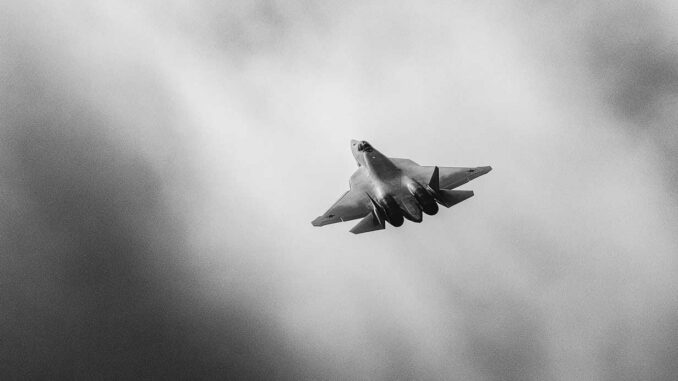
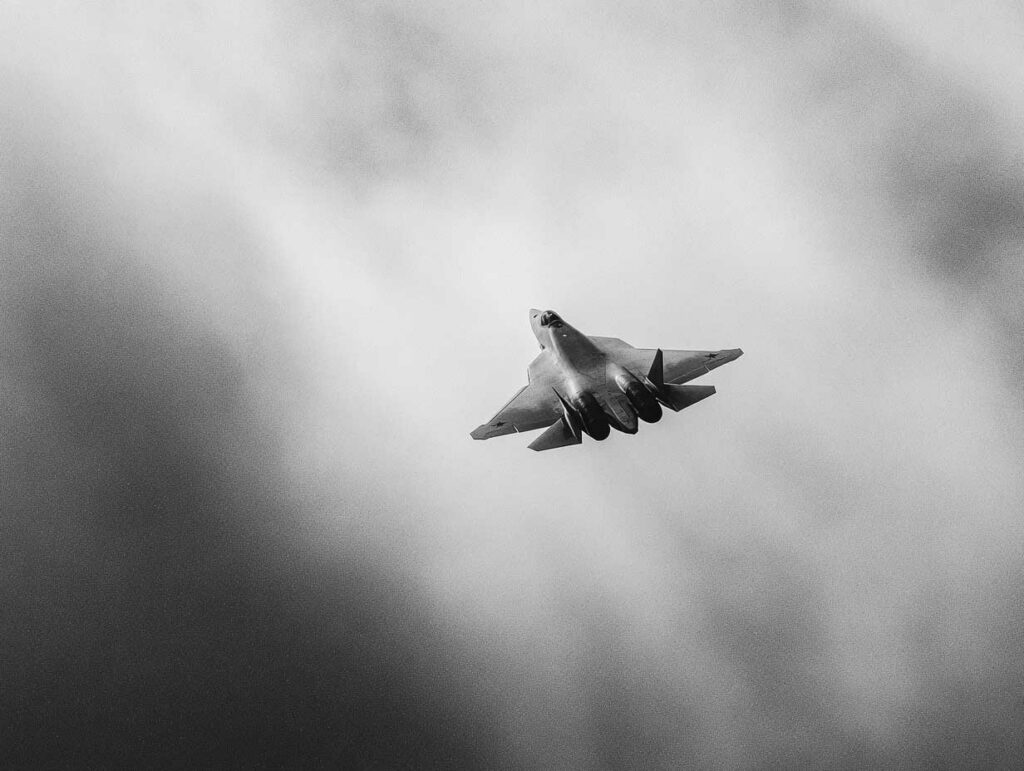
Moscow delivered a new batch of Su-57s in 2026. Avionics, armament, engine: what we really know about this modernized version of the Felon.
In summary
Russia did indeed deliver a new batch of Su-57 Felons in early 2026, but the frequently repeated narrative about an aircraft already fully transformed by the Izdeliye 30 engine needs to be seriously qualified. The established fact is clear: on February 9, 2026, United Aircraft Corporation announced the delivery to the Russian military of a large batch of Su-57s in a new technical configuration, featuring modernized onboard systems and a weapons suite. However, nothing in the available official communications confirms that these production aircraft are all already equipped with the long-awaited next-generation engine. What is confirmed is a distinct milestone: on December 22, 2025, a test Su-57 flew with the new Product 177 engine, presented by Rostec as a fifth-generation engine. The stakes are high. If this propulsion system truly reaches industrial maturity, the Su-57 will gain in thrust, endurance, upgrade potential, and potentially in true supercruise capability. But at this stage, the engine remains as much a hope as a certainty.
The new batch delivered to Moscow reveals something specific
The initial information is accurate, but it must be dated correctly. The first annual batch of Su-57s was not announced in March 2026. It was announced on February 9, 2026. On that day, Rostec and United Aircraft Corporation stated that they had delivered a large batch of Su-57s to the VKS in a “new technical configuration.” The official wording remains cautious. It mentions modernized onboard systems and an improved weapons suite, without publicly detailing the exact composition of the delivered configuration.
This vagueness is not insignificant. Russia is seeking to demonstrate that the program continues despite sanctions, industrial difficulties, and the war in Ukraine. But it has not published either the exact number of aircraft delivered or the exhaustive list of technical modifications. This necessitates separating established facts from strategic communication. The established fact is this: the Su-57 continues its ramp-up to full-scale production, with a new batch of modernized aircraft. What remains uncertain is the exact scope of this modernization across all aircraft in the batch.
The engine remains the crux of the Su-57 program
On paper, the Su-57 Felon was supposed to stand out thanks to a new-generation engine offering greater thrust, improved efficiency, and true supercruise capability. In practice, the program has long been held back by this technological hurdle. The first production aircraft were delivered with a transitional engine derived from the AL-41 family, often referred to as a first-stage engine. TASS had already noted that the first production Su-57s were equipped with this interim engine, while the next-generation engine was expected to arrive later.
This is why the engine issue is central. A fifth-generation stealth fighter is not defined solely by its shape or its sensors. It is also defined by its propulsion. A more powerful and efficient engine changes the range, sustained speed, thermal signature, payload, and the ability to power energy-intensive systems. In the case of the Su-57, this directly affects its credibility against the F-22, the F-35, or future Western fighter jets. Without this engine leap, the Su-57 remains an advanced aircraft, but one that falls short of its initial promise.
The new Russian engine is progressing, but it is not yet a certainty for series production
The technically confirmed milestone is set for December 22, 2025. On that date, Rostec announced the first flight of a Su-57 equipped with the Product 177 engine, presented as a fifth-generation engine. The Russian group specifies that this engine provides increased thrust, better fuel efficiency across all operating ranges, and superior durability. TASS reported a thrust with afterburner of 16,000 kilogram-force, or approximately 157 kilonewtons, which represents a significant leap compared to the transitional engines used on previously delivered aircraft.
This point is important for a simple reason: the term Izdeliye 30 is often used as a catch-all term to refer to the Su-57’s future definitive engine, but the most recent Russian communications primarily highlight Product 177 and its export version 177S. The Aviationist notes that the designations partially overlap in the Russian public sphere, which fuels confusion. What is clear, however, is that the engine presented in late 2025 is still in the flight test phase on a test aircraft and has not yet been officially validated as a standard already in widespread use on the batch delivered in February 2026. This is the key distinction.
The expected performance would truly change the Felon’s profile
If the new engine enters stable production, its effects would be far from cosmetic. The primary benefit lies in thrust. A higher power reserve improves acceleration, climb rate, high-altitude recovery, and the ability to carry more weapons while maintaining good performance. In modern air warfare, this matters just as much as maximum speed. An aircraft capable of quickly regaining energy after a maneuver, or of remaining longer in a favorable tactical envelope, gains a concrete advantage.
The second benefit concerns supercruise. Russia and certain media outlets close to the program claim that the new engine should allow the Su-57 to maintain supersonic speed without afterburner. This is a major issue, as supercruise reduces fuel consumption compared to supersonic flight with afterburner, while limiting the infrared signature. But we must remain rigorous: this capability is strongly suggested by Russian statements and the characteristics highlighted in Dubai, but has not yet been publicly demonstrated in operational service on an identified production batch. Caution is warranted.
The third benefit relates to energy efficiency. Rostec emphasizes reduced fuel consumption at all engine speeds.
This potentially means greater endurance, a longer range, or more leeway for complex mission profiles. In the Russian context, this is crucial. Long-range operations, strikes from the rear, and the need to avoid certain areas covered by enemy defenses require an air force capable of sustained flight without systematically relying on heavy ground support.
Visible modernization also affects sensors and survivability
Regarding the aircraft delivered in February 2026, one point quickly emerged in open-source analyses: several observers identified an evolution of the 101KS system, the Su-57’s onboard optoelectronic suite. TASS reported that the aircraft in the new batch appeared to have been equipped with new passive sensors capable of better detecting and tracking aerial threats via thermal signature. This point is more significant than it seems. A passive system does not emit signals. It detects without revealing itself. This improves both the aircraft’s stealth and survivability.
For a fighter like the Su-57, which seeks to compensate for stealth capabilities that are likely less advanced than those of the F-22 or F-35 through a combination of sensors, electronic warfare, and long-range missiles, these improvements are central. The aircraft does not rely solely on its airframe. It relies on the quality of its detection, its data fusion, and its ability to engage without being engaged. In this context, upgrading sensors is sometimes just as valuable as a raw increase in speed.
Weapons are evolving, but claims about AI must be handled with caution
The other part of the story concerns AI-guided air-to-ground munitions and the lessons learned from the war in Ukraine. Here again, we must be frank. The available official communications do not explicitly confirm that the batch delivered in February 2026 already includes “AI-guided” air-to-ground munitions as understood in Western literature. What is confirmed is a modernization of the weapons system. Since 2024, Rostec has also emphasized the Su-57’s capability to employ a wide range of precision munitions against air, ground, and naval targets.
This does not mean the link to Ukraine is false. It is even likely to be real. The conflict has demonstrated the value of long-range strikes, resilience against jamming, coordination between sensors, and rapid adaptation of targeting chains. It would make sense for Russia to seek to integrate more advanced algorithmic processing methods into its mission systems, loitering munitions, or guided weapons. However, at this stage, the public record does not allow us to definitively state that the Su-57 delivered in February 2026 already has a fully operational system for coordinating AI-guided air-to-ground munitions. We must therefore distinguish tactical inference from documentary evidence.
The true operational impact lies in the depth of the Russian system
Even with these caveats, the modernization of the Su-57 has real operational significance. The Su-57 is not designed as a mere prestige interceptor. It is intended to serve as a penetration platform, an advanced sensor, an effects coordinator, and a carrier of long-range missiles.
If propulsion advances, sensors improve, and weapon systems gain in precision and autonomous processing capabilities, the aircraft becomes a more credible option for first-wave missions against modern defenses.
The impact is also industrial and political. Moscow wants to prove three things: that the Su-57 program is not on hold, that sanctions have not halted its modernization, and that Russian industry is still capable of developing a new-generation engine. The problem is that this type of demonstration is judged less by announcements than by the pace of delivery. Yet Russia remains very tight-lipped about the exact number of aircraft delivered and the actual deployment of the new engine across its units. This is where the program’s credibility will be tested in the coming months.
The engine will determine whether the Su-57 truly moves up a class
The new 2026 batch shows that the Su-57 Felon continues to evolve. On this point, there is no doubt. The aircraft is receiving new sensors, an improved weapons architecture, and, likely, refinements directly inspired by lessons learned from the conflict in Ukraine. But the decisive question remains the same as it was five years ago: can Russia industrialize the engine—which is supposed to bring the Su-57 to its full potential—at a credible production rate?
If the answer becomes yes, the Su-57 will gain in autonomy, power, endurance, and thermal signature reduction. It will evolve from a promising but partially transitional fighter into a much more coherent aircraft. If the answer remains unclear, the engine will continue to create a disconnect between Russian claims and fleet reality. And in this program, it is precisely this gap that matters most.
Sources
Rostec, UAC has Delivered the New Su-57 and Su-34 to the Ministry of Defense of the Russian Federation, March 29, 2025
TASS, Su-57 fighters delivered to Russian Aerospace Forces got new tracking sensors — experts, February 10, 2026
TASS, Russia’s top brass to get first Su-57 fifth-generation fighter in December, November 2, 2020
TASS, First serial-produced Su-57 fighter to be delivered by year’s end, December 7, 2020
TASS, Russia’s Su-57 fighter with fifth-generation engine begins flight tests, December 22, 2025
Rostec, The Su-57 Made Its First Flight with the Product 177, an Advanced Fifth-Generation Engine, December 22, 2025
Rostec, UEC First Demonstrated the Fifth Generation 177S Aircraft Engine in the Middle East, November 19, 2025
The Aviationist, Russia’s Su-57 Flies with New Izdeliye 177 ‘Gen. 5’ Engine, December 22, 2025
War Wings Daily is an independant magazine.