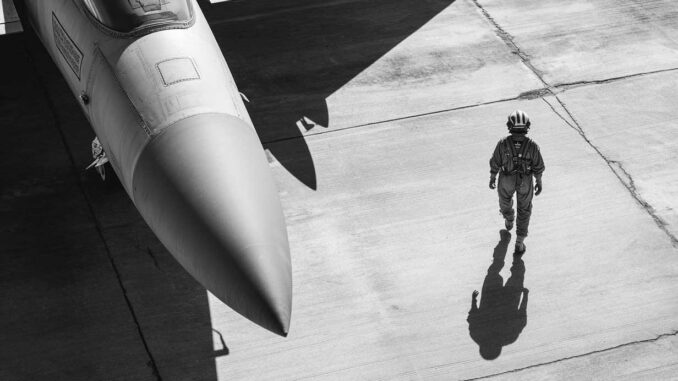
An American pilot remains missing in Iran following the destruction of an F-15E. A detailed look at the crash, the ejection, and the risks.
In summary
The disappearance of an American crew member over Iran marks a military and political turning point. On April 3, 2026, a U.S. F-15E Strike Eagle was shot down in southwestern Iran. The aircraft was carrying two airmen. One was recovered by U.S. forces. The other, described by several U.S. media outlets as a weapons systems officer, remained missing as of April 4. At the same time, an A-10 involved in the search effort was also hit, before its pilot managed to eject and was subsequently recovered. The situation is serious for three reasons. First, it contradicts the notion of a sky fully controlled by Washington and its allies. Second, it sets off a race between American rescue teams and Iranian forces to locate the missing servicemember. Finally, it highlights an often-underestimated reality: ejecting does not mean emerging unscathed. Ejection can save a life, but it exposes the pilot to spinal fractures, limb trauma, head injuries, and extreme vulnerability on the ground.
The turning point revealed by the pilot’s disappearance in Iran
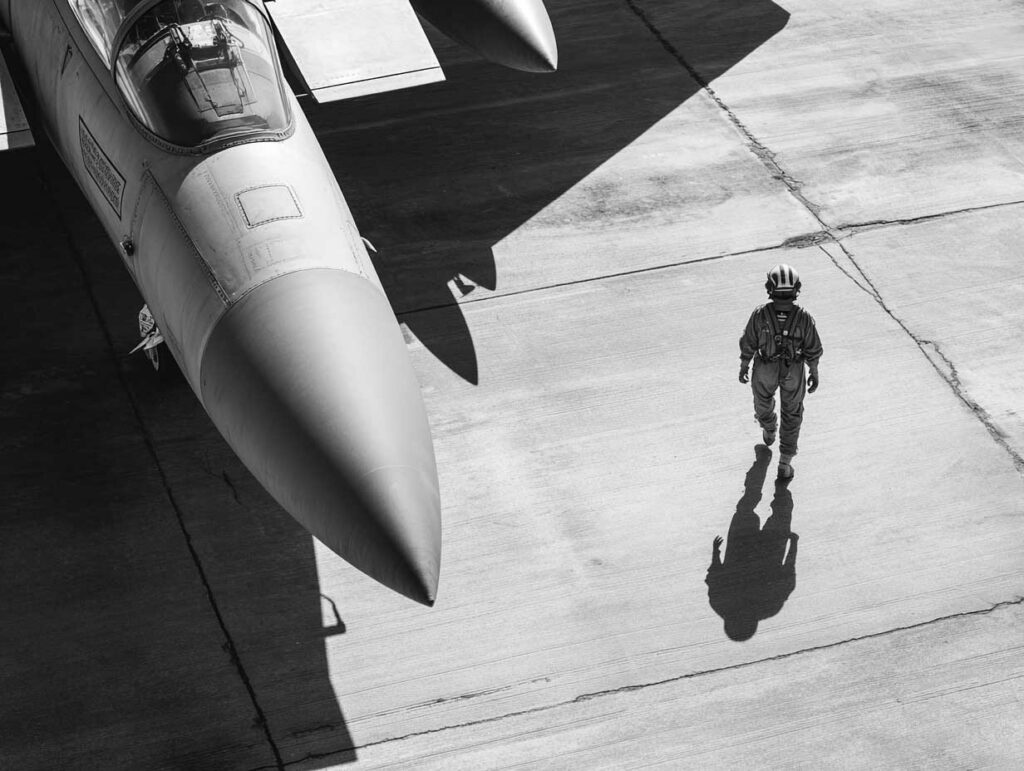
The incident is, first and foremost, a raw military fact. A U.S. F-15E Strike Eagle was shot down over Iran on April 3, 2026. U.S. authorities cited by Reuters and CBS confirmed that one of the two crew members had been recovered, while the other remained missing. The aircraft in question is a two-seat fighter-bomber. It carries a pilot in the front and, in the rear, a weapons systems officer responsible for tactical navigation, sensor management, and weapons deployment. This point is significant because it explains why early reports sometimes referred to a “missing pilot,” when it could actually be the second crew member and not the pilot at the controls.
The crash site underscores the significance of the incident. Several media outlets have placed the incident in southwestern Iran, in the Khuzestan region, with reports converging on the area around Behbahan. This is not a mere geographical detail. It means the aircraft was not shot down in a remote outlying area, but within a zone where a rapid recovery becomes difficult, risky, and politically explosive. A combat operation that turns into a rescue mission in enemy territory immediately changes the tactical logic. The objective is no longer merely to strike, but to extract a survivor before the enemy does.
The sequence of events that turned a crash into a crisis
The available information allows us to reconstruct a coherent sequence of events. The F-15E is hit, its two crew members eject, and then a search-and-rescue mission is launched. One pilot is recovered. The second is not.
The United States then continued a recovery operation under threat, while Iranian authorities and state media called on the public to report or hand over the missing American servicemember. Several sources even reported a promised reward for his capture alive. This shifted the episode from an aviation incident to an open military manhunt.
The dangerous nature of this phase is also evident from the additional losses and damage. CBS reported that an A-10 Warthog engaged in the search support mission had been hit. Its pilot was able to eject over the Persian Gulf and was recovered. Reuters further reported that two Black Hawk helicopters involved in the search effort came under Iranian fire before returning out of Iran, with injured personnel on board according to available information. This speaks volumes about the situation: the problem is not just the downed aircraft, but the adversary’s ability to threaten the platforms sent to rescue the survivors.
Another telling detail: Israel has suspended strikes in areas deemed relevant to the recovery operation, according to CBS, citing an Israeli official relaying information from the Associated Press. Here again, the message is clear: when a crew is on the ground in hostile territory, the priority becomes deconfliction and extraction, even at the cost of a temporary slowdown in the offensive tempo.
Why this pilot remains missing
One should not assume that an ejection automatically results in a functioning beacon, an arriving helicopter, and a quick return to base. In practice, everything depends on four variables: altitude at the time of ejection, the survivor’s physical condition, the quality of communications, and the speed at which enemy forces converge. In this case, several media outlets describe a veritable race between the Americans and the Iranians to reach the missing crew member. The simple fact that he has still not been recovered more than several hours after the crash suggests, at the very least, a highly contested environment, and perhaps also the survivor’s inability to move quickly or transmit for an extended period. This latter hypothesis remains a deduction, not a confirmed fact.
The human context also plays a role. A pilot who has just ejected must first survive the ejection itself, then the landing, and then the aftermath of the landing. If he is injured, disoriented, or separated from some of his equipment, the window for survival narrows quickly. In semi-desert or rural areas, visual exposure is high. In populated areas, the risk comes from civilians, local forces, or improvised surveillance networks. The fact that Iranian state media have mobilized the population around the search further complicates the survivor’s ability to remain discreet.
The Real Risk of Injury During Ejection
We must be frank on this point: ejection saves lives, but it also breaks bodies. In the collective imagination, the pilot pulls the handle, the canopy pops off, the seat shoots out like a rocket, the parachute opens, and the pilot is safe and sound. The reality is harsher.
A meta-analysis published in Injury reviewed 14 studies totaling 1,710 ejections. It estimates the average mortality rate at 10.5% and the average rate of major injuries at 29.8%. Among these major injuries, spinal fractures account for 61.6%, limb injuries for 27.3%, and head injuries for 8.9%.
Other studies point in the same direction. A study published in the Journal of Neurosurgery: Spine concludes that fighter jet crews face a high risk of spinal injury following an ejection seat evacuation. A study on French crews published in Aerospace Medicine and Human Performance also documented the persistence of spinal injuries despite advances in ejection seats and procedures. In other words, even with modern systems, the human body endures a sudden vertical acceleration, followed by an aerodynamic shock, and sometimes a violent landing.
In practical terms, the typical injuries are well-known: vertebral compression fractures, neck pain, shoulder injuries, leg trauma at the moment of separation between the seat and the body, chest injuries, and sometimes injuries related to parachute deployment or ground impact. Clinical reports on survivors also describe eye injuries, rib fractures, and joint trauma. To say that a pilot “ejected” does not, therefore, mean that he can run, hide for long, or effectively resist a pursuit. He may be alive and conscious, but physically impaired. This is a key point in understanding why a crew member may remain missing after only a few minutes.
The strategic implications of this incident for the ongoing war
This incident is not only tragic on a human level. It is also embarrassing from an operational standpoint. Reuters notes that the incident comes at a time when Donald Trump and Defense Secretary Pete Hegseth had claimed to possess a form of air superiority. Yet an F-15E shot down, an A-10 hit, and then rescue helicopters coming under fire show that an enemy defense, even a fragmented one, continues to have an impact. The lesson is old but brutal: air superiority is never a binary switch. It is also measured by the ability to protect one’s crews when things go wrong.
The incident also serves as a reminder that a missing crew member can carry greater political weight than a lost aircraft. A destroyed aircraft costs money and capabilities. A missing airman creates a crisis of command, image, and narrative. As long as he is neither recovered nor officially located, each side exploits the uncertainty. Washington wants to demonstrate that it leaves no one behind. Tehran wants to show that it can not only hit an American aircraft, but also contest the fate of its crew on its own soil. That is, fundamentally, what makes this case so sensitive. It is not just about aviation technology. It is about control, prestige, and vulnerability.
The Current Status as of April 4
As of April 4, 2026, converging reports from Reuters, AP, and CBS indicate that one F-15E crew member has indeed been recovered and that a second remains missing. Iran was continuing its own search, while the United States maintained its rescue efforts. No solid, public confirmation yet allowed for the assertion that the missing servicemember had been captured, killed, or exfiltrated. We must therefore remain cautious: at this time, the exact status of the missing crew member remains unknown. What is certain, however, is that the incident has already shattered an illusion. Even in a campaign dominated by remote strikes, war suddenly becomes very simple and very brutal: a man on the ground, perhaps wounded, surely being hunted, and two nations racing toward him.
Sources
Reuters, April 3, 2026, US fighter jet shot down over Iran, search underway for crew, US official says
Reuters, April 4, 2026, Downed planes spell new peril for Trump as Tehran hunts missing US pilot
Associated Press, April 4, 2026, US presses search for a missing serviceman as Iran calls on public to find enemy pilot
CBS News, April 3–4, 2026, American fighter jet shot down over Iran, 1 crew member rescued, U.S. officials say
CBS News live updates, April 3–4, 2026, Search continues for missing crew member after U.S. fighter jet shot down by Iran
The Guardian, April 3, 2026, One of two US crew members rescued after F-15E jet shot down over Iran
F. Sommer et al., Journal of Neurosurgery: Spine, 2022, Spinal injuries after ejection seat evacuation in fighter aircraft
D. Epstein et al., Injury, 2020, Injuries associated with the use of ejection seats: a systematic review and meta-analysis
O. Manen et al., Aerospace Medicine and Human Performance, 2014, Spine injuries related to high-performance aircraft ejections
J. Zeng et al., World Journal of Clinical Cases, 2022, Analysis of two naval pilots’ ejection injuries: Two case reports
War Wings Daily is an independant magazine.