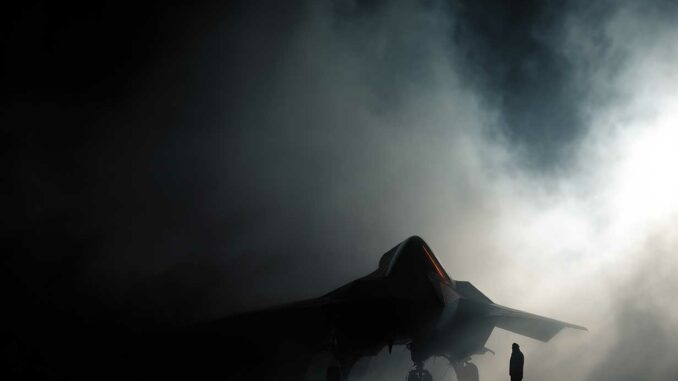
With the F-47 and CCA drones, the US Air Force is preparing for distributed aerial warfare in the face of China and Pacific defenses.
In Summary
The US Air Force is changing its doctrine. The future F-47, emerging from the Next Generation Air Dominance program, is not intended merely to replace the F-22 Raptor. It is to become the center of an aerial combat system composed of manned aircraft, collaborative drones, distributed sensors, data links, and long-range weapons. The principle is clear: facing China, a very expensive stealth aircraft is no longer enough. It is necessary to produce mass, multiply axes of attack, saturate enemy defenses, and reduce human risk. Collaborative Combat Aircraft, or CCAs, are to fly alongside the F-47 and the F-35. They will be able to detect, jam, draw fire, carry missiles, or strike specific targets. The stakes are immense. Washington wants to maintain aerial superiority in the Pacific but must do so with sustainable costs and an industry capable of rapid production.
The F-47 Marks a Break with the Lone Fighter Model
The F-47 is not just another new American fighter jet. It embodies a doctrinal rupture. For decades, American air superiority has relied on highly advanced, very costly platforms piloted by extremely well-trained crews. The F-15 established power, the F-22 established stealth, and the F-35 established data fusion. The F-47 must go further: it must command a network.
Boeing was selected in March 2025 to develop this future sixth-generation fighter under the Next Generation Air Dominance program. The aircraft is intended to replace the F-22 Raptor, which entered service in the early 2000s and is now limited by its age, maintenance costs, and small numbers. The US Air Force only possesses about 180 F-22s, only a portion of which are available at any given time. Facing a China that is fielding more J-20s and accelerating its stealth programs, this volume has become insufficient.
The F-47 must therefore be more than a successor. It must be a flying command node. Its pilot will not just be a shooter; they will be a mission commander, capable of coordinating several semi-autonomous drones, exploiting remote sensors, delegating tasks, and making decisions in saturated airspace. This logic changes the role of the pilot, bringing them closer to an embedded tactical commander placed at the center of a constellation of effectors.
This evolution responds to a brutal reality. In a high-intensity conflict, especially against China, the United States can no longer rely solely on a handful of extremely high-performing aircraft. Losses will be possible. Bases will be threatened. Tankers will be targeted. Surface-to-air defenses will be numerous. Aerial superiority will have to be conquered by a complete system, not by an isolated aircraft.
The NGAD Doctrine Aims for Domination through Network and Depth
The NGAD program is based on a simple idea: future aerial combat will not be won by the best platform alone, but by the best ensemble. The F-47 must operate with CCA drones, satellites, radar aircraft, electronic warfare aircraft, B-21 Raider bombers, F-35s, tankers, ground systems, and long-range weapons.
This doctrine directly addresses the Pacific theater. Distances there are immense. From Guam, Hawaii, Japan, or Australia, American aircraft must travel hundreds or thousands of kilometers to reach contested zones around Taiwan, the South China Sea, or the first island chain. In this environment, endurance, combat radius, and survivability become decisive.
The expected performance of the F-47 remains partially classified. Public information suggests an aircraft stealthier than previous generations, capable of flying faster than Mach 2, with a combat radius exceeding that of the F-22 and F-35. Some American sources mention a range on the order of 1,000 nautical miles, or approximately 1,850 kilometers. This figure is crucial. In the Pacific, a short-range aircraft depends too heavily on tankers. Yet tankers are slow, visible, and vulnerable targets.
The F-47 is also expected to carry more weapons in its bays than the F-22. This is an essential point. A stealth aircraft must keep its missiles inside to preserve its radar signature. However, an internal bay limits the number of munitions. If the F-47 can combine stealth, long range, and increased payload, it will address three weaknesses of the F-22: range, weapons volume, and digital scalability.
NGAD does not, therefore, aim merely to win an aerial duel. It aims to open corridors, destroy sensors, neutralize surface-to-air missiles, protect bombers, guide drones, and prevent China from controlling its near aerial environment.
CCAs Must Create the Mass the US Air Force Can No Longer Afford with Manned Aircraft
The heart of the new doctrine lies in Collaborative Combat Aircraft. These drones are not simple flying targets; they are to become combat partners. The US Air Force eventually wants to buy more than 1,000 of them, with a logic often described as two CCAs for every manned fifth- or sixth-generation fighter. Exact figures will evolve, but the idea is clear: create volume without buying only manned aircraft at $100 million to $200 million apiece.
The first industrial firms selected for the advanced phase of the CCA program are General Atomics and Anduril. Their aircraft, designated YFQ-42A and YFQ-44A, are to serve as representative prototypes. The US Air Force has requested nearly a billion dollars to launch initial CCA purchases, a sign that the program is moving from experimental logic toward initial production.
The function of CCAs will depend on the mission. Some drones could carry air-to-air missiles. Others could jam enemy radars. Some will serve as advanced sensors, sent closer to the threat than the manned aircraft. Others could act as decoys, forcing the adversary to reveal their radars or absorb incoming fire. This diversity is one of the concept’s key attractions.
The economic objective is obvious. A CCA must cost less than a manned aircraft. The US Air Force has often mentioned a cost corresponding to a fraction of that of a modern fighter. Depending on configurations, some American officials have spoken of a price point close to $20 million to $30 million per drone, though actual prices will depend on sensors, engines, stealth, and production volume. The gamble is to create a force performant enough to survive, yet affordable enough to be bought in numbers.
This is a cultural rupture for the US Air Force. For a long time, every American aircraft has become more expensive, rarer, and more precious. CCAs introduce a different logic: accepting a certain level of loss, multiplying vectors, and making the cost of defense unsustainable for the adversary.
Saturating Chinese Defenses Becomes the Center of the Problem
China has built one of the most ambitious anti-access bubbles in the world. It combines ballistic missiles, cruise missiles, stealth fighters, long-range radars, electronic warfare, satellites, surface-to-air systems, anti-aircraft ships, and hardened bases. This architecture aims to prevent American forces from operating freely near the Chinese coastline.
In such an environment, sending only a few very expensive stealth aircraft would be risky. Even the best aircraft can be detected from certain angles, by certain sensors, or when it emits. Even a stealth aircraft must manage its weapons, communications, and fuel. China does not need to destroy every American plane to win time; it only needs to make access too costly, too slow, or too uncertain.
The F-47 and CCAs respond to this logic through dispersion. Instead of concentrating all value in a single aircraft, the US Air Force wants to distribute sensors, weapons, and risks. One CCA can move closer. Another can jam. Another can fire. The F-47 stays further back, analyzes the situation, coordinates the maneuver, and engages only when useful.
Saturation works both ways. Drones can saturate Chinese radars by creating multiple tracks. They can saturate adversary missiles by multiplying targets. They can saturate human decisions by imposing rapid choices: should one fire at a low-cost drone at the risk of wasting an expensive missile? Should one wait, at the risk of letting a real threat through? Should one turn on a radar, at the risk of being localized?
This is the central stake: creating uncertainty for the adversary. The air superiority of tomorrow will not only be a matter of speed or altitude. It will be a battle of perception, data, jamming, and cost-per-engagement.
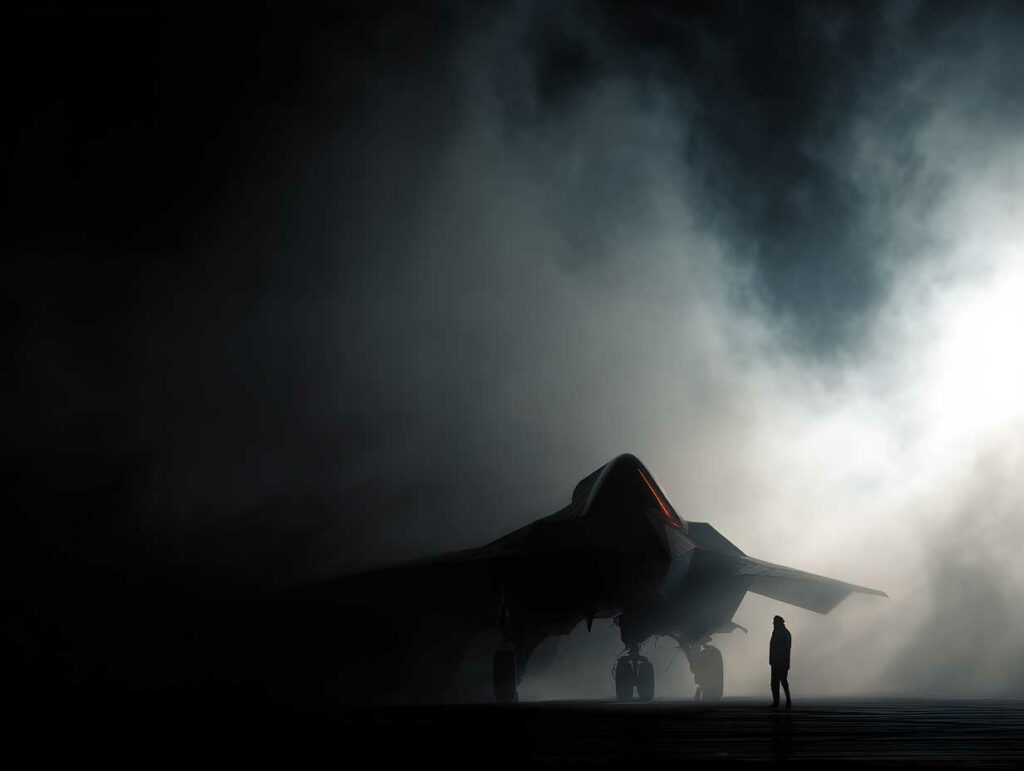
The F-47’s Expected Performance Addresses the Limits of the F-22 and F-35
The F-22 remains an exceptional aircraft, but it was designed for a different era. It offers high stealth, great maneuverability, and strong air-to-air capability. But its fleet is small. Its modernization is expensive. Its initial connectivity was limited. Most importantly, its combat radius is not ideal for the Pacific.
The F-35, for its part, is an excellent flying sensor. It excels in data fusion, precision strike, electronic warfare, and information sharing. But it is not intended as a pure replacement for the F-22 in very high-intensity air superiority. Its speed, combat radius, and internal load have limits. The F-47 must combine very advanced stealth, superior endurance, the ability to command drones, and an open architecture to quickly integrate new software.
This software architecture is as important as the airframe. A sixth-generation aircraft must evolve quickly. Threats change every two or three years, sometimes faster. Adversary radars, missiles, jammers, and algorithms progress. A static aircraft becomes vulnerable. The F-47 must therefore receive rapid updates, integrate new sensors, and communicate with drones that will also evolve.
The expected stealth will not be just frontal. It will need to be broader, more robust, and better adapted to multi-band radars. Electronic warfare will likely be integrated from the design phase. The engine will have to offer range, electrical power, and thermal management. This last dimension is often underestimated. Sensors, processors, data links, and jamming systems consume a lot of energy and produce a lot of heat. A sixth-generation aircraft must manage this heat to remain discreet.
The F-47 should therefore be seen as a digital combat platform, not just a faster plane.
Cost Remains the Program’s Greatest Risk
The primary danger of the F-47 is obvious: it could become too expensive. The NGAD program already underwent a strategic pause in 2024 because the US Air Force feared cost overruns. A sixth-generation aircraft with advanced stealth, new engines, complex sensors, and collaborative piloting can easily exceed planned budgets.
American budget documents project several billion dollars in research and development. Specialized sources mention more than $4 billion in annual funding related to the F-47 and CCAs in the early years. Some life-cycle calculations, over several decades, reach very high levels when development, production, maintenance, modernization, associated drones, weapons, and infrastructure are included.
The US Air Force must avoid the trap of the F-22: an excellent aircraft, but bought in numbers that were too small. If the F-47 becomes too costly, it will be produced in small batches. In that case, it will not solve the problem of mass. The CCAs are precisely there to avoid this impasse. But they too can suffer from scope creep. If every drone becomes too sophisticated, too stealthy, and too expensive, the economic logic disappears.
The industrial challenge is thus brutal: produce a manned aircraft that is very advanced but not inaccessible; produce drones that are performant but not precious; and connect it all in a reliable, resilient, and secure network.
This is easier to write in a doctrine than to produce in a factory. Boeing will have to prove it can meet deadlines after several difficulties on other major programs. General Atomics, Anduril, and other industrial firms will have to prove they can transition from attractive prototypes to robust military production.
Political Stakes Go Beyond the US Air Force
The F-47 is also a political message. The United States wants to show it is not content with merely modernizing its older aircraft. It wants to establish a new aerial warfare architecture before China can reach parity. The designation F-47, announced under the Trump administration, also carries an obvious symbolic weight, as Donald Trump is the 47th President of the United States.
But politics is not enough. Congress will have to fund the program sustainably. Trade-offs will be difficult. The United States must also fund the B-21, submarines, missiles, missile defense, space, hypersonic weapons, and nuclear modernization. The F-47 will therefore have to defend its place against other priorities.
Allies will be watching closely. The F-47 will not necessarily be exported, or at least not quickly. But the CCAs could open up avenues for cooperation. Australia, Japan, the United Kingdom, and certain European countries will follow this model because they face the same problem: manned aircraft are becoming too rare to cover every scenario. Collaborative drones offer a partial solution.
China, for its part, will not remain passive. Beijing is developing its own combat drones, stealth aircraft, long-range missiles, and command systems. The race will therefore not just be about the first aircraft; it will be about the ability to more quickly adapt networks, algorithms, and production volumes.
American Aerial Warfare Enters the Age of Distributed Command
The pivot toward the F-47 and CCAs shows an American realization. Aerial warfare can no longer rely on the idea of a small number of invincible aircraft. Facing China, distances are too great, defenses are too numerous, and potential losses are too costly. There must be mass, depth, and resilience.
The F-47 embodies this transition. It will likely be stealthier, more autonomous, more connected, and more powerful than current fighters. But its importance will come primarily from what it commands. Its value will not just lie in its missiles; it will be in its capacity to organize a complex battlespace, to delegate to drones, to survive in a contested environment, and to strike at the right moment.
CCAs, meanwhile, will give the US Air Force what it lacks most: numbers. Not a blind mass, but an intelligent mass, software-driven, expendable at some moments, precious at others. It is a risky doctrine, as it depends on autonomy, communications, and trust in machines. But it responds to the real-world problem of the Pacific.
The F-47 will not only be judged on its speed or stealth. It will be judged on a harsher question: can it allow the United States to maintain the initiative against a China capable of producing fast, striking far, and contesting every kilometer of the sky? That is where the true value of this program will be played out—not in official renderings, but in its ability to transform American technological superiority into available, repeatable power produced in numbers.
War Wings Daily is an independant magazine.