
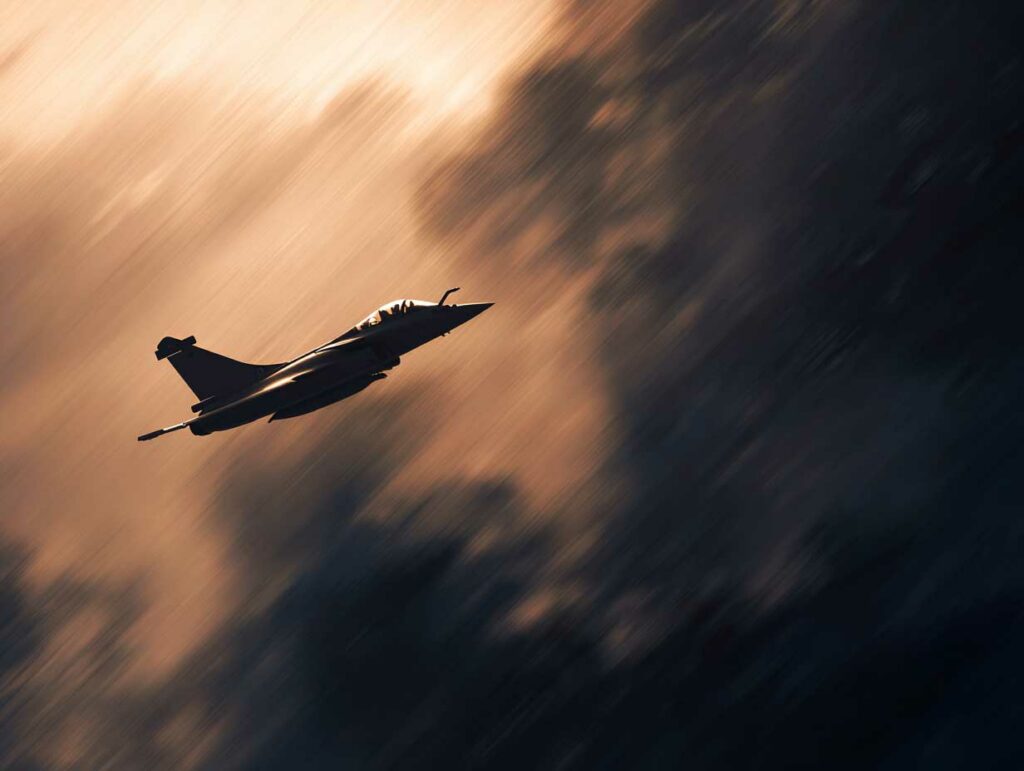
The Rafale F5 is set to carry the ASN4G, command a stealth drone, and maintain French deterrence against modern defenses.
Executive Summary
The Rafale F5 is not a mere modernization of the current Rafale; it marks a strategic rupture for the French Air and Space Force. Scheduled for aircraft delivery around 2030, followed by a stealth combat drone derived from the nEUROn program starting in 2033, it is designed to extend the Rafale’s credibility until the arrival of the FCAS (Future Combat Air System). Its primary role will be twofold: carrying the future ASN4G hypersonic nuclear missile and leading collaborative combat missions with unmanned wingmen. The objective is clear: maintain France’s ability to penetrate increasingly well-defended airspaces. The Rafale F5 must also provide capabilities for suppressing anti-aircraft defenses, electronic warfare, connected combat, and long-range strikes. While the program is real, funded, and launched, it remains technically demanding and budgetarily constrained.
The Rafale F5: France’s Bridge to the FCAS
The Rafale F5 is often described as a “super-Rafale.” While this term is useful for the general public, it can be misleading. This is not an entirely new aircraft but a profoundly transformed standard designed to ensure the Rafale survives in a much harsher strategic environment. France cannot wait for the FCAS, whose entry into service is not expected until beyond 2040. Consequently, it must bolster its primary combat aircraft before that deadline.
The Ministry of the Armed Forces has already placed the first orders related to the F5 standard, involving Dassault Aviation, Thales, Safran, and MBDA. The official timeline sets the arrival of the Rafale F5 around 2030, with the associated stealth combat drone following from 2033. This distinction is vital: the Rafale F5 will arrive before its unmanned wingman, making the full system’s deployment a gradual process.
France aims to avoid a capability gap. While the current Rafale F4 already provides enhanced connectivity, new weaponry, better sensors, and modernized maintenance, the F5 standard aims higher. It prepares the aircraft for high-intensity conflicts, modern surface-to-air defenses, multi-band radars, powerful jamming, and networked operations with unmanned systems.
The Rafale F5 will be more than a modern aircraft; it will be the hub of a system. The pilot will receive more information, manage remote effectors, coordinate a combat drone, fire longer-range weapons, and remain capable of fulfilling the nuclear mission. This evolution brings French doctrine closer to the U.S. approach with the F-47 and CCAs, but with more concentrated resources and a French logic: less mass, more sovereignty.
How the Future Standard Changes Rafale’s Role in Aerial Warfare
The current Rafale is already a multi-role aircraft, handling air defense, conventional strikes, reconnaissance, maritime attack, and nuclear deterrence. The Rafale F5 will retain this versatility while significantly improving three dimensions: penetration, connectivity, and autonomy of action.
Penetration is the focal point. Adversarial air defenses are becoming denser. Systems like the S-400, S-500, HQ-9, long-range radars, passive sensors, and multi-layered surface-to-air missiles make direct approaches increasingly dangerous. The Rafale is not a stealth aircraft in the sense of the F-35 or B-21. Its survivability relies on a mix of a relatively low signature, electronic warfare, tactical flight, long-range missiles, and coordination with other assets. The F5 must reinforce this combination.
Connectivity is the other major shift. A modern combat aircraft must exchange data with other planes, drones, satellites, ships, ground systems, and command centers. The F5 must process more data and prioritize it more effectively. The challenge is no longer just collecting information, but making it useful for the pilot. A cockpit saturated with alerts is dangerous; the real progress will lie in data fusion, decision support, and automation.
Autonomy of action is a specifically French concern. Paris wants to employ the Rafale without depending on a foreign supplier for its weapons, critical software, or strategic missions. The F5 must remain a sovereign system. This dimension is vital for nuclear deterrence and exports. A modernized Rafale, capable of working with a stealth drone, can remain attractive against the F-35, KF-21, J-35, or future European aircraft.
The ASN4G Imposes a Technological and Strategic Leap
The most critical point of the Rafale F5 is the integration of the future ASN4G (Air-Sol Nucléaire de 4ème Génération) missile. It is intended to replace the refurbished ASMPA, which is currently the heart of the airborne component of French deterrence. The F5 standard is explicitly linked to this mission.
The ASN4G is generally described as a hypersonic or high-supersonic nuclear missile. While its exact specifications are classified, its goal is known: to penetrate air defenses far more modern than those the ASMP was designed against. An airborne nuclear missile must remain credible for decades, necessitating the ability to evade radars, interceptors, anti-missile systems, and electronic warfare.
The Rafale F5 must manage a more demanding weapon. This implies modifications to the airframe, avionics, mission calculations, links, nuclear security, and aerodynamic integration. A hypersonic missile imposes heavy constraints—it may be heavier, longer, hotter, and more complex to program than conventional missiles. The carrier aircraft must be able to carry, prepare, and launch it within a safe envelope and survive the mission.
The stakes go beyond technology. The airborne component gives France a flexible nuclear option. While nuclear ballistic missile submarines ensure oceanic permanence, the Strategic Air Forces’ Rafales provide a visible, recallable, and politically graduated capability. An airborne nuclear raid can be demonstrated, dispersed, and prepared, then aborted—making it a force for signaling as much as a strike force.
The nEUROn-Derived Drone: Making Penetration Credible
The combat drone associated with the Rafale F5 is the other pillar of the program. It will benefit from the achievements of the nEUROn demonstrator, developed by Dassault Aviation with several European partners. Since its first flight in 2012, the nEUROn has tested stealth airframes, autonomous flight, and mission architectures.
The future drone will not be a simple updated nEUROn; it will be an operational system. It must fly alongside the Rafale F5, penetrate contested spaces, carry sensors or weaponry, jam defenses, and act as a scout, decoy, or strike effector. The Ministry of the Armed Forces describes it as a stealth combat drone designed to contribute to the operational superiority of French forces starting in 2033.
Its most important mission may be the suppression or destruction of enemy air defenses (SEAD/DEAD). While France has historically had limited capabilities in this area compared to the U.S. “Wild Weasel” culture, the Rafale F5 and stealth drone pairing could bridge this gap. An unmanned system can take more risks, fly closer to radars, and force the adversary to emit signals, opening a window for the Rafale.
The Rafale F5: Systemic Rather Than Stealthy
Comparison with the F-35 is inevitable. The F-35 was designed from the outset as a fifth-generation stealth aircraft. The Rafale will not become stealthy through modernization; the F5 will not change its basic airframe or add an internal weapons bay.
Its advantage will lie elsewhere—in a broader combat system. The Rafale F5 will rely on electronic warfare, long-range weapons, its stealth drone, data links, and multi-role versatility. It must compensate for the lack of native stealth through a distributed approach. The drone will penetrate deeper, missiles will be fired from a distance, and remote sensors will reduce the pilot’s exposure.
This logic is realistic and matches French resources. France cannot fund a full equivalent of the F-35 and NGAD while maintaining its deterrence, navy, army, and satellites. It has chosen a targeted trajectory: improve a proven platform, add a stealth drone, and prepare the ASN4G while waiting for the FCAS.
Budgetary Realities and Necessary Trade-offs
The 2024-2030 Military Programming Law allocates 413 billion euros to the French military. While this is a sharp increase, it is not enough to fund everything without difficult choices. Nuclear modernization, Rafales, frigates, munitions, and cyber defense all compete for credit.
The Rafale F5 standard benefits from development funding, with several billion euros dedicated to the aircraft and its systems through 2030. However, the combat drone is not cheap. It will require its own stealth airframe, sensors, engines, and autonomous software. The final cost will depend on its ambition—a simple stealth decoy is one thing, but a full UCAV capable of strikes and electronic warfare is quite another.
Proven Capabilities vs. Future Promises
The Rafale F5 is not a rumor; the program has launched and orders have been notified. However, the timeline remains ambitious. A 2030 arrival for the F5 assumes software development, flight tests, and certifications proceed without major delays. The 2033 drone timeline is even more challenging.
France has a history of successful aeronautical programs, and the nEUROn demonstrated real expertise. But moving from a demonstrator to an operational combat drone is a massive step. Furthermore, the industrial base—Dassault, Thales, Safran, and MBDA—is already under pressure from export orders and other national needs.
A Response to Russia and FCAS Delays
The Rafale F5 is partly a response to the Russian threat, as the war in Ukraine has highlighted the density of modern air defenses. But it also addresses a European problem: the slow progress of the FCAS.
Due to industrial tensions between Dassault and Airbus and varying national requirements, the FCAS timeline has slipped. France cannot risk its aerial security on a program that won’t arrive until the 2040s. The Rafale F5 serves as insurance. it maintains French expertise, protects deterrence, and reduces the risk of a capability gap.
The Ultimate Stake: The Credibility of French Penetration
The Rafale F5 must answer one question: can France still strike far away, alone if necessary, in an environment defended by major powers?
If the Rafale F5 succeeds, France will retain a rare capability in Europe: a sovereign multi-role aircraft capable of nuclear deterrence and collaborative combat with stealth drones. If the program falters, France risks entering the 2030s with an excellent aircraft that is no longer adapted to the hardening of global threats. Success will be measured not in speeches, but in the ability to fly drones in contested zones and integrate the ASN4G effectively.
War Wings Daily is an independant magazine.