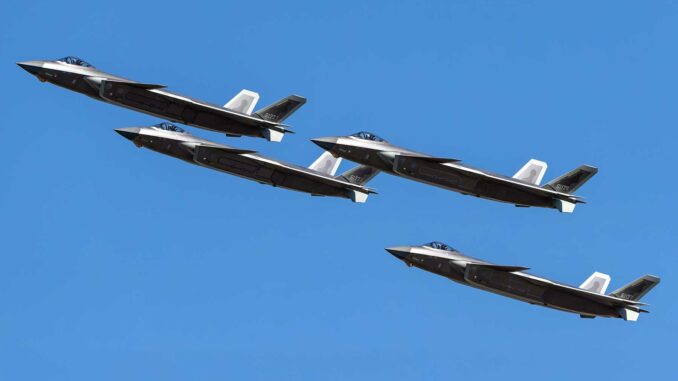
With its automated factories, China is ramping up production of the J-20 and reshaping the industrial balance of power against Europe.
In Summary
China is no longer content with simply producing a credible stealth aircraft. It now seeks to produce them quickly, sustainably, and in large volumes. The latest information released on the Chengdu J-20, nicknamed “Mighty Dragon,” indicates that critical components are being manufactured in a dark factory—a highly automated facility where autonomous vehicles, machine tools, digital inspection systems, and AI-driven software operate almost nonstop. The reported gain is significant: production efficiency has more than doubled for certain structural components. This information should be viewed with caution, as Chinese figures are rarely independently verifiable. But the trend is clear. Beijing is transforming combat aviation into an industrial endeavor. Compared to a Europe that produces slowly, with fragmented supply chains and modest production rates, China is building mass production capacity that could upend the military balance of power and export markets.
China is no longer just building an aircraft; it is building production capacity
The topic of the J-20 is often discussed from a military perspective. Its stealth capabilities are compared to those of the F-22 Raptor, its range to the F-35 Lightning II, or its long-range missiles to Western weaponry. This is useful, but incomplete. The real change may lie elsewhere: in the factory.
According to reports published by the Chinese press and subsequently picked up internationally, a facility involved in the production of J-20 components is said to operate as a dark factory. The term refers to a factory capable of operating with very little human presence. It can theoretically operate in the dark, as robots do not need light to work. In the Chinese case, it is not merely a matter of installing a few robotic arms. The system combines autonomous vehicles, CNC machines, coordination software, quality control sensors, and artificial intelligence tools.
The key information is striking: China claims to have more than doubled the production efficiency of certain components of the J-20. Data cited by several media outlets point to machines capable of operating for more than 21 hours a day, with a significant reduction in the need for direct labor. If these figures are accurate, China is not merely gaining a few points in productivity. It is changing the very economics of stealth fighter jet production.
The J-20 entered service in 2017 with the People’s Liberation Army Air Force. Its first flight took place in 2011. For a long time, debates focused on its maturity, its engines, and its true stealth capabilities. Today, the focus has shifted. China wants to know how many aircraft it can produce, at what pace, with what consistency, and for how long it can maintain that pace.
Artificial intelligence transforms the workshop into an industrial nervous system
In a traditional factory, productivity still depends heavily on human coordination.
Operators feed the machines. Technicians inspect parts. Line managers set priorities. Engineers address defects. In an advanced automated factory, the goal is different. It involves reducing downtime, minimizing human error, anticipating breakdowns, and ensuring parts flow seamlessly between stations.
Industrial AI comes into play at several levels. It can organize production flows, detect anomalies, adjust machining parameters, optimize the sequence of parts, predict tool wear, or trigger maintenance before a breakdown occurs. It can also analyze quality control data in real time. In military aerospace, this aspect is critical. A stealth or structural component does not tolerate approximation. Dimensional tolerances, surface quality, assembly, and repeatability matter just as much as speed.
The promise is therefore twofold. First, to produce faster. Second, to produce more consistently. For an aircraft like the Chengdu J-20, industrial consistency is almost as important as pure performance. A stealth airframe requires precise assemblies, specialized materials, surface treatments, and very tight control of the quality chain. Slow production allows for artisanal attention to detail. Fast production only works if the industrial system absorbs this complexity.
This is where artificial intelligence becomes a strategic asset. It does not merely replace a worker. It eliminates some of the friction in industrial processes. It reduces downtime, rework, delays waiting for parts, late inspections, and repetitive errors. It also allows for capitalizing on every manufacturing cycle. The more the production line produces, the more data it accumulates. The more data it accumulates, the more it can refine its settings. It is this learning cycle that interests Beijing.
The J-20 becomes the symbol of a combat aviation system designed for mass production
The J-20 is not an isolated aircraft. It is part of a larger system. China is simultaneously modernizing its fighter jets, missiles, radars, drones, electronic warfare aircraft, and command systems. The J-20 serves as a showcase, but also as an industrial test bed.
Estimates vary widely. Several analyses suggest a fleet of over 300 J-20s by the fall of 2025, with production rates potentially reaching 100 to 120 aircraft per year. These figures should be viewed with caution. China does not publish detailed statistics comparable to Western industry reports. Analysts rely on images, serial numbers, official documents, statements, and aerial observations. But even allowing for a margin of error, the signal remains clear: Chinese production is on the rise.
The contrast with the F-22 is striking. The United States built 187 production F-22s, then shut down the line. The aircraft remains exceptional, but its fleet is complete. China, on the other hand, appears to be building a fleet that continues to grow. The F-35 remains the true Western giant in terms of production, with 191 deliveries in 2025 according to Lockheed Martin. But the F-35 is a multinational, global program structured around allies and different variants. The J-20, on the other hand, primarily serves China’s national interests.
The comparison with Europe is harsher. Dassault Aviation delivered 26 Rafales in 2025 and had an order book of 220 Rafales at the end of 2025.
Eurofighter has announced plans to ramp up production, with a target of 20 aircraft per year, and eventually 30 depending on orders. These figures are not insignificant for manufacturers producing highly sophisticated aircraft. But they do not operate in the same industrial scale as China, which is capable of producing over a hundred stealth fighters per year.
The WS-15 engine changes the strategic scope of the program
The J-20’s long-standing Achilles’ heel has been its engine. The first aircraft relied on Russian solutions or less advanced Chinese engines. However, a fifth-generation stealth fighter is not defined solely by its shape. It must also have a powerful, reliable engine capable of powering its electronic systems.
The WS-15 is therefore a key factor. It must offer more thrust, better high-speed performance, and supercruise capability—that is, the ability to fly at supersonic speeds without afterburner under certain conditions. This capability is important because afterburner consumes a great deal of fuel and increases the infrared signature. For a stealth aircraft, being able to maintain high speed for longer and more discreetly is an operational advantage.
If the WS-15 reaches a sufficient level of maturity, the J-20 moves into a different category. It becomes less dependent on initial trade-offs. It can improve its acceleration, service ceiling, effective range, and operational availability. It can also carry more energy-intensive electronic equipment, particularly for radar, electronic warfare, and data links.
Caution remains necessary. Military engines are difficult to master. They must operate within extreme ranges of temperature, vibration, pressure, and load. The true maturity of an engine is not judged by a demonstration, but by thousands of hours of operation, maintenance feedback, repeated cycles, and the ability to support an entire fleet. But the direction is clear: Beijing wants to close the historic gap with the West in the field of military turbofans.
Europe remains competitive, but too slow for an industrial war
Europe knows how to design excellent aircraft. The Rafale is a complete, proven, exported, and regularly modernized weapons system. The Eurofighter Typhoon remains a powerful platform, particularly for air defense. Europe’s problem is not technical competence. The problem is industrial speed.
European supply chains are fragmented by country, governance, budgets, and political cycles. Each program depends on compromises between governments, manufacturers, militaries, and election schedules. Decisions take time. Orders come in batches. Suppliers are reluctant to invest without visibility. Subcontractors must sometimes finance capacity expansion without a guarantee of sustainable volume.
China thinks differently. It can align the state, the military, banks, industrial groups, universities, suppliers, and infrastructure around a single objective. This model is not necessarily more efficient in every area. It can lead to waste, duplication, errors, and opaque figures. But when it comes to producing quickly in a priority sector, it offers a clear advantage: continuity.
Europe is still trying to “step up production.” China is already building the tools for nearly continuous production. The difference is as much political as it is industrial. In Europe, the factory often waits for the order. In China, the strategic order shapes the factory.
Export markets could be disrupted by the Chinese method
The J-20 itself is not currently an export product. It remains primarily intended for the PLAAF. But the industrial impact could spread. If China masters highly automated production lines for a heavy stealth fighter, it can transfer part of this approach to other aircraft, notably the J-35, the FC-31, combat drones, advanced trainer aircraft, or exportable systems.
This is where the issue becomes commercial. Countries purchasing fighter jets look at three things: performance, price, and delivery times. Europe can offer excellent aircraft, but with long waiting lists. The United States still dominates the allied stealth aircraft market with the F-35, but access depends on U.S. policy, authorizations, operational constraints, and strategic relations. China can offer a different proposition: rapid availability, financing, weapons integration, training, maintenance, and industrial transfer.
This proposition may appeal to countries that cannot buy American or European aircraft, or that do not want to depend on Washington. Pakistan is already a major aerospace partner of China. Other customers in Asia, the Middle East, or Africa might be receptive to a more integrated Chinese offer. The real risk for Europe is not just losing a few contracts. It is seeing China set a standard: produce quickly, deliver quickly, modernize quickly.
The battle for export markets will no longer be won solely on the spec sheet. It will be won on the ability to guarantee a complete fleet, parts, ammunition, updates, and a sustainable price. In this area, an automated industry can become a decisive advantage.
Industrial scale can compensate for tactical weaknesses
An aircraft does not win a war on its own. Pilot training, sensors, missiles, refueling aircraft, satellites, radar aircraft, and electronic warfare matter just as much as the platform itself. Western forces retain significant advantages in several of these areas. But China is banking on another factor: scale.
A fleet of mass-produced J-20s changes the dynamics of the conflict. It allows for increased patrols, the absorption of losses, the saturation of enemy surveillance, the coverage of multiple axes, and the attrition of enemy resources. In a scenario involving Taiwan or the first island chain, China would also benefit from geographical proximity. Its bases would be nearby. Its supply lines would be shorter. Its aircraft would not have to cross the Pacific.
This is why production matters as much as performance. A Western aircraft may be superior in certain areas. But if it is too rare, too expensive, takes too long to replace, or is too dependent on a complex maintenance chain, its advantage becomes fragile. Military history is ruthless on this point. Quality wins battles. Quality combined with mass wins campaigns.
The J-20 doesn’t need to be perfect to pose a strategic problem. It only needs to be stealthy enough, well-armed enough, well-integrated enough, and produced in sufficient numbers. It is this combination that is cause for concern.
The new balance of power is decided in the factory before it takes to the skies
The rise of the J-20 shows that China has grasped a truth that Europe is slowly rediscovering: modern military power depends on industrial depth. Fighter jets are not just technological marvels. They are industrial products, subject to deadlines, suppliers, machinery, inventory, software, and labor.
The Chinese dark factory is therefore not a curiosity. It is a signal. Beijing wants to reduce reliance on human labor for repetitive tasks, increase productive hours, ensure consistent quality, and accelerate ramp-up. This approach could give China a lead not only with the J-20, but across an entire generation of military systems.
Europe must approach this issue without arrogance. It still has remarkable aircraft, top-tier engineers, and a solid technological foundation. But it cannot respond to an automated factory with press releases about future cooperation. It needs long-term orders, secure supply chains, inventory, robots, software, well-funded suppliers, and a genuine culture of mass production.
The skies of the future will not be dominated solely by the best aircraft. They will be dominated by the country capable of producing, repairing, replacing, and modernizing faster than the rest. In this arena, China is advancing with a cold, calculated approach. And Europe no longer has the luxury of believing that slowness is a sign of seriousness.
Sources
South China Morning Post, “China’s ‘dark factory’ more than doubles production efficiency for J-20 jets,” May 2026.
Science and Technology Daily, excerpts cited by SCMP on the automated production of J-20 components, May 2026.
U.S. Department of Defense, “2025 Annual Report to Congress: Military and Security Developments Involving the People’s Republic of China,” December 2025.
USNI News, “China Reveals New J-20 Fifth-gen Fighter Variant Can Strike Maritime Targets,” January 2026.
CSIS, “China’s Military in 10 Charts,” September 2025.
Lockheed Martin, press release on record F-35 deliveries in 2025, January 2026.
Reuters, “Lockheed says 2025 F-35 deliveries hit 191 as demand lifts production pace,” January 2026.
Dassault Aviation, 2025 results and order book, reported by AeroTime and Investing.com, March 2026.
Eurofighter, interview on the acceleration of Typhoon production, November 2025.
Janes, “Paris Air Show 2025: Eurofighter to increase production,” June 2025.
War Wings Daily is an independant magazine.