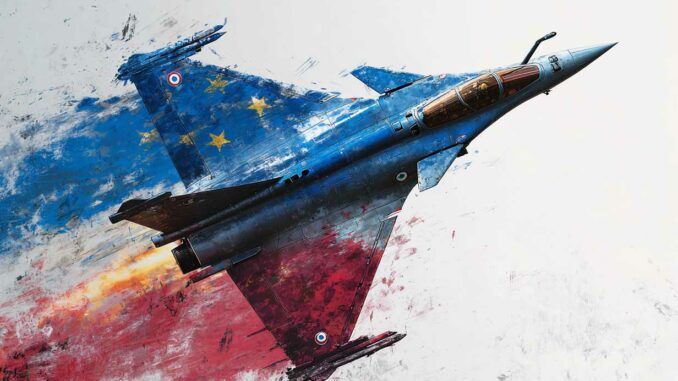
Paris is refocusing the LPM on the Rafale F5, its combat drone, and its future missiles, at the risk of undermining the European Eurodrone program.
In Summary
France appears to be making a sharp turn in its military aviation policy. In the update to the LPM, Paris is prioritizing the Rafale F5, its collaborative combat drone, and future penetration weapons, rather than the Eurodrone program, which is deemed slow, costly, and less suited to the high-intensity combat of the 2030s. The choice is not merely budgetary. It is doctrinal. France wants to maintain a sovereign combat aviation capability, capable of penetrating dense air defenses, coordinating drones, and carrying out nuclear deterrence with the ASN4G. This decision can be justified in the short term. It addresses the strategic urgency created by Russia, China, drones, and long-range missiles. But it also raises a difficult question: by moving away from the Eurodrone, is France gaining speed or is it permanently weakening the European industrial base?
France’s choice marks a sharp turn in the Military Programming Law
The revision of the Military Programming Law confirms a profound shift. France no longer wants to merely fund long-term European programs. It wants capabilities available before 2035. In this context, the Rafale F5 becomes one of the major pillars of French combat aviation. The Eurodrone, meanwhile, drops down the list of priorities.
We must be precise. At this stage, France’s withdrawal from the Eurodrone program must be framed with caution. Some sources speak of an abandonment. Others refer instead to a step back, a removal of the program from planning priorities, or a gradual disengagement. The political signal, however, is clear. Paris no longer seems to want to make the Eurodrone the central solution to its future operational needs.
This decision is part of a broader budget update. The 2026 parliamentary debates mention an additional 36 billion euros for defense. Drones are becoming an explicit priority. The update allocates several billion euros more to this sector, with a different approach than that of traditional large MALE drones. France wants more drones that are faster to produce, better suited for combat, and more seamlessly integrated into existing forces.
The Rafale F5 is therefore the focus of part of this effort. The standard is set to enter service around 2030, according to the Ministry of the Armed Forces. It aims to increase the Rafale’s operational capabilities tenfold. It must incorporate new sensors, new data links, a collaborative combat architecture, future weaponry, and above all, an escort drone derived from the experience of the nEUROn demonstrator.
The message is simple. France does not want to wait for European cooperation to deliver a perfect system. It wants a national solution—one it controls—that is consistent with deterrence and compatible with the operational timeline for the coming decade.
The Rafale F5 becomes the cornerstone of French air sovereignty
The Rafale F5 is not merely a software upgrade. It represents a leap in capability.
The Rafale F4 had already introduced a concept of connectivity, predictive maintenance, and networked combat. The F5 must go further. It must transform the aircraft into the conductor of a broader air system.
The heart of the project is collaborative combat. A Rafale F5 must no longer simply detect, fire, and survive on its own. It must communicate with other aircraft, drones, satellites, ground-to-air defense systems, naval assets, and command centers. This capability becomes vital when facing modern air defenses, such as Russian S-400 networks, Chinese HQ-9 systems, or multi-layered architectures combining radars, missiles, electronic warfare, and fighter jets.
The escort drone is decisive here. It must extend the Rafale’s sensor capabilities, carry payloads, approach dangerous zones, jam, detect, designate, or potentially strike. The idea is similar to the American concept of the “loyal wingman” or “Collaborative Combat Aircraft,” but adapted to French constraints. France does not have the American budget. It must therefore focus its efforts on a more targeted, more sovereign solution directly linked to the Rafale.
This drone must build on the work of the nEUROn demonstrator, led by Dassault Aviation with several European partners. The nEUROn has given France rare experience in stealth, combat drone architecture, flight control, payload integration, and covert operations. It is precisely this know-how that Paris wants to repurpose into an operational capability.
The logic is harsh but consistent. Rather than funding a large European MALE drone whose primary use remains surveillance and intelligence, Paris prefers to invest in a system that directly supports the French fighter jet at the high end of the spectrum.
The Eurodrone pays the price for its slowness and ambiguous positioning
The Eurodrone was meant to symbolize European autonomy. The program brings together Airbus, Dassault Aviation, and Leonardo, with support from Germany, France, Italy, and Spain, under the auspices of OCCAR. On paper, the project addresses a real need: to have a European MALE drone capable of ISR missions, maritime surveillance, communication, and potentially strike capabilities.
But the program suffers from scheduling and conceptual issues. Launched to address Europe’s dependence on American and Israeli drones, it comes at a time when the battlefield has changed. Recent wars have demonstrated the importance of numerous, inexpensive, expendable, or semi-expendable drones. They have also shown that large, slow, and visible drones become vulnerable in a heavily defended environment.
The Eurodrone is a large, twin-engine aircraft designed to fly in non-segregated airspace. This civil and regulatory requirement is useful for peacetime or surveillance missions. It is less so for penetrating contested airspace. Faced with modern defenses, a non-stealthy MALE drone needs a secure environment. It is not designed to enter a dense air defense bubble on its own.
That is where the disconnect lies. The Eurodrone may be suitable for surveillance, aerial patrol, maritime patrol, or certain intelligence missions. But it does not directly address the question now haunting military leadership: how to enter, survive, and strike within an area protected by radars, missiles, and modern fighter jets?
For France, which is banking on the Rafale F5, the ASN4G, and collaborative combat, the program seems too slow and too far removed from the priority need. It is a harsh assessment. It is not absurd.
The ASN4G imposes a non-negotiable sovereign logic
The issue of the Rafale F5 cannot be separated from nuclear deterrence. The F5 is designed to carry the future ASN4G missile, intended to succeed the ASMPA-R. In 2025, Emmanuel Macron announced the future deployment of the Rafale F5 at the Luxeuil Air Base, with an investment of approximately 1.5 billion euros to adapt the base to the new nuclear configuration.
The ASN4G is a new-generation air-to-ground nuclear missile. It is often described as hypersonic or very supersonic, even though its exact characteristics remain, of course, classified. Its role is to ensure the credibility of the airborne component of France’s deterrent in an environment far more dangerous than today’s. Long-range air defenses are advancing. Passive radars are being developed. Electronic warfare is becoming more aggressive. The survivability of an airborne nuclear missile cannot therefore rely on yesterday’s solutions.
A common misconception must be corrected. The ASN4G is not a conventional air defense suppression missile. It is a nuclear weapon. France is also working on other conventional strike, suppression, or penetration capabilities, but the ASN4G falls under the category of deterrence. This distinction is important. It explains why Paris cannot delegate certain industrial or technological choices to overly open cooperation.
French deterrence requires near-total sovereignty. Decision-making chains, software, sensors, communications links, mission architectures, and sensitive technologies must remain under French control. This is also one of the reasons why foreign financing for the Rafale F5, particularly by the United Arab Emirates, reportedly stalled over the sharing of sensitive technologies. Paris can sell Rafales. It cannot share the core of its deterrence and future air warfare without limits.
European cooperation is a victim of its own compromises
France is not abandoning European cooperation on a whim. It is distancing itself because certain programs have become too slow, too complex, and too political. The Eurodrone is one example. The SCAF is another. In both cases, the partners want a European capability. But they do not always share the same doctrine, the same timeline, the same priority industrial partners, or the same definition of sovereignty.
European cooperation has obvious advantages. It shares costs. It creates scale. It supports a common industrial base. It avoids duplication. It allows, in theory, for the creation of industry leaders capable of competing with the United States and China. But it also has well-known flaws: cumbersome governance, rigid industrial sharing, divergent national requirements, drawn-out timelines, and constant political trade-offs.
France has a unique culture in this area. It has a powerful national aircraft manufacturer, Dassault Aviation; a strategic engine manufacturer, Safran; a major missile manufacturer, MBDA; and a comprehensive military ecosystem. It therefore has less need than other countries to cooperate in order to maintain its technological standing. It cooperates when it strengthens its sovereignty. It is wary when it dilutes it.
Germany, Italy, and Spain often think differently. They seek greater industrial sharing, European standardization, political compensation, and mutualization. These approaches are legitimate. But they become difficult to reconcile when it is necessary to rapidly produce high-end combat capabilities.
The French choice is therefore a form of strategic impatience. Paris believes that the 2030s will leave no time for major compromises. The war in Ukraine, China’s rise, and American pressure on Europe have changed the pace.
The risk for Europe is lasting fragmentation
The French decision is defensible from a military standpoint. But it carries a major industrial risk. If every European country funds its own drone, combat system, software architecture, and ammunition, Europe will remain fragmented. It will have good products, but not the critical mass.
This is the historical problem of European defense. The United States produces in large quantities. China is accelerating at breakneck speed. Europe often produces in small batches, with separate schedules and national variants. The result is costly. It complicates maintenance, training, parts inventory, ammunition, and exports.
Abandoning or marginalizing the Eurodrone could therefore weaken a major European effort. Even if the aircraft is imperfect, it represents an attempt at industrial structuring. Airbus, Leonardo, and Dassault are learning to work together on a large unmanned system. European militaries can have a common platform. Manufacturers can create a continental supply chain.
If France withdraws, the Eurodrone could survive with Germany, Italy, and Spain. But the program would lose credibility. It would become less European and more continental without Paris. For Dassault, the situation would also be ambiguous: the company might remain industrially involved while seeing its own country favor a different path.
The fundamental question is stark. Can Europe build strategic autonomy if its members leave programs as soon as they no longer fit their national timelines? The answer is not reassuring.
France’s choice may be rational in the short term
In the short term, France has solid arguments. The Eurodrone does not address the priority need for penetration and collaborative combat. The Rafale F5, on the other hand, is directly linked to France’s high-intensity posture. It protects the Rafale supply chain, supports Dassault Aviation’s expertise, paves the way for the escort drone, strengthens deterrence, and provides a clear trajectory for the Air and Space Force.
There is also a budgetary argument. France cannot finance everything. The 2024–2030 Military Planning Law (LPM) had already allocated €413 billion for military needs. The update adds further requirements, but national budget constraints remain severe. Between ammunition, drones, ground-to-air defense, cyber, space, nuclear capabilities, the next-generation aircraft carrier, and operational maintenance, trade-offs are becoming stark.
In this context, choosing the Rafale F5 is not a retreat. It is a focus. Paris is putting its money where it believes it will achieve the greatest military impact. A Rafale F5 equipped with a sovereign combat drone, modern missiles, and enhanced connectivity can provide a true game-changing capability. A later-model Eurodrone with lower survivability would offer a useful capability, but one that is less decisive at the high end of the spectrum.
The choice is therefore pragmatic. It prioritizes the possible war over the desirable cooperation.
The gamble becomes dangerous if France underestimates the scale
The problem is that sovereignty alone is not enough. A modern air force needs scale. It needs numerous drones, ammunition, stockpiles, spare parts, simulators, personnel, maintenance chains, and industrial production rates. The Rafale F5 will be powerful, but it will remain expensive. The escort drone will likely be sophisticated, and therefore costly. The ASN4G will be strategic, and thus produced in limited numbers.
Yet modern warfare shows that militaries quickly deplete their resources. Drones are shot down. Missiles are fired. Radars are jammed. Bases are targeted. Aircraft are worn down by high operational cycles. If France bets everything on a very high-end but overly scarce system, it risks repeating the very problem it seeks to avoid: technological superiority without sufficient industrial depth.
The Eurodrone was not the answer to everything. But it could have played a role in a broader architecture: surveillance, round-the-clock monitoring, maritime intelligence, communication relay, monitoring of vast areas, and support for overseas operations. By abandoning it too quickly, France must ensure that it does not create a capability gap between light tactical drones and stealth combat drones.
The real question, therefore, is not Rafale F5 or Eurodrone. The real question is the balance between high-end capabilities, volume, endurance, and cost. A credible air force will need all four.
The long term will depend on SCAF and the ability to cooperate differently
The choice of the Rafale F5 must also be seen as a message to the SCAF program. Paris does not want to wait until 2040 to enter collaborative combat. The Rafale F5 becomes a bridge. It allows for the development of building blocks that can feed into the future air combat system, whether it is Franco-German-Spanish or redefined in another way.
But if the SCAF remains stalled by industrial rivalries, France will have to extend the Rafale’s service life even further. This may work for a while. The Rafale is an evolvable platform. But it cannot indefinitely replace a next-generation combat system. The United States is developing the F-47 and CCA programs. China is accelerating the J-20, J-35, and its drones. Europe cannot simply update its existing aircraft every ten years.
France therefore needs a two-pronged strategy. On the one hand, to independently accelerate the Rafale F5 to meet the needs of the 2030s. On the other, to preserve realistic European cooperation to prepare for the post-2040 era. This requires a different approach to cooperation: less artificial political division, more allocation based on actual capabilities, firmer timelines, and clearer industrial responsibilities.
Cooperation is not bad in itself. Bad cooperation is that which produces results that are late, expensive, and vague. Good cooperation is that which accelerates, standardizes, and strengthens the armed forces. Europe must choose which approach it wants to pursue.
The French gamble is defensible, but it comes with a political cost
France is making a tough choice. It is prioritizing rapid sovereignty at the expense of European cooperation, which has become too slow for its operational timeline. This choice is defensible. The Rafale F5 meets vital needs: nuclear deterrence, collaborative combat, penetration, escort drones, industrial autonomy, and the continuity of the Dassault supply chain.
But this choice comes at a cost. It undermines the logic of European pooling of resources. It sends a message of mistrust to Germany, Italy, and Spain. It may reduce the scale of a joint program. It may also establish a dangerous precedent: each country goes its own way as soon as cooperation becomes difficult.
The real test will be industrial. If France succeeds in delivering the Rafale F5, its combat drone, and its future weapons on schedule, the gamble will appear well-judged. If costs skyrocket, if the drone is delayed, if production volumes remain low, and if the SCAF project stalls, the abandonment of the Eurodrone will appear less as an act of sovereignty than as a symptom of fragmentation.
France is probably right to reject slowness. But it will have to prove that it can move quickly on its own, produce enough, and not turn sovereignty into isolation. It is on this point that the Rafale F5 will be judged.
War Wings Daily is an independant magazine.