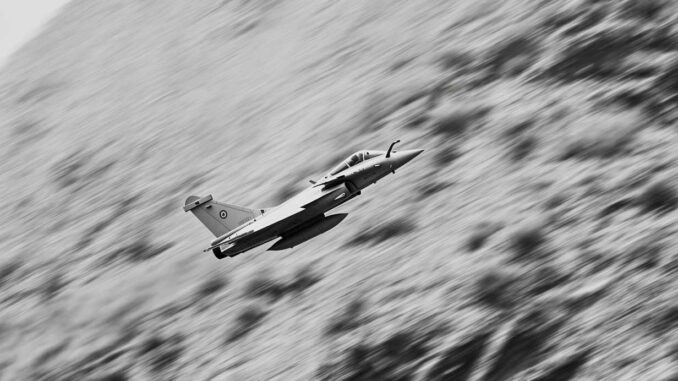
The UAE’s withdrawal from co-financing the Rafale F5 leaves Paris facing a hefty bill and reignites industrial tensions within the SCAF.
In summary
France finds itself facing a familiar dilemma: protect its technological sovereignty or share more to finance its future fighter jets more quickly. According to several industry sources, the United Arab Emirates has reportedly withdrawn from co-financing the Rafale F5 to the tune of approximately 3.5 billion euros, after failing to secure technology transfers deemed acceptable by Paris. Abu Dhabi sought deeper access to certain sensitive components, particularly regarding source codes, weapons integration, radar, and optronics. France refused. This decision protects the Rafale’s technological core, but shifts the financial burden onto the French government and Dassault Aviation. This comes as the SCAF remains mired in governance tensions between Dassault, Airbus, Germany, and Spain. Paris wants to move quickly. But the equation is becoming tight: financing the F5 alone, preserving deterrence, keeping the SCAF on track, and maintaining export credibility.
The UAE’s withdrawal reveals the true cost of French sovereignty
The information is politically sensitive. The United Arab Emirates reportedly considered a major financial stake in the development of the Rafale F5, with a contribution estimated at around 3.5 billion euros out of a remaining bill estimated at close to 5 billion euros. According to specialized media outlets that reported on the matter, discussions reportedly broke down over the level of technology transfer requested by Abu Dhabi. France reportedly refused to deliver components deemed too sensitive, particularly those enabling autonomous weapons integration and significant modifications to mission systems.
This point is central. It is not merely a commercial disagreement. The Rafale F5 is set to become the most strategic standard for the French air force since its entry into service. It must integrate the future ASN4G nuclear missile, a collaborative combat drone, new sensors, more powerful data links, and a networked combat architecture. The Ministry of the Armed Forces presents the F5 as a standard expected around 2030, intended to greatly increase the operational capabilities of the French Air Force.
France’s refusal is therefore logical. Source codes, mission interfaces, weapons integration capabilities, and deep adjustments to the radar or optronics are not mere accessories. They are the keys to the system. Transferring them would amount to giving an export customer a form of technical autonomy over part of the aircraft’s core. For a country like France, which makes the Rafale a pillar of its sovereignty and deterrence, this line is difficult to cross.
The Emirati partner wanted more than just an off-the-shelf aircraft
Abu Dhabi is no ordinary customer. The United Arab Emirates ordered 80 Rafale F4s in December 2021, in the largest export contract ever secured by the French aircraft. Dassault Aviation confirmed this historic contract, signed with the Tawazun Economic Council, to equip the UAE Air Force & Air Defense. The total amount was widely reported to be around 16 billion euros for the aircraft, as part of a broader package that also includes H225M Caracal helicopters.
This order has transformed the Franco-Emirati relationship. The Emirates are no longer merely a major buyer. They are becoming a major user of the Rafale, with a fleet large enough to demand technical influence. Their reasoning is understandable. A country that purchases 80 aircraft and plans to finance part of the next standard wants to be able to integrate its own weapons, its own operational needs, and its own industrial choices.
But this request runs counter to French doctrine. The Rafale is exported with adaptations. It can be equipped with specific weapons. It can be configured for different customers. But it remains a system controlled by Dassault Aviation, Thales, Safran, MBDA, and the Directorate General of Armaments. This architecture safeguards performance, security, certifications, and industrial secrets. It also limits the customer’s autonomy.
The F5 case thus highlights a classic tension in major defense contracts. The more the customer pays, the more access to the technology they want. The more strategic the technology becomes, the more the selling country restricts access. In the case of the Rafale F5, these two logics collided head-on.
Source code has become a strategic red line
The term “source code” is often used broadly. In a modern fighter jet, it does not refer merely to a few lines of software. It refers to critical layers: mission computer, data fusion, sensor management, weapons interface, electronic warfare, communications, liaison with other platforms, and tactical operating modes. Access to these elements would theoretically allow for more profound modifications to the aircraft, the integration of weaponry without going through the French manufacturer, or the adaptation of certain system behaviors.
This is precisely why Paris refuses to fully open this black box. The Rafale F5 will be linked to extremely sensitive capabilities. It will need to communicate with a stealth combat drone, use improved sensors, handle new payloads, integrate into collaborative combat, and carry the ASN4G. The escort drone announced by Dassault Aviation is scheduled to enter service with the Rafale F5 by 2033, building on the experience of the nEUROn demonstrator.
The issue is not merely industrial. It is military. If a third country gains too much control over the integration interfaces, it could modify the aircraft beyond the manufacturer’s initial control. This raises questions regarding security, liability, maintenance, compatibility with future versions, and protection against technology leaks. On an aircraft linked to France’s nuclear posture, the risk becomes unacceptable.
France therefore prefers to forgo potential funding rather than create a reverse technological dependency. It is a costly choice, but one consistent with a strategic culture rooted in autonomy.
The bill falls on the French government and Dassault Aviation
The problem is that sovereignty comes at an immediate cost. Without Emirati funding, France must finance the ramp-up of the Rafale F5 on its own.
This is a complicated time. The 2024–2030 Military Programming Law already allocated €413 billion. Recent adjustments point to additional needs, against a backdrop of European rearmament, the war in Ukraine, tensions with Russia, pressure on ammunition stocks, and nuclear modernization.
Dassault Aviation is financially sound, but the company cannot shoulder the financing of such a strategic program on its own. The Rafale F5 involves the entire French industrial ecosystem: Dassault for the airframe and overall architecture, Safran for propulsion and systems, Thales for sensors and electronics, MBDA for weapons, and the DGA for overall program management. The development of the collaborative drone adds yet another layer of complexity.
The question is not whether France can afford it. It can. The real question is what it will have to postpone or cut elsewhere. Surface-to-air defense, tactical drones, munitions, military space, cyber, naval, deterrence, and maintenance: every euro spent on the F5 takes away from other priorities. The Emirati withdrawal does not kill the program. It makes the trade-offs tougher.
This pressure comes at the worst possible time. The Rafale must remain competitive on the export market, the Air and Space Force must modernize its fleet, the Navy must prepare for the future of the Rafale Marine, and France must finance the future aircraft carrier. The F5 is becoming indispensable, but it is also becoming a heavier political burden.
The SCAF adds a second crisis at the same time
The Rafale F5 issue cannot be separated from the SCAF, the Future Air Combat System. This Franco-German-Spanish program is intended to develop the next-generation European air system, featuring a fighter jet, drones, a combat cloud, sensors, and new weaponry. But it is being undermined by industrial tensions between Dassault Aviation and Airbus, particularly regarding leadership of the future fighter jet and the division of labor.
Reuters reported in December 2025 that the German union IG Metall had even called for Dassault’s exclusion from the program, accusing the French aircraft manufacturer of seeking to impose its leadership. The Financial Times subsequently reported that Éric Trappier, CEO of Dassault Aviation, believed the project was at risk if Airbus did not accept Dassault’s leadership on the fighter jet.
This dispute runs deeper than a clash of corporate egos. France believes Dassault must lead the fighter jet program because the company is the only European prime contractor to have single-handedly designed a complete modern fighter. Germany and Spain want a more balanced industrial division of labor, as they are funding the program and wish to preserve their capabilities. Airbus is, understandably, defending its position.
The result is dangerous. While the United States is accelerating the F-47 and CCA drones, and China is ramping up its production of the J-20, Europe is still debating governance. Paris views this slowness with concern. The Rafale F5 thus becomes a national safeguard against the SCAF project getting bogged down.
The Rafale F5 becomes a stopgap solution ahead of the post-2040 era
France cannot wait indefinitely for the SCAF. The program aims for a service horizon around 2040, or even beyond. Yet the 2030s will already be marked by denser air defenses, combat drones, long-range missiles, and more aggressive electronic warfare.
The Rafale F5 must fill this gap.
It must also extend the Rafale’s operational credibility. The F4 standard has enhanced connectivity, data processing, and maintenance. The F5 must take things to the next level. It will need to enable the aircraft to operate with drones and more complex weapons. It will need to integrate penetration and deterrence capabilities. It will need to remain exportable without exposing French secrets.
This bridging role explains Paris’s firm stance toward the Emirates. The Rafale F5 is not merely a version for export customers. It is the foundation of France’s air force for the 2030s. Granting too much access to a foreign partner would undermine the national technological advantage even before the aircraft enters service.
An important nuance should also be noted. France can continue to sell the Rafale and offer tailored integrations. The refusal does not mean a total shutdown. It means that certain areas remain non-negotiable. In modern combat aviation, sovereignty lies precisely in these areas: software, sensors, electronic warfare, weapons interfaces, and system architecture.
France’s refusal could be commercially costly
The risk is real. Export customers are becoming more demanding. India, the UAE, Saudi Arabia, Indonesia, and other buyers increasingly want local production, technology transfer, integration of national weapons, and maintenance autonomy. France will not always be able to respond with a categorical “no.”
The Rafale has won contracts because it combines performance, relative client sovereignty, the absence of direct U.S. dependence, and greater operational freedom than some Western competitors. But this freedom has limits. If these limits become too visible, some countries might look at other offers. South Korea, Turkey, the United States, Russia, and China all offer, to varying degrees, alternative models.
France’s challenge is therefore to sell autonomy without giving away the core of its autonomy. It’s a fine line. If it’s too open, France loses its secrets. If it’s too closed, it loses customers or funding. The UAE case shows that this line is becoming harder to maintain as the Rafale incorporates increasingly sensitive technologies.
In the short term, Paris can absorb the setback. The Emirates have already ordered 80 Rafale F4s. The strategic relationship remains strong. But in the long term, France will have to devise smarter solutions: exportable modules, controlled interfaces, supervised integration, separate software zones, limited co-development, and final French certification.
The sovereign choice is defensible, but it comes at a cost
The French position is fundamentally sound. A state that funds a sovereign combat aviation program cannot distribute its source codes and most sensitive components. The Rafale F5 will involve deterrence, collaborative stealth, advanced sensors, and the integration of future systems. These technologies cannot be treated as commercial options.
But the consequence is severe. Paris will have to pay more. Dassault will have to meet an ambitious schedule. The government will have to fund the F5 while managing the SCAF, drones, munitions, ground-to-air defense, and nuclear modernization. Sovereignty then becomes less of a slogan and more of a budgetary burden.
The strategic risk is not a rejection by the Emirates. The real risk would be to refuse the transfer and then fail to properly fund the national program. In that case, France would have lost foreign money without gaining the expected sovereign speed. The F5 must therefore move forward quickly. It must deliver a true collaborative drone. It must integrate the ASN4G. It must remain exportable.
And it must avoid becoming a program that is too expensive and too slow.
This equation is demanding. But it reflects the reality of defense in 2026. The major powers no longer sell just aircraft. They sell architectures. France wants to remain in control of its own.
The moment of truth is approaching for the French aerospace industry
The UAE’s withdrawal, tensions within the SCAF, and the rise of the Rafale F5 all tell the same story. France still possesses an exceptional military aerospace base. It knows how to design, produce, modernize, and export a complete fighter jet. Few countries can say the same. But this position is under pressure.
The United States has immense budgetary resources. China is ramping up production and integrating artificial intelligence on a massive scale into its industrial chains. Europe, for its part, remains torn between national sovereignty and continental cooperation. In this landscape, the Rafale F5 becomes a test. If it succeeds, Paris will demonstrate that a European country can still rapidly develop an advanced combat system. If it fails, the discourse on sovereignty will lose credibility.
The Emirati case is therefore not merely a financial episode. It reveals a broader choice. France prefers to keep the key to the Rafale rather than share its technological vault. This is rational. But it will now have to pay for the lock, reinforce the door, and prove that no one will wait too long on the other side.
Sources
La Tribune, information reported by AeroTime, Air & Cosmos, Defence24, and Defense Mirror on the UAE’s withdrawal from co-financing the Rafale F5, April 2026.
AeroTime, “France to fund Rafale F5 alone after UAE deal collapsed,” April 2, 2026.
Air & Cosmos, Rafale F5, SCAF, the future of fighter jets in turbulent times, April 2, 2026.
Defense Mirror, UAE Walks Out of €3.5 Billion Funding for Rafale F5 over French “No” to Tech Transfer, April 2026.
Dassault Aviation, Historic contract for the acquisition of 80 Rafale F4s by the United Arab Emirates, December 3, 2021.
Ministry of the Armed Forces, Rafale F5 standard: at the cutting edge of technology, June 17, 2025.
Dassault Aviation, Unmanned combat aerial vehicle program kicks off as part of the Rafale F5 standard, October 8, 2024.
Reuters, Powerful German union calls for Dassault’s expulsion from fighter jet program, December 10, 2025.
Financial Times, Dassault warns Franco-German jet project is “dead” if Airbus refuses to cooperate, March 2026.
War Wings Daily is an independant magazine.