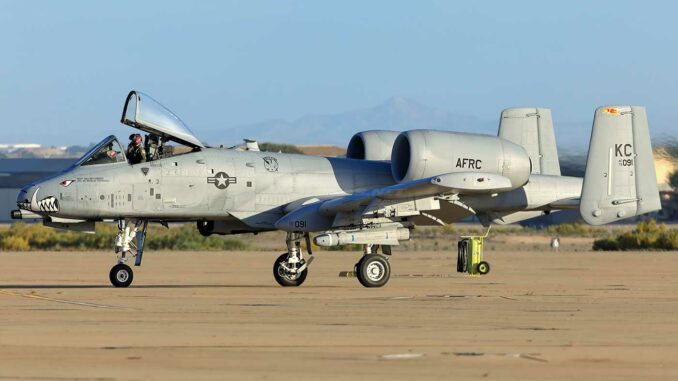
On July 20, 2026, the BRRRRT Act was introduced in Congress to keep 126 A-10 Warthogs in service until 2033, defying the USAF’s push to retire them all.
In Summary
On July 20, 2026, Republican Representative Abe Hamadeh (Arizona) introduced the BRRRRT Act (H.R. 9780), backed by his Democratic counterpart Don Davis (North Carolina). This bipartisan legislation mandates that the U.S. Air Force maintain a minimum of 126 operational A-10 Thunderbolt IIs through fiscal year 2033, forcing the service to pull aircraft already placed in storage at the Davis-Monthan Air Force Base boneyard in Arizona. It prohibits any further retirements without prior certification of an operational replacement validated by the Army, Marine Corps, and Special Operations Command. The bill marks the latest salvo in a decade-long institutional feud between the USAF—which wants to free up funding for sixth-generation platforms—and a Congress convinced that no existing aircraft can replace the Warthog in its close air support mission. Operation Epic Fury against Iran in early 2026 provided these advocates with a concrete demonstration of the aircraft’s irreplaceable value.
The BRRRRT Act: A Law with Precise Parameters
The name of the legislation is no coincidence. “BRRRRT” mimics the signature sound produced by the 30 mm GAU-8/A Avenger rotary cannon when fired. That instantly recognizable sound has for decades served as the most comforting auditory signal ground troops can hear in combat. The law’s official acronym stands for “Bolstering Recognition, Resurgence, Retention, and Remembrance of the Thunderbolt.”
Legislatively, the text is precise and binding. It mandates a minimum of 126 operational A-10s through the end of fiscal year 2033. It prohibits the Secretary of Defense from executing further retirements without first certifying in writing that a replacement is fully operational—a certification that must be countersigned by the Secretary of the Army, the Commandant of the Marine Corps, and the Commander of U.S. Special Operations Command (SOCOM). The bill also sets a deadline of 90 days post-enactment for the Air Force to submit a detailed plan to restore all maintenance, training, and testing infrastructure decommissioned in anticipation of the fleet’s retirement.
The operational impact of those preparations is already apparent. The depot maintenance line at Hill Air Force Base (Utah) closed in February 2026. The final class of A-10 pilots graduated in April, and the Weapons School syllabus at Nellis Air Force Base is drawing to a close. Rebuilding this operational foundation would require reopening facilities, rehiring mechanics and instructors, and pulling airframes out of storage at Davis-Monthan in Arizona, where dozens of Warthogs currently sit in the dry desert air.
A Decade-Long Tug-of-War Between the USAF and Congress
This legislative push is no political accident; it is part of an institutional feud that has endured for more than ten years.
Since 2013, the U.S. Air Force has sought to retire the Warthog. The core argument has remained consistent: the A-10 is a single-mission platform in an era when the military can no longer afford single-mission platforms. According to Air Force budget submissions to Congress, every A-10 kept in service consumes personnel, funding, and logistics that could otherwise be directed toward the F-35, the F-47 NGAD, or sixth-generation programs. In 2014, the Air Force estimated that divesting the fleet would yield $4.2 billion in annual savings. In 2026, that fiscal argument remains the primary driver of the service’s policy.
The Air Force also advances an operational rationale. The Warthog operates low and slow in permissive environments—against forces lacking sophisticated air defenses. However, in a high-intensity conflict against China or Russia, equipped with advanced surface-to-air missile systems like the Russian S-400 or Chinese HQ-9, the A-10 would be shot down before firing a shot. This operational reality remains a cornerstone of the USAF modernization strategy, which prioritizes stealth and long-range standoff warfare.
Congress, however, has consistently resisted. At the start of fiscal year 2026, the Air Force held 162 A-10s in its inventory and sought approval for total divestment. Congress refused, inserting a minimum floor of 103 aircraft through September 30, 2026, into the National Defense Authorization Act (NDAA). In April 2026, Secretary of the Air Force Troy Meink announced that three squadrons—approximately 54 aircraft—would continue flying through 2029 and 2030 at Moody Air Force Base (Georgia) and Whiteman Air Force Base (Missouri). The BRRRRT Act sets that threshold much higher: 126 aircraft through 2033.
Operation Epic Fury: The Demonstration That Reignited the Debate
What Warthog advocates could not achieve through debate alone was provided in concrete terms by Operation Epic Fury against Iran during the spring of 2026.
From the outset of operations in late February 2026, A-10s were deployed within the first 48 hours. They conducted close air support missions against Iranian-backed militia elements in Iraq, provided armed overwatch over scattered targets, and engaged Iranian fast attack craft in the Strait of Hormuz. The 30 mm GAU-8/A Avenger cannon, capable of firing 4,200 rounds per minute with a capacity of 1,174 shells, proved particularly effective at neutralizing small, fast boats in constrained maritime spaces.
The turning point occurred on April 3, 2026, when an F-15E Strike Eagle was shot down over Iran. A complex Combat Search and Rescue (CSAR) operation was launched to recover the crew, including a colonel who suffered a foot injury during ejection. A-10s provided high-risk overhead cover deep in hostile territory. One A-10 was hit by Iranian air defenses, but the pilot managed to fly the damaged aircraft back to friendly airspace before ejecting over Kuwaiti territory. The aircraft absorbed enemy fire and kept flying—a survivability feature intentionally engineered into its airframe.
The mission provided immediate momentum to Warthog defenders on Capitol Hill. Representative Hamadeh noted: “As a former Army intelligence officer, I know the arrival of the A-10 delivers the most comforting sound a soldier under fire can hear.”
The War Machine: What Makes the Warthog Irreplaceable
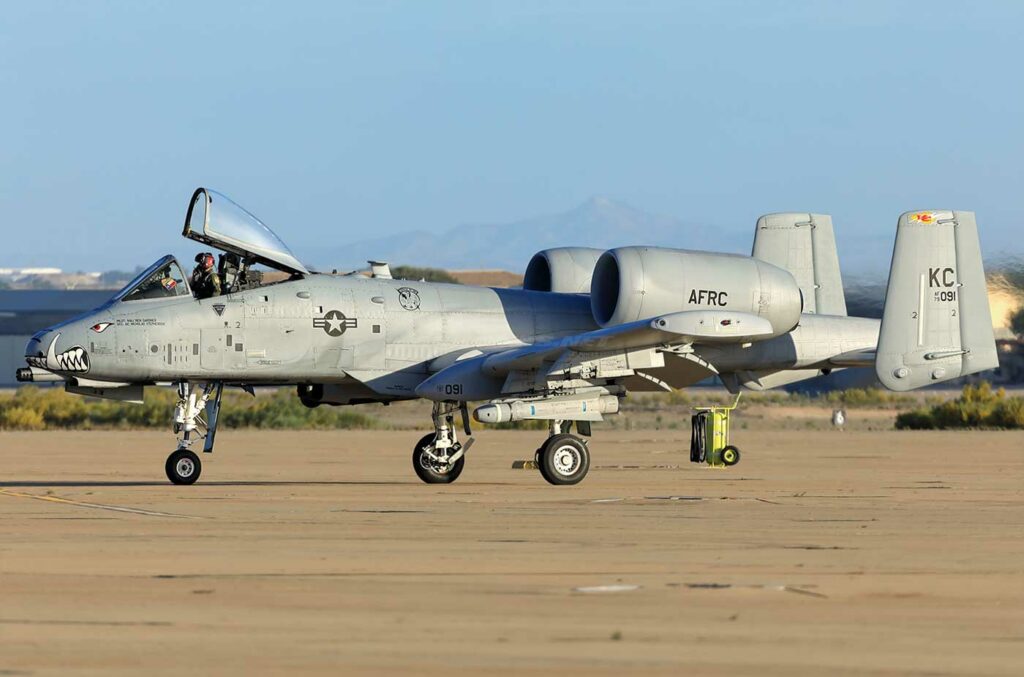
The A-10C Thunderbolt II entered service in 1976, built around a simple, radical design premise: build an airplane around a gun. The GAU-8/A Avenger is a 620-pound (281 kg) flying artillery piece capable of firing armor-piercing depleted uranium shells at 4,200 rounds per minute. The airframe itself was engineered for battle damage survival: the cockpit is encased in a 1,200-pound (544 kg) titanium tub, twin General Electric TF34 engines are mounted high to shield them from ground fire, redundant flight controls are built in, and the landing gear can extend partially even without hydraulic pressure.
The A-10 can fly low and slow—with a cruising speed of roughly 350 mph (560 km/h)—and loiter over the battlefield for extended periods. It can operate from austere, unimproved dirt runways, a critical capability in theaters lacking established air base infrastructure.
By contrast, its intended replacement, the F-35A Lightning II, presents a fundamentally different profile. The F-35A carries an internal 25 mm GAU-22/A cannon with just 182 rounds—less than a sixth of the Warthog’s capacity. Its stealth design and supersonic performance are unsuited for the low-and-slow flight profiles required for traditional close air support. While the Air Force contends the F-35A can fulfill the CAS mission using advanced sensors and standoff precision munitions, critics argue that launching an $80,000 precision missile at a pickup truck or small insurgent team is unsustainable at scale, and that low-altitude loiter capability remains unmatched.
The USAF Perspective: A Different Vision of Warfare
Reducing the USAF position to mere budgetary bureaucracy would be inaccurate; its arguments reflect a distinct strategic outlook.
The first argument centers on technology. In a contested threat environment against China—the primary concern for U.S. defense planners—an unstealthy, low-flying A-10 would be destroyed quickly. Integrated Air Defense Systems (IADS), combining long-range detection radars, surface-to-air missiles, and air superiority fighters, render the low-and-slow operational model vulnerable in such scenarios. The USAF is betting on stealth, standoff munitions, and uncrewed platforms to replace legacy close air support methods.
The second argument involves resource allocation. Air Force Chief of Staff General Kenneth Wilsbach told lawmakers in May 2026 that the service anticipates no capability gap in close air support following the A-10’s final retirement around 2030, pointing to the F-35A, F-15EX, and armed drones as viable alternatives.
The third argument is financial. Maintaining an aging fleet that requires custom-fabricated spare parts or cannibalized components from the Davis-Monthan boneyard carries significant costs. Every dollar spent sustaining a 1976-era airframe is a dollar diverted from the F-47 NGAD or future combat systems.
A Strategic Dilemma Without an Easy Answer
The dispute over the BRRRRT Act highlights a strategic dilemma that neither the USAF nor Congress can easily resolve.
On one hand, Operation Epic Fury demonstrated that medium-intensity conflicts against regional adversaries lacking air superiority still occur, and that the Warthog remains effective in those roles. The rescue of the F-15E colonel served as a vivid example. The assertion that alternative systems can match that capability remains, for now, an unproven claim.
On the other hand, planning for a 2035 conflict using 1976 airframes presents clear limits. China continues to deploy air defense systems capable of engaging targets at ranges exceeding 300 kilometers. In that high-threat environment, the A-10 would be highly vulnerable.
Ultimately, the BRRRRT Act underscores the lack of a unified consensus on how to bridge the gap between these two operational demands: neither establishing a modernized close air support doctrine tailored for future high-threat battlefields nor fully committing to divesting the capability altogether. Congress continues to extend the timeline, the USAF moves forward with dismantling its training pipeline, and troops on the ground continue to rely on that familiar sound overhead.