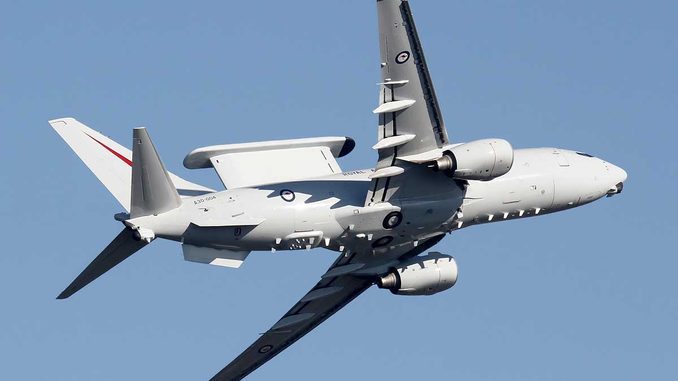
E-7 Wedgetail, ECRS Mk2, NEXUS, and GCAP: London is investing in sensors and networks designed to multiply the effectiveness of its fighters.
Executive Summary
The United Kingdom is no longer content with simply purchasing high-performance fighters. It is rebuilding the sensor, communications, and command architecture required to allow F-35s, Typhoons, and the future GCAP to operate as components of a single, integrated system. The E-7 Wedgetail is intended to restore airborne early warning capabilities lost following the retirement of the E-3D Sentry. The ECRS Mk2 AESA radar will convert 40 Typhoons into powerful detection and electronic warfare platforms. On the ground, GUARDIAN and the NEXUS combat cloud aim to merge intelligence and accelerate the chain connecting sensors, decision-makers, and weapons. Over the longer term, GCAP will incorporate radars, electronic warfare, and communications from the design phase via the ISANKE & ICS architecture developed jointly with Italy and Japan. London is now investing nearly £7.3 billion in its digital targeting network. The goal is clear: derive greater military effectiveness from every single aircraft and missile.
The UK Rediscovers That the Best Fighter Isn’t Enough
The debate surrounding British air power has long focused on platforms.
How many F-35s? How many Typhoons? How much will GCAP cost? Which aircraft will replace the Typhoon after 2035?
While these questions remain important, they tell only part of the story.
In modern air combat, the aircraft launching a missile is no longer necessarily the one that first detects the target. The sensor discovering a threat may reside on another aircraft, a naval vessel, a ground installation, or, in the near future, an autonomous drone.
The advantage belongs to whichever force transforms a detection into an actionable track, that track into a decision, and that decision into a engagement in the shortest amount of time.
The UK is seeking to rebuild this exact architecture.
It relies on several layers: the Boeing E-7 Wedgetail for airborne surveillance, ground-based radars and GUARDIAN for air defense, NEXUS for digital fusion, the ECRS Mk2 to turn the Typhoon into a far more capable sensor and jammer, the F-35 as a stealthy data-collection and fusion platform, and, starting in the 2030s, GCAP alongside its autonomous companion systems.
Value no longer resides in individual platforms. It lies in their connectivity.
This represents a major doctrine shift.
The E-7 Wedgetail Must Restore Depth to British Surveillance
The initial link in this chain is likely the most urgent.
The UK has lacked an operational, dedicated national airborne early warning aircraft since retiring the Boeing E-3D Sentry in 2021.
This operational capability gap has persisted for several years.
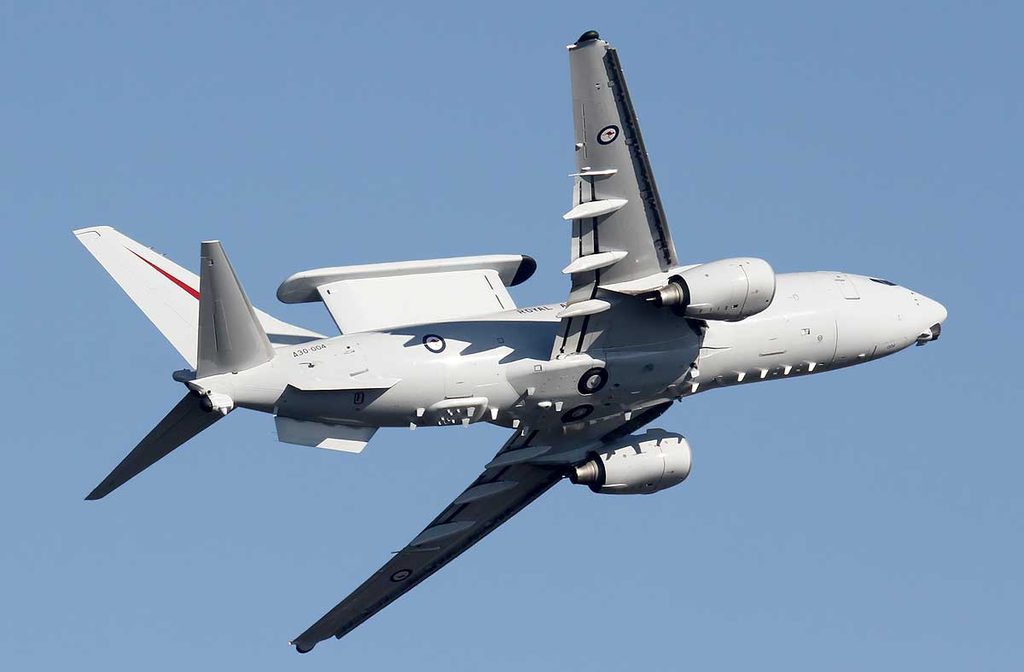
The E-7 Wedgetail is meant to finally address it.
The first British aircraft, WT001, arrived at RAF Lossiemouth on May 21, 2026. It is continuing flight trials ahead of formal handover to the Royal Air Force. The second airframe is set to enter testing, while conversion work on the third continues in Birmingham.
The Wedgetail utilizes a Boeing 737 Next Generation airframe integrated with Northrop Grumman’s MESA (Multi-role Electronically Scanned Array) radar.
The principle of an AEW&C aircraft is straightforward, yet its operational impact is considerable.
Operating at high altitude, its radar partially overcomes line-of-sight limitations imposed on ground stations by the Earth’s curvature. It can scan for aircraft over vast distances, track numerous targets simultaneously, and provide an expanded picture of the airspace.
Yet the Wedgetail is far more than a flying radar.
It functions as an airborne battle management and command platform.
Its operators fuse data from multiple sources to assist in task allocation: identifying which fighter should intercept, which aircraft should hold in reserve, which threat takes priority, and which unit is best positioned to engage.
For an F-35 or Typhoon, this intelligence reduces operational uncertainty.
A fighter no longer needs to expend time and energy searching for surrounding threats entirely on its own.
Three British Wedgetails Remain a Small Fleet
The issue is mathematical.
London originally planned to procure five E-7s. The order was reduced to three in 2021.
The resulting financial savings were modest compared to the loss in operational capability. A UK parliamentary committee noted that a 40% reduction in aircraft numbers reduced procurement costs by only around 12%.
Figures published by the government illustrate the current reality. The whole-life cost of the E-7 program is estimated at approximately £1.94 billion.
Three airframes do not translate into three simultaneously available aircraft.
One must factor in maintenance cycles, training sorties, technical defects, upgrades, and crew rotation constraints.
Maintaining a continuous E-7 presence during a major operation will be extremely difficult with a fleet of three aircraft.
The 2025 Strategic Defence Review logically recommends procuring additional units as financial resources allow, potentially through pooling arrangements with NATO allies.
This limitation should not be overlooked: the UK possesses an ambitious architecture, but still lacks mass.
The program itself faces ongoing challenges. The 2026 government assessment assigned it a “Red” confidence rating, citing industrial delays, supply chain bottlenecks, certification issues, and skilled personnel shortages.
London is rebuilding its AEW&C capability, but doing so belatedly.
The ECRS Mk2 Radar Transforms the Typhoon into an Offensive Sensor
The second development directly affects the Typhoon.
The UK is preparing to integrate the European Common Radar System Mk2 onto 40 aircraft.
This is an Active Electronically Scanned Array (AESA) radar. Unlike mechanically scanned radars that physically point an antenna toward a target area, an AESA employs numerous transmit-receive modules, allowing its beam to be steered electronically with extreme speed.
However, defining the ECRS Mk2 merely as a radar is an understatement.
The system combines detection, tracking, electronic support measures (ESM), and electronic attack (EA).
It will be capable of detecting and tracking multiple air and ground targets while simultaneously searching for, locating, and jamming adversary electromagnetic emissions.
The Typhoon thus becomes a fighter, sensor, and electronic warfare platform all at once.
It is precisely this multirole versatility that enhances the combat power of a numerically limited force.
An ECRS Mk2-equipped Typhoon can contribute to the shared understanding of the electromagnetic spectrum for other assets. It can leverage its substantial electrical power generation and antenna aperture without burdening stealth assets like the F-35 with high-power RF emissions.
The UK is Investing Nearly £3 Billion in This Upgrade
Financial commitments are substantial.
In 2023, London awarded an £870 million contract to BAE Systems and Leonardo UK to advance the development and integration of the ECRS Mk2.
In January 2026, a subsequent £453 million contract initiated the manufacturing of 40 radars, comprising 38 production sets and two test assets.
The total projected cost for the ECRS Mk2 program and the associated Phase 4 Enhancement upgrade stands at approximately £2.93 billion.
The first production radars are scheduled for delivery in 2028.
Leonardo UK is developing and manufacturing the core radar components in Edinburgh and Luton, while BAE Systems is leading integration onto the Typhoon at Warton. Parker Meggitt is also contributing to the program.
This industrial setup carries strategic weight.
London is using the Typhoon as a technological bridge toward GCAP.
The engineering base currently developing AESA radars, data fusion algorithms, and electronic warfare suites will remain active beyond the Typhoon’s lifecycle. These competencies will feed directly into the next generation.
The F-35 Delivers Stealth and Data Fusion
The F-35 fulfills a distinct role within this network.
The UK has taken delivery of all 48 F-35B aircraft from its initial procurement batch. Additional F-35s are expected to follow, including a planned acquisition of 12 F-35As to support the UK’s re-entry into NATO’s dual-capable aircraft nuclear mission.
The value of the F-35 in this architecture extends well beyond its stealth profile.
The aircraft combines an AESA radar, electro-optical sensors, a distributed aperture infrared system, and an advanced electronic warfare suite. Its core processor fuses these inputs to present a single, coherent picture to the pilot.
This function is critical.
The objective is not to overload the pilot with ten displays showing ten raw sensor feeds, but to distill data into actionable information: where the threat is, what type it is, and what response options are available.
In a networked force, this tactical picture can be fed into the broader theater network.
The F-35 can thus serve as a stealthy, forward-deployed sensor node.
A theoretical engagement scenario highlights the operational utility.
A forward-deployed F-35 detects a target or emission passively. An E-7 maintains broad situational awareness over the battle space. A trailing Typhoon occupies a favorable firing window with a Meteor missile. The command network aggregates this data, enabling controllers to guide the optimal assets into position.
This does not mean any missile can automatically be fired off raw target tracks passed across a network; data latency, target quality, and rules of engagement remain strict constraints.
However, platforms no longer operate in isolation.
That is where the operational gain lies.
GUARDIAN Converts British Radars into a Recognized Air Picture
Airborne assets form only one component of the network.
On the ground, the UK relies on a radar network connected to the Air Surveillance and Control System (ASACS).
Its primary operational command center is situated at RAF Boulmer.
The GUARDIAN program, delivered by IBM under an initial contract value of up to £80 million, has modernized this architecture.
GUARDIAN ingests data from ground radars, communications links, tactical data networks, and NATO feeds to generate a Recognized Air Picture (RAP)—a dynamic view of airborne tracks and threats across the area of responsibility.
The system is fully integrated into NATO’s Integrated Air and Missile Defence command structure.
The core principle is simple: an isolated radar provides a target track; GUARDIAN generates an actionable operational picture.
This distinction lies at the heart of modern command and control.
NEXUS Aims to Move Air Command into the Cloud Era
While GUARDIAN focuses primarily on air defense, NEXUS expands the scope.
The Royal Air Force positions NEXUS as its combat cloud—the digital framework built to aggregate operational data and distribute it seamlessly to warfighters.
The Chief of the Air Staff has explicitly designated NEXUS as the foundation of the UK’s future “Digital Targeting Web.”
Its goal is to compress the traditional kill chain—or more accurately, the kill web.
Legacy processes operated sequentially: detect, identify, transmit, evaluate, assign asset, engage.
Each handover point introduced minutes of latency.
Within a digital cloud architecture, multiple sensors continually stream data into a common environment. Algorithms categorize and cross-reference tracks, enabling commanders to digest intelligence rapidly and pair targets with the optimal shooter.
Time itself becomes a key operational capability.
Against high-speed cruise missiles or advanced fighter aircraft, cutting seconds from the engagement cycle yields a higher operational return than adding range to an isolated radar.
Substantial Resources Allocated to the Digital Targeting Web
Budget allocations indicate that London recognizes the strategic priority of these systems.
The Defence Investment Plan published in June 2026 commits nearly £7.3 billion over the next four years toward the Digital Targeting Web and its supporting digital infrastructure.
An additional £17 billion is projected between 2030 and 2035 to develop the broader digital backbone and targeting web across all branches of the UK Armed Forces.
This is no longer a localized RAF IT initiative.
The program aims to link sensors, command nodes, and effectors across land, sea, and air domains.
NEXUS forms the air component of this matrix, complementing the Army’s ASGARD and RAPSTONE systems, as well as the Royal Navy’s Strike Net.
The end state is an architecture where data origin matters less than data fidelity.
A naval vessel may detect; an F-35 may verify; a ground command station may assign; a Typhoon may deliver the payload.
This is what London terms an integrated force.
£790 Million Invested in Integrated Air Defense
A secondary funding envelope complements the Digital Targeting Web investments.
The Defence Investment Plan allocates £790 million over four years to strengthen the UK’s Integrated Air and Missile Defence (IAMD).
Funding is targeted at acquiring next-generation radars, sensors, and command systems, while expanding counter-unmanned aerial systems (C-UAS) and directed energy weapons.
A dedicated Integrated Air, Space and Missile Defence Operations Centre will also be established.
This decision reflects the evolving threat environment.
Modern aerial attacks are increasingly multi-layered, combining low-cost drones, cruise missiles, ballistic threats, and crewed platforms.
Deploying point-defense radars, surface-to-air missile batteries, and interceptor aircraft independently is no longer sufficient.
Assets must share situational data to ensure high-cost interceptors are not expended on low-tier targets that cheaper effectors can neutralize.
Effective command and control thus directly impacts the cost-exchange ratio of combat operations.
GCAP Designed to Integrate Sensors and Electronic Warfare from Outset
With the Global Combat Air Programme (GCAP), London aims to build this networked capability into the airframe from day one, rather than retrofitting it later.
The next-generation aircraft is scheduled to enter service from 2035.
It will be designed around an architecture known as ISANKE & ICS (Integrated Sensing and Non-Kinetic Effects & Integrated Communications Systems).
This philosophy breaks from traditional fighter design.
On legacy platforms, the radar, electronic jammers, radar warning receivers, and communications radios were distinct, federated systems added over time.
By contrast, GCAP treats these sub-systems as a single, fully integrated electronic architecture.
Antenna apertures will no longer be tied to single functions.
Depending on mission requirements, shared radio-frequency arrays can dynamically switch between radar scanning, secure data transmission, electronic attack, or self-protection functions.
Data from radar, electro-optical, infrared, and passive electronic sensors will be fused natively before presentation to the aircrew or transmission across the network.
The future fighter will function as much as a flying processing and electromagnetic node as a traditional combat aircraft.
Technology Sharing with Italy and Japan Enters New Phase
This architecture is being developed as a joint international enterprise.
For sensors and communications, the GCAP Electronics Evolution (G2E) industrial consortium unites Leonardo UK, Mitsubishi Electric, Leonardo (Italy), and ELT Group.
Leonardo UK contributes expertise in AESA radars, electronic warfare, and sensor fusion.
Mitsubishi Electric brings advanced defense electronics capabilities, including expertise in radar systems, missile guidance, and communications.
Leonardo and ELT Group contribute Italian industrial strength in self-protection suites, electronic attack, and sensor suites.
While specific work-share allocations regarding sensitive IP remain classified, viewing this arrangement as a one-way technology transfer is inaccurate.
GCAP is structured as a pooling of national sovereign capabilities.
Each partner country contributes critical technologies while securing sufficient system access to operate, maintain, and upgrade its fleet independently.
This structure also presents program risks.
British oversight reports explicitly identify intellectual property protection and the establishment of a secure trilaterally accessible digital environment as major implementation challenges.
Balancing collaborative development with the preservation of sensitive national IP will test the program’s governance structure.
Excalibur Testbed Aims to De-risk Avionics Ahead of First Flight
The UK is attempting to compress development timelines through dedicated flight testing.
Project Excalibur is converting a commercial Boeing 757 into a flying laboratory under a £115 million contract.
The aircraft will host GCAP’s emerging sensors, processors, and communications suites, allowing them to be evaluated in flight years before the first GCAP airframe is ready to fly.
This strategy mitigates a common pitfall in defense aerospace development.
When a new airframe and its complex avionics undergo flight testing simultaneously, software glitches or sensor issues can ground the entire flight-test program.
By leveraging Excalibur, engineers can test antenna performance, sensor fusion algorithms, and data links on an existing platform while airframe design progresses in parallel.
Sensor development is thus decoupled from airframe development.
This approach offers benefits for both schedule control and cost management.
By July 2026, Excalibur had completed a major modification phase and initial flight trials ahead of continued testing at Boscombe Down.
GCAP Funding Extends Beyond Traditional Airframe Procurement
London has committed significant financial capital to the endeavor.
The Defence Investment Plan allocates £8.6 billion to GCAP over four years.
In July 2026, a £4.6 billion trilateral contract was signed between the GCAP International Government Organisation and Edgewing—the joint venture formed by BAE Systems, Leonardo, and Japan Aircraft Industrial Enhancement Co.
That same month, the UK government announced an additional £708 million national contract to advance Future Combat Air System (FCAS) technology development alongside BAE Systems, Leonardo UK, Rolls-Royce, and MBDA.
Since 2018, London has invested over £5 billion in its national FCAS technology demonstration efforts.
These resources are funding more than just a stealth airframe.
They support software development, artificial intelligence algorithms, digital engineering pipelines, advanced communications, sensor suites, propulsion technologies, and integration frameworks for autonomous collaborative platforms.
GCAP is less a direct replacement for the Typhoon than a combat system architecture built around a core platform.
System Synergy Designed to Maximize Platform Returns
The underlying logic of British defense planning balances operational necessity with fiscal realities.
An F-35 represents a high unit cost.
A modernized Typhoon is expensive.
An E-7 is a high-value asset.
GCAP will require vast capital outlays.
The primary method to maximize the ROI of these platforms is to prevent them from operating as isolated siloes.
An F-35 does not need to radiate with all its active sensors if off-board nodes provide targeting data.
A Typhoon does not need to be the initial detecting platform to deliver kinetic effect.
An E-7 delivers no direct kinetic firepower, but enhances the effectiveness of dozens of surrounding assets.
A ground-based command network possesses no weapons itself, but enables allocation of the optimal effector rather than the first one available.
This capability represents the true force multiplier.
A connected network decouples the sensor, the decision-maker, and the shooter.
This distribution increases force agility while complicating an adversary’s operational targeting calculus.
Transitioning from Concept to Operational Mass Remains Core Challenge
While the architectural blueprint is cohesive, execution faces tangible hurdles.
The UK retired its E-3D fleet several years prior to the introduction of its replacement.
Initial operational capacity for the E-7 will rely on just three aircraft.
Only 40 Typhoons out of the wider fleet are scheduled to receive the ECRS Mk2 radar upgrade.
The UK’s F-35 fleet continues to navigate availability, logistics, and personnel constraints highlighted in reports by the National Audit Office.
GCAP remains a complex development program classified as high-risk in government project ratings.
Furthermore, increasing dependency on networked data introduces operational vulnerabilities: the network itself becomes a high-priority target.
Adversaries will target data links, degrade satellite communications, attempt cyber penetrations, and force platforms to operate in degraded or emissions-controlled environments.
The future British force structure must retain combat effectiveness when access to the digital network is disrupted or denied.
This represents perhaps its most demanding requirement.
Nonetheless, the UK has correctly diagnosed the underlying operational challenge. Procuring advanced combat aircraft without rebuilding the sensor, command, and networking framework around them yields an expensive yet underutilized force.
London is now investing in the less visible connective tissue of air power: the ability to detect first, process faster, and assign the appropriate weapon in seconds.
The F-35, the Typhoon ECRS Mk2, and eventually GCAP can no longer be evaluated solely on individual radar range, low observability, or weapons payload capacity.
Their true operational utility will be defined by the network to which they belong.
In future air warfare, the nation capable of most effectively connecting its sensors, decision nodes, and weapons platforms will generate military power far exceeding its raw platform count.
Sources
UK Ministry of Defence — Strategic Defence Review 2025, “Making Britain Safer: secure at home, strong abroad.” Identifies GUARDIAN and NEXUS as core elements of UK integrated command and recommends procuring additional E-7 aircraft.
UK Ministry of Defence / Royal Air Force — Arrival of the first British E-7 Wedgetail at RAF Lossiemouth, May 21, 2026, and fleet status updates, June 2026.
National Infrastructure and Service Transformation Authority — Major Projects Annual Report 2025-26. Evaluates whole-life E-7 program cost at approximately £1.937 billion with a “Red” confidence rating; ECRS Mk2/P4E cost evaluated at approximately £2.93 billion.
UK House of Commons — Defense Committee reporting on the E-7 Wedgetail procurement. Notes reduction of original five-aircraft order to three yielded disproportionately low cost savings compared to capability loss.
UK Ministry of Defence — £453 million production contract for 40 ECRS Mk2 radars, January 2026.
Royal Air Force / UK Ministry of Defence — £870 million contract for ECRS Mk2 development and integration; details program role in maintaining industrial skills for the Future Combat Air System.
Leonardo UK — Technical specifications for the ECRS Mk2 radar: multi-function AESA, electronic support measures, and electronic attack capabilities.
Royal Air Force — GUARDIAN Air Command and Control System details at RAF Boulmer and integration with NATO air defense networks.
UK Ministry of Defence — Initial investment allocation of up to £80 million for Project GUARDIAN.
Chief of the Air Staff — 2025 address outlining NEXUS as the RAF’s combat cloud and key component of the UK Digital Targeting Web.
UK House of Commons Library — Defence Investment Plan 2026: allocating nearly £7.3 billion for the Digital Targeting Web and supporting infrastructure over four years, with approximately £17 billion projected between 2030 and 2035; £790 million allocated for IAMD.
Dstl — Project SIREN overview detailing UK multi-sensor distributed fusion and cloud integration flight demonstrations.
UK Ministry of Defence — Defence Investment Plan and GCAP contracting: £8.6 billion UK investment over four years and £4.6 billion international contract awarded to Edgewing, July 2026.
UK Ministry of Defence — £708 million contract award to advance Future Combat Air System technologies, July 2026.
GCAP Electronics Evolution / Leonardo / Mitsubishi Electric / ELT Group — Formation of the G2E consortium for ISANKE & ICS development, September 2025.
Leonardo UK — ISANKE & ICS technical suite details: multi-function radar, electro-optical/infrared sensors, electronic warfare, data fusion, and high-bandwidth communications.
UK Ministry of Defence / Leonardo — Project Excalibur Flight Test Aircraft: £115 million contract converting a Boeing 757 into an avionics testbed for GCAP sensors and communications.
BAE Systems — Progress updates on Excalibur modification milestones and integrated sensor testing, July 2026.
UK Ministry of Defence — Future Combat Air System Digital Strategy, July 2026. Outlines digital architecture, collaborative environments, data standards, and technology insertion strategies.
National Audit Office — The UK’s F-35 Capability report. Analyzes fleet availability, infrastructure readiness, and long-term support costs for the UK F-35 program.
UK Parliament / Ministry of Defence — Delivery confirmation of 48 F-35B aircraft to the UK and government life-cycle cost estimate of approximately £57 billion for planned procurement and support of up to 138 F-35s through 2069.
War Wings Daily is an independant magazine.