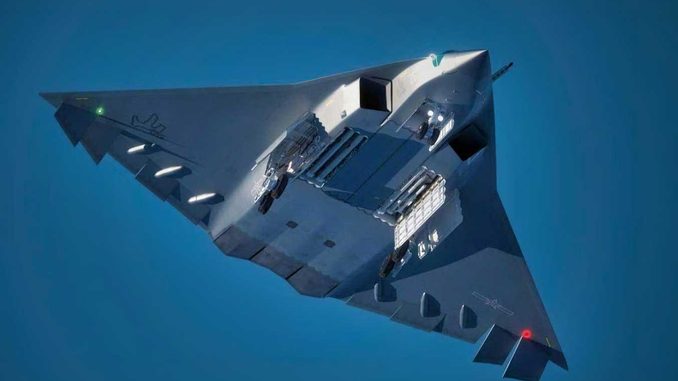
The Chinese J-36 is already flying, with multiple prototypes emerging. Facing the American F-47, it reveals a new battle for air superiority.
Executive Summary
The J-36 represents one of the most significant developments in Chinese military aviation since the emergence of the J-20. Developed by the Chengdu Aircraft Corporation, this massive, tailless stealth aircraft was first seen publicly in flight in December 2024. Since then, its architecture has evolved rapidly. Images that surfaced in July 2026 may even show a fifth prototype. Beijing also made its first official allusion to the program in June 2026. China clearly possesses a sixth-generation fighter program undergoing advanced testing.
However, asserting that it has already surpassed the United States would be premature. While Boeing’s F-47 is not expected to make its maiden flight until 2028, the American demonstrators that paved its way have been flying secretly since 2019 and 2022, accumulating several hundred flight hours each. China has taken the lead in visibility and the apparent pace of prototyping. Real technological superiority remains impossible to establish.
The J-36 is Far More Than Just a New Chinese Fighter
On December 26, 2024, an aircraft with an unusual shape appeared in the skies over Chengdu. Flying alongside a twin-seat J-20S acting as a chase plane, its landing gear remained down. The aircraft was massive, featuring neither vertical stabilizers nor a conventional tail assembly.
A number starting with “36” visible on the airframe quickly led observers to designate it the J-36. Beijing has still not officially confirmed this designation.
Yet this is no longer a mere rumor.
The Pentagon’s 2025 report on Chinese military power explicitly acknowledges that two Chinese manufacturers flew two sixth-generation aircraft prototypes in December 2024. The second is developed by Shenyang and is generally designated as the J-XDS, J-50, or J-XD depending on the source.
China is therefore not pursuing a single concept; it appears to be developing two distinct architectures in parallel.
The Chengdu program is by far the most spectacular.
Janes estimates the dimensions of the first aircraft at approximately 23 meters (75.5 ft) in length and 24.8 meters (81.3 ft) in wingspan. This makes it noticeably wider than the J-20, which has a wingspan of roughly 13 meters (42.6 ft).
These proportions immediately suggest that the J-36 is likely not designed as a direct successor to the J-20 in the traditional sense.
It resembles a very long-range air superiority platform capable of also executing strike missions, electronic warfare, and airborne command and control.
In other words, calling it a “fighter” becomes almost reductive.
The Tailless Airframe Prioritizes Stealth and Range Above All
The most remarkable feature of the J-36 is its aerodynamic layout.
The aircraft features a massive double-delta or diamond wing blended into the fuselage. The vertical fins have completely disappeared.
This elimination is critical for stealth.
A vertical tail acts as a surface that readily reflects radar energy. On a conventional aircraft, twin tails produce several additional angles that must be mitigated through structural shaping and radar-absorbent materials.
Removing them simplifies the task of reducing the aircraft’s radar cross-section across multiple threat sectors.
However, this architecture poses a major challenge: tail fins traditionally control yaw, which is the aircraft’s rotation around its vertical axis.
A tailless aircraft therefore demands an exceptionally sophisticated flight control system. Wing-integrated control surfaces must operate differentially, spoilers can locally alter drag, and thrust vectoring can also contribute to directional control.
The J-36 thus illustrates a fundamental characteristic of the sixth generation: aerodynamics becomes software-dependent.
Without a flight control computer capable of continuously making split-second corrections, such an architecture would be far more difficult to operate.
The Three Engines Represent the J-36’s Core Technical Enigma
The second striking engineering choice involves its propulsion system.
The J-36 is a trijet.
Two lateral air intakes feed the side engines, while a third intake is mounted on the upper fuselage.
This configuration is exceptional for a modern combat aircraft.
It generates immense thrust and potentially a substantial electrical power generation capacity. Future combat aircraft will need to power high-output radars, electronic jammers, mission computers, data links, and eventually, directed-energy weapons.
Yet three engines also bring serious drawbacks.
They consume more fuel, add structural weight, and complicate maintenance. Managing three intake ducts and three exhausts also complicates radar and infrared signature management.
This layout is unlikely to be a design luxury.
It may be necessary to propel an airframe of such considerable dimensions. It could also reflect the requirement to sustain supersonic performance while carrying substantial internal fuel loads and heavy weapons payloads.
The exact engine model utilized remains unknown.
Claims that the J-36 is already powered by three WS-15 engines and possesses guaranteed supercruise capability should be treated as speculative hypotheses. No reliable public data currently confirms its top speed, available thrust, or actual combat radius.
New Prototypes Show Chengdu Did Not Stop at Flying a Single Demonstrator
The tempo of the program is perhaps even more telling than the aircraft itself.
Following the initial airframe spotted in December 2024, a heavily modified second prototype appeared in October 2025.
The changes were significant.
The side air intakes were redesigned, the main landing gear configuration was altered, and most notably, the engine exhausts became far more angular.
Images analyzed by Janes and The War Zone point to the probable inclusion of two-dimensional thrust-vectoring nozzles.
This technology allows a portion of the engine thrust to be directed. On a tailless airframe, it can provide critical control authority, particularly in flight regimes where aerodynamic control surfaces lose effectiveness.
Integrating such nozzles also suggests that Chengdu is evaluating different trade-offs between rear-aspect stealth, flight control authority, and aerodynamic efficiency.
A third airframe reportedly flew in December 2025, followed by a fourth observed in early 2026.
Even more dramatically, imagery released in July 2026 led several analysts, including Andreas Rupprecht, to point to the existence of a distinct fifth prototype.
While this identification awaits formal confirmation—as Beijing releases neither complete serial numbers nor official inventories—the observed structural variations make the hypothesis of a single, constantly modified demonstrator increasingly implausible.
China appears to be conducting a fully-fledged flight test campaign.
China Begins to Acknowledge the Program’s Existence
For eighteen months, Beijing allowed images to circulate without offering formal commentary on the aircraft.
That strategy quietly shifted on June 28, 2026.
China Military Bugle, an official media outlet of the People’s Liberation Army, released a video marking the tenth anniversary of the Y-20’s entry into service.
At the end of the clip, a co-pilot asks which aircraft needs to be refueled. The response refers first to “Master Six,” a nickname tied to the H-6 bomber, and then to “Little Six.”
A tailless stealth silhouette then appears briefly on screen.
This represents the first implicit official acknowledgment of China’s sixth-generation program.
The scene also suggests that aerial refueling trials may be underway, though concluding that the J-36 has already completed its aerial refueling qualification would be premature.
Testing a capability is not the same as declaring it operational.
Tremendous Internal Volume Points to the Real Mission
The physical footprint of the J-36 offers clues to its operational role.
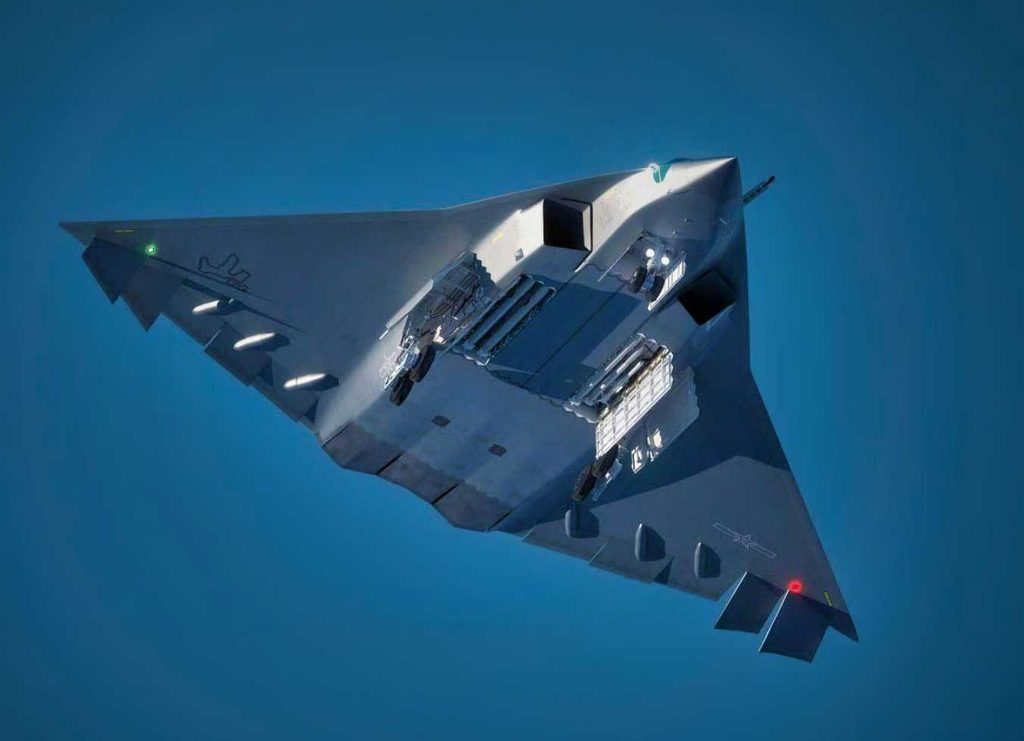
A large airframe provides two decisive advantages: greater internal fuel capacity and larger weapons bays.
Both features are critical in the Pacific theater.
A conflict between China and the United States would be fought across vast maritime distances. American forces would rely heavily on aerial refueling, while Chinese aircraft operating far from the mainland would face the exact same geographic constraints.
An aircraft capable of covering extended distances on internal fuel mitigates that dependency.
The large weapons bay observed beneath the J-36 addresses a second challenge.
Stealth requires weapons to be carried internally. However, long-range air-to-air missiles and standoff air-to-ground ordnance are inherently bulky.
Justin Bronk, an airpower specialist at the Royal United Services Institute, emphasizes that combat in the Indo-Pacific will favor platforms capable of internally accommodating weapons much larger than those carried by current conventional fighters.
The J-36 appears tailored to this operational reality.
It could serve as a very long-range platform specialized in targeting high-value airborne assets.
The J-36 May Target the Critical Support Nodes of U.S. Airpower
The primary mission of the J-36 is likely not dogfighting an F-35 at close range.
Its most critical targets lie much further back.
Airborne early warning aircraft such as the E-3 or E-7, KC-46 tankers, intelligence-gathering platforms, electronic warfare aircraft, and flying command posts form the backbone of U.S. air operations in the Pacific.
They are also far less stealthy than an F-35.
A platform like the J-36 could seek to penetrate deep into adversary airspace to launch very long-range air-to-air missiles against these high-value airborne assets.
China is already developing the PL-17, an ultra-long-range air-to-air missile designed specifically for engaging support aircraft.
However, there is no public confirmation that the J-36 currently carries the PL-17.
A standoff strike role is equally plausible.
With its large internal bay, the same airframe could deliver long-range anti-ship or land-attack munitions, targeting surface vessels or integrated air defense systems.
The traditional line between a fighter and a tactical bomber thus becomes increasingly blurred.
The Cockpit Layout Points to a Command Hub as Much as a Fighter
Detailed photography has also led Janes to identify what appears to be a side-by-side crew seating arrangement.
This configuration is highly unusual for a modern fighter.
Yet it makes sense if the J-36 is intended to simultaneously manage its own sensors, weapons, electronic warfare suites, and multiple uncrewed platforms.
The pilot would no longer be tasked solely with flying and fighting the aircraft.
Instead, one crew member could act as the local battle manager for a formation of autonomous uncrewed systems.
Indeed, the Pentagon assesses that future Chinese sixth-generation platforms will likely perform air-to-air and air-to-ground missions while controlling uncrewed combat aircraft.
This is where the true generational leap occurs.
Stealth alone is no longer enough.
Sixth-generation warfare requires integrating sensors, artificial intelligence, electronic attack, collaborative drones, secure data links, and long-range weapons into a single distributed combat system.
The J-36’s Sensors May Be as Critical as Its Missiles
Multiple electro-optical apertures are visible around the aircraft’s nose section.
These sensors allow the aircraft to passively detect and track targets without emitting electromagnetic signals, unlike radar.
This passive detection capability is vital in engagements between stealth aircraft.
An active radar emission can reveal a platform’s location, whereas an infrared or electro-optical system operates with far greater discretion.
The J-36 is also expected to feature a modern active electronically scanned array (AESA) radar and highly integrated electronic warfare systems.
However, no verified technical specifications for these subsystems are available in the public domain.
Sensational descriptions depicting the J-36 as possessing 360-degree radar coverage, operational combat lasers, or fully autonomous artificial intelligence should be viewed with caution.
While compatible with a sixth-generation architecture, these capabilities remain unproven.
The American F-47 is Not as Far Behind as It Appears
On the surface, the comparison appears unfavorable for Washington.
The J-36 has been flying publicly since December 2024, with multiple prototypes now actively engaged in testing.
By contrast, Boeing’s first F-47 is not expected to fly until 2028.
In July 2026, the U.S. Air Force confirmed that F-47 test aircraft were currently under construction as part of the Engineering and Manufacturing Development phase.
This timeline might suggest that China holds a three- to four-year lead.
However, that conclusion overlooks a critical piece of the puzzle.
The American NGAD program has been flying airframes for years.
DARPA revealed in March 2025 that Boeing and Lockheed Martin built two X-planes to de-risk technologies for the future NGAD program. The first took to the air in 2019, followed by the second in 2022.
Each aircraft reportedly accumulated several hundred flight hours.
General David Allvin confirmed that these demonstrators tested key technologies related to stealth, autonomy, operational range, and tactical concepts.
The United States was flying core technologies for the F-47 five years before the public appearance of the J-36.
The difference lies in visibility: the American demonstrators remained classified.
The F-47 is Built Around Ambitious Performance Goals
Washington discloses few details regarding its future air-dominance platform.
Nevertheless, a few key parameters have been made official.
The U.S. Air Force targets a combat radius exceeding 1,000 nautical miles (over 1,850 km) and a top speed in excess of Mach 2.
The service envisions acquiring at least 185 aircraft—roughly matching the size of the F-22 fleet the F-47 is destined to replace.
Crucially, the F-47 will not operate in isolation.
It will serve as the central node of the broader NGAD system-of-systems alongside Collaborative Combat Aircraft (CCA).
The U.S. Air Force plans to field over 1,000 of these uncrewed aircraft, with initial YFQ-42A and YFQ-44A prototypes already undergoing flight testing.
The F-47 will benefit from a broader battle network of uncrewed platforms, distributed sensors, and advanced data links.
This is precisely the operational environment in which the J-36 is also designed to operate.
Both superpowers are converging on the same concept: the future fighter is less an isolated aircraft and more a stealthy command node in a networked combat system.
The Scale of the American Industrial Effort Remains Substantial
Boeing’s EMD contract for the F-47, awarded in March 2025, is valued at over $20 billion for its initial phase, according to Reuters.
U.S. defense budget allocations for the program reached approximately $3.48 billion for Research, Development, Test & Evaluation in FY2026, with over $5 billion requested for FY2027.
The U.S. Air Force maintains a 2028 target for the maiden flight of Boeing’s development aircraft.
This milestone must be distinguished from the earlier X-planes.
The F-47 scheduled to fly in 2028 will represent an operational-configuration aircraft rather than a technology demonstrator.
China, by contrast, discloses virtually no official budget, contracting, or production data for the J-36.
Comparing the competition solely by counting photographed airframes provides an incomplete picture of the overall industrial balance.
Operational Deployment of the J-36 Remains Years Away
This is the key detail often overlooked in enthusiastic commentaries.
The J-36 is flying; it is not operational.
At the end of 2025, the Pentagon assessed that Chinese sixth-generation programs were still in their early development phases, projecting an initial operational capability around 2035.
Janes offers a similarly cautious timeline.
China’s experience with the J-20 and the FC-31/J-35 shows that nearly a decade can elapse between initial prototypes and operational deployment. Given the far greater complexity of the J-36, Janes suggests the development cycle could span 12 to 15 years.
The rapid tempo observed since 2024 could potentially condense this timeline.
The progression to four or five distinct prototypes would be particularly meaningful. Aircraft manufacturers typically expand their prototype fleet as testing diversifies across different disciplines: flight envelope expansion, propulsion, avionics, weapons integration, aerial refueling, stealth validation, and systems integration.
Even so, no firm evidence suggests an operational J-36 squadron will be fielded before 2030.
A realistic timeline remains the early to mid-2030s.
China Has Built an Industrial Advantage Washington Cannot Ignore
The true signal sent by the J-36 is industrial.
Twenty years ago, the Chinese aviation industry relied heavily on foreign technology for its most advanced combat aircraft.
Today, Chengdu produces the J-20, is developing advanced variants powered by domestic engines, and is flying a next-generation architecture.
Concurrently, Shenyang is developing the J-35 and a second sixth-generation demonstrator.
This parallel development capacity is profound.
China has demonstrated that it possesses multiple design bureaus capable of running advanced stealth aircraft programs simultaneously.
A structural gap with the American defense industrial base persists. The United States retains unmatched experience in stealth design, propulsion, integrated sensors, networked warfare, and complex flight testing.
Yet Washington can no longer view China as an adversary condemned to trail a generation behind.
That era has passed.
Being First to Fly Does Not Guarantee Victory
The J-36 has achieved something politically powerful: it has inverted the traditional narrative of technological competition.
Today, a mysterious Chinese aircraft is flying publicly while the American F-47 remains behind closed doors in a classified program.
However, relying on public visibility as a metric of technological maturity is misleading.
The United States flew its NGAD technology demonstrators in 2019, whereas China revealed its airframe publicly in 2024. Boeing targets 2028 for the F-47’s first flight, while Beijing has provided no official target for the J-36’s entry into service.
The critical question is no longer who flew the first airframe resembling a sixth-generation fighter.
The real race centers on four far less visible arenas: the quality of stealth signatures, actual combat radius, advanced engine reliability, and above all, the ability to securely network crewed jets, uncrewed platforms, satellites, sensors, and weapons in a contested electronic warfare environment.
In terms of visible flight-test prototypes, China is currently setting the pace.
In terms of operational capability, neither side can yet claim a decisive lead over the other.
This is precisely what makes the J-36 so significant: for the first time in decades, Washington must seriously confront the reality that when the next generation of combat aircraft enters service, its primary competitor may arrive at the gate at virtually the same time.
Sources
U.S. Department of Defense, Military and Security Developments Involving the People’s Republic of China 2025, December 2025. Confirmation of two Chinese sixth-generation prototypes and assessment of operational capability around 2035.
DARPA, “DARPA X-planes paved the way for the F-47,” March 21, 2025. First flights of X-planes in 2019 and 2022 with several hundred flight hours accumulated.
U.S. Air Force, “Air Force Awards Contract for Next Generation Air Dominance Platform, F-47,” March 21, 2025. NGAD program, modularity, and integration with Collaborative Combat Aircraft.
Defense News, “F-47 program producing test aircraft, on schedule for 2028 flight,” July 30, 2026. Production of test airframes, first flight planned for 2028, FY2026 and FY2027 funding, and target fleet of at least 185 F-47s.
U.S. Department of Defense Comptroller, FY 2026 Program Acquisition Costs by Weapon System. Approximately $3.48 billion dedicated to F-47 research and development in FY2026.
Reuters, “Trump picks Boeing over Lockheed for fighter jet contract,” March 21, 2025. Engineering and Manufacturing Development contract valued at over $20 billion.
Janes, “Two Chinese stealth aircraft programmes emerge unexpectedly,” December 2024. Estimated dimensions of the J-36, trijet configuration, air intakes, and electro-optical sensors.
Janes, “Second J-36 prototype breaks cover,” 2025. Modifications to air intakes, landing gear, and exhausts on the second prototype.
Janes, “Front view of Chinese tailless stealth aircraft hints at long-range strike role.” Analysis of cockpit layout, potential long-range strike role, and development timeline.
Royal United Services Institute, Justin Bronk, “Large, Crewed Sixth-Generation Aircraft Have Unique Value in the Indo-Pacific,” March 5, 2025. Analysis of range, large internal bays, long-distance missions, and electronic warfare in the Indo-Pacific.
South China Morning Post, “What signal is China sending with first official footage of sixth-generation fighter?,” June 29, 2026. First implicit official acknowledgment of the program by official Chinese military media.
South China Morning Post, “New images point to fifth prototype for China’s J-36 fighter jet in air power race with US,” July 30, 2026. Analysis of images indicating the possible existence of a fifth prototype.
Defense News, “Air Force eyes longer range for F-47 as combat edge in Pacific theater,” May 14, 2025. Combat radius exceeding 1,000 nautical miles and top speed above Mach 2.
War Wings Daily is an independant magazine.