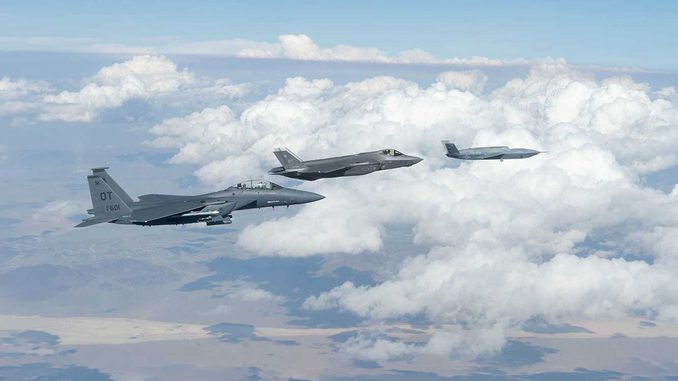
The FQ-42 Vengeance enters a new phase: flights with manned fighters, armament, AI, and a target of 500 American CCAs as early as 2032.
In Summary
General Atomics’ FQ-42 Vengeance is no longer just a combat drone prototype. A new aircraft arrived at Creech Air Force Base on September 18, 2026, while General Atomics revealed the FQ-42 flying in formation with an F-35A and an F-15E. The US Air Force aims to field at least 500 Collaborative Combat Aircraft by 2032, supplemented by 500 simpler and less expensive Massed Modular Aircraft. The shift is as much economic as it is technological: a CCA is currently estimated at around $20 million for the airframe alone, compared to several times that for a manned fighter jet. Artificial intelligence is expected to enable a few pilots to command multiple aircraft rather than remote-piloting them individually. However, the USAF is not yet preparing for the elimination of the human pilot. Into the 2030s, it is building a hybrid force where humans command and machines execute an increasing share of the mission.
The FQ-42 Transitions from Prototype to Fighter Integration
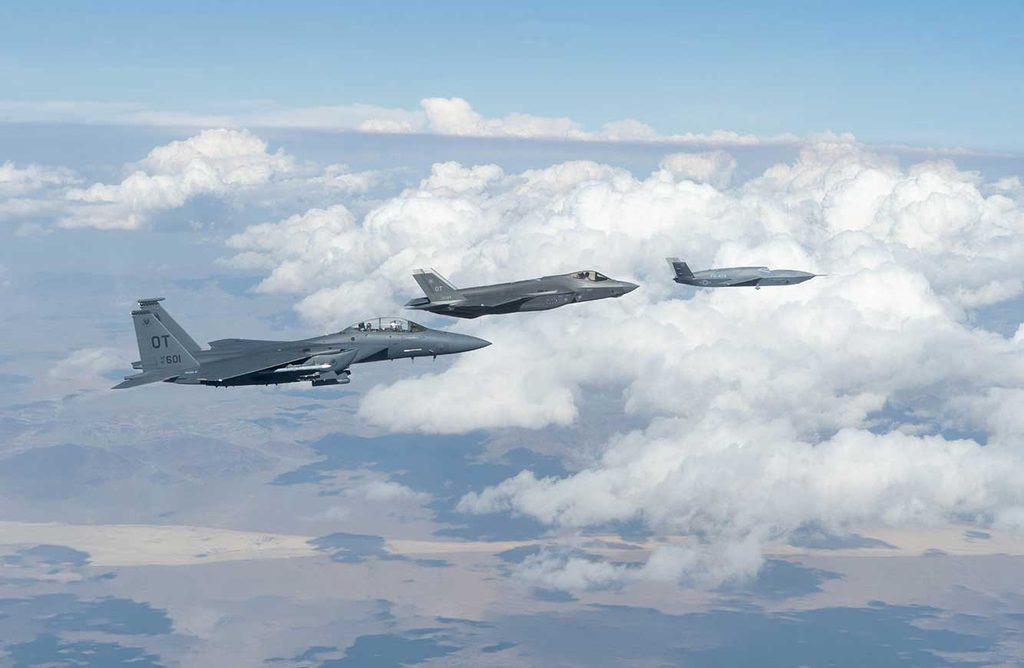
The American Collaborative Combat Aircraft program has just passed a symbolic milestone. General Atomics delivered a new FQ-42 Vengeance to Creech Air Force Base in Nevada on September 18, 2026. A few days later, the manufacturer published a photograph of an FQ-42 flying alongside an F-35 Lightning II and an F-15E Strike Eagle.
The image is striking, but it must be interpreted correctly. It demonstrates that the drone can operate in the same formation and tactical airspace as manned fighters. It does not prove that the F-35 pilot was directly commanding the FQ-42 during that flight.
That is precisely the next step.
General Atomics has already used its MQ-20 Avenger and XQ-67A as testbeds for autonomous flight and collaborative control experiments from manned fighters. The F-22 Raptor notably served in preparatory work for this type of interaction.
The Fundamental Difference Between a Remote-Piloted Drone and a CCA
An MQ-9 Reaper remains, essentially, a remotely piloted aircraft. A human operator controls the airframe from the ground.
The FQ-42 operates under a different logic. The pilot no longer needs to constantly instruct it where to turn, what altitude to fly, or how to approach a target. The pilot assigns it a mission intent. The autonomy software then translates that instruction into trajectories, maneuvers, and tactical actions.
It is this difference that makes massing forces possible. Commanding five autonomous aircraft is realistic for a pilot. Remote-piloting five drones simultaneously is not.
Massing Forces Becomes the US Air Force’s True Objective
Secretary of the Air Force Troy Meink announced a very precise goal on September 14: at least 500 operational CCAs by 2032.
The USAF is adding a second tier. It also wants 100 Massed Modular Aircraft (MMA) by 2029 and 500 by 2032. These aircraft are intended to take over a portion of the intelligence and strike missions currently assigned to the MQ-9, with several models potentially produced by different manufacturers.
Financial orders of magnitude explain the strategy. Air Force officials cite approximately $20 million per CCA airframe and nearly $10 million for an MMA, prior to adding sensors and specific mission equipment.
An F-35A costs tens of millions of dollars more. A manned fighter also requires a cockpit, an ejection seat, life support systems, human-tailored interfaces, and an architecture designed to protect its pilot.
Above all, that pilot must be trained. The US Air Force was still reporting a shortage of 2,470 pilots for fiscal year 2025. It is now aiming to train roughly 1,500 per year.
CCAs do not merely solve an acquisition cost problem. They alter the ratio between available pilots and the number of aircraft that can be fielded.
Artificial Intelligence Must Turn the Pilot into a Mission Commander
The chosen technological architecture is as important as the FQ-42 itself.
The USAF intentionally separates the drone hardware from its autonomy software. Its Autonomy Government Reference Architecture (A-GRA) is designed to allow different “AI pilots” to be installed on various airframes without relying on a single manufacturer.
Software developed by companies like Collins Aerospace and Shield AI is being tested across multiple platforms. The goal resembles an open operating system: continually improve the drone’s intelligence without rebuilding the aircraft.
This AI already handles navigation, trajectory management, coordination, threat tracking, and tactical maneuvers. Eventually, it will fuse data from multiple sensors, reroute in response to air defenses, allocate targets among multiple CCAs, or select the optimal position to release a weapon.
The human pilot becomes less of a traditional flyer and more of a tactical commander of a machine swarm.
Pilot Trust Becomes a Military Capability
The key question is not whether the algorithm can fly—it already can.
The challenge is determining whether a pilot will trust it enough to delegate parts of the engagement.
Trust must be calibrated. An aircrew must understand the algorithm’s capabilities, as well as its limitations and behaviors when it loses a data link, receives conflicting information, or encounters an unprecedented scenario.
This is why live exercises are critical.
In December 2026, CCAs are scheduled to participate in Emerald Flag at Eglin Air Force Base. The exercise will integrate them for the first time into a large-scale air operation alongside fourth- and fifth-generation aircraft. The USAF specifically plans to test a complete kill chain and offensive counter-air scenarios.
Anduril’s FQ-44 Fury fired an AIM-120 AMRAAM missile against a digital target back in July. The FQ-42’s first live air-to-air launch is slated for later in 2026. Prior testing began with inert captive carriage to verify aerodynamics, structural integrity, and weapon separation.
Strike Decisions Remain Under Human Control for Now
Autonomy does not mean an FQ-42 is given free rein to identify and destroy its own targets.
Current US doctrine requires an appropriate level of human judgment in the use of force. During the AIM-120 firing by the FQ-44, the Air Force stressed the retention of human supervision for weapons release authorization.
However, that line could shift.
Advanced military autonomy does not need to wait for a human to validate every single maneuver. A commander could define a sector, a mission, authorized target categories, and rules of engagement. The AI could then detect, classify, prioritize, and present a firing solution.
Technically, a further step would allow it to automatically engage a target meeting those criteria. US directives on autonomous weapons do not impose an absolute ban on this capability; rather, they require exceptionally strict validation, reliability, and human oversight procedures.
The issue is therefore becoming as much doctrinal and legal as it is technological.
Replacing Pilots Is Not Programmed for 2032
The figure of 500 CCAs might give the impression that the US Air Force is preparing for fully unmanned combat aviation. That is not what its current plans show.
In May 2026, Air Force Chief of Staff Gen. Kenneth Wilsbach acknowledged that current autonomy levels do not yet permit the complete replacement of the combat fleet, or even the fighter branch alone.
2032 will be an era of human-machine teaming, not the disappearance of the cockpit.
The F-35, F-22, and particularly the future F-47 will continue to serve as the human and decision-making nodes of a force featuring an expanding number of CCAs. A single aircrew, however, will be able to project far more combat power than today.
No official timeline currently envisions the total elimination of American fighter pilots. Into the 2030s, the model will remain hybrid. Beyond 2040, a predominantly autonomous force becomes technologically conceivable, but it remains a potential scenario rather than an announced USAF program.
The Real Shift Lies in the Aircraft-to-Pilot Ratio
The FQ-42 Vengeance does not render the pilot obsolete; it changes their role.
The most significant transformation may be less dramatic than a fully autonomous fighter. It consists of shifting from a system where one pilot equals one combat aircraft to an architecture where one pilot directs multiple platforms capable of sensing, maneuvering, and fighting largely on their own.
That is where the military value of CCAs lies. The US Air Force is no longer simply pursuing the ultimate individual fighter jet. It is seeking to saturate the skies with enough sensors, missiles, and platforms to present an insoluble problem to the adversary while putting fewer human crews in harm’s way.
The FQ-42 marks not the end of the pilot, but the beginning of an era of aviation where a human presence on board every aircraft is no longer essential.