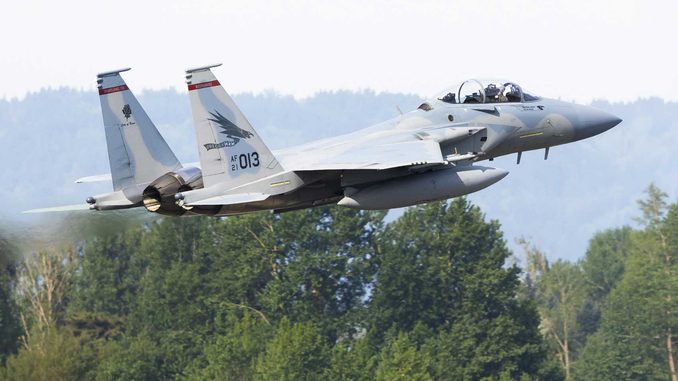
Why the US Air Force is still buying F-15EXs alongside its F-35s: stealth, delays, inventories, costs, and Pacific requirements.
In Summary
The F-35 vs. F-15EX debate is not a duel between the past and the future. It reveals a much harsher constraint: the US Air Force suffers from a shortage of available fighter jet inventory, needs to replace its aging F-15C/Ds and F-15Es, and cannot rely solely on the F-35A, which remains bogged down by Block 4 modernization and Technology Refresh 3 delays. The F-35 remains the essential stealth aircraft required to penetrate modern defenses. But the F-15EX Eagle II offers something else: range, payload capacity, rapid integration into existing F-15 units, and up to twelve AMRAAM missiles. In the Pacific, where distances are vast, this sheer mass matters. The US Air Force is therefore not choosing between stealth and payload capacity. It is buying both because its wartime operational scenarios demand both.
The American Debate Opposes Two Very Different Operational Needs
The US Air Force continues to procure F-15EX aircraft even though the F-35A is its primary stealth fighter. This might seem paradoxical, but in reality, it is highly logical.
The F-35 Lightning II is engineered to penetrate heavily defended airspace. It relies on stealth, sensor fusion, and networked warfare. Its role is to see without being seen, penetrate modern surface-to-air defenses, and provide a rich tactical picture to other platforms.
The F-15EX Eagle II addresses a different challenge: how to rapidly generate credible aerial mass with high weapons capacity without waiting for all F-35 issues to be resolved?
That is where the debate becomes compelling. The US Air Force is not replacing the F-35 with the F-15EX. It is offsetting the F-35’s production constraints, availability issues, and internal payload limits with a non-stealthy, heavily armed fighter.
The F-35 Remains Irreplaceable in the Opening Hours of a Conflict
The F-35A Lightning II is the primary American asset for high-risk missions. It is tasked with suppressing air defenses, locating radar systems, gathering electronic intelligence, and sharing data across platforms.
Its value is therefore not measured strictly by speed or payload capacity. The F-35 acts as a stealthy flying sensor node. It can operate in environments where non-stealth aircraft must remain standoff.
Its specifications illustrate this trade-off. The F-35A carries up to 8.16 metric tons (18,000 lbs) of payload, reaches Mach 1.6, and offers an internal fuel range exceeding 2,200 kilometers (1,350 miles). However, in a stealth configuration, weapons must be stored internally, significantly limiting immediate capacity.
This is the trade-off required for low observability.
In an air campaign against an adversary equipped with S-400 or HQ-9 systems, long-range radars, and modern fighters, this trade-off is entirely justified. But once initial defenses are degraded, the US Air Force requires aircraft capable of carrying far larger weapons loads.
The F-15EX Delivers the Mass the F-35 Cannot Provide
The Boeing F-15EX Eagle II is frequently described as a modernized legacy platform. While true, that description remains incomplete.
Although the airframe derives from the F-15 family, the aircraft features digital fly-by-wire controls, a modern cockpit, APG-82 AESA radar, an open systems architecture, and the EPAWSS electronic warfare suite. Crucially, it retains the historic advantage of the F-15: an immense payload capacity.
Boeing cites a payload capacity of 13.3 metric tons (29,500 lbs). The aircraft can carry up to twelve AMRAAM missiles in an air-to-air configuration, representing a substantial magazine depth.
This positions the F-15EX as a high-speed missile carrier. It can launch at standoff ranges while receiving targeting data from an F-35 or other sensors. This capability is vital in the Pacific theater, where China presents vast distances, numerous targets, and heavy missile volume requirements.
F-35 Delays Strengthened the Case for the F-15EX
The F-35 program is not being canceled, but its timeline remains a concern.
The US Government Accountability Office (GAO) reported that the F-35 Block 4 modernization is more than five years behind initial estimates, incurring over $6 billion in cost overruns. The Technology Refresh 3 upgrade, required for Block 4 capability, has similarly delayed deliveries.
In 2024, Lockheed Martin delivered 110 F-35s to the US government, all of which experienced delivery delays averaging 238 days. These figures explain why the US Air Force is pursuing additional operational capacity elsewhere.
The challenge extends beyond manufacturing to sustainment. The GAO estimates that mission-capable rates for the F-35 fleet dropped from 67% to 44% between 2021 and 2025, while full mission-capable rates declined from 38% to 25%. These metrics remain below requirements for a fleet intended as the backbone of American air combat.
Selecting the F-15EX Addresses an Airframe Fleet Crisis
The US Air Force faces a broader fleet aging challenge.
Existing F-15C/D airframes have been extended well beyond their intended service lives. While the F-15E Strike Eagle remains a capable platform, structural and technical limits are approaching for portions of that fleet as well. Procuring F-15EXs enables faster unit replacement with minimal logistical disruption.
This continuity represents a major operational factor. Units currently operating the F-15 already possess trained personnel, compatible hangers, tooling, and operational procedures. Transitioning to the F-15EX can be completed within months rather than years.
For a military force required to maintain continuous operational readiness, this seamless transition saves both financial resources and time.
Budget Numbers Reveal a Balanced Portfolio Strategy
US defence budget allocations reflect this strategy.
For fiscal year 2027, the US Air Force plan includes 62 new fighters: 38 F-35As and 24 F-15EXs. In the preceding year, procurement stood at 24 F-35s and 22 F-15EXs. Furthermore, total planned F-15EX procurement expanded from 129 to 267 aircraft.
This adjustment signals that the F-15EX is no longer viewed merely as a temporary replacement for aging F-15C/Ds, but as a long-term component of the force structure.
The strategy is clear: the US Air Force requires stealth fighters to breach defended airspace, alongside heavily armed platforms to exploit the resulting openings.
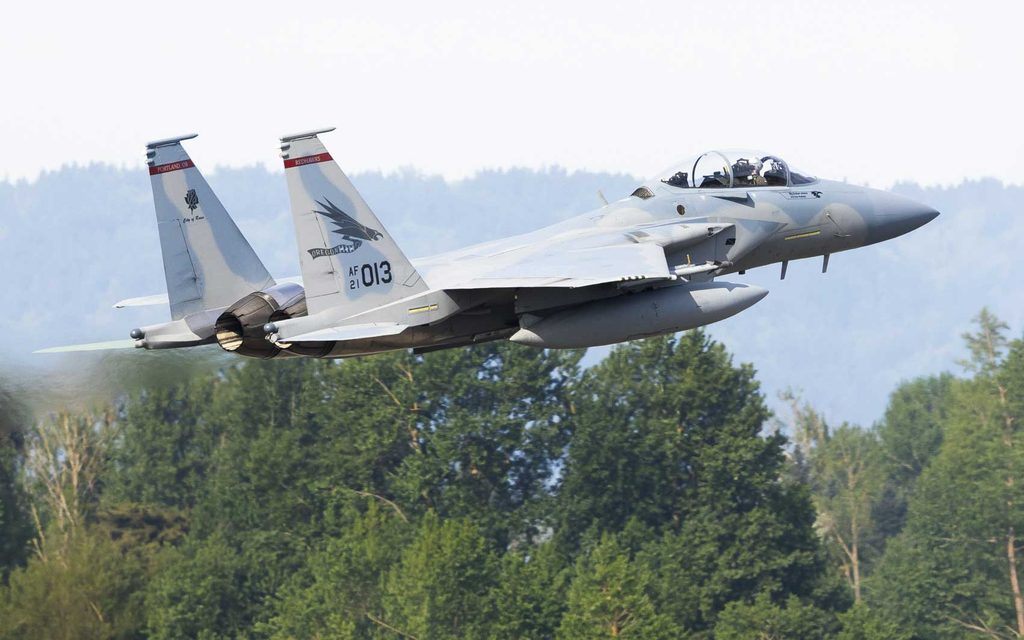
The F-15EX Leverages Stealth Rather Than Replacing It
The F-15EX is not a stealth aircraft and is not intended for unassisted missions against modern integrated air defenses on day one of a conflict.
Its core value emerges within collaborative combat networks.
An F-35 detects, identifies, and transmits target data. An F-15EX fires a larger volume of ordnance. Airborne early warning platforms, satellites, or unmanned systems complete the tactical picture. The result is a distributed kill web rather than isolated fighter engagements.
This explains why discussions surrounding modern air combat platforms can no longer focus solely on single-aircraft specifications; combat system architecture is the primary metric.
The Pacific Theater Imposes Unique Constraints
Indo-Pacific operational realities heavily influence these decisions.
Distances between operating bases, aerial refueling assets, patrol zones, and target areas are extreme. Usable runways may be limited, and long-range strike threats put major airbases at risk. Under these conditions, an airframe featuring long range, high payload capacity, and compatibility with existing infrastructure becomes highly valuable.
The F-35 provides low observability, while the F-15EX delivers persistent magazine depth.
The US Air Force procurement strategy for the F-15EX is driven by operational realities rather than legacy preferences. High-intensity modern warfare rapidly consumes airframe hours, ordnance stocks, and mission availability. A fleet that is highly advanced but limited in capacity is insufficient, as is a numerically large fleet lacking advanced sensor integration.
American force structure planning reflects a clear reality: air superiority relies on a force mix combining low observability, available munitions capacity, practical sustainment, and scalable production output. The F-35 opens the engagement, while the F-15EX provides operational mass. In a sustained conflict, this combination represents a decisive factor.
Sources
U.S. Government Accountability Office, “F-35 Joint Strike Fighter: Actions Needed to Address Late Deliveries and Improve Future Development,” September 2025.
U.S. Government Accountability Office, “F-35 Sustainment: Actions Needed to Ensure Updated Strategy Improves Persistent Readiness Challenges,” June 2026.
Air & Space Forces Magazine, “Air Force Doubles Planned F-15EX Fleet to 267 Fighters,” April 2026.
Air & Space Forces Magazine, “F-35 Delays Drove Boost to Air Force’s F-15EX Buy,” May 2026.
Boeing, F-15EX Eagle II technical specifications and program overview.
U.S. Air Force, official public domain data on the F-35A Lightning II.
Reuters, “Boeing awarded contract with ceiling value of $131.2 billion for F-15 program,” August 2026.