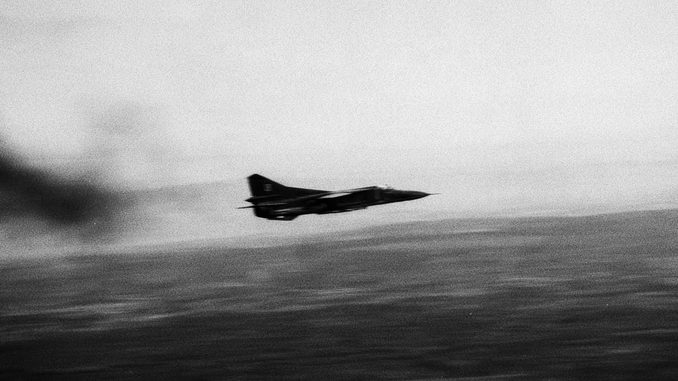
In 1989, an abandoned Soviet MiG-23 flew over 900 km on its own before crashing into a home in Belgium.
In Summary
On July 4, 1989, a routine Soviet training flight turned into one of the most extraordinary incidents of the Cold War. Shortly after takeoff from Bagicz Air Base near Kołobrzeg, Poland, Colonel Nikolai Skuridin believed his MiG-23M suffered an engine failure. He ejected at very low altitude. However, the jet engine regained power. The automatic flight control system stabilized the aircraft, which continued heading west on its own. The unmanned MiG-23 crossed Poland, East Germany, West Germany, the Netherlands, and finally Belgium. Two U.S. F-15s intercepted the fighter, discovered an empty cockpit, and escorted it without being able to determine where it would land. After flying over 900 km and over an hour of involuntary autonomous flight, the fighter ran out of fuel. It crashed near Kortrijk, killing 18-year-old Wim Delaere. The accident triggered a diplomatic crisis between Belgium and the Soviet Union.
The Flight Begins as a Perfectly Ordinary Soviet Mission
The date was July 4, 1989, four months before the fall of the Berlin Wall.
The Soviet Union still maintained substantial military forces in Poland. At Bagicz, a former airbase near Kołobrzeg on the Baltic coast, the 871st Fighter Aviation Regiment was stationed, equipped with Mikoyan-Gurevich MiG-23s.
That morning, Colonel Nikolai Skuridin took off at the controls of a MiG-23M, tactical number 29, for a routine training flight.
The MiG-23, codenamed “Flogger” by NATO, was a variable-sweep wing fighter developed in the 1960s. Its wings could sweep back or forward depending on the flight regime, while its Tumansky R-29 turbojet enabled it to exceed Mach 2.
To understand the era of Soviet tactical aviation and its development, explore the history of modern fighter jets.
Just seconds after takeoff, everything went wrong.
An Apparent Failure Prompts the Pilot to Eject
While the aircraft was flying at an altitude of only 90 to 150 meters according to available accounts, Skuridin heard a loud bang or sudden noise. The afterburner shut off, engine RPM dropped precipitously, and airspeed decayed rapidly.
The aircraft began to descend.
The pilot reported an engine failure to ground control. He attempted to steer his MiG toward the Baltic Sea to ensure a potential crash would not hit populated areas.
Ground control authorized him to eject.
Skuridin abandoned the aircraft. His parachute deployed normally, and he landed safely on the ground.
To both the pilot and Soviet ground controllers, the incident seemed over. The MiG was expected to crash seconds later.
What actually happened was the exact opposite.
The Engine Regains Power After Ejection
The engine had not completely shut down.
Shortly after the ejection, the engine’s RPM surged back up. Thrust became sufficient to stop the descent, and the automatic flight control system subsequently helped stabilize the aircraft.
This was not an autonomous drone in the modern sense.
The MiG-23 was unaware of its situation. It was not following a programmed destination, nor did it possess any onboard intelligence capable of crafting a flight plan. Its simple automation merely maintained specific flight parameters.
That was enough.
The fighter maintained its westerly course and began to climb. It eventually reached an altitude between 11,500 and 12,000 meters (roughly 38,000 to 39,000 feet).
The most astonishing element was not just that an uncrewed plane kept flying, but that an aircraft deemed lost moments earlier regained enough stable thrust to cross a large portion of Europe.
The Warsaw Pact Loses Track of Its Own Fighter
The second problem arose immediately: Soviet forces did not realize the aircraft was continuing its flight path.
The MiG crossed Poland and entered the airspace of East Germany (GDR).
Warsaw Pact authorities lost track of the jet. Soviet officials later acknowledged that their command structure only discovered the aircraft’s actual trajectory through Western intelligence reports.
For a military alliance built around a vast air defense architecture, the episode was deeply embarrassing.
An unmanned Soviet fighter had just left Eastern Bloc airspace on its own and was heading directly toward NATO territory.
For a broader look at the technological context of Cold War aviation, learn more about classic and modern fighter aircraft.
NATO Radars Detect an Incoming Soviet Aircraft
As the MiG approached West Germany, NATO radar monitoring systems picked up the track.
At that moment, no one on the Western side knew the cockpit was empty.
A Soviet military aircraft had just crossed one of the most heavily monitored borders on the planet without authorization.
Two U.S. Air Force F-15C Eagles from the 32nd Tactical Fighter Squadron, stationed at Soesterberg in the Netherlands, were scrambled. The unit, known as the Wolfhounds, was directly assigned to Western European air defense.
The American fighters intercepted the MiG.
Their pilots then observed something baffling: the canopy was gone, and the cockpit was completely empty.
There was no pilot to contact, no crew to force down, and no hostile maneuvers to interpret.
Instead, there were simply several tons of metal, fuel, and ammunition cruising through European airspace at high altitude.
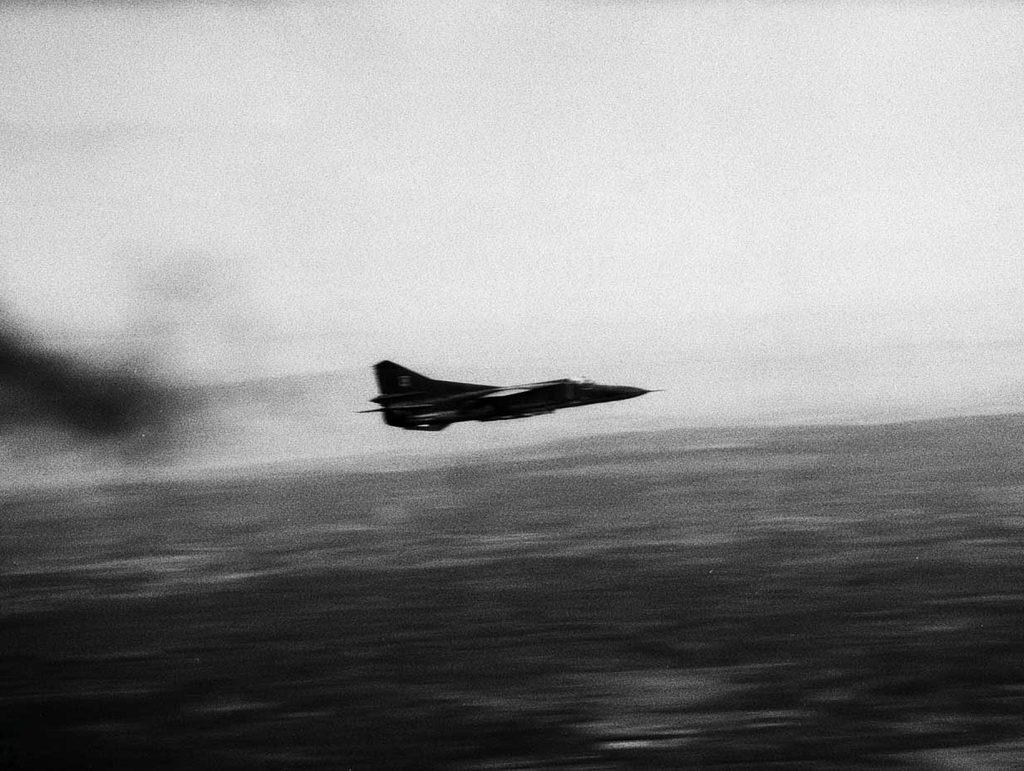
F-15s Could Not Simply Shoot It Down
The intuitive response would have been to launch a missile.
However, that was not necessarily the safest option.
Destroying a MiG at 12,000 meters does not make it disappear. The aircraft becomes a cloud of heavy debris whose impact trajectory is difficult to predict.
The MiG was flying over densely populated regions, passing near major urban centers like Eindhoven, Antwerp, and Ghent.
The F-15s were ordered to escort the runaway jet. A shootdown remained an option if the aircraft directly threatened a major population center.
NATO command hoped the jet would eventually reach the North Sea or the English Channel, where it could be downed with far less collateral risk.
The Royal Air Force also placed a Phantom FGR2 from 56 Squadron on alert in case the MiG continued toward British airspace.
However, the aircraft gradually veered off course.
It turned toward Belgium and moved toward northern France.
Fuel Runs Out Over Belgium
After over an hour of uncrewed flight, the engine finally flamed out.
This time, it would not restart.
The MiG-23 became a multi-ton glider, steadily losing altitude and speed. The accompanying F-15s saw it going down, but they still could not pinpoint the exact impact site.
The French Air Force was put on alert, as the city of Lille lay near the flight path.
Finally, at around 10:30–10:37 AM, the MiG reached the area south of Kortrijk.
It crashed directly into a residence in Bellegem, near the border of Kooigem, just a few kilometers from the French border.
The ghost flight ended after traveling approximately 900 km, or more depending on the measurement method. Contemporaneous news reports cited over 500 miles (more than 800 km), while other evaluations approached 1,000 km.
The Crash Kills a Young Belgian at Home
The human toll immediately transformed an extraordinary incident into a tragedy.
Wim Delaere was inside the house struck by the falling aircraft. Contemporary news reports gave his age as 18 or 19; Belgian official documents generally record him as 18 years old.
He was killed on impact.
Other members of his family were away from the home at the time of the crash.
Emergency responders searching through the rubble discovered the tail section of the MiG still bearing the Soviet red star. The photograph would become one of the most striking visual images from the final years of the Cold War.
The aircraft was not carrying nuclear weapons, but it did have live cannon ammunition on board, adding to safety concerns during the recovery operation.
The Accident Triggers an Immediate Diplomatic Crisis
The controversy was not just about the mechanical failure itself.
For over an hour, a Soviet military jet had traversed multiple sovereign nations without Moscow notifying the affected governments.
Belgium lodged an official protest.
Belgian Foreign Minister Mark Eyskens publicly criticized the slow pace at which Soviet authorities communicated details about the aircraft and its armament.
The Soviet Union issued an official apology. Mikhail Gorbachev publicly expressed his regrets, and Moscow promised to handle financial compensation.
Belgian parliamentary records mention approximately 25 million Belgian francs paid in compensation, which international sources converted to roughly $685,000 at the time.
Ten days after the accident, a Soviet technical team was permitted to retrieve the wreckage following Belgian investigations.
Investigations Reveal an Aircraft Guided by Automation, Not Mystery
The incident is sometimes portrayed today as a story of a MiG that somehow “decided” to cross Europe on its own.
The technical reality is far more straightforward.
The aircraft made no decisions.
A temporary propulsion malfunction convinced the pilot and ground controllers that the jet was falling. After the ejection, the engine recovered sufficient thrust. The automatic stabilization system then maintained basic flight conditions, allowing the fighter to stay airborne.
The precise root cause of the initial engine hiccup was never publicly established with absolute certainty.
The episode demonstrated how a very simple automated system can yield an extraordinary result when it continues to execute an instruction that has become absurd.
To see how this aircraft fits into the broader timeline of jet combat technology, read about key developments in fighter jet history.
The Ghost MiG Exposed Weaknesses in Both Blocs
The event captured global attention because it occurred near the twilight of the Cold War.
NATO successfully detected and intercepted the aircraft, yet could not prevent it from crashing into a residential home.
The Warsaw Pact, on the other hand, lost track of one of its own fighters, failed to monitor its trajectory, and failed to alert neighboring countries in a timely manner.
Neither side lost control of a battle, yet the two most powerful military structures in Europe were outmaneuvered by an empty plane.
The story also carries a stark technical irony: the MiG-23 was designed to intercept high-speed enemy aircraft, yet on July 4, 1989, its most famous flight carried no mission, no target, and no pilot.
Months later, the Berlin Wall fell. Two years later, the Soviet Union dissolved. The ghost MiG-23 remains one of the stranger footnotes of the late Cold War: a Soviet machine abandoned feet off the ground, recovered over an hour later on the other side of Europe after crossing the border between two worlds entirely on its own.