Turkey introduces the Yıldırımhan, a 6,000 km range missile—a strategic breakthrough that raises questions for NATO, Iran, Israel, and Europe.
In Summary
Turkey has caused a major surprise in Istanbul by unveiling a model of the Yıldırımhan, a ballistic missile announced with a range of 6,000 kilometers, a speed between Mach 9 and Mach 25, and a payload of 3,000 kilograms. On paper, this range places the weapon at the lower limit of the Intercontinental Ballistic Missile (ICBM) category. However, caution is advised. The Yıldırımhan is not yet an operational system. Turkish authorities cite successful laboratory trials and upcoming field tests. The political message, however, is already clear. Ankara wants to demonstrate that its defense industry is no longer limited to drones, armored vehicles, ships, and tactical missiles. It now intends to enter the field of strategic deterrence. This choice alters the perception of Turkish power and may concern its neighbors, rivals, and allies alike.
The Yıldırımhan missile places Ankara in a different strategic category
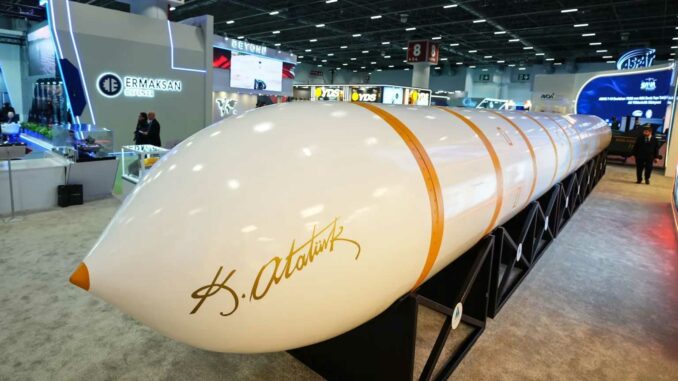
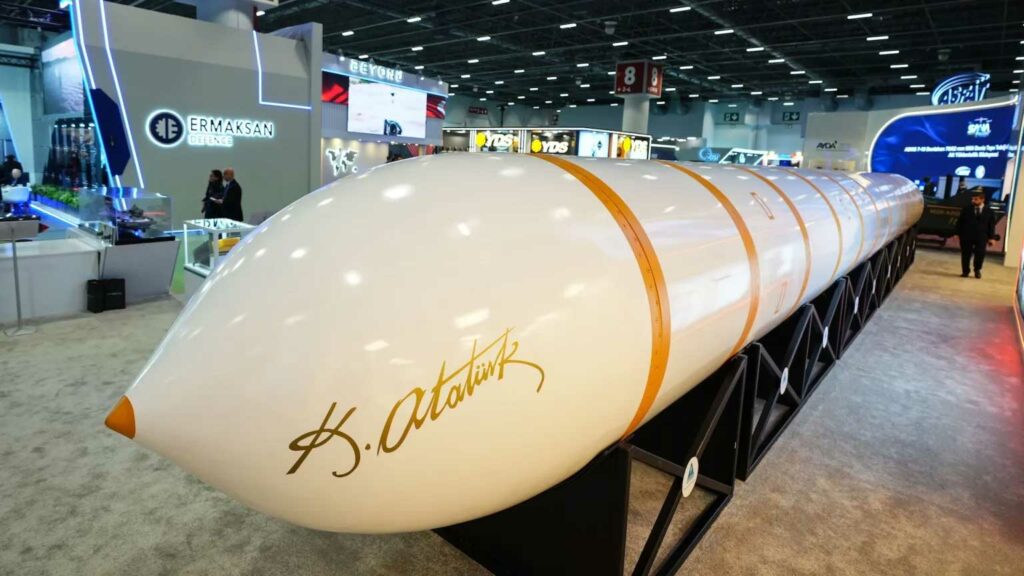
The presentation of the Yıldırımhan at the SAHA 2026 exhibition in Istanbul is more than a simple industrial demonstration; it is a display of power. Turkey exhibited a model of a very long-range ballistic missile developed by the research and development center of the Milli Savunma Bakanlığı, the Turkish Ministry of National Defense. According to information displayed at the fair and reported by several media outlets, the system is designed to reach a range of 6,000 kilometers, with a terminal speed of up to Mach 25 and a 3-ton carrying capacity.
This technical specification immediately shifts the level of debate. An intercontinental ballistic missile is generally defined by a range exceeding 5,500 kilometers. With an announced 6,000 kilometers, the Yıldırımhan would cross the symbolic ICBM threshold, even if its range remains significantly lower than that of major American, Russian, or Chinese systems. An American Minuteman III can exceed 13,000 kilometers. A Russian RS-24 Yars reaches approximately 11,000 kilometers. A Chinese DF-41 is often estimated beyond 12,000 kilometers. The Yıldırımhan, if it truly reaches its announced range, would thus be a minimal but politically significant ICBM.
The nuance is essential. At this stage, Turkey has not presented a missile tested under real conditions. It has presented a model and claimed characteristics. Turkish sources indicated that laboratory tests were conducted successfully, but field or ground trials are yet to follow. The Financial Times also reported that Turkish authorities acknowledged that a fully constructed and tested prototype does not yet exist. The Yıldırımhan is therefore a program, not a proven military capability.
This distinction matters. In the ballistic field, a trade show spec sheet is never enough. One must prove propulsion, flight stability, stage separation (if applicable), guidance, the thermal resistance of the reentry vehicle, terminal precision, storage reliability, launcher mobility, and the capacity for mass production. Each of these points represents a massive undertaking.
The technical specifications raise as many questions as they provide answers
The announced data is ambitious. A range of 6,000 kilometers would allow Turkey to cover the entire Middle East, Europe, a large part of North Africa, a significant portion of Central Asia, and certain areas of the Indian Ocean. Conversely, this range would not allow for strikes on the continental United States from Turkey. Promotional videos mentioned in the press, which appeared to show American targets, created unnecessary and politically clumsy controversy.
The choice of a 3,000-kilogram payload is also intriguing. This is a high mass for a missile of this class. The heavier the payload, the more difficult the range, precision, and total mass of the missile become to control. A missile capable of carrying three tons over 6,000 kilometers requires powerful propulsion, a resistant structure, advanced materials, and a mature flight architecture.
The announced fuel has also drawn attention. Several Turkish sources mention liquid propulsion using nitrogen tetroxide with four rocket engines. This type of technology is not new in the history of ballistic missiles. Nitrogen tetroxide is a powerful oxidant; it allows for high performance but is toxic and corrosive. It requires heavy procedures for storage, filling, safety, and maintenance. Modern major arsenals often prefer solid-propellant missiles for mobile forces, as they are simpler to store, faster to deploy, and better suited for a reactive deterrence posture.
This is where technical caution becomes indispensable. Turkey has shown real progress in drones, guided munitions, tactical missiles, naval systems, and sensors. However, moving from a ballistic missile of a few hundred kilometers to a 6,000-kilometer system is not a linear evolution; it is a category jump. Turkey already tested the Tayfun at approximately 561 kilometers in 2022 and continued to develop longer versions. But the Yıldırımhan would represent a tenfold increase in range compared to Turkish capabilities publicly demonstrated only a few years ago.
The doubt, therefore, does not stem from a lack of respect for Turkish industry. It comes from the gap between what has been publicly tested and what is now being announced.
Turkish strategy seeks sovereignty over provocation
To understand Yıldırımhan, the program must be placed within the Turkish strategy of the last twenty years. Ankara is pursuing a logic of industrial sovereignty. This strategy accelerated following several crises with its Western allies. The partial embargo after the Turkish intervention in Cyprus in the 1970s left a deep impression. More recently, Turkey’s exclusion from the F-35 program after the purchase of the Russian S-400 system reinforced the idea that the country must produce its own critical capabilities.
This logic has already produced visible results. Bayraktar TB2 drones have been exported massively and used in Ukraine, Libya, Syria, and Nagorno-Karabakh. The Akıncı drone, MAM munitions, the SOM cruise missile, naval systems, the MİLGEM program frigates, the Altay tank, the future KAAN fighter jet, and the Steel Dome air defense system all illustrate the same direction: reducing dependence on foreign suppliers.
Figures confirm this movement. Turkish defense and aerospace exports reached approximately $7.2 billion in 2024, compared to $1.6 billion in 2013, according to data highlighted by Turkish institutions. Several Turkish sources subsequently mentioned more than $10 billion in exports for 2025. Ankara no longer wants just to equip its army; it wants to become a strategic supplier.
The Yıldırımhan fits into this move upmarket. But it belongs to a different category. A drone is exportable. A tactical missile can be sold to certain partners. A 6,000-kilometer ballistic missile falls under a different political, diplomatic, and security regime. It is no longer just about industrial autonomy; it is about strategic deterrence.
The message targets neighbors and allies alike
Turkey lives in a difficult strategic environment. It sits between the Black Sea, the Caucasus, the Middle East, the Eastern Mediterranean, and the Balkans. It faces Russia to the north, Iran to the east, Syrian and Iraqi conflicts to the south, rivalry with Greece in the Aegean Sea, and energy tensions in the Eastern Mediterranean.
In this context, Ankara wants to avoid depending entirely on the Western umbrella. Turkey remains a member of NATO, but it increasingly behaves as an autonomous power. It buys Russian systems, negotiates with the United States, cooperates with Ukraine, sells drones to multiple sides, talks with Gulf countries, and projects its influence in Africa. This is the diplomacy of a middle power, but with the ambitions of a major regional power.
The Yıldırımhan speaks first to Iran. Tehran possesses a vast ballistic arsenal with missiles capable of reaching Israel, American bases in the Gulf, and parts of Southeastern Europe. Turkey does not want to remain in a position of inferiority in this area for the long term. It also observes Israeli progress, long-range strikes, missile defenses, and regional operations. Ankara does not want just to be protected; it wants the ability to threaten from a distance.
The message also concerns Russia. Turkey cooperates with Moscow when its interests require it but resists on other files. It supports Ukraine with drones, controls the straits, defends its interests in the Black Sea, and wants to avoid Russian domination over its neighborhood. A 6,000-kilometer missile would not change the balance with Moscow on its own, but it would add a psychological dimension to Turkey’s posture.
Finally, the message targets Western allies. Ankara is essentially saying: Turkey is not a mere flank of NATO. It is an industrial, military, and geopolitical power capable of producing its own instruments of pressure.
The nuclear problem remains the great unsaid
An ICBM is historically associated with nuclear deterrence. This is the sensitive point of the matter. Turkey does not officially possess nuclear weapons. It is a signatory to the Treaty on the Non-Proliferation of Nuclear Weapons. However, American B61 nuclear bombs are estimated to be present at Incirlik as part of NATO nuclear sharing, under American control. Public estimates vary, but several analyses suggest around 20 to 30 weapons.
This situation makes the Yıldırımhan politically delicate. An intercontinental ballistic missile with a conventional payload can exist. But its military value is more limited. A 3-ton conventional payload can produce significant damage, but launching a strategic missile for a conventional effect exposes the user to an enormous risk of escalation. An adversary could interpret the launch as nuclear, especially if the trajectory resembles that of a strategic missile.
This is why ICBMs are almost always associated with nuclear deterrence. Their operational logic rests on the ability to strike very far, very fast, with a decisive effect. Without a nuclear warhead, their utility becomes more political than military, except in very specific scenarios against high-value fixed targets.
Turkey has not announced a nuclear doctrine. But the simple act of presenting a missile of this range raises the question. Does it only want to develop a conventional long-range strike capability? Does it want to equip itself with a long-term technological option? Does it want to weigh in on the regional nuclear security debate if Iran crosses a threshold? Ankara does not say so clearly. This ambiguity can serve deterrence, but it can also fuel mistrust.
The implications for NATO are real but complex
Turkey has been a member of NATO since 1952. It houses strategic infrastructure, including the Incirlik base and elements of allied missile defense. In theory, a stronger Turkey strengthens the Alliance. In practice, a Turkish intercontinental ballistic program could create deep unease.
NATO rests on a nuclear doctrine dominated by the United States, the United Kingdom, and France. Other allies participate in deterrence through mechanisms of sharing, consultation, or support. If a member state independently develops an intercontinental-range missile, it introduces a national capability that does not easily fit into collective doctrine.
Allies may also worry about political control. Who would decide on its use? What would be the doctrine? What type of payload would be planned? Would the missile be mobile? Where would it be based? Would it be integrated into a national or allied command architecture? These questions are crucial. A poorly explained strategic missile can worry allies more than adversaries.
There is also a non-proliferation dimension. Turkey participates in the Missile Technology Control Regime (MTCR), which regulates the transfer of technologies capable of carrying at least 500 kilograms over 300 kilometers. Developing a national missile is not prohibited by this regime, which primarily concerns exports. But politically, a 6,000-kilometer missile developed by a non-nuclear state remains a strong signal. It may prompt other regional powers to justify their own programs.
Neighbors will see Turkish assurance, not just a window display
In Greece, Israel, Iran, Egypt, Saudi Arabia, and European capitals, the Yıldırımhan will be studied closely. Even if the program is still far from operational, it indicates a direction. Turkey wants to master every level of modern military power: drones, missiles, air defense, navy, combat aviation, space, and long-range strike.
For Greece, the subject is sensitive. Athens is already following the expansion of Turkish capabilities in the Aegean Sea, armed drones, surface ships, anti-ship missiles, and Turkish ambitions in the Eastern Mediterranean. An intercontinental missile is not designed for the Aegean, but it reinforces the image of a Turkey capable of producing increasingly heavy systems.
For Israel, the question is different. Israel possesses technological superiority, multilayered defense, and, according to international estimates, an undeclared nuclear capability. But the arrival of a Turkish actor in the strategic missile field would add a variable to a Middle East already saturated with Iranian arsenals, drones, cruise missiles, and long-range strikes.
For Iran, the message is even more direct. Ankara does not want to be the only major non-Arab state in the region without credible ballistic depth. The Yıldırımhan can be read as a long-term response to the militarization of its neighborhood.
Political reach exceeds the program’s technical maturity
The Yıldırımhan does not need to be operational tomorrow to produce effects today. Weapons programs have an industrial dimension, but also a narrative one. They build an image of power. They attract engineers. They support budgets. They provide an argument for leaders. They force adversaries to revise their calculations.
This is likely Ankara’s immediate objective. Turkey wants to show that it is entering a new phase. Its industry is no longer content with being agile and export-oriented; it wants to be strategic. This ambition can strengthen its weight in negotiations with Washington, Brussels, Moscow, Tehran, and Gulf capitals.
But the risk is real. If Turkey announces more than it can deliver, it risks a loss of credibility. If it truly delivers a 6,000-kilometer capability, it opens a much harsher security debate. In both cases, the Yıldırımhan forces observers to take Ankara seriously.
Turkey transforms its defense industry into a diplomatic tool
This is the core of the matter. The Yıldırımhan is not an isolated program. It extends a strategy where the defense industry becomes an instrument of foreign policy. Turkish drones have already served this method. They have strengthened partners, opened markets, created technical dependencies, and given Ankara a visibility far superior to its raw economic weight.
The ballistic missile adds a more vertical dimension. It is no longer about dominating a local battlefield, but signaling a long-distance strike capability. It is a different grammar. It is more dangerous. It is also more costly.
Turkey must now clarify its doctrine. A 6,000-kilometer missile cannot remain solely a trade show object. It demands explanations regarding its purpose, timeline, tests, compliance with international commitments, and its role in Turkey’s posture. Silence can serve deterrence, but too much ambiguity can create crises.
The Yıldırımhan, therefore, tells less about the immediate arrival of a superweapon than about the rise of a more self-assured, more industrial Turkey that is more difficult to contain diplomatically. The program may still be immature. The signal, however, is already mature. Ankara wants to be treated as a power that matters. Its neighbors and allies have just received the message.
War Wings Daily is an independant magazine.