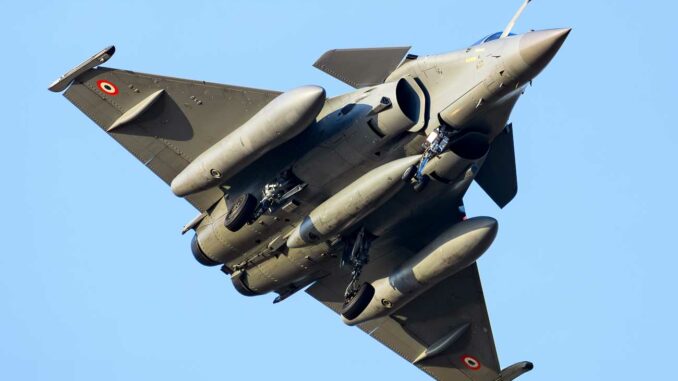
The planned support for 36 Rafale jets fuels Indian communication without being enough to erase signs of at least one loss in May 2025.
In Summary
A request for logistical support published in June 2026 for the Indian fleet of 36 Rafales has been presented by several Indian media outlets as proof that no aircraft was lost during Operation Sindoor in May 2025. The document does constitute a new element. It shows that the Indian Air Force is preparing for the continuity of its fleet’s support based on the contractual baseline of 36 aircraft. However, it is neither a certified physical inventory, a record of combat-ready aircraft, nor the result of an investigation into losses. The theory that several Rafales were destroyed, defended by Pakistan, is weakened by its inconsistencies and by the public reappearance of certain serial numbers previously announced as shot down. Conversely, Indian military statements acknowledging initial losses, as well as information gathered by Reuters and the Associated Press, maintain the credibility of the hypothesis that one Rafale was lost. The case therefore remains open.
The Document Putting the Thirty-Six Rafales Back at the Center of the Debate
The information is based on requests for proposals dated June 12 and 15, 2026. Air Headquarters reportedly approached Dassault Aviation and Safran Aircraft Engines to ensure transitional support for five months after September 18, 2026. This request for proposals must cover maintenance, spare parts, consumables, technical assistance, and logistical support for the Indian fleet.
The scope mentions 36 Rafales, which is exactly the number purchased from France under the intergovernmental agreement signed on September 23, 2016. The plan anticipates an annual utilization rate of 150 hours per aircraft. Over five months, this represents 2,250 flight hours for the entire fleet.
The calculation is simple. An aircraft flying 150 hours per year must log 62.5 hours over five months. Multiplied by 36 aircraft, these 62.5 hours equal 2,250 hours. The document therefore uses a planning assumption perfectly consistent with the contractual fleet.
However, the nature of the text must be clarified. It is not an awarded contract. Nor is it a public registry detailing every airframe. It is a procedure designed to avoid a gap in support between the end of the existing framework and the implementation of a longer-term agreement.
According to BharatShakti, the documents do not appear on the public electronic portal of the Indian Ministry of Defence. Their content is reported by media outlets that had access to the papers or to ministerial sources.
This limitation does not mean the information is false. It simply means it cannot be interpreted to say more than it actually does.
The Difference Between a Contractual Fleet and an Intact Fleet
The shortcut defended by a section of the Indian press is appealing: if the Indian Air Force requests support for 36 aircraft, it must mean it still possesses 36 aircraft. This deduction is possible. It has not been proven.
An Administrative Quantity That Does Not Equal a Physical Inventory
In an operational readiness maintenance contract, the figure indicated often corresponds to the reference population of the program. This population is used to scale stocks, tooling, teams, repairs, spare engines, and manufacturer assistance.
It does not automatically constitute a certified snapshot of the aircraft present on bases, let alone those immediately fit for a mission.
A crashed airframe can remain in the administrative inventory during an investigation. A severely damaged aircraft can still fall within the scope of support if it is to be repaired. An aircraft undergoing a major overhaul is still counted in the fleet, even though it is unavailable.
Finally, a call for tenders may retain the historical figure of the initial contract to avoid altering the legal and financial architecture of the support system.
The expression “fleet of 36 aircraft” therefore does not mean “36 simultaneously operational aircraft.” Furthermore, the initial contract included a performance-based support mechanism. Information published at the time of its signing mentioned a guaranteed availability threshold of 75%.
Out of a theoretical fleet of 36 aircraft, this corresponds to approximately 27 available aircraft at any given time, not 36.
The Flight Hours Calculation That Fails to Settle the Debate
The volume of 2,250 hours also fails to reveal the exact number of intact airframes. If 35 aircraft were to carry out this program, each would fly approximately 64.3 hours over five months. This rate is equivalent to nearly 154 hours per year.
The variance from the official assumption of 150 hours is only about 2.9%. An overall flight volume can therefore be achieved with 35 airframes without disrupting planning.
The June 2026 document does not prove zero losses. It shows that the Indian Air Force continues to manage the Rafale program based on a nominal fleet of 36 aircraft.
Inconsistencies Weakening Pakistani Claims
Acknowledging the weakness of the Indian demonstration does not mean validating the Pakistani narrative. The latter has changed over the months.
At the beginning of the clashes, Islamabad claimed to have shot down five Indian aircraft, including three Rafales. The total was later increased to six aircraft. In September 2025, retired Lieutenant General Khalid Kidwai mentioned seven aircraft and one drone, with four Rafales among the losses.
Serial numbers BS001, BS021, BS022, and BS027 were cited at the time.
This inflation of figures poses a credibility problem. A confirmed aerial victory normally relies on several converging elements: radar data, weapon system recordings, missile telemetry, impact point imagery, debris identification, communications interception, and intelligence on the fate of the crew.
Pakistani authorities have not made public a comprehensive file confirming four Rafale destructions.
The Reappearance of a Rafale Announced as Destroyed
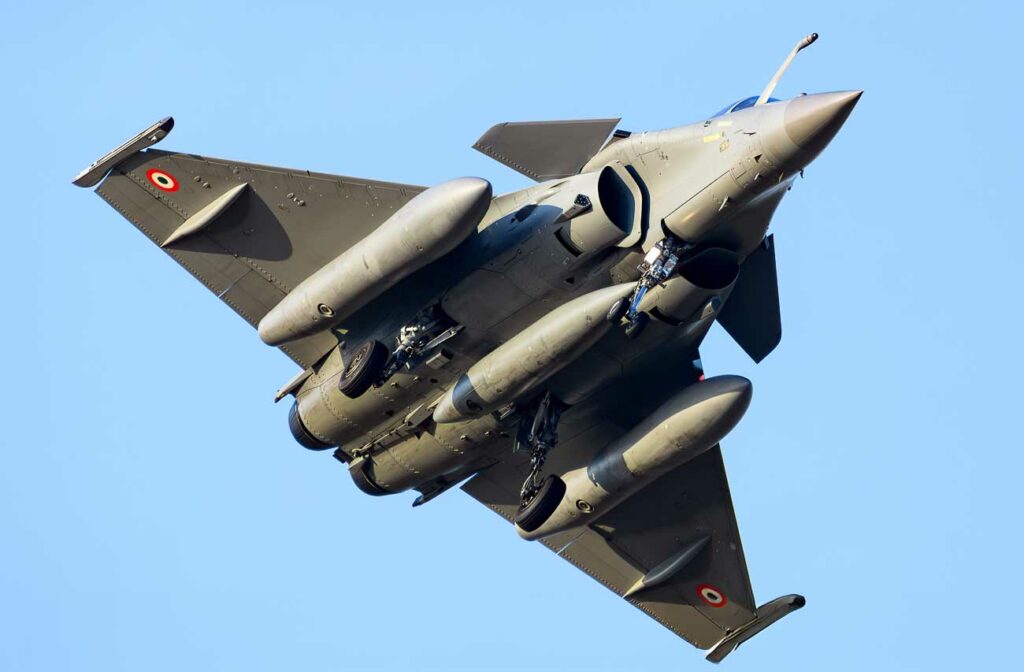
The presence of Rafale BS022 during the Republic Day parade on January 26, 2026, constitutes a more concrete element. This aircraft had been presented as destroyed. Its participation in the flypast invalidates at least this specific identification.
It does not prove that all Rafales are intact. However, it reveals that some of the serial numbers circulated by Pakistani outlets were incorrect.
The information warfare was also polluted by manipulated images, footage from video games, and visuals generated by artificial intelligence. French officials accused China of exploiting the narrative to damage the commercial reputation of the Rafale and promote its own equipment.
This campaign is not enough to erase a real loss. However, it forces one to treat any unverified, non-geolocated viral image with caution.
The Pakistani scenario of three or four destroyed Rafales is therefore not solidly established. The maintenance document weakens it further. Yet, it is not enough to rule out the hypothesis of a single lost aircraft.
Statements Keeping New Delhi From Closing the Case
The difficulty for India stems from its own military statements. On May 31, 2025, General Anil Chauhan, Chief of Defence Staff, acknowledged initial aerial losses.
He declined to specify the number and types, but explained that tactics were subsequently corrected. Air Marshal A. K. Bharti had previously stated that losses were part of combat.
These statements establish at least one initial loss. They do not say a Rafale was destroyed. Nevertheless, they render the notion that India lost no aircraft during the clashes untenable.
Investigations by Reuters are more precise. The agency reported, based on U.S., Indian, and Pakistani officials, that one Rafale was shot down during the combat on May 7, 2025.
The Associated Press later cited General Jérôme Bellanger, Chief of Staff of the French Air and Space Force. He stated he had seen indications pointing to the loss of three Indian aircraft: a Rafale, a Sukhoi, and a Mirage 2000.
This information does not constitute an official Indian confirmation. It relies partly on anonymous sources and military assessments that have not been made public in their entirety.
Yet, it remains more compelling than a simple number written into a logistical support request.
The Distinction Between a Lost Aircraft and a Shot Down Aircraft
Two questions must be distinguished. Was a Rafale lost? Was it shot down by a Pakistani missile?
A loss can result from enemy fire, a technical failure, a collision, pilot error, or an incident during a combat mission. The disappearance of an aircraft therefore does not automatically prove a Pakistani air-to-air victory.
The elements published by Reuters favor the theory of a PL-15 air-to-air missile strike. New Delhi has not confirmed this. The details of the causes therefore remain contested.
This distinction is essential. Public debate often confuses the loss of an airframe with the technical superiority of an opposing aircraft. However, an aerial engagement depends on orders received, the tactical situation, available intelligence, and coordination between different platforms.
Aerial Combat That Goes Beyond Sole Rafale Performance
The clash on May 7, 2025, involved approximately 110 aircraft, according to estimates cited by Reuters. The aircraft remained mainly within their respective airspaces. The battle was fought at long range, using sensors, data links, and missiles, long before any visual contact.
This type of beyond-visual-range combat does not just measure the quality of an aircraft. It evaluates an entire system.
The fighter must receive a reliable tactical picture. It must identify threats, share radar tracks, know the actual range of enemy weapons, and coordinate its maneuvers with airborne early warning aircraft, ground stations, and electronic warfare assets.
According to Reuters, the PL-15 launched by a Pakistani Chengdu J-10C reportedly struck the Rafale at approximately 200 kilometers (124 miles). Indian officials questioned by the agency admitted that the effective range of the version employed had been underestimated.
The Indian pilots reportedly believed they were remaining outside the engagement zone.
Pakistan is also said to have linked its J-10Cs, ground radars, and surveillance aircraft through a more coherent kill chain. In this setup, the firing fighter does not need to turn on its own radar for long.
It can receive a track provided by another sensor, remain discreet, launch its missile, and then update the data via a secure link.
Such a sequence does not prove that the J-10C is superior to the Rafale in all situations. It shows that a high-performance aircraft can be placed in jeopardy by a poor intelligence assessment, overly restrictive doctrine, or a less fluid data architecture.
Modern air warfare rewards the best-informed crew, not just the one with the best technical spec sheet.
Logistical Support Revealing India’s True Stake
The Indian Rafale maintenance contract primarily meets an operational need. The fleet is divided between two squadrons and must remain available to face two potential fronts: Pakistan to the west and China to the north and east.
The Indian Air Force cannot accept a disruption in parts, engines, diagnostic software, or industrial assistance.
Safran intervenes on the M88 engine. Dassault ensures support for the airframe and general integration. Thales supplies a major share of the sensors, avionics, and the SPECTRA electronic warfare system.
Actual availability depends on coordination between these manufacturers, stocks present in India, turnaround times for depot-level equipment repairs, and local capacity to perform maintenance operations.
The 2,250 hours planned over five months provide an indication of the desired operational tempo. They show a commitment to maintaining a sustained level of activity.
They reveal neither the daily number of combat-ready aircraft, the availability of each radar, the condition of each engine, nor the capacity of each airframe to employ its full suite of weaponry.
This is where the public debate misinterprets the document. A support procedure is designed to buy future availability. It is not designed to certify past losses.
The Transparency Still Missing From the Operation Sindoor File
The June 2026 document is a useful administrative clue. It contradicts the idea of a fleet depleted by three or four Rafales and left permanently without replacement. It does not prove that the 36 original airframes are intact.
To settle the matter, independent proof would be required: an airframe-by-airframe inventory, verified serial numbers, airworthiness status, decommissioning decisions, accident reports, technical identification of debris, and an official casualty report of the crews.
None of these elements have been fully published.
New Delhi has sound military reasons to protect this data. Revealing the details of losses, failures, and repairs would inform Pakistan and China about the fleet’s availability.
But this secrecy comes at a price. It leaves room for opposing narratives, political interpretations, and commercial campaigns.
The most solid analysis therefore remains nuanced. Pakistan has not provided public proof of multiple downed Rafales. India has not provided public proof that no Rafale was lost.
The new call for tenders reinforces the first challenge, but it does not resolve the second. One year after Operation Sindoor, the number 36 remains a contract figure. It is still not a verdict.
War Wings Daily is an independant magazine.