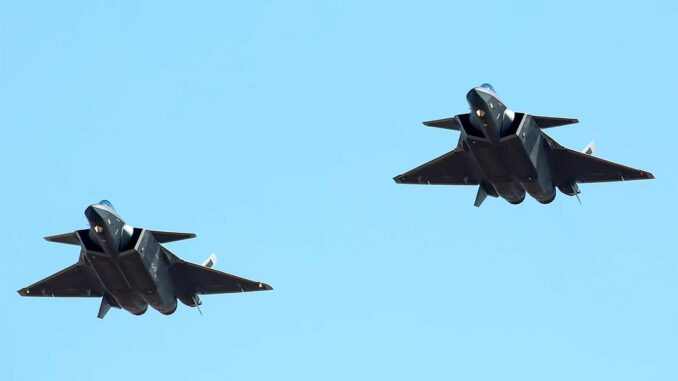
Satellites show at least eleven J-20s at Hotan and Damxung. Their presence reveals China’s new aerial strategy vis-à-vis India.
In Summary
Commercial images taken on June 25 and July 9, 2026, show at least eleven J-20s split between Hotan, in Xinjiang, and Damxung, in Tibet. Seven aircraft were identified at Hotan and four at Damxung. However, this figure should be handled with precision. It corresponds to the aircraft visible during two satellite passes, not to the permanent strength of the bases. Nor is this concentration unprecedented in absolute terms: twelve J-20s had already been observed at Hotan in November 2025. The novelty lies primarily in their simultaneous deployment across two axes facing Ladakh and Arunachal Pradesh. Beijing is thus demonstrating its ability to operate its stealth fighter from airfields close to the Line of Actual Control. The message is clear: Chinese fifth-generation operations in the Himalayas are no longer a matter of one-off experimentation. They are becoming part of routine military planning.
The Deployment Reveals a Presence Distributed Across Two Fronts
The images published in late July 2026 were provided by Vantor, an American company specializing in satellite imagery and geospatial intelligence. They show seven aircraft at Hotan, photographed on July 9, and four at Damxung, photographed on June 25.
The directly visible total is therefore eleven aircraft. Some articles have mentioned twelve J-20s. However, their own detailed breakdown remains seven plus four. The most rigorous formulation is thus that of at least eleven identified aircraft.
Hotan is a dual civil-military airbase in Xinjiang. It lies approximately 389 km from Leh and 245 km from the Indian airfield at Daulat Beg Oldie, in northern Ladakh. This location allows coverage of the western sector of the Line of Actual Control, notably the approaches to Depsang and the Karakoram.
Damxung, for its part, is located in the Lhasa region, approximately 344 km northwest of Tawang. It opens a second axis toward Arunachal Pradesh, a territory administered by India but largely claimed by China under the name Zangnan.
The dispersion between the two bases is more significant than the raw number of aircraft. It shows that the People’s Liberation Army Air Force can move J-20s between the western and eastern sectors of the border. Beijing is no longer concentrating its modern assets solely opposite Ladakh. It is now extending this posture across the entire Himalayan arc.
Nevertheless, a misinterpretation must be avoided. A satellite image is a snapshot. It does not reveal how long the aircraft remained on site, how many were combat-ready, or whether they belonged to a resident unit. The observed J-20s may have constituted a temporary detachment, a training rotation, or an alert force.
The July 2026 Concentration Is Not Entirely Unprecedented
The framing of this gathering as the largest concentration of J-20s ever observed facing India requires nuance.
In November 2025, radar imagery analyzed by Janes had already revealed twelve J-20s at Hotan. The base also hosted four Xi’an H-6 bombers, eighteen Flanker-family fighters, several KJ-200 and KJ-500 airborne early warning aircraft, as well as Y-20s, including at least one YY-20 tanker.
That precedent was tied to the timeframe of the Indian exercise Trishul 2025. It had already demonstrated China’s capability to transform Hotan into a complete air power hub, combining stealth fighters, conventional combat aircraft, bombers, tankers, and command platforms.
The June and July 2026 deployment is therefore smaller in absolute numbers. It is, however, more geographically widespread. The simultaneous presence of J-20s at Hotan and Damxung serves as an indicator of the operational permanence of this fleet along the Indian border.
The real takeaway is not that China has suddenly moved eleven aircraft to the Himalayas. It is that Beijing now appears capable of repeating this type of deployment across multiple bases without any apparent extraordinary mobilization.
The Choice of Hotan and Damxung Follows a Precise Military Logic
Hotan offers a major advantage: its altitude remains moderate for the region. The airfield sits at approximately 1,424 m (4,672 ft). Takeoff constraints are therefore significantly less severe than on the Tibetan Plateau.
The platform has also been expanded. A new 3,800 m (12,467 ft) runway entered service in 2024, supplementing the historic 3,200 m (10,499 ft) runway. This capacity facilitates operations for heavy aircraft, fuel-laden fighters, and support platforms.
Hotan can thus serve as a forward staging base. It is close enough to Ladakh to shorten transit times, yet low enough to preserve a portion of takeoff performance.
Damxung operates under a different logic. Located at approximately 4,300 m (14,105 ft), the airfield offers a much harsher environment. Its value lies in enabling the PLAAF to test and demonstrate its capacity to operate directly from the Tibetan Plateau.
In a standard atmosphere, air density at 4,300 m is only about 63% of sea-level density. Wings generate less lift at equal speed. Engines ingest a lower air mass and deliver less thrust. Takeoff distances increase.
A fighter can compensate by reducing fuel, armament, or both. It can also use a longer runway and take off when temperatures are low. But no technology can override the laws of physics.
The deployment to Damxung does not mean the J-20 retains all of its nominal performance. It proves that Chinese crews, maintainers, and infrastructure can nevertheless sustain fifth-generation operations in this environment.
The Gathering Serves Preparation Rather Than Immediate Escalation
Beijing has not issued a detailed official explanation. It would therefore be unwise to attribute this deployment to a specific political decision or the preparation of an offensive operation.
However, several military objectives are plausible.
The first is training. Operating a stealth aircraft does not depend solely on the pilot. It requires specialized technicians, diagnostic equipment, spare parts, properly maintained coatings, fuel, armaments, and secure networks. Deploying a handful of aircraft for several days makes it possible to test this entire supply and support chain.
The second objective is airfield qualification. The PLAAF must measure the real-world performance of the J-20 based on altitude, temperature, wind, and payload. It must also validate refueling, maintenance, and turnaround procedures after each sortie.
The third objective is dispersion. During a crisis, massing aircraft on a single base creates an obvious target. The ability to utilize multiple airfields complicates Indian surveillance and reduces the potential effectiveness of a strike on Chinese infrastructure.
The fourth objective is deterrence. The visible presence of J-20s serves as a reminder to New Delhi that China can commit its most modern aircraft to the Himalayan front. This demonstration weighs on Indian planning, even when no combat is imminent.
The timing is all the more instructive given that diplomatic relations have seen relative improvement. In May 2026, both governments reiterated their commitment to maintaining peace along the border. Foreign ministers restated this goal in July. Yet political thaw has not been accompanied by regional disarmament.
China is thus pursuing two policies in parallel: stabilizing the relationship through dialogue while consolidating the means that would allow it to manage a new crisis from a favorable posture.
The J-20 Is Designed to Detect and Engage Before Its Adversary
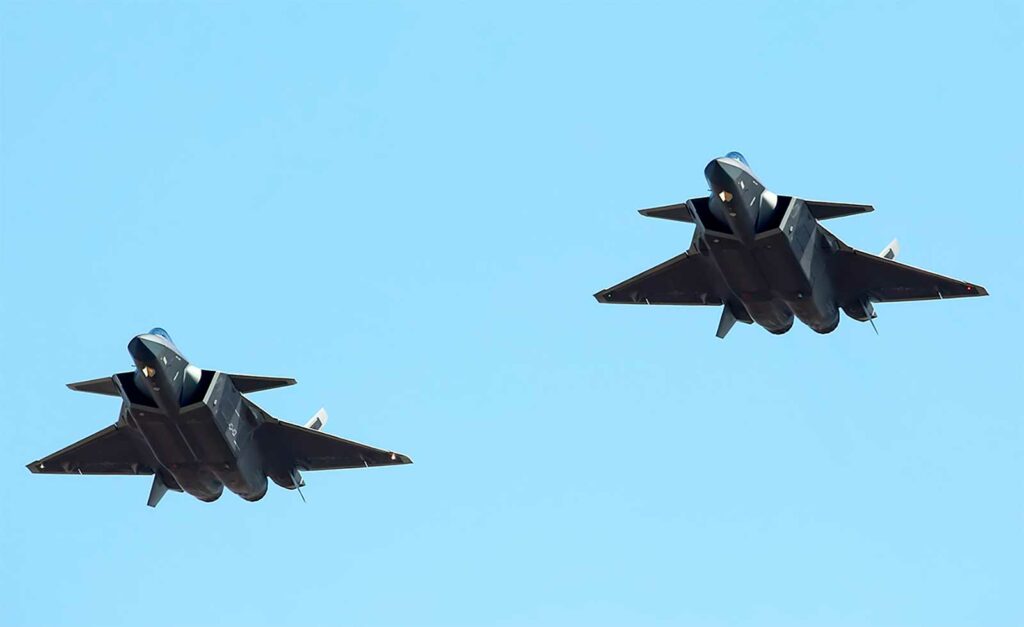
The Chengdu J-20 is a heavy stealth fighter that officially entered service in 2017. It measures approximately 20.4 m (66.9 ft) in length, with a wingspan close to 13.5 m (44.3 ft). Its maximum takeoff weight is generally estimated between 34 and 37 metric tons.
Its primary mission is long-range air superiority. Its large airframe provides significant internal volume for fuel, sensors, and weapons.
The airframe incorporates diverterless supersonic inlets, ducts designed to mask reflective engine components, precise geometric alignments, and serrated-edge bay doors. Missiles are carried internally to avoid external pylons, which are highly visible on radar.
This architecture primarily delivers frontal stealth. The J-20 is designed to delay the distance at which adversarial radars can identify it and obtain a reliable weapons track. It is not invisible. Its signature varies depending on the aspect angle, radar frequency, flight configuration, and the condition of its coatings.
Its canards, twin vertical stabilizers, and the rear engine area remain potential sources of radar reflection. The nozzles also produce an infrared signature. No public, verifiable figures exist to directly compare its radar cross-section to that of the F-22 or F-35.
The J-20 likely features an active electronically scanned array (AESA) radar, electro-optical sensors, passive detection systems, and datalinks. This equipment is intended to allow it to fuse information coming from its own radar, other aircraft, ground stations, satellites, or a KJ-500 airborne early warning aircraft.
Its armament includes the PL-10 infrared missile for short-range combat and the active radar-guided PL-15 for beyond-visual-range engagements. Public estimates generally attribute an operational range of over 140 km (87 mi) to the PL-15, with higher figures depending on launch profiles. Exact values remain classified.
This combination enables the J-20 to threaten opposing fighters, as well as high-value assets: airborne early warning aircraft, tankers, and intelligence platforms. Neutralizing or pushing back these force multipliers can disrupt an entire air force without needing to destroy every single fighter.
Chinese Engines Are Gradually Overcoming a Historic Weakness
Initial J-20s utilized Russian engines from the AL-31 family. Subsequent production runs received domestically produced WS-10 engines, notably WS-10C variants.
The WS-15 represents the next step. This engine is expected to deliver greater thrust, improve acceleration, and enable a more compelling supercruise—extended supersonic flight without relying on continuous afterburner.
Prototypes fitted with WS-15s have been observed, and new production airframes appear to be entering service with this powerplant. The full extent of its operational rollout, however, remains difficult to independently verify.
This development is significant in the Himalayas. A higher thrust reserve facilitates takeoff from high-altitude bases. It does not eliminate the performance degradation caused by thin air, but it reduces the payload and fuel penalty.
The J-20’s exact range is not public. Open-source estimates vary widely, generally between 1,200 and 2,700 km (746 and 1,678 mi) depending on the definition and mission profile used. Nevertheless, its large internal capacity and aerial refueling capability grant it a range well-suited to the scale of the Sino-Indian front.
China’s True Advantage Rests on a Combat Network
Comparing a J-20 directly to a Rafale or a Su-30MKI offers limited insight. Modern air combat is not an isolated duel.
The J-20 is designed as a node in a combat network. A KJ-500 can detect Indian aircraft and relay their positions without forcing the stealth fighter to keep its own radar active. Ground-based systems can complement this air picture. A YY-20 tanker can extend patrol times. J-16s can carry larger missile inventories or conduct electronic warfare missions.
Geography reinforces the importance of this architecture. Mountains create radar shadows, restrict line-of-sight, and complicate communications. An airborne early warning aircraft flying at high altitude can look over terrain obstacles and coordinate dispersed assets.
The November 2025 precedent at Hotan was telling. The simultaneous presence of J-20s, Flankers, H-6 bombers, KJ-500s, and a tanker revealed the outline of a complete package. The eleven aircraft observed in 2026 should be interpreted within this continuum, rather than as a standalone force.
The Balance of Power Is Turning More Unfavorable for India
China has accelerated J-20 production. The Royal United Services Institute estimates its industrial output at approximately 120 J-20s per year. An estimate published in July 2026 puts the number of delivered aircraft at nearly 500, distributed across fourteen front-line units and several flight-test or training centers. This total remains an estimate based on serial numbers, imagery, and unit identifications.
India currently possesses no operational stealth fighters. Its air force relies primarily on 36 Rafales, roughly 260 Su-30MKIs, Mirage 2000s, MiG-29s, and a growing fleet of Tejas aircraft.
These platforms are far from obsolete. The Rafale combines a relatively low radar signature, advanced electronic warfare capabilities, and the Meteor missile. The Su-30MKI offers long range and a heavy payload capacity. Indian S-400 surface-to-air missile systems, ground radars, and airborne early warning aircraft also pose serious threats to Chinese sorties.
Nevertheless, the gap is widening. The Indian Air Force currently operates around 29 fighter squadrons, against an authorized strength of 42. The indigenous Advanced Medium Combat Aircraft (AMCA) program is intended to provide a stealth fighter, but its maiden flight is targeted for around 2028, with entry into service expected in the mid-2030s.
The contemplated acquisition of 114 additional Rafales would significantly increase available mass. It would not, however, immediately grant India a comparable stealth penetration capability.
China faces constraints of its own. It must divide its top-tier fighters among the Indian border, Taiwan, the East China Sea, and the South China Sea. India also enjoys the advantage of bases situated at lower altitudes, allowing its fighters to take off with fuller fuel tanks and heavier payloads.
Eleven J-20s are not enough to dominate the thousands of kilometers of the Line of Actual Control. They are, however, sufficient to maintain multiple patrol orbits, train crews, and compel India to commit sophisticated detection assets.
A Stealth Presence Is Becoming the New Himalayan Normal
The images from Hotan and Damxung do not prove that China is preparing an attack. They reveal something more enduring: the PLAAF is normalizing the employment of its most advanced aircraft facing India.
The strategic signal lies not merely in the eleven visible airframes. It is found in the expanded runways, shelters, tankers, early warning aircraft, and repeated rotations. Beijing is building a capability that can remain low-key in peacetime and be rapidly reinforced during a crisis.
Subsequent indicators will matter more than this single deployment. Key elements to watch include the duration of the aircrafts’ presence, the potential arrival of KJ-500s or YY-20s, the staging of missile stocks, the construction of hardened shelters, and the frequency of rotations.
The border may remain quiet while the balance of power shifts. That is precisely what makes these images important. They do not capture the start of a war; they document the methodical preparation for one that must not come as a surprise.
War Wings Daily is an independant magazine.