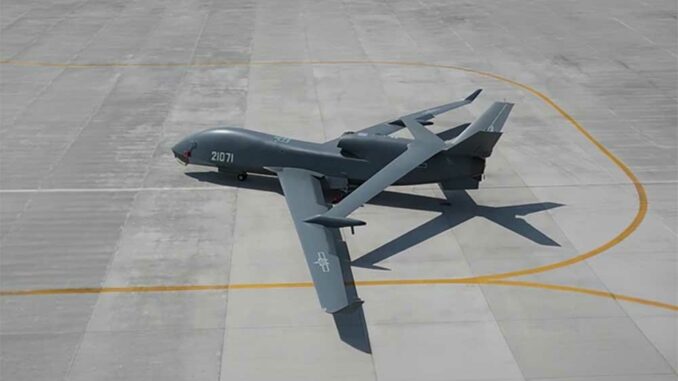
With the GJ-3A, WZ-10, and WZ-7, the PLAAF aims to bridge tactical reconnaissance, strategic intelligence, and joint strikes.
Executive Summary
The joint presentation of the GJ-3A, WZ-10, and WZ-7 reveals less a simple addition of drones than a new combat architecture. Images broadcast by CCTV on August 4, 2026, and subsequently widely relayed on August 5, depict the People’s Liberation Army Air Force as an intelligence provider for all Chinese forces. The GJ-3A is intended to provide persistent surveillance and can carry armaments. The WZ-10 brings rapid, high-altitude reconnaissance capabilities. The WZ-7 covers vast areas to generate strategic intelligence. Their effectiveness, however, depends on the network capable of fusing data, tracking targets, and allocating strikes. Beijing wants to shorten the delay between detection and opening fire. Nevertheless, the demonstration does not yet prove that this chain will remain functional in the face of jamming, cyberattacks, and modern air defenses.
The First Appearance of the GJ-3A Confirms a Change of Scale
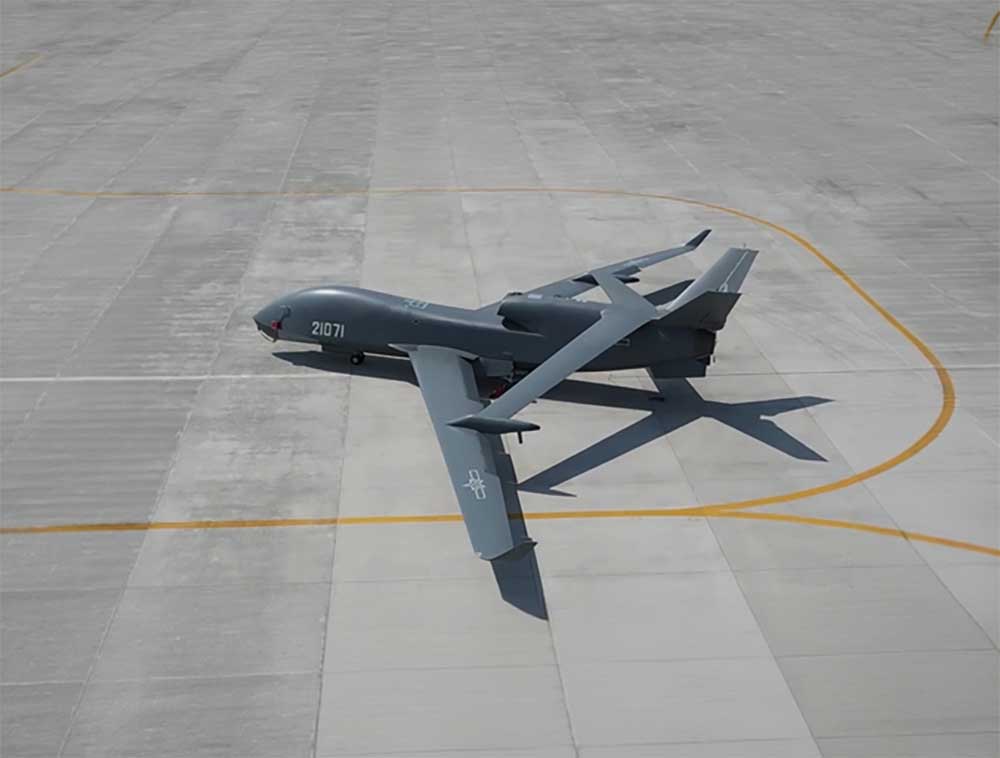
The new development is the first public appearance of the GJ-3A. The aircraft appears in the sixth and final episode of the military documentary series Zhisheng, produced by China Central Television. It is shown alongside the WZ-10 and WZ-7 in a sequence dedicated to joint operations.
The message goes far beyond the presentation of a new drone. The People’s Liberation Army Air Force, or PLAAF, no longer wants to showcase its aircraft as standalone platforms. It is presenting a set of complementary sensors linked to a single chain of command.
The timeline warrants clarification. The footage was broadcast by CCTV on Tuesday, August 4. It was then picked up on August 5, 2026, by Chinese military and state media. These outlets highlighted the three beneficiaries of the arrangement: the People’s Liberation Army Ground Force, the People’s Liberation Army Navy, and the People’s Liberation Army Rocket Force. The PLAAF is thus positioning itself as a provider of joint intelligence, rather than the sole recipient of the data collected by its drones.
The exact specifications of the GJ-3A remain partially unknown. No full military technical datasheet has been published. Wang Yanan, editor-in-chief of the Chinese magazine Aerospace Knowledge, estimates that its maximum takeoff weight exceeds 6 tons and its payload exceeds 2 tons. He describes it as an enlarged and improved derivative of the Wing Loong family, developed for domestic Chinese requirements.
The same expert mentions air-to-ground capabilities and a possible air-to-air combat capability. The latter point must remain conditional. It is an assessment relayed by state media, not an officially demonstrated capability during a firing test or public exercise.
The technical proximity to the Wing Loong 3 is nonetheless hard to ignore. Unveiled at the Zhuhai Airshow in 2022, the latter measures 12.2 meters in length and has a wingspan of 24 meters. Its maximum takeoff weight reaches approximately 6,200 kilograms, with a claimed payload of 2,300 kilograms. Its endurance exceeds 40 hours, and its ferry range is stated to reach up to 10,000 kilometers. While these figures cannot be automatically applied to the GJ-3A, they provide a credible order of magnitude.
The Trio Combines Three Levels of Reconnaissance
The composition of the system is not accidental. The GJ-3A, WZ-10, and WZ-7 do not occupy the same position in the intelligence chain. Combining them allows coverage across multiple altitudes, distances, and operational tempos.
The GJ-3A Provides Persistence Over the Area
The GJ-3A belongs to the medium-altitude, long-endurance (MALE) drone category. Its primary function is persistence. It can linger over a region for extended periods, monitor an axis of movement, and maintain contact with a mobile target.
This persistence is critical when dealing with a missile battery, a mobile command post, or a naval unit. A satellite image provides a location at a single moment in time; it does not guarantee the target will be in the same spot an hour later. The drone must maintain an updated track.
The sequence broadcast by CCTV illustrates this logic. Two aircraft are initially sent toward a forward position. Once their mission is complete, the GJ-3A takes over to continue surveillance and tracking. The goal is to avoid any gap in coverage when the initial sensors need to return to base.
The GJ-3A’s payload capacity theoretically enables it to carry several categories of equipment. It can be fitted with an electro-optical turret, synthetic aperture radar, communications relays, or guided munitions. The platform thus becomes a reconnaissance-strike tool. It can detect a target, track its movement, and potentially engage it, or transmit its coordinates to another effector.
This second option is often the most important. The drone does not necessarily have to fire itself. A missile battery, a fighter aircraft, a surface vessel, or an artillery unit may possess a more suitable weapon.
The WZ-10 Prioritizes Reaction Speed
The WZ-10 is presented by Chinese sources as a high-altitude, long-endurance drone that is faster than aircraft in the Wing Loong family. Its role is to rapidly reach an area of interest and collect intelligence before other assets arrive.
Its airframe incorporates shapes designed to reduce radar detection. Its actual level of stealth remains unknown, as China has published neither its radar cross-section nor test results against modern defense systems.
However, the WZ-10 can be used to probe an electromagnetic environment, pinpoint emissions, or identify the activity of an air defense network. The precise composition of its military sensor suite is not public, but its altitude and speed allow it to observe an area faster than a propeller-driven drone.
The aircraft is already in service beyond airshow demonstrations. On May 27, 2024, the Japanese Joint Staff detected a WL-10—the export designation associated with the WZ-10—over the East China Sea. Japan Air Self-Defense Force fighters scrambled to intercept it. The Japanese Ministry of Defense noted at the time that this was the first observed instance of this type of aircraft in the context of its airspace policing measures.
This activity demonstrates that the WZ-10 is no longer merely a display program. It participates in real-world missions in an area hosting Japanese bases, U.S. installations, and strategic air-naval routes.
The WZ-7 Extends Surveillance to the Theater Level
The WZ-7 is the largest of the three aircraft. It is distinguished by a joined-wing aerodynamic design. According to the Aviation Industry Corporation of China, it measures 14 meters long, 3.9 meters high, and has a 22.8-meter wingspan. The manufacturer attributes optical and infrared sensors to it for strategic and tactical imagery intelligence.
Its mission differs from that of the GJ-3A. The WZ-7 is not primarily designed to track a small unit at close range; it is meant to monitor a wider expanse. It can observe air bases, border zones, maritime corridors, or the movements of a naval group.
Its operating altitude provides a wide radar and optical horizon, enabling it to cover an area without having to approach as closely as lower-flying aircraft. It can assist in initial target detection, positional updates, and post-strike damage assessment.
In a maritime scenario, the WZ-7 can help detect a naval formation and establish an initial track. The WZ-10 can then seek supplementary information, and the GJ-3A can ultimately maintain tracking closer to the operational zone. This division of tasks forms the core logic of the system presented by China.
The Heart of the System Relies on Data Flow
The drones are the most visible components, but the true challenge lies within the network. An airborne sensor has limited value if its information remains locked inside a local control station.
To produce a military effect, data must be transmitted, cross-referenced, fused, and translated into decisions. It must then reach the firing unit before the target moves.
This architecture falls under C4ISR—command, control, communications, computers, intelligence, surveillance, and reconnaissance. The system must connect drones to satellites, ground-based radars, airborne early warning aircraft, ships, command centers, and missile units.
The goal is to create a system of systems. Every aircraft, drone, radar, or satellite becomes a terminal in a larger network. The destruction or unavailability of a single sensor should not break the entire chain.
The U.S. Department of Defense’s 2025 report estimates that Chinese drones and specialized aircraft play a critical role in intelligence, communications relay, and electronic warfare missions. The same report estimated that as of January 2024, China had over 359 satellites dedicated to intelligence, surveillance, and reconnaissance.
Satellites provide vast coverage, while drones offer more flexible presence. Drones can quickly revisit a target, shift sectors, or maintain continuous observation for hours. Combining the two reduces the windows during which a target can evade surveillance.
Command Reform Supports Joint Integration
China’s 2024 military reform accompanies this technical evolution. Beijing dissolved the Strategic Support Force and placed an Aerospace Force, a Cyberspace Force, and an Information Support Force directly under the authority of the Central Military Commission.
The Information Support Force is tasked with information systems and communications support across the entire People’s Liberation Army. It is meant to centralize aspects of technical intelligence management and facilitate joint operations among the various service branches.
This organization aims to break down silos. A missile unit should no longer rely solely on its own sensors; it can receive a track generated by a PLAAF drone. A People’s Liberation Army Navy vessel can leverage data provided by a land-based aircraft. An army brigade can obtain updated targeting data to execute long-range strikes.
The Chinese documentary assigns a specific function for the PLAAF regarding each of these users: its drones represent a new intelligence source for the People’s Liberation Army Rocket Force, offer the Navy an additional channel for situational awareness, and support the long-range fires of the Ground Force.
Technical integration, however, does not guarantee seamless cooperation. Data formats, classification levels, dissemination authorizations, and command procedures can slow exchanges. Inter-service rivalries also remain a significant factor. Breaking down IT silos is difficult; breaking human habits is even harder.
The Targeting Chain Must Act in Minutes
A kill chain comprises several stages: detecting the target, identifying it, determining its position, tracking its movement, selecting a weapon, transmitting the order, executing the strike, and assessing damage.
Each step takes time. A mobile battery can move, a ship can alter course, and an aircraft can launch. Accurate but stale information quickly becomes useless.
The Chinese trio thus seeks to reduce latency. The WZ-7 monitors a broad area, the WZ-10 rapidly reaches a sector to gather additional intelligence, and the GJ-3A maintains contact. The information system then compares these elements with data originating from satellites, radars, and other units.
Chinese media claim that artificial intelligence can analyze available assets and propose a course of action within seconds or tens of seconds. This assertion should be approached with caution. An algorithm can prioritize options, but it eliminates neither rules of engagement, nor the risk of error, nor the authority of human command.
The most credible advancement lies in data fusion. A radar track can be correlated with an infrared image and electromagnetic emissions. Multiple incomplete clues can together produce a robust identification, allowing the command center to select the fastest or most appropriate weapon available.
Numerous Vulnerabilities Remain
The CCTV sequence presents a smooth operational workflow, but real warfare will not be so seamless.
The first vulnerability lies in communications. A drone operating far from its base depends on Beyond-Line-of-Sight (BLOS) links via satellite, airborne relays, or ground infrastructure. These links can be jammed, intercepted, or attacked.
The second difficulty involves bandwidth. High-definition video, radar imagery, and electromagnetic data represent immense volumes of information. The network must route these feeds without saturation, prioritizing time-sensitive data.
The third weakness is platform survivability. While the GJ-3A has long endurance, its sizable airframe does not appear designed to deeply penetrate airspace covered by intact, modern air defenses. The WZ-7 is similarly large. The WZ-10 appears stealthier, but there is no public proof that it can operate freely against advanced radar systems.
China will therefore need to pair its drones with jamming operations, suppression of enemy air defenses (SEAD), decoys, and stand-off weapons. It will also need to proliferate sensors so that losing a single aircraft does not sever the tracking chain.
The fourth vulnerability is data trustworthiness. False, delayed, or manipulated positioning data can corrupt the entire chain. The more automated the decision-making process becomes, the more rigorously the system must verify data origin and consistency. Link resilience becomes as crucial as the drones’ altitude or endurance.
A Demonstration Targeted at Adversaries as Much as Headquarters
China does not showcase a new military capability without a political objective. Staging the GJ-3A alongside two established drones sends several messages.
First, it signals to Chinese officials that joint integration is progressing. Second, it indicates to defense industry leaders that the focus is no longer solely on airframes and engines—software, networks, sensors, and algorithms are now central.
Finally, it signals to regional adversaries that the PLA is working to maintain continuous surveillance over mobile targets. This message directly impacts maritime operations, bases along the First Island Chain, and Taiwan scenarios.
A force seeking to enforce a blockade or strike distant installations requires real-time intelligence. Long-range missiles are not enough; their theoretical precision loses all value if the target shifts position before arrival.
However, it would be an exaggeration to view this video as proof of a fully mature, actual operational capability. It confirms that the platforms exist and demonstrates a coherent doctrine. It suggests that rotation and intelligence-sharing procedures have been experimented with. It does not prove that the system as a whole can function continuously under heavy electronic and cyber attack.
The Decisive Test Will Be Intelligence Continuity Under Attack
The GJ-3A, WZ-10, and WZ-7 trio presents a clear image of China’s ambitions. Beijing aims to synthesize tactical reconnaissance, strategic surveillance, electronic intelligence, and precision strike, while positioning the PLAAF as a primary data provider for the entire People’s Liberation Army.
The shift is therefore not merely aeronautical; it is digital and organizational. The drone matters less as an isolated asset than as a networked sensor linked to a broader command architecture.
Yet information superiority is not measured by the number of platforms displayed on screen. It hinges on the ability to retain a reliable track when satellites are contested, networks jammed, and command nodes attacked.
A peacetime demonstration can produce a flawless image. A joint intelligence system holds military value only if it remains fast, distributed, and credible in a hostile environment. The GJ-3A represents a visible milestone, but the resilience of the surrounding network remains the central question.
War Wings Daily is an independant magazine.