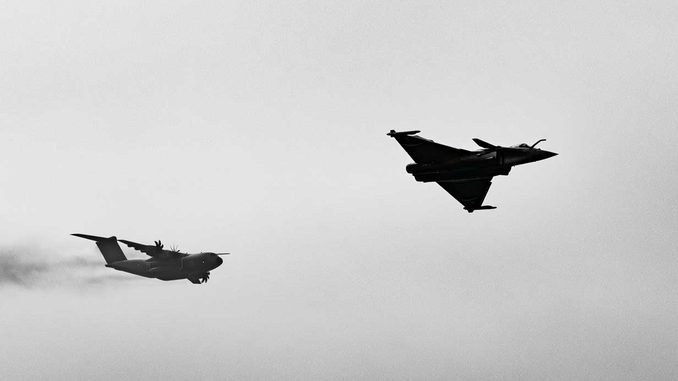
A400M, Rafale, and A330 MRTT: France is consolidating an air force capable of shifting rapidly between Europe, its overseas territories, and the Indo-Pacific.
In Summary
The French Air and Space Force is no longer structuring its airpower around the Rafale alone. It is progressively building a projection system in which the fighter jet, the A400M Atlas, the A330 MRTT Phénix, and overseas French bases fulfill complementary functions. The deployment of an A400M to French Polynesia from August 1 to 8, 2026, following an initial leg in New Caledonia in January, reflects this shift. Just days prior, four Rafales completed four months of Baltic Air Policing in Lithuania. France is thus demonstrating its ability to simultaneously support its European commitments and its footprint in the Indo-Pacific. The Rafale provides combat capability, the Phénix supplies strategic reach and refueling, while the A400M transports personnel, parts, and equipment to forward operating bases. The new Pacific Command completes this architecture by linking French assets in Polynesia and New Caledonia more closely together.
French Airpower No Longer Relies Solely on the Rafale
The Rafale remains the center of gravity for French combat aviation. However, its performance alone does not dictate France’s capability to operate thousands of kilometers from the mainland.
A fighter jet generates military power only if it can reach its operational theater, receive fuel, weapons, spare parts, mechanics, and mission data once there, and maintain that posture over time.
This is precisely where the evolution of the Air and Space Force becomes compelling.
France is incrementally building an operational chain in which the Rafale is paired with the A330 MRTT Phénix for strategic projection and the A400M Atlas for strategic and tactical mobility. Surrounding this airborne architecture is a network of French and allied bases.
The upcoming Pégase 2026 deployment offers a near-perfect illustration of this logic. It will deploy four Rafale F4s, three A330 MRTTs, two A400Ms, and nearly 300 aviators over 38 days. The itinerary spans the Arctic, North America, the Indo-Pacific, the Indian Ocean, and the Middle East.
This structure demonstrates a simple truth: power projection has become a system-level operation.
The A400M Transforms French Military Geography in the Pacific
The deployment of an A400M Atlas to French Polynesia from August 1 to 8, 2026, deserves attention beyond that of a routine logistical stopover.
The aircraft was previously deployed from January 24 to 26 to Air Base 186 “Lieutenant Paul Klein” in Nouméa-La Tontouta, New Caledonia.
These two operations lay the groundwork for the regular integration of an airframe far more capable than the CASA CN-235 traditionally used in the region.
The difference is substantial.
The A400M can carry approximately 35 metric tons of payload under configurations used by the French military. Its cargo bay can fit two heavy vehicles such as the VAB or TRM, or up to 116 paratroopers. Airbus lists a theoretical maximum payload of 37 tons and a range of roughly 6,300 km with a 20-ton load.
With a reduced payload, its maximum ferry range exceeds 8,700 km.
In the Pacific, these figures directly compress operational timelines. The Air and Space Force notes that an A400M can connect Tahiti to Nouméa in approximately six non-stop hours, compared to over twelve hours with a CASA.
The time saved is not merely a matter of convenience; it fundamentally alters how quickly command staff can concentrate forces.
The A400M Combines Strategic Transport with Tactical Access
The primary advantage of the A400M lies in an unusual combination of capabilities.
A conventional strategic airlifter can move large volumes of equipment across long distances, but generally requires extensive airport infrastructure.
A tactical transport aircraft can operate from rustic airstrips, but carries smaller loads over shorter distances.
The A400M bridges the gap between the two.
It can cover thousands of kilometers with a heavy payload and subsequently land on short or unpaved runways. During its Polynesian deployment, the French crew trained specifically for landings on short strips.
This capability is particularly vital in the Pacific. Distances between archipelagos are vast, and airfields capable of supporting large military aircraft over time remain scarce.
France can thus haul equipment to a main hub before extending the mission onward to a more austere forward location.
It is this final segment of the logistical supply chain that gives the system its operational value.
Pacific Command Turns Two Local Presences into a Regional Network
The more frequent presence of the A400M coincides with a restructuring of French military command.
Pacific Command, or CPP, became operational on January 1, 2026. Headquartered in French Polynesia, it operates under the authority of the Senior Commander of the Armed Forces in French Polynesia.
Its purpose is not to supersede the Armed Forces in French Polynesia or the Armed Forces in New Caledonia, as their geographic areas of responsibility remain separate.
Instead, it aims to better coordinate their joint actions.
Together, the two commands represent a permanent footprint of roughly 3,200 military personnel. New Caledonia notably hosts Tontouta Air Base, while Polynesia provides a second anchoring point several thousand kilometers to the east.
The A400M acts as a connective link between these two hubs.
The underlying rationale is key: a dispersed military posture becomes far more useful when it can be rapidly reinforced and reorganized.
Without heavy transport, two distant bases remain isolated, self-contained units. With long-range transport capable of moving personnel, vehicles, munitions, and technical teams within hours, they function as nodes within a single regional network.
The Phénix Supplies the Reach the Rafale Demands
The A400M does not replace the A330 MRTT Phénix; the two aircraft serve distinct roles.
The Phénix acts primarily as the force multiplier extending the reach of French deployments.
Derived from the A330-200, it can carry up to 110 metric tons of fuel and refuel two Rafales simultaneously. It also handles the strategic transport of personnel and cargo.
In specific configurations, it can carry up to 272 passengers or roughly 30 tons of cargo over a distance of 10,000 km.
France is aiming for a total fleet of 15 MRTTs.
The role of the Phénix becomes obvious during fighter deployments. The Rafales do not need to land every time their fuel tanks run low; successive aerial refuelings allow them to cover distances that would otherwise be incompatible with rapid power projection.
The MRTT also transports a portion of the support personnel required for the detachment.
This yields a dual effect:
The tanker extends the combat radius of the Rafale and reduces the number of required stopovers, thereby shortening the window between political decisions and the actual arrival of fighters in-theater.
This capability has been repeatedly validated during successive Pégase missions.
The A400M Can Also Support Fighters Directly In-Flight
The boundary between airlift and aerial refueling is less rigid than it appears.
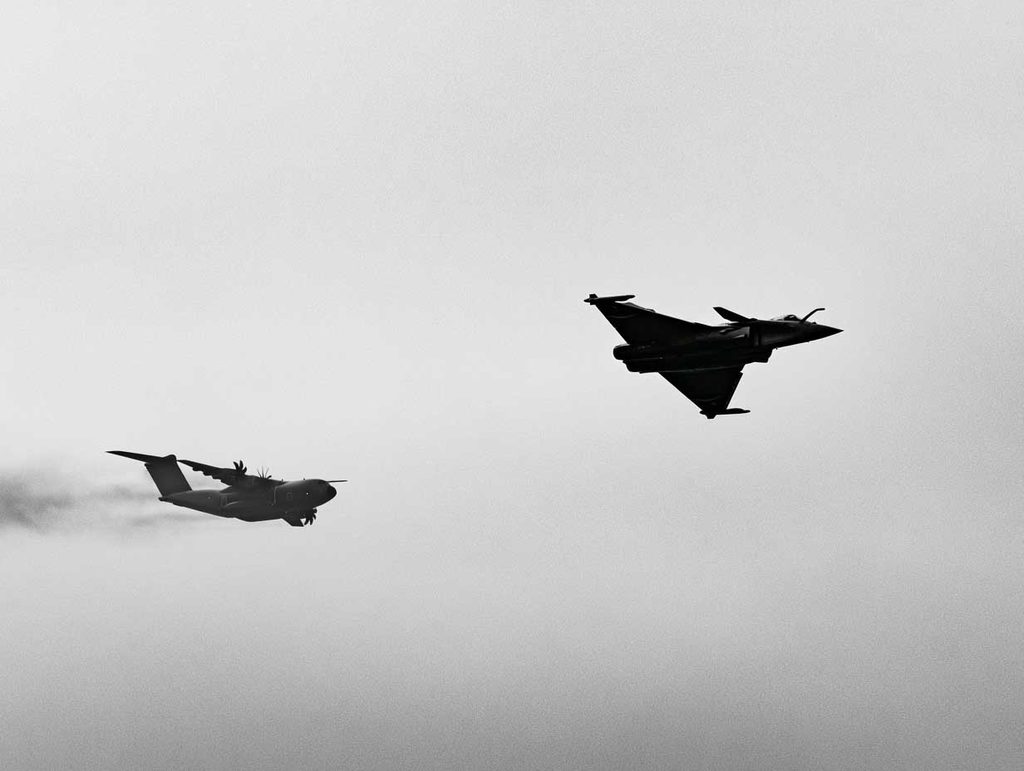
The French A400M has demonstrated its ability to refuel the Rafale using two underwing pods, allowing it to supply two fighters simultaneously.
During a deployment to Greece in 2023, an A400M accompanied three Rafales across approximately 2,600 km.
The aircraft fulfilled multiple roles during that single transit: refueling the fighters, transporting their mechanics, and carrying the maintenance kits required for ground operations upon arrival.
This serves as a clear illustration of French operational logic.
The same aircraft can assist in escorting the fighters during transit and then serve as the logistical backbone for the detachment at its destination.
While the Phénix remains far more capable for large-scale, long-distance aerial refueling, the A400M offers a complementary solution, particularly for smaller or more widely dispersed detachments.
France thus maintains multiple tiers of refueling capability rather than relying exclusively on a single fleet.
Baltic-Based Rafales Demonstrate Another Dimension of Projection
Thousands of kilometers from the Pacific, the French commitment in Lithuania highlights the opposite end of the operational spectrum.
From April 1 to July 31, 2026, France participated in the 71st rotation of the Baltic Air Policing mission out of Šiauliai.
Four Rafale Bs from Air Base 113 in Saint-Dizier executed the first rotation through May 31. They were subsequently replaced by four Rafale Cs from Air Base 118 in Mont-de-Marsan.
Over four months, French detachments logged 540 flight hours, executing 39 Alpha Scrambles for real-world operational alerts and 69 Tango Scrambles for training.
Roughly 200 aviators were mobilized across the two rotations.
On June 8, two Rafale Cs scrambled on alert, with one aircraft destroying an unauthorized drone operating in Latvian airspace.
These metrics highlight a capability distinct from the one demonstrated in Polynesia.
In the Baltics, the goal was not merely rapid arrival, but maintaining armed fighters on standby for four continuous months, capable of launching within fifteen minutes during heightened alert periods.
The true test here lies in operational persistence.
The Ability to Pivot from Europe to the Pacific Becomes a Strategic Goal
It would be an overstatement to suggest that the four Rafales departing the Baltics were immediately redeployed to the Pacific.
That is not what occurs in practice.
However, the rapid sequence of operations is telling of the overall transformation underway.
A single air force must be capable of maintaining Rafales on NATO’s eastern flank, reinforcing its overseas territories, and preparing a multi-continent Pégase deployment just weeks later.
Achieving this demands more than just capable aircraft.
It requires available flight crews, mechanics, spare parts, munitions stockpiles, communications networks, and a command structure capable of planning multiple parallel logistical chains.
The strategic challenge for France is making the deployment of airpower reversible and flexible.
Units must no longer be implicitly tailored around a single geographic scenario. They must be prepared to transition smoothly from collective defense in Europe to a crisis in the Indian Ocean or the Pacific.
Overseas Bases Reduce the Tyranny of Distance
France holds a distinct advantage that few European powers possess.
Its overseas territories provide permanent outposts across the Atlantic, the Caribbean, the Indian Ocean, and the Pacific.
In the Indo-Pacific, Réunion, New Caledonia, and French Polynesia serve as crucial strategic staging points.
They make it possible to station aircraft, personnel, fuel, and support infrastructure without having to continuously negotiate access to foreign territory.
While this sovereignty does not remove the need for regional partnerships, it provides a strategic depth unique to France.
French defense spending reflects this priority: funds allocated to overseas sovereignty exceed 1.7 billion euros in 2026. Announced investments explicitly cover upgrading infrastructure to support A400Ms at overseas operating locations.
The logic is sound: expanding the aircraft fleet without adapting base facilities yields limited strategic value.
The Transport Fleet Becomes as Critical as Fighter Squadrons
The update to the Military Programming Law enacted on August 16, 2026, confirms this shift in priorities.
France operated 24 A400Ms at the end of 2024. The new baseline targets at least 41 A400Ms by 2035.
This represents a major scale-up: an increase of over 70% relative to the end-2024 inventory.
The text explicitly justifies this expansion based on the requirements of sovereignty forces, pre-positioned units, and overseas power projection.
A portion of the A400M fleet is also slated for upgraded capabilities and enhanced self-protection suites to operate in contested environments.
This development is noteworthy.
For years, debates surrounding airpower focused almost exclusively on fighter jet counts. Yet a grounded Rafale lacking spare parts or sitting 15,000 km away from a crisis generates zero operational power.
In certain operational scenarios, an additional transport aircraft can hold as much strategic value as an extra fighter jet.
The New Caledonia Crisis Highlighted the Utility of This Architecture
The practical execution of this concept was tested during the crisis in New Caledonia in May 2024.
Seven A400Ms participated in moving large numbers of personnel and equipment to the archipelago in under a week.
This example illustrates what strategic projection truly entails.
It is not simply about sending a few fighter jets across the globe for a show of force.
It involves rapidly transporting sufficient personnel and materiel to tangibly alter the balance of forces or manage a crisis effectively.
The same aircraft can subsequently carry out humanitarian missions following a cyclone, transport special operations forces, evacuate citizens, or move equipment between archipelagos.
This versatility explains why the A400M plays an increasingly central role in France’s Pacific strategy.
The Rafale, Phénix, and A400M Triptych Relies on a Clear Division of Labor
The overall coherence of this force structure becomes clear when viewing the complete mission rather than individual assets.
The Rafale detects, protects, strikes, and delivers combat effects.
The Phénix enables fighters to cover extreme distances, supplies in-flight refueling, and moves personnel.
The A400M transports technicians, cargo, spare parts, vehicles, and the ground support equipment needed to establish or reinforce a deployment.
Overseas bases provide the airfields, fuel depots, infrastructure, and staging areas.
Finally, command structures coordinate the entire system.
The Pégase 2026 mission is designed to showcase this triptych. Utilizing four Rafale F4s, three Phénix tankers, and two A400Ms, it will cross four oceans and make nine stopovers.
The symbolic value is clear, but the underlying operational architecture is even more significant.
France is steadily building the capacity to deploy its entire combat ecosystem alongside its fighter jets.
Mass Remains France’s Primary Constraint
This strategy should not be over-interpreted.
Projecting four Rafales across multiple continents is an impressive technical demonstration, but it is not the same as sustaining dozens of aircraft in a high-intensity conflict 15,000 km from the home country.
The difference is measured in metric tons of fuel, missile stockpiles, spare engines, maintenance crews, and daily mission-ready aircraft.
While 15 planned MRTTs represent a sizable fleet by European standards, it remains modest relative to the potential demands of a prolonged operation in the Indo-Pacific.
The same applies to overseas staging bases: while they grant France an exceptional geographic footprint, they must be adequately protected, supplied, and equipped to absorb a sudden surge in operational tempo.
The key challenge in the coming years will be less about proving France can reach the Pacific, and more about proving it can sustain credible military power there over time.
The ongoing transformation is aimed precisely at that objective.
The Rafale remains indispensable, but it is no longer treated as a standalone capability. Built around it is an integrated projection framework comprising tankers, heavy transports, forward bases, command networks, and international partnerships.
This represents perhaps the most significant structural shift within the Air and Space Force today.
French airpower is no longer measured solely by the number of Rafales lined up on a tarmac. It is now measured by the distance at which those fighters can operate, how long they can remain deployed, and how quickly France can maneuver the entire system from one theater to another.
Sources
Ministry of the Armed Forces and Veterans Affairs — “The A400M Atlas gains momentum in the Pacific,” August 19, 2026.
Ministry of the Armed Forces and Veterans Affairs — “FANC – New Caledonia Armed Forces welcome an A400M at Air Base 186,” February 25, 2026.
Ministry of the Armed Forces and Veterans Affairs — “Baltic Air Policing 71: Four months of French deployment in Baltic skies,” August 12, 2026.
Ministry of the Armed Forces and Veterans Affairs — “Baltic Air Policing: Interception and destruction of a drone in Baltic skies,” June 16, 2026.
Ministry of the Armed Forces and Veterans Affairs — “Pégase 26: Strategic deployment of the Air and Space Force,” August 27, 2026.
Ministry of the Armed Forces and Veterans Affairs — Airbus A330 Phénix factsheet.
Directorate General of Armament — Flight tests for A400M aerial refueling capabilities with the Rafale.
Ministry of the Armed Forces and Veterans Affairs — “EUNOMIA: A400M escorts Rafales to Greece for the first time.”
Airbus Defence and Space — A400M specifications and performance metrics.
Ministry of the Armed Forces and Veterans Affairs — Force projection data regarding the deployment of seven A400Ms to New Caledonia in May 2024.
Armed Forces General Staff — Presentation of Pacific Command, operational since January 1, 2026.
Ministry of the Armed Forces and Veterans Affairs — 2026 Draft Budget Bill: Overseas sovereignty efforts and A400M infrastructure expansion.
Légifrance — Law No. 2026-791 of August 16, 2026, updating military programming for the years 2024 through 2030.
War Wings Daily is an independant magazine.