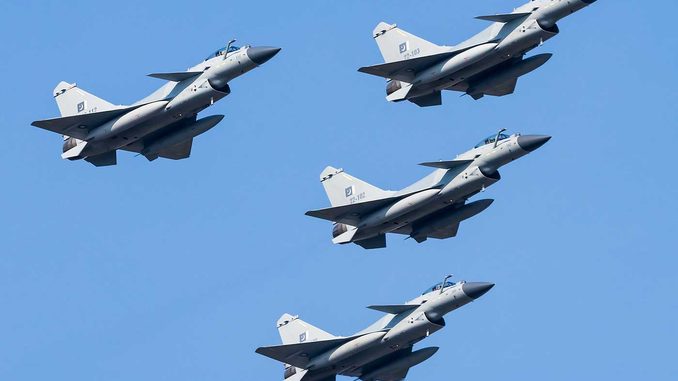
Pakistan’s J-10C and its PL-15 surprised the Indian Rafale. Above all, the clash reveals the power of network-centric air warfare.
In brief
The aerial engagement between India and Pakistan during the night of May 6–7, 2025, will remain one of the most studied events in the recent history of air combat. American officials estimated with a high level of confidence that Chinese-made J-10s operated by Pakistan shot down at least two Indian aircraft, including a Rafale. The investigation subsequently published by Reuters revealed above all that New Delhi likely underestimated the range of the PL-15 missile. The fatal shot was reportedly taken at approximately 200 km, or even further according to certain Indian sources. However, the event does not prove that the J-10 is superior to the Rafale. It demonstrates something far more important: system against system. AESA radar, long-range missile, Saab 2000 Erieye airborne early warning aircraft, Data Link 17, electronic warfare, and tactical preparation enabled Pakistan to build a coherent kill chain and surprise an Indian force that was nevertheless equipped with extremely high-performance fighters.
The battle of May 7, 2025 changed the perception of the Chinese J-10
The starting point is now sufficiently documented to set aside the most fantastical interpretations.
During the night of May 6–7, 2025, India launched Operation Sindoor. It struck several targets in Pakistan and Islamabad-administered Kashmir, which it framed as infrastructure linked to terrorist groups.
The Pakistan Air Force reacted.
According to the investigation published by Reuters in August 2025, approximately 110 aircraft were involved in the engagement, making it one of the largest air battles in several decades. Fighters from both sides reportedly remained on their respective sides of the border. The combat therefore took place essentially at very long ranges, beyond visual range.
Pakistani J-10CEs engaged Indian aircraft.
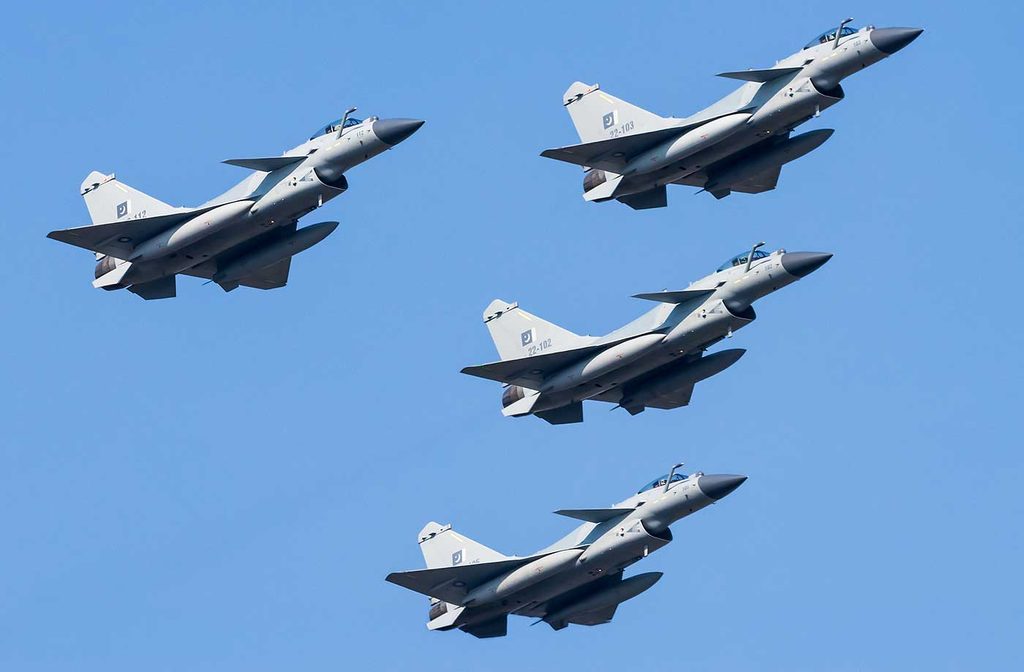
The term J-10C is widely used in the press and in internet searches. Precision is necessary, however: Pakistan operates the J-10CE, the export version of the Chinese J-10C.
Two American officials quoted by Reuters stated as early as May 8, with a high degree of confidence, that the J-10s had shot down at least two Indian aircraft with air-to-air missiles. One of them was a Rafale.
India has never published a detailed accounting confirming the type of each aircraft lost. However, its Chief of Defence Staff, General Anil Chauhan, acknowledged that aircraft were lost during the initial phase and that tactics were subsequently corrected.
The Chief of Staff of the French Air and Space Force, General Jérôme Bellanger, declared that he had seen elements indicating the loss of one Rafale and two other Indian aircraft.
The premise of the loss of at least one Rafale is therefore much solidly grounded today than the initial Pakistani claims of three destroyed Rafales.
This distinction is essential. A documented tactical victory must not be transformed into a commercial marketing narrative.
The PL-15 created a surprise with its actual range
The missile is probably the most significant technical element of the engagement.
The PL-15 is a Chinese air-to-air missile designed for BVR, or Beyond Visual Range, combat. It allows an aircraft to engage a target before the two pilots can visually acquire one another.
The International Institute for Strategic Studies estimates the kinematic range of the Chinese PL-15 at approximately 200 km. Janes puts forward an estimate reaching up to approximately 300 km under certain conditions and for certain variants.
Pakistan uses the PL-15E, the export version.
During its public presentation at Airshow China in 2021, its range was announced as 145 km.
This figure reportedly played a decisive role in Indian planning.
According to Indian officials interviewed by Reuters, pilots believed that their distance from the J-10s kept them outside the effective range of the Chinese missile.
They were wrong.
Pakistani officials stated to Reuters that the PL-15 that struck the Rafale was fired from approximately 200 km. Indian officials reportedly estimated the distance to be even greater.
This does not necessarily mean that the official specifications of the PL-15E were false.
The concept of an air-to-air missile’s range is vastly more complex.
The range of a missile never corresponds to a fixed distance
To state that a missile has a range of 145 km or 200 km is a simplification.
Its range depends on the launch altitude, the speed of the launching aircraft, the missile’s trajectory, the altitude of the target, and, above all, the direction in which the target is maneuvering.
A missile fired from a fighter flying fast and high immediately benefits from considerable energy.
If launched against an oncoming aircraft, the distance separating the two platforms decreases throughout the entire flight duration of the missile.
Conversely, a target that detects the threat quickly, turns, and flies away forces the missile to cover more distance while steadily losing its energy.
This is why the published range is not an absolute range.
A distinction must also be made between the maximum kinematic range and the No-Escape Zone.
The former designates roughly the maximum distance at which a missile can reach a target under favorable circumstances.
The latter represents the zone in which the target has far fewer options to escape the missile, even if it immediately executes a defensive maneuver.
This is a fundamental difference when comparing the PL-15 to the European Meteor.
The PL-15 combines range, datalink, and radar seeker
The PL-15 is not notable solely for its range.
Its architecture allows it to operate within a network.
After launch, the missile uses inertial navigation. Trajectory updates can be transmitted to it mid-course via datalink. In the terminal phase, its active radar seeker independently searches for the target.
Public data regarding the precise architecture of the PL-15E remains limited.
The Chinese version is generally described as utilizing an AESA radar seeker, a technology that notably enables strong electronic agility and increased resistance to countermeasures.
The IISS estimates that the Chinese PL-15 can exceed Mach 5 in top speed.
However, the true operational innovation lies elsewhere.
The missile does not require the J-10’s radar to continuously illuminate the enemy aircraft throughout its flight.
The fighter can receive an air picture constructed by other sensors. It can execute the launch. The missile can receive mid-course updates before its own radar takes over.
The result is potentially far more dangerous than a simple face-off between two radars.
The Saab 2000 Erieye likely played a central role
Pakistan has long operated Saab 2000 airborne early warning aircraft equipped with the Erieye radar.
An AEW&C, or Airborne Early Warning and Control platform, is essentially a flying radar paired with a command center.
From an altitude of several thousand meters, it sees much further than a ground-based radar limited by the curvature of the Earth.
It can simultaneously track numerous aircraft. It can also transmit this tactical picture to fighters.
According to Reuters, Pakistan used its national Data Link 17 system to interconnect equipment of different origins, notably its Chinese J-10s and its Swedish Saab 2000s.
This is a major detail.
A J-10 could theoretically receive the coordinates of an Indian aircraft thanks to information generated by the network, without needing to constantly run its own radar.
It could therefore remain more discreet.
Here lies the heart of the matter: a J-10 with its radar off can be far more difficult to identify as an immediate threat than an aircraft actively searching for its target with its fire-control radar.
Reuters reports that the J-10s closest to India may have flown using radar tracking data provided by the surveillance aircraft stationed further back.
The exact degree of integration remains unknown. In particular, it is not publicly established whether the Erieye or other sensors directly provided mid-course trajectory corrections to the PL-15 during its flight.
However, the general principle is clear.
Pakistan apparently possessed a more coherent tactical picture.
Situational awareness likely did more than the J-10’s intrinsic performance
Former British Air Marshal Greg Bagwell summarized the outcome to Reuters in a few words: the winner was the one who possessed the better tactical picture.
This is situational awareness.
It refers to the ability to know where friendly platforms, enemy platforms, missiles, radars, and threats are located, and then to distribute that information to those who need it.
In a BVR engagement, seeing before the adversary can be more important than flying faster or turning tighter.
A fighter with an excellent radar but forced to construct its entire tactical picture on its own can be at a disadvantage against an aircraft that is already receiving a precise track from a remote radar.
The modern air warrior, therefore, no longer necessarily searches for the target.
The network finds it for them.
This is the difference between a high-performance combat aircraft and an integrated air combat system.
Electronic warfare likely further increased Indian uncertainty
Pakistan also claims to have conducted an electronic warfare operation against Indian systems.
Five Pakistani officials interviewed by Reuters described efforts designed to disrupt enemy sensors and communications.
Indian officials, however, dispute parts of this account.
In particular, they maintain that the Rafales were not “blinded” and that Indian satellites were not jammed. They do, however, acknowledge disruptions affecting certain systems on the Su-30s.
It would therefore be incorrect to claim that Pakistani electronic warfare neutralized the Rafale’s SPECTRA system.
There is no public evidence to establish this.
Yet electronic warfare does not need to render a radar unusable to be effective.
Creating ambiguous tracks, delaying a transmission, inducing a few seconds of uncertainty, or masking the exact origin of a threat can be enough.
At a distance of 200 km, a few seconds can alter the entire geometry of an engagement.
The J-10CE’s AESA radar does not alone explain the victory
The J-10CE features an active electronically scanned array (AESA) radar.
An AESA radar utilizes a large number of small, electronically controlled transmit-receive modules. It can move its beam almost instantaneously, track multiple targets, and rapidly vary its operating frequencies and modes.
The Rafale also features a highly capable AESA radar, the Thales RBE2 AESA.
The “Chinese radar versus French radar” comparison is therefore not particularly relevant without knowing the geometry of the combat.
Actual detection range depends notably on the radar cross-section of the target, its orientation, altitude, the frequency used, and electronic jamming.
The exact performance specifications of the J-10CE’s radar are classified.
Those of the RBE2 AESA are as well.
It is therefore impossible to seriously demonstrate that the J-10’s radar is superior to that of the Rafale based on this engagement.
The J-10 may not have even needed to use its radar at full capacity to obtain the initial track.
The SPECTRA system is not an absolute bubble of invulnerability
The Rafale possesses one of the most sophisticated electronic warfare suites fitted to a fighter aircraft.
SPECTRA can detect and identify radar emissions, locate threats, and contribute to jamming and countermeasure deployment.
Dassault explains that the system fuses information on radars, missiles, and other threats to provide the pilot with a tactical picture.
However, SPECTRA does not suspend the laws of aerial warfare.
Its effectiveness depends notably on the intelligence available regarding the threat and how that threat presents itself.
A missile equipped with an active radar seeker does not necessarily require the launching fighter to continuously illuminate the target.
If the J-10 remains relatively discreet and the PL-15 activates its terminal radar seeker late in flight, the timeline of threat alerts can become far less favorable to the Rafale.
No one publicly knows what alerts the Indian pilot received.
It is therefore impossible to state that SPECTRA “failed.”
One can only observe that, in at least one engagement, the overall defensive system did not prevent the destruction of the aircraft.
The Meteor likely never had the opportunity to demonstrate its superiority
The PL-15 versus Meteor comparison immediately became popular.
It is also frequently misframed.
MBDA’s Meteor utilizes a variable-flow ramjet. Unlike a missile propelled solely by a conventional rocket motor whose thrust ceases after fuel burnout, the Meteor can maintain thrust over a large portion of its flight.
This allows it to retain more kinetic energy during the terminal phase.
MBDA states that this architecture gives it the largest No-Escape Zone in its class.
The Meteor also features an active radar seeker and a two-way datalink.
On paper, it therefore constitutes an extremely dangerous BVR weapon.
Yet there is no evidence that a Meteor was fired at the J-10s during the engagement that cost India a Rafale.
Rules of engagement also appear to have constrained Indian operations at the start of the mission.
Analyses by the Royal United Services Institute indicate that pilots had received restrictive instructions to avoid preemptively attacking Pakistani aircraft and air defense systems during the initial phase.
The difference is substantial.
The Meteor was not defeated by the PL-15 in a symmetrical duel.
It is possible that it simply never enjoyed a situation that allowed the Rafale to fire first under favorable conditions.
The Rafale and the J-10 were not necessarily executing the same mission
Another error consists of imagining two fighters flying toward each other with the sole mission of shooting one another down.
Indian Rafales were participating in an offensive operation.
They had to contribute to strikes and to the escort of the package.
Pakistan was in a different posture. Its air force knew that an attack was probable and could concentrate its assets on intercepting incoming Indian aircraft.
Reuters reports that Air Chief Marshal Zaheer Sidhu had anticipated the assault and that Pakistani forces were intensely monitoring enemy air activity.
The defender therefore knew the approximate direction of the threat and could prepare a BVR ambush.
A platform on a strike mission operates under different operational constraints than a fighter tasked exclusively with establishing a firing geometry.
Tactical context matters just as much as technical specifications.
The 150 km miscalculation highlights the limits of technical intelligence
One of the most sobering lessons for India ultimately concerns intelligence.
Pilots knew that the PL-15E existed.
They knew its appearance.
They knew its publicly advertised range.
However, they were reportedly operating with overly conservative parameters.
This is a classic problem.
An exporting nation is under no obligation to publish the true maximum performance of a weapon. Specifications announced at an air show do not constitute complete tactical documentation.
Performance must also be reconstructed through signals intelligence, observed tests, engine data, trajectory profiles, and adversary training exercises.
An error of a few dozen kilometers regarding a missile’s practical engagement envelope can transform a zone considered safe into a kill zone.
The PL-15 exploited precisely that margin.
India’s highly diverse fleet complicates data fusion
The other challenge is architectural.
The Indian Air Force operates aircraft and systems originating from multiple countries.
In particular, it flies French Rafales, Russian and Indian Su-30MKIs, French Mirage 2000s, Russian-origin MiG-29s, and indigenous Tejas fighters.
It also operates various air defense and detection systems.
India does possess its Integrated Air Command and Control System as well as AEW&C platforms like the Netra.
However, seamlessly integrating equipment designed by different manufacturers using proprietary protocols and closed architectures represents a vast engineering challenge.
Reuters reports that Indian officials acknowledged this complexity following the fighting.
Carnegie India also highlighted after Operation Sindoor that networking disparate platforms must become a top priority.
The issue is therefore not whether India possesses radars.
It possesses many.
The challenge consists of passing a single tactical track, in real time, across all sensors and shooters.
Pakistan turned its mix of equipment into an advantage
The Pakistani case is particularly interesting because its network is not homogeneous either.
The country operates Chinese-origin J-10CEs and JF-17s, American F-16s, and Swedish Saab 2000 Erieyes.
The deployment of Data Link 17 appears to have allowed it to bypass a portion of this heterogeneity.
If the Reuters analysis is correct, Islamabad managed to construct an operational interface enabling a Swedish radar to feed a kill chain comprising Chinese fighters and missiles.
This represents a notable integration achievement.
And it is likely far more interesting to foreign military staffs than the intrinsic performance of the J-10 itself.
China gained exceptional operational feedback for free
For Beijing, the engagement represents almost a real-world laboratory.
Prior to May 2025, the J-10 and PL-15 had virtually no known combat experience against modern Western aircraft.
China now has access, directly or indirectly, to operational feedback involving its aircraft, its missile, its radars, and likely part of its doctrinal concepts.
Reuters also reported that the head of the Chinese air force, Lieutenant General Wang Gang, visited Pakistan in July 2025 and expressed keen interest in Pakistani experience with multi-domain operations.
This information is strategic.
The Chinese military can study how a long-range missile behaves in reality against a fighter equipped with an advanced Western electronic warfare suite.
It can analyze firing distances, data transmissions, adversary reactions, missile trajectories, and encountered issues.
Every real engagement provides data that is impossible to fully replicate in an exercise.
The J-10’s success also had an immediate commercial impact
The battle altered the international perception of the Chinese aerospace industry.
A few weeks later, Indonesia confirmed that it was evaluating a potential acquisition of the J-10.
Jakarta had already ordered 42 Rafales from France for approximately $8.1 billion. Discussions regarding the J-10 existed before the clash, but the Indonesian Ministry of Defense explicitly indicated that the performance reported in Pakistan would be taken into account in its evaluation.
This constitutes a commercial victory for Beijing, regardless of the ultimate outcome of those discussions.
For the first time, a Chinese 4.5-generation fighter could be presented not merely as cheaper than a Western aircraft, but as a system that participated in the downing of a front-line Western platform.
This dimension also explains why the information war was particularly intense following the conflict.
Faked or repurposed images were used to inflate the number of destroyed Rafales. French and American organizations subsequently accused networks linked to China of amplifying narratives targeting the Rafale.
The technical reality is interesting enough on its own without needing this propaganda.
The true lesson is not that the J-10 is better than the Rafale
A Rafale was likely destroyed by a PL-15 fired from a J-10CE.
That statement is dramatic.
It does not, however, prove that a J-10CE is intrinsically superior to the Rafale.
To prove that, one would need to compare equivalent situations: identical tactical picture, similar rules of engagement, comparable AWACS support, known crew proficiency, identical payloads, comparable geometry, and the ability for both sides to freely employ their missiles.
That was manifestly not the case.
The engagement of May 7 demonstrates something far more useful.
A good aircraft can lose if it belongs to the less-informed tactical system.
A missile possessing a theoretically excellent No-Escape Zone is useless if the pilot does not know early enough where the adversary is located, or is not authorized to engage.
An extremely capable AESA radar loses part of its advantage if the opposing side already tracks the aircraft using a sensor positioned several hundred kilometers away.
And the best electronic warfare suite never guarantees absolute protection against a threat whose engagement envelope was incorrectly assessed.
This is the true lesson of May 2025.
Modern air combat is no longer Rafale versus J-10, Meteor versus PL-15, or French radar versus Chinese radar.
It opposes entire chains of detection, decision, and firing.
Whichever side detects first, understands first, transmits first, and fires under the best conditions gains a disproportionate advantage.
Pakistan appears to have executed this sequence successfully during the opening hours of May 7.
India subsequently adapted its tactics. In the days that followed, it conducted much deeper strikes against Pakistani military facilities and claims to have achieved significant results without repeating its initial losses.
This final element is just as revealing.
A modern air battle does not definitively crown the best aircraft. It reveals the one that, at a precise moment in time, had the better system surrounding it.
War Wings Daily is an independant magazine.