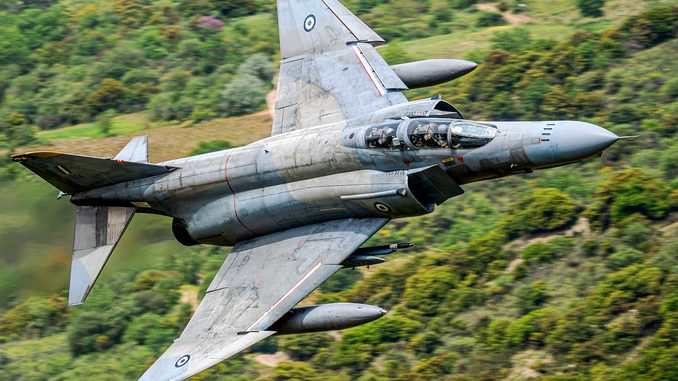
A Greek F-4E Phantom II crashed in Tanagra during Athens Flying Week 2026. Two pilots died during the demonstration.
In Summary
A Hellenic Air Force F-4E Phantom II crashed on September 5, 2026, during Athens Flying Week at Tanagra Air Base, approximately 60 km north of Athens. The accident occurred at 2:55 p.m., a few minutes after takeoff, while the aircraft was performing a low-altitude demonstration. Both crew members, Squadron Leader (Επισμηναγός) Ioannis Blesias, 40, and Flight Lieutenant (Σμηναγός) Dimitrios Petrou, 37, were killed. The Phantom belonged to 338 Mira of the 117 Combat Wing, based at Andravida. The aircraft came down three nautical miles—about 5.6 km—southeast of the 114 Combat Wing. The crash triggered a large fire and led to the cancellation of the airshow. The causes remain unknown. A Hellenic Air Force investigation is underway. The Greek Ministry of Defence has declared three days of mourning within the armed forces.
The Crash Occurred Minutes After Takeoff
The F-4E demonstration was one of the highlights of Athens Flying Week 2026. The airshow, held on September 5 and 6 at Tanagra, brought together Greek and foreign combat aircraft in front of several thousand spectators.
According to the official statement from the Hellenic Air Force, the accident occurred at 2:55 p.m. on September 5. The F-4E from 338 Mira of the 117 Combat Wing crashed three nautical miles from Tanagra, approximately 5.6 km southeast of the base.
Available video footage shows the aircraft in a right bank at a very low altitude before a rapid loss of height. Impact caused a fireball and scattered debris across several areas. Part of the wreckage struck a nearby industrial zone, and a fire spread to local vegetation.
More than 100 firefighters and several aerial firefighting assets were deployed. The public was instructed to leave the area, and the remainder of the Athens Flying Week flight program was canceled. No injuries were reported among spectators on base. However, public broadcaster ERT reported that two civilians were slightly injured by debris at a nearby factory.
Both crew members died. They were Squadron Leader (Επισμηναγός) Ioannis Blesias, 40, and Flight Lieutenant (Σμηναγός) Dimitrios Petrou, 37.
The Greek F-4E Remains a Powerful Aircraft Despite Its Age
The F-4 Phantom II is a two-seat, twin-engine fighter designed in the late 1950s. Its prototype first flew in 1958. In total, 5,195 Phantom IIs were built across various variants.
The F-4E version is powered by two General Electric J79-GE-17 turbojet engines, each delivering approximately 79.6 kN of thrust with afterburner. The aircraft measures roughly 19.2 m in length with an 11.7 m wingspan. Its maximum takeoff weight approaches 28 metric tons, and its top speed exceeds Mach 2.
These performance figures illustrate the kinetic energy involved during a display. However, they do not imply that the Phantom is inherently dangerous at low altitudes. The primary risk stems from the combination of speed, mass, flight path, bank angle, and the limited altitude available to recover from an abnormal situation.
Greek Modernization Extended the Phantom’s Service Life
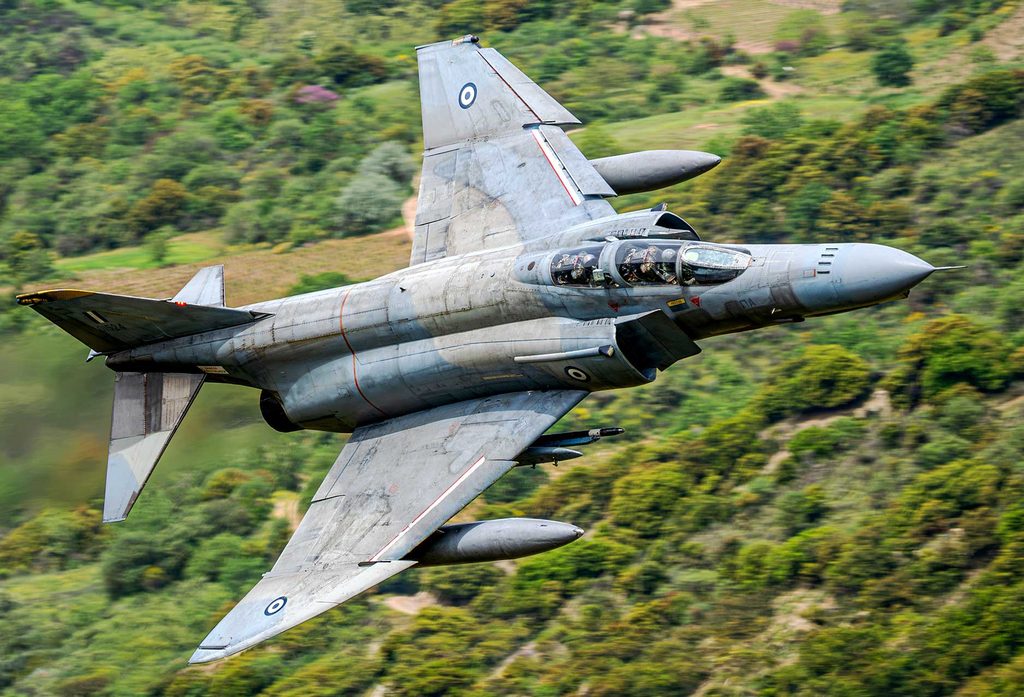
Greek Phantoms are no longer in their original 1970s configuration. A significant portion of the fleet underwent extensive upgrades under the Peace Icarus 2000 program.
The upgraded F-4E AUPs received an AN/APG-65 radar, modernized avionics, multifunction displays, GPS/INS navigation, and the capability to deploy more modern weapons, such as the AIM-120 AMRAAM and precision-guided munitions.
This modernization explains in part why Greece retained the Phantom far longer than most Western air forces. In 2026, 338 Mira “Ares,” based at Andravida, remains the final Greek unit operationally flying the type.
Low Altitude Drastically Reduces Recovery Margins
It would be premature to attribute the crash of the Greek F-4 Phantom to pilot error, mechanical failure, or aerodynamic stall. No official cause has been established at this stage.
Available imagery shows only that the aircraft was maneuvering at low altitude in a bank when it rapidly lost height. This is a demanding flight phase for any fighter aircraft.
Turn Physics Explain the Narrow Safety Margin
When an aircraft enters a steep bank, it must generate additional lift to maintain altitude. In a level turn at a 60-degree bank angle, the load factor theoretically reaches 2 g, increasing the stall speed by approximately 41%.
This data point is critical. As the bank angle increases, the aircraft must maintain adequate airspeed and energy. If a high descent rate develops just tens or hundreds of meters above the ground, the time available to roll the wings level, add thrust, and alter the flight path can be measured in seconds.
The F-4 also possesses high mass and significant inertia. An aircraft nearly 20 meters long weighing tens of tons cannot instantaneously alter its velocity vector.
This does not constitute an explanation for the Tanagra crash. The investigation must determine whether a technical fault, aerodynamic condition, human factor, or a combination of factors preceded the impact.
The Crash Strikes a Fleet at the End of Its Era
The symbolic impact of the accident is particularly profound in Greece. The first F-4Es arrived in the Hellenic Air Force in 1974, meaning the Phantom has served for more than fifty years.
Athens Flying Week had billed the participating Phantoms in 2026 as making one of their final public appearances before retirement.
This conclusion to its service career comes as the Hellenic Air Force undergoes comprehensive fleet modernization. Greece now operates the Dassault Rafale, is upgrading a major portion of its F-16 fleet to the Viper standard, and retains the Mirage 2000 in its combat inventory. Athens has also ordered F-35As.
Yet the Phantom occupies a unique place. Its longevity reflects the structural robustness of its airframe, as well as decades of heavy maintenance, support for its J79 engines, and avionics modernizations.
Military Mourning Precedes the Technical Investigation
Greek Defence Minister Nikos Dendias declared three days of mourning within the armed forces, from Saturday, September 5, through Monday, September 7, 2026. An important distinction: this is not three days of national mourning in the strict sense, but official mourning designated within the Greek Armed Forces.
Prime Minister Kyriakos Mitsotakis also paid tribute to the two pilots, emphasizing the risks borne daily by Greek military aircrews.
The designated Hellenic Air Force commission must now reconstruct the flight sequence. Investigators have access to numerous videos of the demonstration, air traffic control communications, and technical and maintenance records for the aircraft.
In a low-altitude accident, mere seconds can separate a fully controlled maneuver from an unrecoverable trajectory. Concluding today that pilot error, an F-4E failure, or a stall was responsible would go beyond the established facts.
The loss of the two aviators comes as the Greek Phantom was preparing to step off the stage. The Tanagra crash marks not only one of the gravest accidents in the recent history of Athens Flying Week, but also hits one of the world’s last operational communities still flying the F-4 Phantom II on a daily basis.
War Wings Daily is an independant magazine.