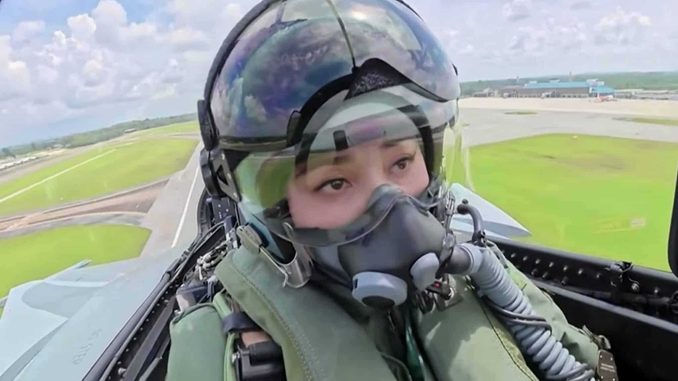
Queen Suthida completes a solo flight in a Gripen C in Thailand—a female first for this supersonic fighter following military training.
In Summary
On October 8, 2026, Queen Suthida of Thailand completed her first solo flight at the controls of a Saab JAS 39C Gripen, a Swedish-built supersonic fighter jet. The 41-minute flight took place from Wing 7 Air Base in Surat Thani, in the south of the country, in the presence of King Maha Vajiralongkorn.
At 48, the monarch becomes the first Thai woman to fly this type of fighter jet solo. This performance crowns a military training program comprising 45 theoretical modules, 20 simulator sessions, and over ten flight hours in a two-seater Gripen.
A former flight attendant turned experienced pilot, she totals more than 1,188 flight hours across various aircraft. The event comes as the Royal Thai Air Force continues the modernization of its combat aviation with the acquisition of new Gripen E/F jets from the Swedish manufacturer Saab.
Queen Suthida’s first solo flight in a Gripen C
On October 8, 2026, at Wing 7 Air Base in Surat Thani province, Queen Suthida Bajrasudhabimalalakshana took the controls of a single-seat JAS 39C Gripen belonging to the Royal Thai Air Force.
Following a pre-flight inspection and flight plan briefing, she taxied to Runway 22 to conduct a 41-minute training mission.
King Maha Vajiralongkorn, himself a qualified pilot on several military and civilian aircraft, attended the operation. The Commander-in-Chief of the Royal Thai Air Force, Air Chief Marshal Seksan Kantha, was also present.
Upon her return, the King presented her with a bouquet of flowers and the Gripen Order Golden Patch honorary badge, awarded to those who have piloted the Swedish fighter.
According to the Bureau of the Royal Household, Suthida thus becomes the first female Gripen pilot in Thailand.
However, this achievement warrants a clarification. Completing a solo flight in a fighter jet does not immediately confer full operational qualification, which requires additional skills in air combat, weapons employment, and tactical missions.
The military training required to fly a Gripen
Queen Suthida did not enter this program without aviation experience.
A former commercial flight attendant with Thai Airways, she began her pilot training in 2010 on the Cessna T-41D.
Her flight path subsequently included several trainer aircraft, notably the CT-4E Airtrainer, the Pilatus PC-9, and the Aero L-39 Albatros.
She has also piloted Boeing 737s during official travel, regularly serving as co-pilot to the King.
By the time she converted to the Gripen, her logbook totaled 1,188.48 hours, including more than 450 hours on the Boeing 737-800.
Transitioning from simulator to single-seat fighter
Specific preparation for the Gripen began with 45 instructional modules devoted to onboard systems, standard procedures, and emergency situations.
Training then included 20 simulator sessions before moving to the JAS 39D, the two-seat variant of the fighter.
The Queen logged 10.13 hours in the Gripen D with an instructor prior to her first flight in the Gripen C.
This progression fulfills an essential requirement. In a single-seater, the pilot must independently manage flight path, navigation, onboard systems, and potential technical anomalies.
The simulator allows pilots to rehearse scenarios that are difficult to reproduce safely in the air, such as engine failures or flight control malfunctions.
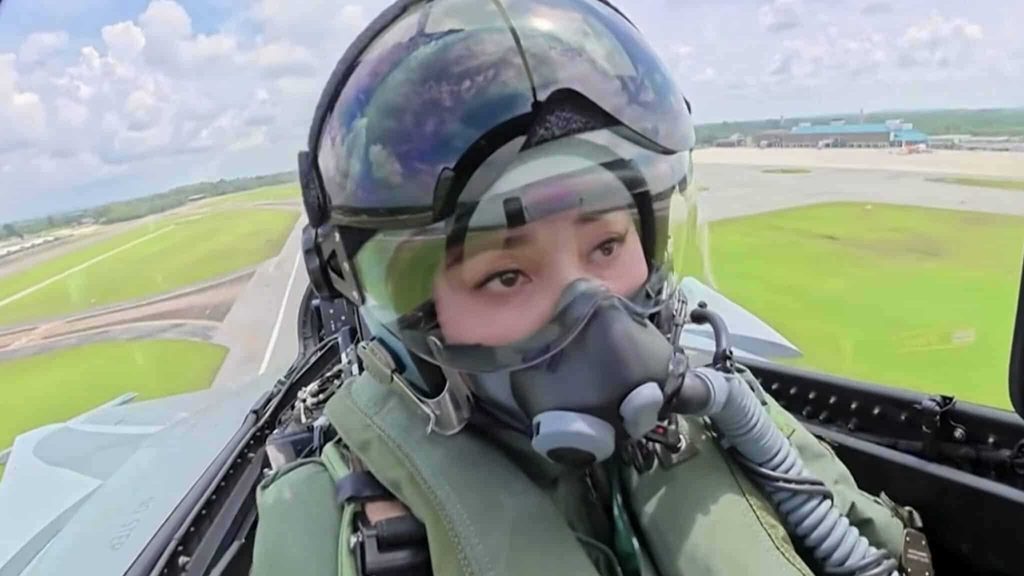
The Gripen C is a lightweight fighter capable of Mach 2
Developed by Saab, the JAS 39 Gripen is a multirole combat aircraft designed for air defense, interception, reconnaissance, and ground attack missions.
The Gripen C measures 14.9 meters in length with an 8.4-meter wingspan. Its maximum takeoff weight reaches 14 metric tons (approximately 30,865 pounds).
Powered by a Volvo RM12 afterburning turbofan engine—derived from the General Electric F404—it develops a maximum thrust of 80.5 kN.
Its maximum speed reaches Mach 2 at high altitude, approximately 2,100 km/h depending on atmospheric conditions.
Its service ceiling exceeds 16,000 meters (52,500 feet). Its airframe can withstand loads up to +9 g, requiring specific physical preparation for high-g maneuvers.
The aircraft features an aerodynamic layout combining a delta wing with canards. These control surfaces enhance maneuverability, while fly-by-wire controls stabilize an naturally unstable airframe.
This architecture delivers excellent responsiveness, but demands precise knowledge of flight control laws and flight envelope limits from the pilot.
The Gripen is also designed for rapid turnaround. Saab advertises a ten-minute air-to-air refueling and rearming time under prepared field conditions, a feature rooted in Sweden’s doctrine of dispersed operations. This approach is detailed in our analysis of Gripen engine maintenance.
Thailand continues modernization of its fighter fleet
The Royal Thai Air Force has operated the Gripen C/D since 2011, primarily with 701 Squadron based at Surat Thani.
Thailand originally ordered twelve aircraft. One Gripen C was lost in a crash in January 2017, reducing the fleet to eleven aircraft.
In August 2025, Bangkok signed a contract worth approximately $556 million for four next-generation Gripens—three single-seat E models and one two-seat F model—with deliveries planned through 2030.
The Gripen E/F variants feature an AESA active electronically scanned array radar, a more powerful engine, increased range, and modernized electronic warfare capabilities.
This program aims to enable Thailand to progressively renew its air assets while maintaining continuity with its existing fleet.
Thailand’s strategy fits into an international market where the Gripen competes with aircraft such as the F-16 and Rafale. Colombia’s recent selection, analyzed in our article on the competition between the Rafale and the Gripen, highlights the importance of operating costs and industrial partnerships.
The military and symbolic significance of this first flight
Queen Suthida’s flight represents first and foremost an individual aviation accomplishment. It demonstrates that a structured training program can allow an experienced pilot to step up to the controls of a modern supersonic fighter jet.
Its institutional dimension is equally significant. Leadership of the Royal Thai Air Force presented this initiative as an encouragement to its personnel, coinciding with the Queen’s 48th birthday and the Air Force’s upcoming 90th anniversary.
However, it would be overstating matters to view this as a new operational capability for Thai defense. There is no public indication that the Queen will pursue full combat qualification.
Above all, the event serves as a reminder that piloting a fighter jet relies on a demanding progression in which experience, system knowledge, and procedural mastery matter far more than the pilot’s status.
The real question now is whether this initiative will remain an exceptional royal event or help make fighter pilot careers more accessible to women within the Thai military.